


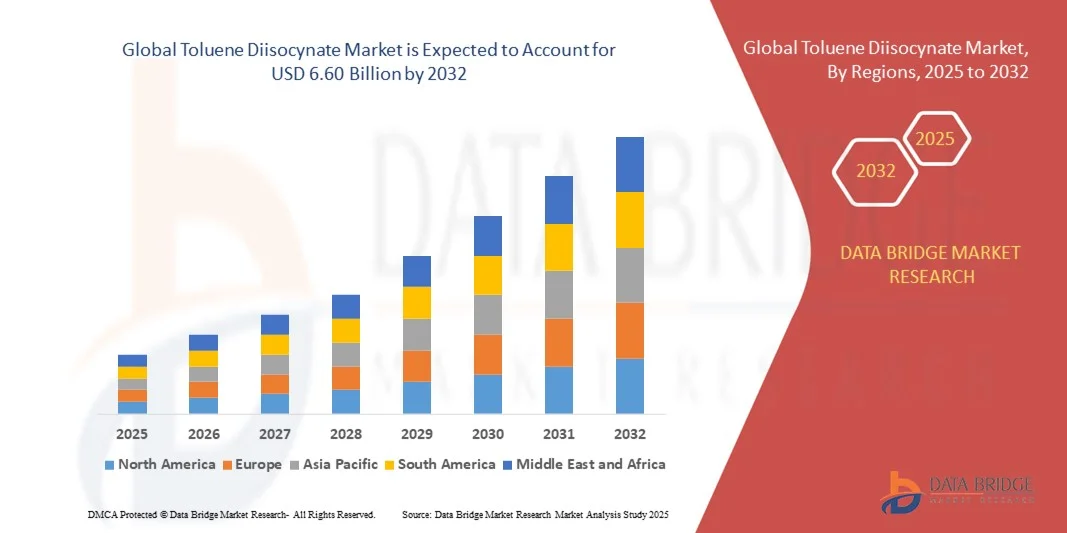
Toluene Diisocynate Market Size
- The global toluene diisocynate market size was valued at USD 5.2 billion in 2024 and is expected to reach USD 6.60 billion by 2032, at a CAGR of 4.35% during the forecast period
- The market growth is largely fuelled by the increasing demand for flexible and rigid polyurethane foams in industries such as automotive, furniture, bedding, and construction
- Rising applications of TDI in coatings, adhesives, sealants, and elastomers (CASE) are further supporting market expansion by enabling high-performance material properties such as durability, elasticity, and chemical resistance
Toluene Diisocynate Market Analysis
- Increasing automotive production and demand for lightweight, fuel-efficient vehicles are promoting the use of TDI-based flexible foams in seating, insulation, and interior components
- Rising consumer demand for high-quality furniture, mattresses, and bedding products is accelerating TDI adoption in the residential and commercial segments
- North America dominated the toluene diisocyanate market with the largest revenue share in 2024, driven by the growing polyurethane industry and increasing demand for flexible foams, coatings, adhesives, and sealants across automotive, furniture, and construction sectors
- Asia-Pacific region is expected to witness the highest growth rate in the global toluene diisocynate market, driven by growing urbanization, rising disposable incomes, and expanding production capacities in countries such as China, Japan, and South Korea
- The 2,4-TDI segment held the largest market revenue share in 2024 driven by its high reactivity, ease of handling, and widespread use in flexible foam production for furniture, bedding, and automotive seating applications. 2,4-TDI also supports efficient polymerization and consistent foam quality, making it a preferred choice among manufacturers
Report Scope and Toluene Diisocynate Market Segmentation
|
Attributes |
Toluene Diisocynate Key Market Insights |
|
Segments Covered |
|
|
Countries Covered |
North America
Europe
Asia-Pacific
Middle East and Africa
South America
|
|
Key Market Players |
|
|
Market Opportunities |
|
|
Value Added Data Infosets |
In addition to the insights on market scenarios such as market value, growth rate, segmentation, geographical coverage, and major players, the market reports curated by the Data Bridge Market Research also include import export analysis, production capacity overview, production consumption analysis, price trend analysis, climate change scenario, supply chain analysis, value chain analysis, raw material/consumables overview, vendor selection criteria, PESTLE Analysis, Porter Analysis, and regulatory framework. |
Toluene Diisocynate Market Trends
Rising Demand For Polyurethane-Based Products
- The growing adoption of toluene diisocyanate (TDI) is transforming the polyurethane industry by enabling the production of lightweight, flexible, and durable foams for furniture, automotive, and construction applications. Its versatility allows manufacturers to optimize performance, reduce material costs, and meet increasing consumer expectations for comfort and safety. TDI also supports customized foam densities and specialty formulations for niche industrial applications
- Increasing demand for TDI in coatings, adhesives, sealants, and elastomers is accelerating the development of specialized formulations. These products provide enhanced mechanical strength, chemical resistance, thermal stability, and long-term durability, driving market growth across automotive, electronics, and construction sectors. Manufacturers are investing in research to create more environmentally friendly and low-VOC solutions
- The ease of integration with other polyurethane precursors and compatibility with advanced manufacturing processes is making TDI a preferred choice for producers seeking efficiency and regulatory compliance. Its adaptability allows companies to scale production, improve process efficiency, and reduce wastage, while ensuring adherence to safety and environmental standards
- For instance, in 2023, several furniture and automotive manufacturers in Europe reported improved product performance, reduced production costs, and enhanced energy efficiency after adopting TDI-based flexible foams for cushions and seating applications. The adoption also enabled faster product turnaround times and minimized defects in end products
- While TDI is enhancing product performance and operational efficiency, its growth depends on continued innovation, environmental compliance, and cost optimization. Manufacturers must focus on sustainable, high-quality formulations, advanced process control, and efficient supply chain management to meet evolving industry demands and regulatory expectations
Toluene Diisocynate Market Dynamics
Driver
Increasing Usage In Polyurethane Foams And Coatings
- Rising demand for polyurethane foams in furniture, automotive, and insulation applications is driving the need for TDI, ensuring enhanced flexibility, durability, thermal comfort, and ergonomic benefits in end products. The material also supports lightweight construction, contributing to energy efficiency and reduced environmental impact
- Manufacturers are increasingly recognizing the benefits of TDI, such as high reactivity, low viscosity, compatibility with various polyols, and ease of formulation control, which encourages regular adoption across multiple applications. Its versatility enables development of specialty foams, elastomers, and coatings tailored to specific industrial requirements
- Supportive industrial growth and expansion in construction, automotive, and electronics sectors are promoting the use of TDI for high-performance coatings, adhesives, sealants, and elastomers. Companies are investing in R&D to introduce innovative, environmentally sustainable formulations that comply with emerging global standards
- For instance, in 2022, several North American automotive companies incorporated TDI-based flexible foams and coatings, enhancing safety, comfort, thermal insulation, and durability in vehicles. This adoption also contributed to lower production waste, improved energy efficiency, and faster assembly line operations
- While industrial demand and technological advantages are driving market expansion, there remains a need to develop cost-effective, eco-friendly, and application-specific TDI solutions to ensure long-term adoption and market penetration. Continuous innovation, advanced process control, and regulatory alignment will remain key to sustaining growth
Restraint/Challenge
Fluctuating Raw Material Prices And Environmental Concerns
- The volatility of toluene and other raw material prices increases production costs, affects profitability, and can limit adoption rates, particularly in price-sensitive markets. Companies may face challenges in long-term contract pricing, inventory management, and maintaining stable profit margins under fluctuating supply conditions
- In addition, stringent environmental regulations regarding the handling, storage, and emissions of isocyanates may hinder production processes, increase compliance costs, and slow market expansion. Manufacturers must invest in emission control technologies, safety training, and monitoring systems to comply with local and international standards
- Technical expertise is required for safe handling, storage, and transport of TDI, creating barriers for smaller manufacturers and new entrants. Lack of trained personnel and proper infrastructure can result in operational inefficiencies, safety incidents, and limited market penetration
- For instance, in 2023, several chemical plants in Asia-Pacific faced operational delays due to stricter regulatory compliance, raw material price fluctuations, and supply chain disruptions, impacting the availability and timely delivery of TDI-based products to key industrial sectors
- While TDI formulations continue to evolve, addressing cost volatility, safety, and environmental concerns is critical. Market players must focus on sustainable production practices, process optimization, robust supply chains, and regulatory adherence to unlock long-term growth potential and maintain competitive advantage
Toluene Diisocynate Market Scope
The market is segmented on the basis of forms, application, and end users
- By Forms
On the basis of forms, the toluene diisocyanate (TDI) market is segmented into 2,4-Toluene Diisocyanate and 2,6-Toluene Diisocyanate. The 2,4-TDI segment held the largest market revenue share in 2024 driven by its high reactivity, ease of handling, and widespread use in flexible foam production for furniture, bedding, and automotive seating applications. 2,4-TDI also supports efficient polymerization and consistent foam quality, making it a preferred choice among manufacturers.
The 2,6-TDI segment is expected to witness the fastest growth rate from 2025 to 2032 driven by its suitability for specialty foams, coatings, adhesives, sealants, and elastomers. 2,6-TDI is particularly popular for producing rigid and semi-rigid polyurethane foams and is valued for its thermal stability, chemical resistance, and compatibility with diverse polyols, enabling tailored industrial applications.
- By Application
On the basis of application, the TDI market is segmented into flexible foam, rigid foam, coatings, adhesives and sealants, binders, and elastomers. The flexible foam segment held the largest market share in 2024 driven by growing demand in furniture, automotive, and bedding industries. Flexible foam applications benefit from TDI’s ability to produce lightweight, resilient, and durable materials with high comfort and ergonomic properties.
The coatings, adhesives, and sealants segment is expected to witness the fastest growth rate from 2025 to 2032 driven by increasing usage in automotive, construction, and electronics sectors. These applications benefit from TDI’s high mechanical strength, chemical resistance, and adhesion properties, enabling the development of high-performance and durable end products.
- By End Users
On the basis of end users, the TDI market is segmented into wood or furniture, CASE (coatings, adhesives, sealants, and elastomers), automotive, and diverse industries. The wood or furniture segment held the largest share in 2024 due to growing demand for comfortable, lightweight, and durable furniture products. Manufacturers prefer TDI-based foams for cushions, mattresses, and seating that combine cost efficiency with performance.
The CASE and automotive segments are expected to witness the fastest growth rate from 2025 to 2032 driven by expanding industrial and automotive production, increasing focus on product durability, thermal insulation, and lightweight materials, and the adoption of sustainable and high-performance TDI formulations.
Toluene Diisocynate Market Regional Analysis
- North America dominated the toluene diisocyanate market with the largest revenue share in 2024, driven by the growing polyurethane industry and increasing demand for flexible foams, coatings, adhesives, and sealants across automotive, furniture, and construction sectors
- Manufacturers and end users in the region highly value the efficiency, versatility, and regulatory compliance offered by TDI-based products, supporting widespread adoption in multiple industrial applications
- This growth is further supported by robust industrial infrastructure, technological expertise, and strong R&D capabilities, establishing North America as a key market for high-performance TDI products
U.S. Toluene Diisocyanate Market Insight
The U.S. toluene diisocyanate market captured the largest revenue share in 2024 within North America, fueled by high demand for polyurethane foams in automotive, furniture, and insulation applications. Manufacturers are increasingly adopting TDI for coatings, adhesives, and sealants to enhance performance, durability, and cost-efficiency. In addition, the integration of advanced manufacturing processes and expansion of industrial facilities is driving the growth of TDI consumption in the U.S.
Europe Toluene Diisocyanate Market Insight
The Europe toluene diisocyanate market is expected to witness the fastest growth rate from 2025 to 2032, primarily driven by stringent regulations for high-performance polyurethane products and increasing industrial applications. The growing automotive and construction industries, coupled with rising urbanization, are fostering adoption of TDI-based foams, coatings, and adhesives. European manufacturers are also focusing on eco-friendly and sustainable formulations, which is further supporting market expansion.
Germany Toluene Diisocyanate Market Insight
The Germany toluene diisocyanate market is expected to witness significant growth from 2025 to 2032, fueled by increasing awareness of high-performance materials and demand for flexible polyurethane foams in automotive and furniture industries. Industrial innovation, advanced production facilities, and a strong emphasis on sustainability are encouraging the adoption of TDI-based products. In addition, manufacturers are integrating TDI with modern production technologies to ensure quality, safety, and compliance with European standards.
Asia-Pacific Toluene Diisocyanate Market Insight
The Asia-Pacific toluene diisocyanate market is expected to witness the fastest growth rate from 2025 to 2032, driven by rapid industrialization, increasing demand for automotive and furniture products, and expanding construction activities in countries such as China, India, and Japan. The region's growing polyurethane manufacturing base and government initiatives promoting industrial growth are boosting the adoption of TDI. In addition, the availability of cost-effective TDI and local production capabilities is increasing accessibility for diverse end users.
China Toluene Diisocyanate Market Insight
The China toluene diisocyanate market accounted for the largest market revenue share in Asia-Pacific in 2024, attributed to rapid urbanization, a growing automotive and furniture industry, and high rates of industrial production. The country stands as a leading hub for polyurethane manufacturing, and TDI-based products are increasingly used in flexible foams, coatings, adhesives, and sealants. In addition, local manufacturers’ focus on affordable and high-quality TDI formulations is supporting strong market growth
Japan Toluene Diisocyanate Market Insight
The Japan toluene diisocyanate market is expected to witness notable growth from 2025 to 2032 due to the country’s advanced manufacturing capabilities, strong automotive and electronics industries, and demand for high-performance materials. Japanese manufacturers are leveraging TDI in flexible foams, coatings, and adhesives to enhance product performance, durability, and compliance with stringent quality standards. In addition, innovation in sustainable and eco-friendly formulations is further propelling market adoption.
Toluene Diisocynate Market Share
The Toluene Diisocynate industry is primarily led by well-established companies, including:
- BASF SE (Germany)
- Dow (U.S.)
- Tosoh Corporation (Japan)
- Wanhua Chemical Group Co., Ltd. (China)
- Yantai Juli Fine Chemical Co., Ltd. (China)
- Vencorex Holding SAS (France)
- OVERSEAS POLYMERS PVT. LTD. (India)
- GNFC Limited (India)
- OCI Company Ltd. (South Korea)
- Hanwha Group (South Korea)
- LANXESS (Germany)
- Covestro AG (Germany)
- China National Bluestar (Group) Co, Ltd. (China)
- Anderson Development (U.S.)
- Bayer AG (Germany)
- Lyondellbasell Industries Holdings B.V. (Netherlands)
- Huntsman International LLC. (U.S.)
- ChemChina Petrochemicals Corporation (China)
- NAN YA PLASTICS CORPORATION (Taiwan)
- Factory & Industrial (U.S.)
Latest Developments in Global Toluene Diisocynate Market
- In July 2023, BASF reported its preliminary Q2 figures, highlighting the challenging market conditions driven by high energy costs and reduced demand across several industries. The company revised its annual financial projections in response to slowing economic activity, particularly in Europe, which impacted both chemical production and sales. This development reflects BASF’s proactive approach to managing market volatility, focusing on operational efficiency and sustaining its market position amidst economic uncertainties
- In May 2023, Dow announced a major sustainability initiative, launching circular plastics developed from advanced recycling technologies. These innovative materials aim to support the circular economy by offering environmentally friendly alternatives for key industries such as packaging. The move reinforces Dow’s commitment to innovation and reducing environmental impact, while positioning the company to meet growing market demand for sustainable solutions

- Interactive Data Analysis Dashboard
- Company Analysis Dashboard for high growth potential opportunities
- Research Analyst Access for customization & queries
- Competitor Analysis with Interactive dashboard
- Latest News, Updates & Trend analysis
- Harness the Power of Benchmark Analysis for Comprehensive Competitor Tracking
Global Toluene Diisocynate Market, Supply Chain Analysis and Ecosystem Framework
To support market growth and help clients navigate the impact of geopolitical shifts, DBMR has integrated in-depth supply chain analysis into its Global Toluene Diisocynate Market research reports. This addition empowers clients to respond effectively to global changes affecting their industries. The supply chain analysis section includes detailed insights such as Global Toluene Diisocynate Market consumption and production by country, price trend analysis, the impact of tariffs and geopolitical developments, and import and export trends by country and HSN code. It also highlights major suppliers with data on production capacity and company profiles, as well as key importers and exporters. In addition to research, DBMR offers specialized supply chain consulting services backed by over a decade of experience, providing solutions like supplier discovery, supplier risk assessment, price trend analysis, impact evaluation of inflation and trade route changes, and comprehensive market trend analysis.
Data collection and base year analysis are done using data collection modules with large sample sizes. The stage includes obtaining market information or related data through various sources and strategies. It includes examining and planning all the data acquired from the past in advance. It likewise envelops the examination of information inconsistencies seen across different information sources. The market data is analysed and estimated using market statistical and coherent models. Also, market share analysis and key trend analysis are the major success factors in the market report. To know more, please request an analyst call or drop down your inquiry.
The key research methodology used by DBMR research team is data triangulation which involves data mining, analysis of the impact of data variables on the market and primary (industry expert) validation. Data models include Vendor Positioning Grid, Market Time Line Analysis, Market Overview and Guide, Company Positioning Grid, Patent Analysis, Pricing Analysis, Company Market Share Analysis, Standards of Measurement, Global versus Regional and Vendor Share Analysis. To know more about the research methodology, drop in an inquiry to speak to our industry experts.
Data Bridge Market Research is a leader in advanced formative research. We take pride in servicing our existing and new customers with data and analysis that match and suits their goal. The report can be customized to include price trend analysis of target brands understanding the market for additional countries (ask for the list of countries), clinical trial results data, literature review, refurbished market and product base analysis. Market analysis of target competitors can be analyzed from technology-based analysis to market portfolio strategies. We can add as many competitors that you require data about in the format and data style you are looking for. Our team of analysts can also provide you data in crude raw excel files pivot tables (Fact book) or can assist you in creating presentations from the data sets available in the report.













