


What is the Tool Steel Market Size and Growth Rate?
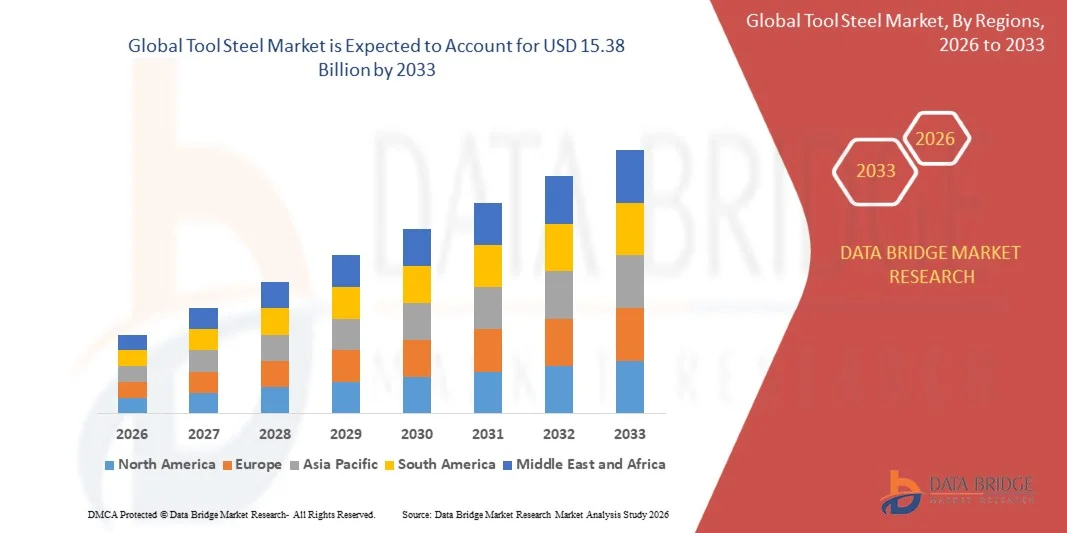
- As per Data Bridge Market Research analysis, the tool steel market was valued at USD 8.13 billion in 2025 and is projected to reach USD 15.38 billion by 2033, growing at a CAGR of 8.30% from 2026 to 2033.
- The market is experiencing consistent growth driven by rising automotive and manufacturing production, increasing demand for precision machining and durable cutting tools, and expanding applications of tool steel across aerospace, defense, electronics, and heavy engineering industries.
- The increasing adoption of electric vehicle manufacturing, industrial automation, and high-precision machining, combined with demand for longer tool life and improved wear and heat resistance, is compelling manufacturers to adopt advanced tool steel grades. High-speed, hot-working, and cold-working tool steels are increasingly used in cutting tools, dies, molds, and forming applications, supporting efficient and high-volume manufacturing processes.
Market Size & Forecast
- Global Market Value (2025): USD 8.13 Billion
- Expected Market Value (2033): USD 15.38 Billion
- Forecast CAGR (2026–2033): 8.30%
- Leading Region in 2025: North America
- Fastest Growing Region: Asia Pacific
What are the Major Takeaways of the Tool Steel Market?
- North America dominated the tool steel market with the largest revenue share of 31% in 2025, supported by advanced manufacturing infrastructure and strong demand for precision tooling across automotive, aerospace, defense, and industrial machinery applications.
- Asia-Pacific is expected to be the fastest-growing region at a CAGR of 7.21% from 2026 to 2033, fueled by expanding automotive and machinery manufacturing, rapid industrialization, and rising investments in precision machining and tooling infrastructure across China, India, Japan, and South Korea.
- The tungsten segment led the market with a 35.3% share in 2025, driven by its ability to improve hardness, toughness, wear resistance, and high-temperature performance.
- Molybdenum are the fastest-growing material type, projected to register a CAGR of 6.5%, reflecting the surge in its contribution to hardness, toughness, wear resistance, and thermal stability.
- The die work segment dominated the application category with a 40% revenue share in 2025, led by extensive use of tool steels in stamping, blanking, punching, forming, and extrusion dies
- Cold-work accounted for 35.07% of the market share in 2025, preferred by its extensive use in punching, blanking, shearing, stamping, and forming applications
- The hot-working segment is the fastest-growing product type category, with a CAGR of 6.21%, driven by increasing demand for tooling used in high-temperature forming, forging, and die-casting operations.
Report Scope and Tool Steel Market Segmentation
|
Attributes |
Tool Steel Key Market Insights |
|
Segments Covered |
|
|
Countries Covered |
North America
Europe
Asia-Pacific
Middle East and Africa
South America
|
|
Key Market Players |
|
|
Market Opportunities |
|
|
Value Added Data Infosets |
In addition to the insights on market scenarios such as market value, growth rate, segmentation, geographical coverage, and major players, the market reports curated by the Data Bridge Market Research also include import export analysis, production capacity overview, production consumption analysis, price trend analysis, climate change scenario, supply chain analysis, value chain analysis, raw material/consumables overview, vendor selection criteria, PESTLE Analysis, Porter Analysis, and regulatory framework. |
What is the Key Trend in the Tool Steel Market?
- Manufacturers are increasingly adopting additive manufacturing and powder-based tool steel technologies to produce complex molds, dies, inserts, and tooling components with improved design flexibility, reduced material waste, and integrated conformal cooling channels.
- For instance, in August 2025, Sandvik introduced Osprey MAR 55, a new tool steel powder specifically designed for laser powder bed fusion and directed energy deposition, offering more than 50 HRC hardness, high wear resistance, and improved weldability for advanced tooling applications.
- Additive manufacturing enables manufacturers to produce complex geometries and repair damaged tool-steel components while reducing lead times and material consumption compared with conventional tooling processes.
- Automotive, aerospace, and industrial manufacturers are increasingly exploring laser powder bed fusion and directed energy deposition for high-performance tool steels requiring enhanced wear resistance, toughness, and thermal management.
- For instance, in December 2024, researchers at Oak Ridge National Laboratory demonstrated the successful binder-jet additive manufacturing of AISI M2 tool steel, achieving approximately 970 HV hardness and compressive strength of about 3,580 MPa, demonstrating the potential of additive manufacturing for complex, high-performance tool-steel components.
- As manufacturers continue prioritizing longer tool life, complex geometries, lower material waste, and faster tooling development, the adoption of additive-manufactured and powder-metallurgy tool steels is expected to accelerate, reinforcing advanced processing as a key trend in the global tool steel market.
What are the Key Drivers of the Tool Steel Market?
- The rapid expansion of automotive, electric vehicle, aerospace, and precision manufacturing has significantly increased demand for high-performance tool steels used in cutting tools, molds, dies, stamping, forging, and machining applications.
- For instance, in June 2025, voestalpine reported strong demand for high-quality tool steel in its Tooling segment during the first quarter of fiscal 2025/26, supported by resilient industrial production and continued demand for higher-performance tooling solutions.
- Automotive and industrial manufacturers are increasingly requiring tool steels with higher hardness, wear resistance, thermal stability, and dimensional consistency to support high-speed machining and increasingly demanding production environments.
- For instance, in August 2025, a Hong Kong-listed specialty-steel producer reported that strong demand from China’s new energy vehicle and consumer-electronics industries drove growth in the high-end tool steel market during the first half of 2025, with powder-metallurgy tool steels gaining penetration in high-end applications because of their superior mechanical properties.
- With manufacturing industries increasingly emphasizing precision, productivity, durability, and advanced material performance, demand for high-speed, cold-work, hot-work, and powder-metallurgy tool steels will continue supporting market expansion.
Which Factors are Challenging the Growth of the Tool Steel Market?
- Advanced tool steels require significant quantities of alloying elements such as tungsten, molybdenum, vanadium, and chromium, making production costs sensitive to raw-material availability, energy prices, and supply-chain fluctuations.
- For instance, in February 2025, China imposed export controls on tungsten and several other critical minerals, requiring exporters to obtain government approval, increasing supply-chain uncertainty for Western manufacturers that rely on tungsten for high-performance cutting and tool applications.
- These elevated material costs can restrict adoption among smaller manufacturers and price-sensitive tooling producers, particularly where conventional carbon and alloy steels can provide lower-cost alternatives.
- Additive manufacturing of tool steels also faces technical challenges including cracking, residual stresses, porosity, chemical inhomogeneity, and the need for post-processing, increasing production complexity and qualification requirements.
- For instance, in January 2026, tungsten prices reached record levels as Chinese export controls, reduced mining quotas, and tightening inventories constrained global supply, increasing the cost pressure on manufacturers using tungsten-containing tool steels and other industrial tooling materials.
- The combination of high alloying costs, energy-intensive processing, raw-material volatility, and technical complexity in advanced manufacturing continues to challenge tool steel producers and can limit adoption in cost-sensitive applications and emerging markets.
How is the Tool Steel Market Segmented?
The tool steel market is segmented on the basis of material, application, product type, end-use, format type, and process
- By Material
On the basis of material, the tool steel market is segmented into tungsten, chromium, vanadium, and molybdenum. The tungsten segment dominated the market with 35.3% share in 2025, supported by its ability to improve hardness, toughness, wear resistance, and high-temperature performance. Tungsten-containing tool steels are extensively used in high-speed cutting tools and demanding machining applications. Their ability to retain hardness at elevated temperatures makes them particularly suitable for intensive industrial operations. Automotive, aerospace, and general manufacturing industries generate significant demand for tungsten-containing grades. The increasing requirement for durable tooling with extended service life continues to support the segment's leading position.
The molybdenum segment is projected to register the fastest growth at 6.5% CAGR during forecast period, supported by its contribution to hardness, toughness, wear resistance, and thermal stability. Molybdenum is extensively used in high-speed and hot-working tool steels exposed to demanding temperatures and mechanical stresses. Increasing adoption of advanced machining technologies is creating demand for tool steels with improved performance and longer service life. Automotive and aerospace manufacturers increasingly require high-performance tooling for precision machining. Growing requirements for productivity and extended tool life are further supporting molybdenum-containing grades. Continued development of high-performance tool steel compositions is expected to strengthen this segment.
- By Application
On the basis of application, the tool steel market is segmented into injection molding, die work, and forging. The die work segment is expected to dominate the application category, accounting for an 40% share in 2025, supported by extensive use of tool steels in stamping, blanking, punching, forming, and extrusion dies. Tool steels provide the hardness, wear resistance, toughness, and dimensional stability required for repeated forming operations. Automotive manufacturing represents an important source of demand because dies are extensively used for producing vehicle body panels and components. General manufacturing and machinery industries also rely heavily on durable die materials. Increasing automation and high-volume manufacturing are strengthening demand for long-life die tooling.
The injection molding segment is projected to register the fastest growth at 4.5% CAGR during forecast period, supported by increasing production of precision plastic components. Automotive lightweighting is increasing the use of engineered plastic components and consequently supporting demand for durable injection molds. Electronics, medical devices, packaging, and consumer products are also expanding their use of precision molded components. Tool steels provide molds with high hardness, dimensional stability, polishability, and resistance to wear. Increasing complexity of molded components is encouraging manufacturers to use higher-performance mold materials. The continuing expansion of injection molding applications is therefore expected to create sustained demand for tool steel.
- By Product Type
On the basis of product type, the global tool steel market is segmented into water-hardening, cold-work, shock-resisting, high speed, hot-working, and special purpose tool steels. The cold-work tool steel segment dominated the market with a 35.07% share in 2025, owing to its extensive use in punching, blanking, shearing, stamping, and forming applications. Cold-work grades provide high hardness, excellent wear resistance, and dimensional stability during repeated production cycles. Automotive, machinery, electronics, and general manufacturing industries are important consumers of these grades. Their ability to maintain sharp edges and resist deformation improves tooling productivity and service life. Continued demand for precision metal forming supports the segment's leading position.
The hot-working tool steel segment is projected to be the fastest-growing product category at a 6.21% CAGR during forecast period, supported by increasing demand for tooling used in high-temperature forming, forging, and die-casting operations. Hot-working grades are designed to retain hardness, strength, and thermal-fatigue resistance under elevated operating temperatures. Automotive manufacturing is a major application area because hot-work tooling is used for producing numerous high-strength components. Increasing adoption of high-pressure die casting is also creating demand for high-performance hot-work grades. Manufacturers are seeking longer tool life and reduced downtime in intensive forming operations. These requirements are expected to continue supporting the growth of hot-working tool steel.
- By End-Use
On the basis of end-use, the tool steel market is segmented into general manufacturing, automotive, defense and aerospace, electronic and electrical, ship building, and others. The automotive segment dominated the market with 28% share in 2025, driven by extensive consumption of tool steels in stamping dies, molds, cutting tools, forming equipment, and machining applications. Vehicle manufacturers require high-performance tooling to maintain precision during high-volume production. The transition toward electric vehicles is also creating demand for specialized tooling for lightweight structures and battery-related components. Increasing vehicle manufacturing activity in emerging economies is expanding demand for industrial tooling. Growing automation and advanced manufacturing practices are further strengthening automotive consumption of tool steel.
The defense and aerospace segment is projected to register the fastest growth at 6.8% CAGR during forecast period, supported by increasing aerospace production and defense modernization programs. Aerospace manufacturing requires highly precise tooling for components produced from titanium, nickel alloys, high-strength steels, and other difficult-to-machine materials. Tool steels provide the hardness, toughness, and dimensional stability required for demanding machining and forming operations. Growing investments in aircraft manufacturing and defense equipment are increasing requirements for specialized tooling. Advanced high-speed and powder-metallurgy tool steels are particularly suited to precision aerospace applications. The increasing emphasis on manufacturing efficiency and component quality is expected to support segment expansion.
- By Format Type
On the basis of format type, the tool steel market is segmented into round format, square format, and other format. The round format segment dominated the market with 45% share in 2025, supported by widespread use of round tool-steel bars for drills, punches, cutters, reamers, shafts, and other cylindrical tooling components. Round bars can be readily turned, ground, machined, and heat-treated according to specific tooling requirements. Their standardized availability makes them suitable for high-volume industrial manufacturing. Automotive, machinery, metalworking, and cutting-tool producers are important consumers of round tool-steel products. Their versatility across machining and tooling applications continues to support their leading position.
The square format segment is projected to register the fastest growth at 5.8% CAGR during forecast period, supported by increasing use in dies, punches, blades, holders, and other industrial tooling applications. Square tool-steel products provide convenient geometry for machining and manufacturing various tooling components. Their shape can reduce material removal during production of specific tools and dies. Automotive and general manufacturing industries are important users of square tool-steel products. Increasing demand for precision forming and cutting equipment is supporting consumption. Continued industrial automation and tooling modernization are expected to provide further growth opportunities for this format.
- By Process
On the basis of process, the tool steel market is segmented into forged and rolled. The forged segment dominated the market with 60% share in 2025, supported by the ability of forging to produce tool-steel products with favorable grain structures, strength, toughness, and mechanical integrity. Forged tool steels are widely used for heavy-duty dies, industrial tools, automotive tooling, and demanding machining applications. The process is particularly suitable for applications requiring high strength and resistance to impact and fatigue. Forging can improve the reliability and durability of tooling during repeated industrial use. Increasing demand for durable tooling in automotive and general manufacturing continues to support forged tool steel.
The rolled segment is projected to register the fastest growth at 5.5% CAGR during forecast period, supported by its suitability for producing standardized bars, plates, sheets, and other semi-finished tool-steel products. Rolling enables efficient production with consistent dimensions and surface characteristics. These products can subsequently undergo machining, heat treatment, grinding, and finishing for specific tooling applications. Automotive, electronics, machinery, and general manufacturing industries continue to use rolled tool-steel products. Increasing industrial production and demand for standardized tooling materials are supporting consumption. Improvements in rolling technology and quality control are expected to further strengthen the segment's growth.
Which Region Holds the Largest Share of the Tool Steel Market?
- North America dominated the tool steel market with the largest revenue share of 31% in 2025, supported by advanced manufacturing infrastructure and strong demand for precision tooling across automotive, aerospace, defense, and industrial machinery applications.
- The region also benefits from established metalworking and machining capabilities, significant investments in advanced manufacturing technologies, and strong demand for high-performance tool steels across automotive, aerospace, defense, and industrial machinery applications. The U.S. remains the leading country in the region, supported by its large manufacturing base and continued focus on precision engineering and advanced production technologies.
U.S. Tool Steel Market Insight
The U.S. tool steel market is witnessing strong growth due to rising investments in advanced manufacturing, automotive production, aerospace, defense, and precision machining. The country's mature industrial ecosystem, along with increasing adoption of high-performance cutting tools, molds, dies, and specialized tooling systems, is driving demand across manufacturing applications. In addition, reshoring of manufacturing activities, industrial automation, and growing requirements for durable and wear-resistant tooling are accelerating tool steel adoption among manufacturers.
Asia-Pacific Tool Steel Market Insight
The Asia-Pacific tool steel market is expected to witness rapid growth, driven by expanding automotive production, industrialization, and increasing investments in manufacturing infrastructure across countries such as China, India, and Japan. Growing demand for precision tooling, advanced machining technologies, and durable dies is supporting regional market expansion. In addition, the increasing production of electric vehicles, electronics, machinery, and industrial equipment is accelerating demand for high-performance tool steels across the region.
Japan Tool Steel Market Insight
The Japan tool steel market is witnessing consistent growth due to rising investments in precision manufacturing, automotive production, and advanced machining technologies. Automotive manufacturers, machinery producers, and specialized tooling companies are increasingly using high-performance tool steels for molds, dies, cutting tools, and precision components. Moreover, Japan's strong focus on manufacturing automation, engineering quality, and technological innovation is further contributing to demand for advanced tool steel grades.
China Tool Steel Market Insight
The China tool steel market is growing rapidly, driven by expanding automotive manufacturing, industrial production, and rising investments in advanced manufacturing infrastructure. Growing adoption of high-speed, cold-work, and hot-working tool steels across automotive, machinery, electronics, and mold manufacturing is significantly boosting market demand. In addition, increasing electric vehicle production, industrial automation, and demand for precision tooling are positioning China as one of the fastest-growing tool steel markets globally.
U.K. Tool Steel Market Insight
The U.K. tool steel market is experiencing steady growth, supported by rising demand from automotive, aerospace, defense, engineering, and precision manufacturing industries. Increasing investments in advanced manufacturing technologies and growing demand for durable, wear-resistant tooling solutions are contributing to market growth. Furthermore, the integration of additive manufacturing, advanced machining, and specialized heat-treatment technologies is improving tooling performance and supporting demand for high-quality tool steels in the U.K.
Germany Tool Steel Market Insight
The Germany tool steel market is expanding steadily due to the country's strong automotive manufacturing base, advanced engineering capabilities, and extensive metalworking industry. Automotive companies, machinery manufacturers, mold producers, and precision engineering firms are increasingly utilizing tool steels for cutting tools, dies, molds, and forming applications. Continuous advancements in industrial automation, electric vehicle manufacturing, and high-precision machining, along with Germany's strong focus on manufacturing efficiency and technological innovation, are further driving market growth.
Which are the Top Companies in Tool Steel Market?
The tool steel industry is primarily led by well-established companies, including:
- Sandvik AB (Sweden)
- Daido Steel Co., Ltd. (Japan)
- SSG (Switzerland)
- CRS Holdings, LLC. (U.S.)
- Friedr. Lohmann GmbH (Germany)
- Rovalma, S.A. (Spain)
- Erasteel (France)
- Tiangong International Company Limited (China)
- Fushun Special Steel Co., Ltd. (China)
- Sanyo Special Steel Co., Ltd. (Japan)
- SeAH Besteel Corp. (South Korea)
- CITIC Pacific Special Steel Group Co., Ltd. (China)
- Hunan Qilu Industrial Co., Ltd. (China)
- Ellwood Specialty Metals (U.S.)
- Niagara Specialty Metals, Inc. (U.S.)
- TimkenSteel Corporation (U.S.)
- Northeast Special Steel Group Co., Ltd. (China)
- Shougang Group Co., Ltd. (China)
- Kobe Steel, Ltd. (Japan)
- Nippon Steel Corporation (Japan)
What are Latest Developments in Tool Steel Market?
- In August 2025, Sandvik introduced Osprey MAR 55, a new tool steel powder developed for additive manufacturing that combines high strength, wear resistance, and weldability. The material is designed for advanced additive manufacturing processes, including laser-based powder-bed fusion and directed energy deposition. Its properties enable manufacturers to produce tooling and components requiring high mechanical performance and resistance to demanding operating conditions. This development reinforces Sandvik’s focus on expanding its advanced metal-powder portfolio for next-generation tooling applications.
- In May 2025, Daido Steel announced the development of new steel grades and evaluation technologies to expand sales to overseas customers, reflecting the company's focus on strengthening its specialty-steel portfolio and international business. The initiative includes efforts to develop materials that address increasingly sophisticated requirements from industrial customers. Daido Steel supplies a broad range of tool steels used in cutting tools, dies, molds, and other demanding manufacturing applications. The initiative demonstrates the industry's increasing emphasis on customized grades, material performance, and global specialty-steel demand.
- In April 2024, voestalpine reported the successful ramp-up of its new special-steel plant in Kapfenberg, Austria, strengthening its production capabilities for high-performance specialty steels. The facility represents a major investment in modern special-steel manufacturing and incorporates advanced production and quality-control technologies. The plant is operated within voestalpine's High Performance Metals business, which supplies tool steels and other premium steels for demanding industrial applications. The development strengthens Europe's capacity for producing advanced specialty steels and supports voestalpine's global tool-steel business.
- In December 2021, Uddeholm launched Uddeholm Dievar for additive manufacturing, extending its established high-performance hot-work tool steel into additive manufacturing applications. Dievar is designed for demanding tooling environments where high toughness, thermal-fatigue resistance, and dimensional stability are important. The additive-manufacturing version enables manufacturers to produce more complex tooling geometries and components that can incorporate design features difficult to achieve through conventional manufacturing. The launch highlighted Uddeholm's strategy of combining established tool-steel grades with emerging additive-manufacturing technologies.
- In November 2021, voestalpine's Steel Division received ResponsibleSteel certification, strengthening the company's sustainability credentials in specialty-steel production. ResponsibleSteel certification evaluates steel production against environmental, social, and governance-related criteria across areas such as climate change, responsible sourcing, labor practices, and community impacts. The certification reflected voestalpine's efforts to improve sustainability throughout its steel-production activities. ResponsibleSteel certification therefore represented an important step toward greater transparency and responsible production practices in specialty steel.

- Interactive Data Analysis Dashboard
- Company Analysis Dashboard for high growth potential opportunities
- Research Analyst Access for customization & queries
- Competitor Analysis with Interactive dashboard
- Latest News, Updates & Trend analysis
- Harness the Power of Benchmark Analysis for Comprehensive Competitor Tracking
Global Tool Steel Market, Supply Chain Analysis and Ecosystem Framework
To support market growth and help clients navigate the impact of geopolitical shifts, DBMR has integrated in-depth supply chain analysis into its Global Tool Steel Market research reports. This addition empowers clients to respond effectively to global changes affecting their industries. The supply chain analysis section includes detailed insights such as Global Tool Steel Market consumption and production by country, price trend analysis, the impact of tariffs and geopolitical developments, and import and export trends by country and HSN code. It also highlights major suppliers with data on production capacity and company profiles, as well as key importers and exporters. In addition to research, DBMR offers specialized supply chain consulting services backed by over a decade of experience, providing solutions like supplier discovery, supplier risk assessment, price trend analysis, impact evaluation of inflation and trade route changes, and comprehensive market trend analysis.
Data collection and base year analysis are done using data collection modules with large sample sizes. The stage includes obtaining market information or related data through various sources and strategies. It includes examining and planning all the data acquired from the past in advance. It likewise envelops the examination of information inconsistencies seen across different information sources. The market data is analysed and estimated using market statistical and coherent models. Also, market share analysis and key trend analysis are the major success factors in the market report. To know more, please request an analyst call or drop down your inquiry.
The key research methodology used by DBMR research team is data triangulation which involves data mining, analysis of the impact of data variables on the market and primary (industry expert) validation. Data models include Vendor Positioning Grid, Market Time Line Analysis, Market Overview and Guide, Company Positioning Grid, Patent Analysis, Pricing Analysis, Company Market Share Analysis, Standards of Measurement, Global versus Regional and Vendor Share Analysis. To know more about the research methodology, drop in an inquiry to speak to our industry experts.
Data Bridge Market Research is a leader in advanced formative research. We take pride in servicing our existing and new customers with data and analysis that match and suits their goal. The report can be customized to include price trend analysis of target brands understanding the market for additional countries (ask for the list of countries), clinical trial results data, literature review, refurbished market and product base analysis. Market analysis of target competitors can be analyzed from technology-based analysis to market portfolio strategies. We can add as many competitors that you require data about in the format and data style you are looking for. Our team of analysts can also provide you data in crude raw excel files pivot tables (Fact book) or can assist you in creating presentations from the data sets available in the report.













