


Tooth Mounted Sensor Market Size
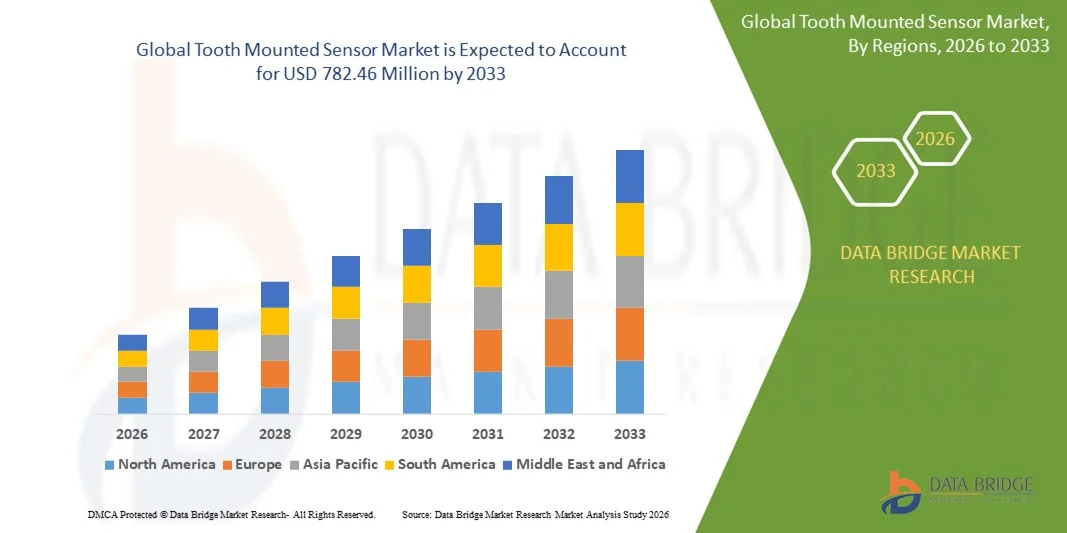
- The global tooth mounted sensor market size was valued at USD 432.25 million in 2025 and is expected to reach USD 782.46 million by 2033, at a CAGR of 7.70% during the forecast period
- The market growth is largely fueled by the rising adoption and technological advancements in non-invasive health monitoring devices, enabling continuous tracking of dietary intake, glucose, alcohol, and other biomarkers. The integration of tooth mounted sensors with mobile health applications and wearable devices is increasing consumer engagement and providing real-time insights, thereby accelerating market expansion
- Furthermore, growing consumer awareness of preventive healthcare, personalized nutrition, and lifestyle management is driving demand for tooth mounted sensors as practical tools for continuous monitoring. These converging factors are encouraging both individual users and healthcare providers to adopt these devices, significantly boosting market growth
Tooth Mounted Sensor Market Analysis
- Tooth mounted sensors, designed for continuous monitoring of oral and systemic health markers such as glucose, salt, and alcohol intake, are becoming vital tools in both personal wellness and clinical applications due to their non-invasive nature, real-time data collection, and compatibility with digital health platforms
- The escalating demand for these sensors is primarily fueled by the increasing prevalence of lifestyle-related diseases, rising interest in personalized nutrition, and the growing need for non-invasive, easy-to-use diagnostic and monitoring solutions. Continuous monitoring capabilities, ease of integration with apps, and potential for early disease detection are further driving the adoption of tooth mounted sensors across the market
- North America dominated the tooth mounted sensor market with a share of 41.67% in 2025, due to rising awareness of non-invasive health monitoring, increasing prevalence of lifestyle-related diseases, and strong adoption of connected health devices
- Asia-Pacific is expected to be the fastest growing region in the tooth mounted sensor market during the forecast period due to increasing urbanization, rising disposable incomes, and growing awareness of preventive healthcare in countries such as China, Japan, and India
- Monitoring dietary intake segment dominated the market with a market share of 52.8% in 2025, due to increasing consumer focus on personalized nutrition and health management. Tooth mounted sensors provide precise, real-time data on nutrient consumption, hydration, and other dietary habits, enabling actionable insights for both individuals and healthcare providers. The segment benefits from integration with mobile applications and digital health platforms, facilitating continuous health tracking and data analysis. Growing awareness of lifestyle-related health conditions such as obesity, hypertension, and diabetes reinforces the demand for dietary monitoring solutions
Report Scope and Tooth Mounted Sensor Market Segmentation
|
Attributes |
Tooth Mounted Sensor Key Market Insights |
|
Segments Covered |
|
|
Countries Covered |
North America
Europe
Asia-Pacific
Middle East and Africa
South America
|
|
Key Market Players |
|
|
Market Opportunities |
|
|
Value Added Data Infosets |
In addition to the insights on market scenarios such as market value, growth rate, segmentation, geographical coverage, and major players, the market reports curated by the Data Bridge Market Research also include in-depth expert analysis, pricing analysis, brand share analysis, consumer survey, demography analysis, supply chain analysis, value chain analysis, raw material/consumables overview, vendor selection criteria, PESTLE Analysis, Porter Analysis, and regulatory framework. |
Tooth Mounted Sensor Market Trends
Rising Adoption of Non-Invasive, Real-Time Oral Health Monitoring
- The global tooth mounted sensor market is witnessing rapid growth due to the increasing adoption of non-invasive, continuous oral health monitoring devices that track biomarkers such as glucose, alcohol, and salt intake, providing real-time insights into individual health and nutrition. The integration of these sensors with mobile health applications and wearable devices is significantly enhancing user engagement and convenience, driving wider acceptance of the technology.
- For instance, the MouthIO dental brace developed by MIT CSAIL and Aarhus University offers real-time monitoring of oral activity and dietary intake while enabling hands-free device control, highlighting the practical applications of advanced intra-oral sensors. Such innovations are encouraging healthcare providers and consumers to adopt these devices for preventive care and lifestyle management
- Tooth mounted sensors are increasingly being used in personalized nutrition and wellness programs, enabling continuous tracking of intake patterns and providing actionable feedback for healthier lifestyle choices. The non-invasive nature of these sensors reduces user discomfort and increases compliance, supporting broader market adoption and integration into daily routines.
- The integration of these sensors with cloud-based platforms allows for centralized data collection, analysis, and remote monitoring, facilitating more informed decision-making for both users and healthcare professionals. Users can access personalized insights and recommendations, creating a seamless experience for managing oral and systemic health simultaneously.
- The trend toward miniaturization and improved sensor accuracy is making these devices more practical for continuous wear, expanding potential applications across consumer health and clinical diagnostics. Companies such as IOTeeth and Densor are developing highly accurate, wearable tooth sensors that enhance the feasibility of long-term monitoring for various health parameters
- The rising adoption of non-invasive, real-time oral health monitoring is reshaping consumer expectations for preventive healthcare and personalized nutrition, with both individuals and healthcare providers increasingly seeking solutions that combine convenience, accuracy, and actionable insights
Tooth Mounted Sensor Market Dynamics
Driver
Growing Awareness of Preventive Healthcare and Personalized Nutrition
- Increasing awareness of preventive healthcare and personalized nutrition is driving the adoption of tooth mounted sensors, as consumers and healthcare professionals seek non-invasive tools to monitor dietary intake and key health biomarkers continuously. These devices enable proactive management of lifestyle-related diseases, fostering better health outcomes
- For instance, IOTeeth’s intra-oral retainer-based sensors monitor teeth activity and dietary intake to provide real-time feedback, demonstrating the practical benefits of continuous health monitoring. Such innovations by leading companies are promoting market growth and encouraging broader acceptance of oral wearable sensors
- Consumers are increasingly prioritizing devices that support proactive health management and personalized dietary tracking, motivating the development and adoption of advanced tooth mounted sensors. The ability to integrate these devices with mobile health apps and digital health platforms enhances user experience and supports informed lifestyle choices
- The rising prevalence of lifestyle-related diseases such as diabetes, hypertension, and obesity is reinforcing the need for continuous, non-invasive monitoring solutions that provide actionable insights. Tooth mounted sensors meet this need by offering real-time data collection and analysis, which is valuable for both individuals and healthcare providers
- The increasing investment in digital health technologies and connected wellness solutions is further supporting the growth of the tooth mounted sensor market, as companies focus on delivering accurate, user-friendly, and actionable monitoring devices. Growing partnerships between sensor manufacturers and healthcare providers are expected to expand the market’s reach and impact
Restraint/Challenge
High Cost and Technical Complexity of Tooth Mounted Sensor Devices
- The high cost of advanced tooth mounted sensor devices is a significant challenge, as it can limit adoption, particularly in developing regions or among price-sensitive consumers. Advanced features, miniaturization, and integration with digital platforms contribute to elevated manufacturing and retail costs, posing a barrier to widespread uptake
- For instance, early adopters of IOTeeth and Densor sensors often face higher purchase prices due to sophisticated components and sensor accuracy requirements. Such cost considerations can hinder adoption despite the devices’ technological advantages
- The technical complexity involved in designing, manufacturing, and maintaining tooth mounted sensors is another major restraint, requiring advanced miniaturized electronics, biocompatible materials, and reliable data transmission capabilities. This complexity increases production challenges and necessitates specialized knowledge for maintenance and troubleshooting
- Consumers may require training or support to effectively use these devices and interpret the data, which can impact user satisfaction and slow adoption rates. Ensuring seamless user experience while maintaining technical precision is a key challenge for manufacturers
- Addressing the high costs and technical complexity through optimized manufacturing processes, scalable designs, and enhanced user education will be critical for sustained growth in the tooth mounted sensor market, enabling wider adoption and integration into preventive healthcare and personalized nutrition programs
Tooth Mounted Sensor Market Scope
The market is segmented on the basis of intake information and application.
- By Intake Information
On the basis of intake information, the tooth mounted sensor market is segmented into salt, alcohol, glucose, and others. The glucose segment dominated the market with the largest market revenue share in 2025, driven by the rising prevalence of diabetes and the critical need for real-time glucose monitoring for effective disease management. Healthcare providers and patients increasingly prefer continuous glucose monitoring systems that provide accurate, non-invasive readings, enhancing compliance and reducing complications associated with traditional blood tests. The glucose segment also benefits from growing integration with smart health devices and mobile applications, allowing seamless data tracking and personalized dietary or treatment recommendations. The ability of glucose sensors to support early detection of abnormal sugar levels further reinforces their market leadership.
The alcohol segment is anticipated to witness the fastest growth rate from 2026 to 2033, fueled by increasing awareness of alcohol consumption monitoring for health and safety purposes. Alcohol sensors offer real-time detection and reporting, which is particularly useful in clinical settings, workplace safety programs, and personal health management. Advancements in sensor miniaturization and wireless connectivity enhance their practicality and user convenience. For instance, companies such as BACtrack are innovating wearable and tooth-mounted alcohol sensors that integrate with smartphones to provide instant feedback. Rising adoption among health-conscious consumers and regulatory compliance initiatives in workplaces contributes to the rapid expansion of the alcohol segment.
- By Application
On the basis of application, the tooth mounted sensor market is segmented into monitoring dietary intake and diagnostics and imaging. The monitoring dietary intake segment dominated the market with the largest revenue share of 52.8% in 2025, driven by increasing consumer focus on personalized nutrition and health management. Tooth mounted sensors provide precise, real-time data on nutrient consumption, hydration, and other dietary habits, enabling actionable insights for both individuals and healthcare providers. The segment benefits from integration with mobile applications and digital health platforms, facilitating continuous health tracking and data analysis. Growing awareness of lifestyle-related health conditions such as obesity, hypertension, and diabetes reinforces the demand for dietary monitoring solutions.
The diagnostics and imaging segment is expected to witness the fastest CAGR from 2026 to 2033, fueled by advancements in non-invasive diagnostic technologies and the ability of tooth mounted sensors to support early disease detection. These sensors can detect biochemical markers in saliva, providing valuable insights for monitoring oral and systemic health conditions. For instance, companies such as DentCheck are developing sensors capable of assisting in early detection of dental decay, infections, and metabolic disorders. Increasing adoption in clinical research, preventive healthcare programs, and personalized medicine initiatives drives the segment’s growth. The convenience, accuracy, and continuous monitoring capabilities of tooth mounted diagnostic sensors enhance their popularity across medical and research applications.
Tooth Mounted Sensor Market Regional Analysis
- North America dominated the tooth mounted sensor market with the largest revenue share of 41.67% in 2025, driven by rising awareness of non-invasive health monitoring, increasing prevalence of lifestyle-related diseases, and strong adoption of connected health devices
- Consumers in the region highly value the convenience, real-time monitoring capabilities, and seamless integration of tooth mounted sensors with mobile health apps and wearable devices
- This widespread adoption is further supported by high disposable incomes, technologically advanced healthcare infrastructure, and growing preference for personalized health tracking, establishing tooth mounted sensors as a favored solution for both clinical and consumer applications
U.S. Tooth Mounted Sensor Market Insight
The U.S. tooth mounted sensor market captured the largest revenue share in 2025 within North America, fueled by rapid adoption of digital health solutions and growing focus on preventive healthcare. Consumers are increasingly prioritizing continuous monitoring of glucose, alcohol, and other intake information for personalized health management. The growing trend of integrating sensors with smartphones and health platforms, combined with robust demand for non-invasive diagnostic tools, further propels market growth. Moreover, ongoing research and development initiatives by key players to improve sensor accuracy and comfort are significantly contributing to market expansion.
Europe Tooth Mounted Sensor Market Insight
The Europe tooth mounted sensor market is projected to expand at a substantial CAGR throughout the forecast period, primarily driven by stringent health regulations and the rising need for preventive healthcare solutions. Increasing urbanization, high health awareness, and growing adoption of connected health devices are fostering the use of tooth mounted sensors. European consumers are attracted to the convenience, real-time monitoring, and personalized insights these devices provide. The region is witnessing significant growth across clinical, research, and consumer health applications, with sensors being adopted in both hospital and at-home monitoring.
U.K. Tooth Mounted Sensor Market Insight
The U.K. tooth mounted sensor market is anticipated to grow at a noteworthy CAGR during the forecast period, driven by increasing health consciousness and adoption of digital health solutions. Concerns regarding diabetes management, alcohol consumption, and dietary tracking are encouraging both consumers and healthcare providers to choose tooth mounted sensors. The U.K.’s robust digital healthcare infrastructure and high smartphone penetration are expected to continue stimulating market growth.
Germany Tooth Mounted Sensor Market Insight
The Germany tooth mounted sensor market is expected to expand at a considerable CAGR during the forecast period, fueled by high awareness of preventive healthcare and the demand for non-invasive monitoring solutions. Germany’s well-developed healthcare system, strong R&D capabilities, and emphasis on innovation promote the adoption of tooth mounted sensors, particularly for glucose and dietary intake monitoring. Integration with digital health platforms and mobile applications is increasingly prevalent, with a strong preference for precise and reliable monitoring aligning with local consumer expectations.
Asia-Pacific Tooth Mounted Sensor Market Insight
The Asia-Pacific tooth mounted sensor market is poised to grow at the fastest CAGR during the forecast period of 2026 to 2033, driven by increasing urbanization, rising disposable incomes, and growing awareness of preventive healthcare in countries such as China, Japan, and India. The region's growing inclination towards digital health and smart wearable devices, supported by government initiatives promoting healthcare technology adoption, is driving sensor uptake. Furthermore, APAC emerging as a hub for advanced sensor manufacturing enhances affordability and accessibility, expanding the consumer base.
Japan Tooth Mounted Sensor Market Insight
The Japan tooth mounted sensor market is gaining momentum due to the country’s high-tech culture, rapid urbanization, and increasing focus on preventive healthcare. Japanese consumers prioritize non-invasive, real-time monitoring solutions, particularly for glucose and dietary intake. Integration with health management platforms and IoT devices is fueling growth, and the aging population is expected to spur demand for easier-to-use monitoring solutions in both residential and clinical settings.
China Tooth Mounted Sensor Market Insight
The China tooth mounted sensor market accounted for the largest market revenue share in Asia-Pacific in 2025, attributed to the country’s expanding middle class, rapid urbanization, and strong technological adoption. China is one of the largest markets for connected health and wearable devices, and tooth mounted sensors are increasingly adopted in both clinical and personal health applications. Government support for digital health initiatives, the availability of affordable sensor options, and strong domestic manufacturers are key factors propelling market growth.
Tooth Mounted Sensor Market Share
The tooth mounted sensor industry is primarily led by well-established companies, including:
- Sirona Dental Systems (Germany)
- Owandy Radiology (France)
- CORAMEX, S.A. (Spain)
- Villa Sistemi Medicali Spa (Italy)
- Dentsply Sirona (U.S.)
- ALLPRO Imaging (U.S.)
- KaVo Dental (Germany)
- FONA Dental (Czech Republic)
- Planmeca Oy (Finland)
- Align Technology, Inc. (U.S.)
- Envista Holdings Corporation (U.S.)
- Vatech Co., Ltd. (South Korea)
- Carestream Dental LLC (U.S.)
- A‑dec, Inc. (U.S.)
Latest Developments in Global Tooth Mounted Sensor Market
- In November 2024, researchers at Delft University of Technology and Radboudumc unveiled Densor — a battery‑free intraoral brace that captures oral health data (jaw position, temperature, mouth movements) and sends it to a smartphone, enabling long-term, low‑maintenance monitoring without external power supply. This development significantly advances the viability of oral‑wearable sensors for everyday use by eliminating the need for bulky batteries, lowering barriers to adoption and paving the way for mass‑market and clinical applications
- In October 2024, a joint team from MIT CSAIL and Aarhus University introduced MouthIO — a customizable, 3D‑printed dental brace with embedded sensors and actuators that enables both health monitoring (oral activity, jaw movement, saliva/temperature sensing) and hands‑free control of external devices through tongue or mouth interactions. This broadened the concept of oral wearable devices, expanding market potential beyond narrow health metrics to include accessibility, assistive technology, and general human‑machine interaction
- In September 2024, researchers led by Xiogang Liu published a novel tactile oral pad — an intra‑oral “mouthguard” style sensor array — capable of detecting tongue movements and teeth bites to enable complex control actions such as typing, swiping, and clicking via mouth motions. This expands the potential use-case of intra‑oral sensors from passive monitoring to active control, creating a new segment for oral sensor products aimed at assistive technologies and augmented user interaction, thereby widening the target market
- In March 2024, researchers behind IOTeeth introduced an intra‑oral sensing system integrated into a retainer platform using miniaturized piezoelectric sensors to monitor teeth activity and recognize occlusal (bite-related) diseases. The system achieved high accuracy in recognizing biting and grinding activities and dental disease markers, positioning intra‑oral sensors firmly within clinical dentistry and oral health diagnostics markets and signaling the technology’s maturity from experimental prototypes to clinically relevant applications

- Interactive Data Analysis Dashboard
- Company Analysis Dashboard for high growth potential opportunities
- Research Analyst Access for customization & queries
- Competitor Analysis with Interactive dashboard
- Latest News, Updates & Trend analysis
- Harness the Power of Benchmark Analysis for Comprehensive Competitor Tracking
Global Tooth Mounted Sensor Market, Supply Chain Analysis and Ecosystem Framework
To support market growth and help clients navigate the impact of geopolitical shifts, DBMR has integrated in-depth supply chain analysis into its Global Tooth Mounted Sensor Market research reports. This addition empowers clients to respond effectively to global changes affecting their industries. The supply chain analysis section includes detailed insights such as Global Tooth Mounted Sensor Market consumption and production by country, price trend analysis, the impact of tariffs and geopolitical developments, and import and export trends by country and HSN code. It also highlights major suppliers with data on production capacity and company profiles, as well as key importers and exporters. In addition to research, DBMR offers specialized supply chain consulting services backed by over a decade of experience, providing solutions like supplier discovery, supplier risk assessment, price trend analysis, impact evaluation of inflation and trade route changes, and comprehensive market trend analysis.
Data collection and base year analysis are done using data collection modules with large sample sizes. The stage includes obtaining market information or related data through various sources and strategies. It includes examining and planning all the data acquired from the past in advance. It likewise envelops the examination of information inconsistencies seen across different information sources. The market data is analysed and estimated using market statistical and coherent models. Also, market share analysis and key trend analysis are the major success factors in the market report. To know more, please request an analyst call or drop down your inquiry.
The key research methodology used by DBMR research team is data triangulation which involves data mining, analysis of the impact of data variables on the market and primary (industry expert) validation. Data models include Vendor Positioning Grid, Market Time Line Analysis, Market Overview and Guide, Company Positioning Grid, Patent Analysis, Pricing Analysis, Company Market Share Analysis, Standards of Measurement, Global versus Regional and Vendor Share Analysis. To know more about the research methodology, drop in an inquiry to speak to our industry experts.
Data Bridge Market Research is a leader in advanced formative research. We take pride in servicing our existing and new customers with data and analysis that match and suits their goal. The report can be customized to include price trend analysis of target brands understanding the market for additional countries (ask for the list of countries), clinical trial results data, literature review, refurbished market and product base analysis. Market analysis of target competitors can be analyzed from technology-based analysis to market portfolio strategies. We can add as many competitors that you require data about in the format and data style you are looking for. Our team of analysts can also provide you data in crude raw excel files pivot tables (Fact book) or can assist you in creating presentations from the data sets available in the report.













