Top Load Cartoning Machines Market Overview
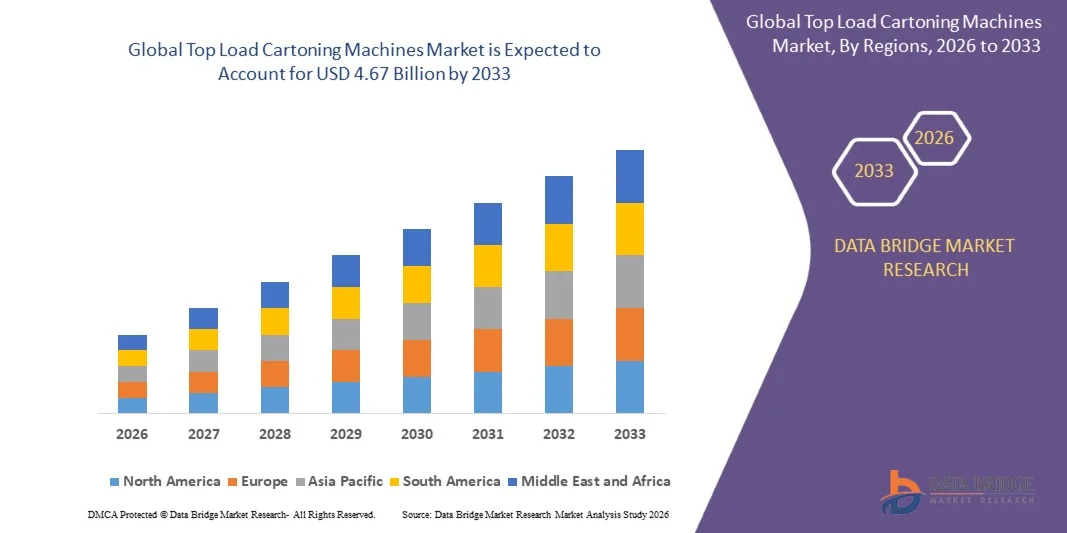
As per Data Bridge Market Research analysis the Top Load Cartoning Machines Market was valued at USD 3.17 billion in 2025 and is projected to reach USD 4.67 billion by 2033, growing at a CAGR of 5.00% from 2026 to 2033. The market is witnessing steady expansion driven by rising demand for high-speed and automated secondary packaging solutions, increasing adoption of end-of-line packaging automation, and growing emphasis on product safety, efficiency, and precision in packaging operations across multiple industries.
The growing shift toward automation in packaging lines, coupled with rising demand from the food and beverage, pharmaceuticals, personal care, and household goods sectors, is significantly boosting the adoption of top load cartoning machines. These systems are increasingly preferred due to their flexibility in handling diverse product shapes and sizes, improved throughput capabilities, and compatibility with smart manufacturing environments. In addition, the expansion of e-commerce and increasing focus on reducing labor dependency are further accelerating market growth globally.
Key Market Trends & Insights
- North America dominated the top load cartoning machines market with the largest revenue share of 38.7% in 2025, supported by strong industrial automation adoption, a well-established manufacturing base, and early integration of advanced packaging technologies across food and pharmaceutical sectors.
- Asia-Pacific is expected to be the fastest-growing region, recording a CAGR of 6.9% from 2026 to 2033. Growth is driven by rapid industrialization, expanding FMCG and pharmaceutical manufacturing, rising disposable incomes, and increasing adoption of automated packaging systems in countries such as China, India, and Japan.
- The horizontal segment held the largest market revenue share of approximately 58.6% in 2025 driven by its widespread adoption in high-speed packaging lines across food, beverage, and pharmaceutical industries. Horizontal top load systems are preferred due to their higher stability in continuous operations, better compatibility with automated feeding systems, and ability to handle a wide range of carton formats with consistent precision.
- The vertical segment is projected to register the fastest growth at a CAGR of 6.7% from 2026 to 2033, driven by increasing demand for compact packaging systems in space-constrained production facilities. Rising adoption in personal care and healthcare packaging applications is further accelerating segment growth, particularly in facilities requiring flexible changeovers and multi-SKU handling capabilities.
- The 150 to 400 CPM segment held the largest market revenue share of approximately 42.3% in 2025 driven by its strong utilization in large-scale FMCG and pharmaceutical production lines requiring high throughput and continuous packaging efficiency. This capacity range is widely preferred due to its balance between speed, operational stability, and integration flexibility with upstream and downstream automation systems.
- The above 400 CPM segment is projected to register the fastest growth at a CAGR of 7.4% from 2026 to 2033, driven by increasing demand for ultra-high-speed packaging solutions in global manufacturing hubs. Expansion of large contract packaging organizations and rising need for mass production in food and beverage export-oriented industries are further supporting segment growth.
- The food segment held the largest market revenue share of approximately 34.9% in 2025 driven by rising consumption of packaged and ready-to-eat food products, increasing demand for hygienic packaging, and growing automation in food processing plants. Top load cartoning machines are widely used in frozen foods, bakery products, and snack packaging due to their speed and flexibility.
- The healthcare segment is projected to register the fastest growth at a CAGR of 7.9% from 2026 to 2033, driven by increasing pharmaceutical production, rising demand for unit-dose packaging, and strict regulatory requirements for product safety and traceability. Expanding healthcare infrastructure and contract manufacturing activities are further accelerating adoption of advanced cartoning systems in this segment.
Market Size & Forecast
- Global Market Value (2025): USD 3.17 Billion
- Expected Market Value (2033): USD 4.67 Billion
- Forecast CAGR (2026–2033): 5.00%
- Leading Region in 2025: North America
- Fastest Growing Region: Asia-Pacific
Report Scope and Top Load Cartoning Machines Market Segmentation
|
Attributes |
Top Load Cartoning Machines Key Market Insights |
|
Segments Covered |
· By Product Type: Horizontal and Vertical · By Capacity: Less Than 70 CPM, 70 to 150 CPM, 150 to 400 CPM, and Above 400 CPM · By End User: Food, Beverage, Personal Care, Healthcare, Homecare, and Others |
|
Countries Covered |
North America · U.S. · Canada · Mexico Europe · Germany · France · U.K. · Netherlands · Switzerland · Belgium · Russia · Italy · Spain · Turkey · Rest of Europe Asia-Pacific · China · Japan · India · South Korea · Singapore · Malaysia · Australia · Thailand · Indonesia · Philippines · Rest of Asia-Pacific Middle East and Africa · Saudi Arabia · U.A.E. · South Africa · Egypt · Israel · Rest of Middle East and Africa South America · Brazil · Argentina · Rest of South America |
|
Key Market Players |
• Tetra Pak Group (Sweden) |
|
Market Opportunities |
• Expansion Of E-Commerce Driven Packaging Automation Demand |
|
Value Added Data Infosets |
In addition to the insights on market scenarios such as market value, growth rate, segmentation, geographical coverage, and major players, the market reports curated by the Data Bridge Market Research also include in-depth expert analysis, pricing analysis, brand share analysis, consumer survey, demography analysis, supply chain analysis, value chain analysis, raw material/consumables overview, vendor selection criteria, PESTLE Analysis, Porter Analysis, and regulatory framework. |
Top Load Cartoning Machines Market Trends
Trend: Growth In Automated End-Of-Line Packaging And Smart Cartoning Integration
Increasing demand for high-speed, flexible, and fully automated packaging systems across food and beverage, pharmaceuticals, personal care, and consumer goods industries is driving adoption of advanced cartoning technologies. Traditional manual and semi-automated packaging operations are being replaced by fully automated top load cartoning systems due to rising labor costs, productivity requirements, and stricter packaging quality standards across global supply chains.
In modern packaging lines, manufacturers are integrating top load cartoning machines with robotic pick-and-place systems and vision inspection technologies, For instance to handle irregularly shaped products, multipack configurations, and fragile items with higher precision while reducing product damage rates and improving line efficiency. In pharmaceutical and food packaging, these systems are increasingly deployed for unit-dose packaging and high-speed retail-ready cartons, supporting compliance with stringent safety and traceability regulations.
The rapid expansion of e-commerce and omnichannel retail distribution is also increasing demand for durable and tamper-evident secondary packaging solutions capable of withstanding long-distance logistics. In addition, smart factories are integrating IoT-enabled cartoning systems for real-time monitoring, predictive maintenance, and throughput optimization. Industry deployments in Europe and North America during 2025 reported productivity improvements of around 15–20% after integrating fully automated top load cartoning lines with digital control systems.
Top Load Cartoning Machines Market Dynamics
Key Market Driver: Rising Demand For Packaging Automation And High-Speed Production Lines
Manufacturers across industries are increasingly investing in automation to improve production efficiency, reduce dependency on manual labor, and ensure consistent packaging quality. The growing scale of FMCG production and pharmaceutical manufacturing is creating strong demand for high-speed cartoning systems capable of handling continuous, large-volume operations with minimal downtime.
Food and beverage companies are widely deploying top load cartoning machines for multipack cartons, frozen food packaging, and ready-to-eat meal distribution, For instance to improve packaging speed and maintain hygiene standards in automated production environments while reducing human contact in sensitive packaging processes.
Similarly, pharmaceutical manufacturers are adopting automated cartoning solutions for blister packs, vials, and medical kits to ensure accuracy, serialization compliance, and traceability requirements. Large-scale deployments in the U.S. pharmaceutical sector during 2024 recorded packaging line efficiency improvements of nearly 18–22% after transitioning from semi-automatic to fully automated cartoning systems.
Key Restraint/Challenge: High Initial Investment And Complex System Integration
Top load cartoning machines require significant capital investment due to advanced robotics, servo-driven mechanisms, and integrated control systems, which can limit adoption among small and medium-sized enterprises. The need for customized configuration based on product type, carton design, and production speed further increases implementation costs and setup time.
In addition, integrating cartoning machines into existing production lines often requires extensive modifications, skilled technical operators, and compatibility with upstream and downstream equipment, creating operational complexity for manufacturers transitioning from legacy systems.
Industry assessments indicate that fully automated top load cartoning systems can require installation and integration costs ranging from 20–35% higher than conventional side-load systems, with additional downtime of several weeks during commissioning phases in large-scale manufacturing facilities.
Key Market Opportunity: Expansion Of Smart Manufacturing And Sustainable Packaging Systems
Growing adoption of Industry 4.0 technologies and sustainable packaging initiatives is creating significant opportunities for advanced cartoning machine manufacturers. Companies are increasingly focusing on lightweight, recyclable carton materials and energy-efficient packaging machinery to reduce environmental impact and comply with global sustainability regulations.
Packaging manufacturers are deploying smart top load cartoning systems, For instance integrated with AI-based defect detection and real-time production analytics, to improve packaging accuracy and reduce material wastage across high-volume production environments in food and pharmaceutical sectors.
In addition, rising investment in automated fulfillment centers and contract packaging organizations is expanding demand for flexible cartoning systems capable of handling multiple SKUs with rapid changeover capabilities. Pilot installations in Asia-Pacific during 2025 reported material waste reduction of approximately 10–14% after adopting intelligent cartoning systems with automated adjustment and optimization features.
Top Load Cartoning Machines Market Scope
The market is segmented on the basis of product type, capacity, and end user.
- By Product Type
On the basis of product type, the Top Load Cartoning Machines Market is segmented into horizontal and vertical systems. The horizontal segment held the largest market revenue share of approximately 58.6% in 2025 driven by its widespread adoption in high-speed packaging lines across food, beverage, and pharmaceutical industries. Horizontal top load systems are preferred due to their higher stability in continuous operations, better compatibility with automated feeding systems, and ability to handle a wide range of carton formats with consistent precision.
The vertical segment is projected to register the fastest growth at a CAGR of 6.7% from 2026 to 2033, driven by increasing demand for compact packaging systems in space-constrained production facilities. Rising adoption in personal care and healthcare packaging applications is further accelerating segment growth, particularly in facilities requiring flexible changeovers and multi-SKU handling capabilities.
- By Capacity
On the basis of capacity, the market is segmented into less than 70 CPM, 70 to 150 CPM, 150 to 400 CPM, and above 400 CPM. The 150 to 400 CPM segment held the largest market revenue share of approximately 42.3% in 2025 driven by its strong utilization in large-scale FMCG and pharmaceutical production lines requiring high throughput and continuous packaging efficiency. This capacity range is widely preferred due to its balance between speed, operational stability, and integration flexibility with upstream and downstream automation systems.
The above 400 CPM segment is projected to register the fastest growth at a CAGR of 7.4% from 2026 to 2033, driven by increasing demand for ultra-high-speed packaging solutions in global manufacturing hubs. Expansion of large contract packaging organizations and rising need for mass production in food and beverage export-oriented industries are further supporting segment growth.
- By End User
On the basis of end user, the market is segmented into food, beverage, personal care, healthcare, homecare, and others. The food segment held the largest market revenue share of approximately 34.9% in 2025 driven by rising consumption of packaged and ready-to-eat food products, increasing demand for hygienic packaging, and growing automation in food processing plants. Top load cartoning machines are widely used in frozen foods, bakery products, and snack packaging due to their speed and flexibility.
The healthcare segment is projected to register the fastest growth at a CAGR of 7.9% from 2026 to 2033, driven by increasing pharmaceutical production, rising demand for unit-dose packaging, and strict regulatory requirements for product safety and traceability. Expanding healthcare infrastructure and contract manufacturing activities are further accelerating adoption of advanced cartoning systems in this segment.
Top Load Cartoning Machines Market Regional Analysis
North America Top Load Cartoning Machines Market Insight
North America dominated the top load cartoning machines market with the largest revenue share of 38.7% in 2025, supported by strong demand for advanced packaging automation, high adoption of Industry 4.0 technologies, and a well-established food, pharmaceutical, and personal care manufacturing base. Manufacturers in the region are increasingly investing in fully automated end-of-line packaging systems to improve throughput efficiency, reduce labor dependency, and ensure consistent packaging quality. The presence of leading packaging equipment providers and early adoption of robotics-integrated cartoning systems further strengthen market growth across the region.
U.S. Top Load Cartoning Machines Market Insight
The U.S. top load cartoning machines market captured the largest revenue share within North America in 2025, driven by rapid expansion of pharmaceutical manufacturing, high demand for packaged food products, and widespread automation in FMCG production facilities. Companies are increasingly adopting high-speed cartoning lines integrated with robotic pick-and-place systems and vision inspection technologies to enhance operational efficiency and compliance with strict FDA packaging regulations. In addition, rising investments in smart factories and contract packaging organizations are further accelerating market expansion in the country.
Europe Top Load Cartoning Machines Market Insight
The Europe top load cartoning machines market is projected to witness the fastest growth from 2026 to 2033, primarily driven by strict regulatory standards on packaging quality, increasing emphasis on sustainable packaging, and strong demand for automation in pharmaceutical and food industries. European manufacturers are focusing on energy-efficient and recyclable packaging solutions, encouraging adoption of advanced cartoning systems. Growing investments in smart manufacturing and rising demand for flexible packaging lines capable of handling multiple product formats are further supporting regional growth.
U.K. Top Load Cartoning Machines Market Insight
The U.K. top load cartoning machines market is expected to witness strong growth from 2026 to 2033, driven by increasing adoption of automated packaging systems in food processing, healthcare, and personal care industries. Rising labor costs and growing emphasis on production efficiency are encouraging manufacturers to shift toward high-speed cartoning solutions. In addition, expansion of e-commerce distribution networks and contract packaging facilities is further boosting demand for flexible and compact cartoning machines across the country.
Germany Top Load Cartoning Machines Market Insight
The Germany top load cartoning machines market is expected to witness significant growth from 2026 to 2033, fueled by strong industrial automation adoption, advanced manufacturing infrastructure, and high demand for precision packaging systems. Germany’s focus on engineering excellence and sustainability is driving investments in energy-efficient and digitally integrated packaging machinery. Increasing deployment of smart packaging lines in automotive components, pharmaceuticals, and food industries is further accelerating market expansion.
Asia-Pacific Top Load Cartoning Machines Market Insight
The Asia-Pacific top load cartoning machines market is expected to witness the fastest growth from 2026 to 2033, supported by rapid industrialization, rising disposable incomes, and expanding manufacturing activities in countries such as China, India, and Japan. The region’s growing FMCG sector and increasing demand for packaged food and pharmaceuticals are significantly driving automation adoption. In addition, APAC’s position as a global manufacturing hub for packaging machinery is improving affordability and accessibility, encouraging widespread deployment across small and large-scale industries.
Japan Top Load Cartoning Machines Market Insight
The Japan top load cartoning machines market is expected to witness steady growth from 2026 to 2033 due to strong technological advancement, high demand for precision packaging, and increasing automation in manufacturing processes. Japanese industries place strong emphasis on space-efficient, high-accuracy packaging systems, particularly in electronics, healthcare, and food sectors. Integration of cartoning machines with robotics and IoT-based monitoring systems is further enhancing operational efficiency and supporting market expansion.
China Top Load Cartoning Machines Market Insight
The China top load cartoning machines market accounted for the largest market revenue share in Asia-Pacific in 2025, attributed to rapid urbanization, strong expansion of the FMCG and pharmaceutical sectors, and large-scale industrial automation adoption. China’s growing e-commerce industry and high demand for packaged consumer goods are significantly boosting installation of high-speed cartoning systems. Strong domestic manufacturing capabilities and government support for smart manufacturing initiatives are further propelling market growth across the country.
Top Load Cartoning Machines Market Share
The Top Load Cartoning Machines industry is primarily led by well-established companies, including:
• Tetra Pak Group (Sweden)
• Cama 1 S.p.A. (Italy)
• Robert Bosch GmbH (Germany)
• Omori Machinery Co., Ltd. (Japan)
• ROVEMA GmbH (Germany)
• EconoCorp Inc. (U.S.)
• PMI KYOTO Packaging Systems (Japan)
• Langley Holdings plc (U.K.)
• Mpac Group plc (U.K.)
• Marchesini Group S.p.A. (Italy)
• OPTIMA packaging group GmbH (Germany)
• ATS Automation Tooling Systems Inc. (Canada)
• ACG (India)
• Körber AG (Germany)
• Jacob White Packaging (U.K.)
• Douglas Machine Inc. (U.S.)
• I.M.A. Industria Macchine Automatiche S.p.A. (Italy)
• Kyoto Seisakusho Co., Ltd. (Japan)
• SHIBUYA CORPORATION (Japan)
• ADCO Manufacturing (U.S.)
Latest Developments in Top Load Cartoning Machines Market
- In August 2026, Robert Bosch GmbH introduced a new line of high-speed top load cartoning machines, a product launch aimed at improving production efficiency in the food packaging sector and reducing operational bottlenecks. This development is expected to strengthen Bosch’s competitive position and increase its market share in high-speed automated cartoning solutions.
- In September 2025, Krones AG entered into a strategic partnership with a leading AI technology firm to develop smart cartoning systems integrated with machine learning-based predictive maintenance capabilities. This collaboration is expected to improve equipment uptime, optimize operational efficiency, and accelerate the adoption of intelligent packaging automation across global manufacturing facilities.
- In July 2025, Tetra Pak Group launched a sustainability initiative focused on reducing carbon emissions by introducing eco-friendly materials into its top load cartoning machines. This development is expected to enhance the company’s environmental positioning while strengthening its appeal among sustainability-focused food and beverage manufacturers worldwide.
- In June 2025, Mpac Group plc collaborated with Freyr Battery to develop advanced casting and unit cell assembly systems for large-scale manufacturing applications. This partnership is expected to expand Mpac’s technological capabilities and strengthen its presence in high-growth industrial automation and energy storage production markets.
- In March 2025, Syntegon Technology GmbH introduced a new SBM line sterilizer system, expanding its packaging machinery portfolio with advanced sterilization solutions. This product launch is expected to enhance operational efficiency in pharmaceutical and food packaging lines while reinforcing Syntegon’s position in the global automated packaging market.
- In January 2024, Omori Machinery Co., Ltd. increased its stake in Omori North America, strengthening its subsidiary operations and accelerating its digital transformation initiatives. This strategic move is expected to improve regional market penetration and enhance service capabilities across the North American packaging machinery market.

- Interactive Data Analysis Dashboard
- Company Analysis Dashboard for high growth potential opportunities
- Research Analyst Access for customization & queries
- Competitor Analysis with Interactive dashboard
- Latest News, Updates & Trend analysis
- Harness the Power of Benchmark Analysis for Comprehensive Competitor Tracking
Data collection and base year analysis are done using data collection modules with large sample sizes. The stage includes obtaining market information or related data through various sources and strategies. It includes examining and planning all the data acquired from the past in advance. It likewise envelops the examination of information inconsistencies seen across different information sources. The market data is analysed and estimated using market statistical and coherent models. Also, market share analysis and key trend analysis are the major success factors in the market report. To know more, please request an analyst call or drop down your inquiry.
The key research methodology used by DBMR research team is data triangulation which involves data mining, analysis of the impact of data variables on the market and primary (industry expert) validation. Data models include Vendor Positioning Grid, Market Time Line Analysis, Market Overview and Guide, Company Positioning Grid, Patent Analysis, Pricing Analysis, Company Market Share Analysis, Standards of Measurement, Global versus Regional and Vendor Share Analysis. To know more about the research methodology, drop in an inquiry to speak to our industry experts.
Data Bridge Market Research is a leader in advanced formative research. We take pride in servicing our existing and new customers with data and analysis that match and suits their goal. The report can be customized to include price trend analysis of target brands understanding the market for additional countries (ask for the list of countries), clinical trial results data, literature review, refurbished market and product base analysis. Market analysis of target competitors can be analyzed from technology-based analysis to market portfolio strategies. We can add as many competitors that you require data about in the format and data style you are looking for. Our team of analysts can also provide you data in crude raw excel files pivot tables (Fact book) or can assist you in creating presentations from the data sets available in the report.