


What is the Topical Dispenser Market Size and Growth Rate?
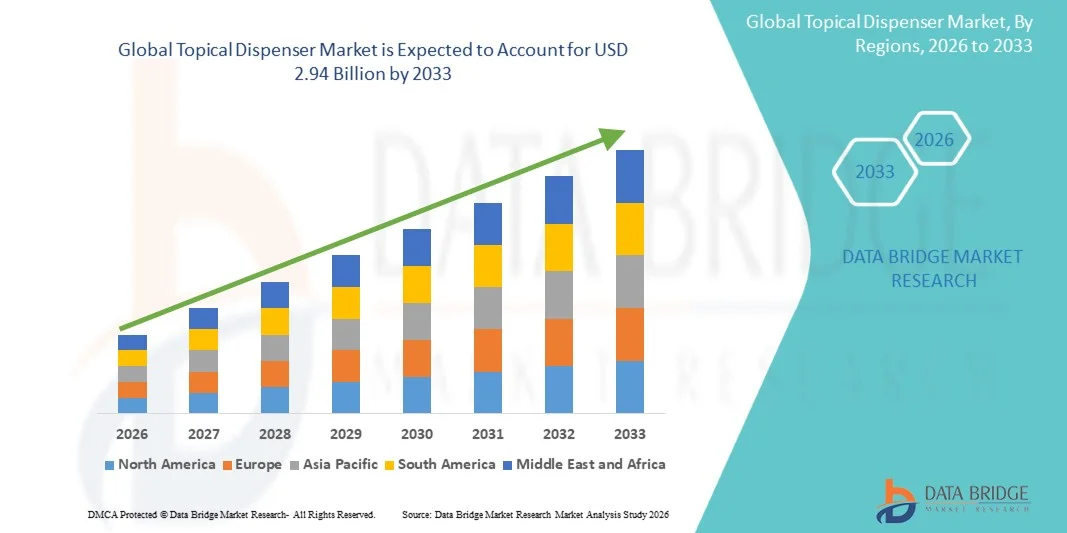
The global Topical Dispenser market was valued at USD 1.36 billion in 2025 and is projected to reach USD 2.94 billion by 2033, growing at a CAGR of 10.15% from 2026 to 2033. The market is experiencing consistent growth driven by rising demand for safe and precise topical drug delivery systems, rapid advancements in pharmaceutical formulation technologies, and expanding applications across dermatology, wound care, and pain management. Increasing prevalence of skin disorders such as dermatitis, psoriasis, acne, and fungal infections is significantly boosting demand for topical dispensers that ensure controlled dosing and improved patient compliance. In addition, growing preference for self-administration and home-based care solutions is accelerating the adoption of user-friendly dispenser formats such as pumps, sprays, and metered-dose applicators across global healthcare systems.
The increasing burden of chronic skin conditions, combined with rising awareness regarding hygienic and accurate drug application, is encouraging healthcare providers, dermatology clinics, and pharmacies to adopt advanced topical dispensing solutions. Pharmaceutical companies are increasingly focusing on improving formulation stability and delivery precision through innovative dispenser designs that reduce wastage and enhance therapeutic effectiveness. Furthermore, the shift toward over-the-counter (OTC) dermatological treatments, along with expanding e-commerce distribution channels for skincare and therapeutic products, is further supporting market expansion across both developed and emerging regions..
Market Size & Forecast
- Global Market Value (2025): USD 1.36 Billion
- Expected Market Value (2033): USD 2.94 Billion
- Forecast CAGR (2026–2033): 10.15%
- Leading Region in 2025: North America
- Fastest Growing Region: Asia-Pacific
What are the Major Takeaways of Topical Dispenser Market?
- North America dominated the global Topical Dispenser market with the largest revenue share of 38.56% in 2025, supported by advanced healthcare infrastructure, high adoption of dermatology and wound care treatments, and strong presence of leading pharmaceutical and medical packaging companies. The region benefits from high awareness regarding skin health, widespread availability of OTC topical medications, and strong reimbursement frameworks for dermatological treatments. In addition, increasing prevalence of chronic skin conditions such as eczema, psoriasis, and dermatitis, along with rising demand for self-care and home-based treatment solutions, is significantly driving market growth. The growing penetration of advanced metered dispensing systems in hospitals, pharmacies, and homecare settings further strengthens regional leadership.
- The Metered Topical Dispensers segment dominated the market with a 56.42% revenue share in 2025, driven by rising demand for accurate dosing, reduced medication wastage, and improved patient compliance in dermatology and wound care applications
- Asia-Pacific is expected to be the fastest-growing region at a CAGR of 8.21% from 2026 to 2033, fueled by rising healthcare expenditure, expanding pharmaceutical manufacturing, and increasing awareness of dermatological treatments across China, India, and Japan. Rapid urbanization, growing access to healthcare services, and increasing penetration of OTC skincare and therapeutic products are further accelerating market expansion. In addition, the rise of e-commerce distribution channels and growing adoption of affordable self-care solutions are strengthening regional growth momentum.
- Semi-Solid formulations are the fastest-growing dosage segment, projected to register a CAGR of 7.64%, driven by strong demand for creams, gels, and ointments used in dermatology and wound care applications. Their high therapeutic efficiency, ease of application, and better skin absorption properties are increasing adoption across clinical and homecare settings. Rising prevalence of skin infections, burns, and inflammatory conditions is further supporting segment growth.
- The Dermal route segment dominates the market with a 61.38% revenue share in 2025, led by widespread use of topical dispensers for treating skin disorders, wound healing, and cosmetic dermatology applications. Increasing preference for localized treatment with minimal systemic side effects is driving strong adoption. Growth in aesthetic dermatology procedures and over-the-counter skincare treatments is further reinforcing segment dominance.
- The Homecare end-use segment dominates the market with a 48.92% revenue share in 2025, driven by increasing preference for self-administration of topical medications, rising chronic skin conditions, and expanding elderly population requiring long-term dermatological care. The convenience of at-home treatment, along with improved dispenser designs and availability of OTC products, is further strengthening demand. Growth of telemedicine and online pharmacy platforms is also supporting homecare adoption.
- The Hospital end-use segment is expected to be the fastest-growing with a CAGR of 7.98%, driven by increasing patient inflow for dermatological treatments, wound care management, and post-surgical skin applications. Expanding hospital infrastructure, rising adoption of advanced topical drug delivery systems, and increasing clinical demand for precision dosing are accelerating segment growth across global healthcare facilities.
Report Scope and Global Topical Dispenser Market Segmentation
|
Attributes |
Topical Dispenser Key Market Insights |
|
Segments Covered |
|
|
Countries Covered |
North America
Europe
Asia-Pacific
Middle East and Africa
South America
|
|
Key Market Players |
|
|
Market Opportunities |
|
|
Value Added Data Infosets |
In addition to the insights on market scenarios such as market value, growth rate, segmentation, geographical coverage, and major players, the market reports curated by the Data Bridge Market Research also include in-depth expert analysis, geographically represented company-wise production and capacity, network layouts of distributors and partners, detailed and updated price trend analysis and deficit analysis of supply chain and demand. |
What is the Key Trend in the Global Topical DispenserXYZ Market?
Trend: Growth in Dermatology Care, Self-Medication, and Precise Drug Delivery Systems
The Global Topical Dispenser Market is witnessing steady growth driven by rising demand for accurate, hygienic, and user-friendly drug delivery solutions across dermatology, wound care, and pain management applications. Increasing prevalence of skin disorders such as eczema, acne, psoriasis, and fungal infections—affecting a significant portion of the global population—has accelerated the adoption of controlled-dose topical dispensers. According to dermatology burden studies, chronic skin conditions account for nearly 15–20% of outpatient consultations in developed healthcare systems, reinforcing the need for precise and contamination-free topical application systems. The growing preference for metered-dose pumps, airless dispensers, and spray-based delivery formats is further enhancing treatment compliance and reducing medication wastage. In addition, the expansion of OTC skincare and therapeutic products across global retail and e-commerce channels is strengthening demand for advanced dispensing technologies in both developed and emerging markets.
Global Topical Dispenser Market Dynamics
Key Market Driver: Rising Prevalence of Skin Disorders and Expanding Demand for Controlled Topical Drug Delivery
The increasing global burden of dermatological conditions is a major driver for the topical dispenser market. Conditions such as dermatitis, psoriasis, acne, and wound infections collectively impact hundreds of millions of patients worldwide, with acne alone affecting an estimated 650 million individuals globally. This rising disease prevalence is driving demand for precise and controlled drug delivery systems that ensure consistent dosage and improved therapeutic outcomes. Pharmaceutical and skincare companies are increasingly adopting metered topical dispensers to enhance product efficacy, improve patient adherence, and minimize contamination risks during application. In addition, the shift toward self-medication and homecare treatment is encouraging the use of easy-to-operate dispensing systems such as pumps, droppers, and spray applicators. Growing investments in dermatology-focused drug formulations and packaging innovation across the U.S., Europe, and Asia-Pacific are further strengthening market expansion.
Key Restraint/Challenge: Cost Sensitivity and Limited Adoption in Low-Income and Price-Conscious Markets
Despite strong growth potential, the market faces challenges related to the higher cost of advanced dispensing systems, particularly airless pumps and precision metered devices. These technologies require specialized manufacturing, high-quality materials, and strict compliance with pharmaceutical packaging standards, increasing production costs. In price-sensitive regions across parts of Asia, Africa, and Latin America, conventional packaging formats such as tubes and simple bottles still dominate due to affordability constraints. In addition, smaller pharmaceutical and cosmetic manufacturers often hesitate to adopt advanced dispensers due to higher procurement costs and limited scalability. Variability in regulatory standards for packaging and drug-device combination products across countries further complicates global adoption. Rapid innovation cycles in packaging design also increase replacement frequency and operational costs for manufacturers.
Key Market Opportunity: Innovation in Smart Packaging, Sustainability, and Personalized Drug Delivery Systems
The integration of smart packaging technologies and sustainable materials presents a significant opportunity for the topical dispenser market. Manufacturers are increasingly investing in eco-friendly materials such as recyclable plastics, biodegradable polymers, and refillable dispenser systems to align with global sustainability goals. In addition, the development of smart dispensers equipped with dose-tracking mechanisms, patient adherence monitoring, and connected health features is gaining traction in advanced healthcare markets. The expansion of personalized medicine and dermatology-specific formulations is further driving demand for customized dispensing solutions that improve treatment precision. Emerging economies such as India, Brazil, and Southeast Asia are witnessing rapid growth in pharmaceutical packaging innovation, supported by expanding healthcare infrastructure and rising consumer awareness. Furthermore, increasing partnerships between pharmaceutical companies and packaging technology providers are accelerating innovation in ergonomic, contamination-free, and patient-centric delivery systems globally.
How is the Global Topical Dispenser Market Segmented?
The Global Topical Dispenser market is segmented on the basis of type, dosage form, capacity, route of administration, and end-use
- By Type
On the basis of type, the market is segmented into Metered Topical Dispensers and Swab Topical Dispensers. The Metered Topical Dispensers segment dominated the market with a 56.42% revenue share in 2025, driven by rising demand for accurate dosing, reduced medication wastage, and improved patient compliance in dermatology and wound care applications. These systems ensure controlled drug release, minimizing overdose risks and improving therapeutic outcomes. Hospitals and pharmacies increasingly prefer metered systems due to their compatibility with prescription-based therapies. Growing adoption in chronic skin disease management such as eczema, psoriasis, and dermatitis is further strengthening demand. Pharmaceutical companies are integrating metered dispensing formats into commercial drug packaging for better usability. Technological advancements in pump-based and spray-based dispensing systems are enhancing efficiency and precision. Increasing healthcare standardization and regulatory focus on dosing accuracy are also supporting segment leadership.
The Swab Topical Dispensers segment is expected to register the fastest CAGR of 6.9% from 2026 to 2033, driven by increasing usage in wound care management, antiseptic applications, and low-cost healthcare environments. Swab-based systems are widely adopted in emerging economies due to affordability and simplicity of use. Rising number of surgical procedures and burn injury cases is significantly boosting demand. Homecare adoption is increasing due to ease of application without medical supervision. Growth in emergency care and first-aid applications is further supporting segment expansion. Limited requirement for complex handling systems makes swab dispensers highly accessible. Expanding healthcare infrastructure in Asia-Pacific and Latin America is accelerating adoption globally.
- By Dosage
On the basis of dosage, the market is segmented into Solid, Semi-Solid, and Liquid formulations. The Semi-Solid segment dominated the market with a 48.17% share in 2025, driven by widespread use in ointments, creams, and gels for dermatological and wound care treatments. Semi-solid formulations offer superior skin absorption, controlled drug release, and enhanced therapeutic effectiveness. They are widely preferred in hospitals for chronic skin conditions and post-surgical care. Increasing prevalence of fungal infections, psoriasis, and eczema is strongly supporting demand. Pharmaceutical manufacturers prefer semi-solid dosage forms due to formulation stability and packaging compatibility. Rising OTC dermatology product consumption is further strengthening segment dominance. Strong clinical preference for sustained-release topical formulations is reinforcing market leadership.
The Liquid dosage segment is expected to register the fastest CAGR of 7.2% from 2026 to 2033, driven by increasing use in antiseptic solutions, sprays, and disinfectants. Liquid formulations are gaining popularity due to rapid absorption and ease of application over large affected skin areas. Rising demand in wound cleansing and infection prevention is boosting growth. Increasing use in hospital infection control protocols is further accelerating adoption. Liquid-based topical drugs are widely used in ophthalmic and nasal applications as well. Growing homecare treatment adoption is expanding market reach. Expanding pharmaceutical innovation in liquid delivery systems is supporting long-term growth.
- By Capacity
On the basis of capacity, the market is segmented into Up to 10ml, 11ml to 30ml, 31ml to 50ml, and Above 50ml. The 11ml to 30ml segment dominated the market with a 39.58% revenue share in 2025, driven by optimal balance between portability and clinical usability. This capacity range is widely used in dermatology prescriptions and outpatient treatment applications. Hospitals prefer this segment due to reduced wastage and improved dosage control. Increasing demand for compact and travel-friendly medication packaging is supporting growth. Pharmaceutical companies are standardizing this capacity for topical drug packaging. Strong adoption in homecare settings is also reinforcing dominance. Rising focus on patient compliance and convenience is further strengthening market share.
The Above 50ml segment is expected to register the fastest CAGR of 6.8% from 2026 to 2033, driven by increasing demand in hospitals, burn centers, and long-term treatment applications. Large-capacity dispensers reduce refill frequency and improve operational efficiency. Burn injury treatments requiring frequent topical application are boosting adoption. Hospitals prefer bulk dispensing for cost efficiency and workflow optimization. Rising surgical procedures globally are further increasing demand. Expanding healthcare infrastructure in emerging economies is accelerating usage. Growth in institutional pharmacy systems is further supporting segment expansion.
- By Route of Administration
On the basis of route, the market is segmented into Dermal, Ophthalmic, Rectal, Vaginal, and Nasal. The Dermal segment dominated the market with a 61.25% revenue share in 2025, driven by high prevalence of skin disorders and widespread use of topical dermatology treatments. Dermal applications are the most common use case for topical dispensers globally. Increasing cases of infections, burns, and chronic skin diseases are supporting demand. Hospitals rely heavily on dermal drug delivery systems for standardized treatment protocols. Rising cosmetic dermatology procedures are also contributing to growth. Strong prescription-based dermatological drug consumption reinforces dominance. Expanding OTC skincare product usage is further strengthening market position.
The Ophthalmic segment is expected to register the fastest CAGR of 7.1% from 2026 to 2033, driven by rising incidence of eye infections, dry eye syndrome, and post-surgical care needs. Increasing use of eye drops and sterile ophthalmic solutions is boosting adoption. Growing aging population is a key demand driver globally. Rising number of cataract and LASIK procedures is further supporting growth. Precision dosing requirements are increasing use of metered dispensers. Expanding ophthalmic pharmaceutical innovation is strengthening segment expansion. Growing awareness of eye health is also accelerating adoption.
- By End-Use
On the basis of end-use, the market is segmented into Homecare, Hospitals, and Burn Centers. The Hospital segment dominated the market with a 52.83% revenue share in 2025, driven by high patient inflow and strong adoption of controlled drug delivery systems. Hospitals require precise dosing for dermatology, wound care, and infection management. Increasing surgical procedures globally are boosting demand. Advanced hospital pharmacy systems support widespread adoption. Strict hygiene and regulatory compliance requirements are reinforcing usage. Growing healthcare infrastructure development is strengthening market penetration. Hospitals remain the primary end-user due to centralized care delivery systems.
The Homecare segment is expected to register the fastest CAGR of 7.4% from 2026 to 2033, driven by rising preference for self-medication and outpatient care. Increasing geriatric population is boosting demand for home-based treatment solutions. Chronic disease management outside hospitals is expanding rapidly. Easy-to-use dispensers are supporting self-administration trends. Rising healthcare cost pressures are shifting care to home settings. Growth in telemedicine and remote care is further supporting adoption. Expanding consumer awareness of self-care solutions is accelerating market expansion.
Global Topical Dispenser Market Regional Analysis
North America dominated the Topical Dispenser market and accounted for the largest revenue share of 38.56% in 2025, supported by advanced healthcare infrastructure, high adoption of dermatology and wound care treatments, and strong presence of leading pharmaceutical and medical packaging companies. The region benefits from high awareness regarding skin health, widespread availability of OTC topical medications, and strong reimbursement frameworks for dermatological treatments. In addition, increasing prevalence of chronic skin conditions such as eczema, psoriasis, and dermatitis is significantly driving market demand. Rising demand for self-care and home-based treatment solutions is further accelerating adoption of topical dispensing systems. The growing penetration of advanced metered dispensing technologies in hospitals, pharmacies, and retail drug stores is improving dosing accuracy and patient compliance. Strong pharmaceutical innovation and continuous product launches in dermatology therapeutics are further strengthening market leadership. Expansion of outpatient dermatology services across the U.S. and Canada is also supporting regional dominance. High consumer spending on personal care and skincare products continues to reinforce North America’s leading position in the global market.
U.S. Topical Dispenser Market Insight
The U.S. Topical Dispenser market is witnessing strong growth due to rising prevalence of skin disorders, increasing adoption of advanced dermatological treatments, and strong presence of global pharmaceutical manufacturers. The country has a highly developed healthcare system that supports widespread use of prescription-based topical medications. Growing demand for precise and contamination-free drug delivery systems is driving adoption of metered dispensers. Increasing cases of chronic conditions such as eczema, acne, and psoriasis are further supporting market growth. Rising preference for home-based treatment and self-medication is boosting demand for user-friendly dispensing devices. Strong investment in pharmaceutical R&D and drug formulation technologies is enhancing product innovation. Expanding telemedicine and digital healthcare services are also improving access to dermatological care. High healthcare expenditure and strong insurance coverage continue to support market expansion.
Europe Topical Dispenser Market Insight
The Europe Topical Dispenser market remains a major contributor to global revenue, driven by strong healthcare systems, strict regulatory standards, and high adoption of advanced dermatological treatments. Countries such as Germany, France, and the UK are witnessing increasing demand for topical medications due to rising cases of skin diseases. The region benefits from strong government healthcare support and universal healthcare systems. Increasing focus on patient safety and accurate drug dosing is driving adoption of metered dispensing technologies. Growth in aging population is further increasing demand for dermatology and wound care products. Rising awareness of skin health and cosmetic dermatology is also supporting market expansion. Strong pharmaceutical manufacturing base and innovation in drug delivery systems are reinforcing regional growth. Expansion of hospital and pharmacy networks is further strengthening adoption of topical dispensers.
U.K. Topical Dispenser Market Insight
The U.K. Topical Dispenser market is experiencing steady growth, supported by rising prevalence of skin disorders and strong adoption of advanced healthcare technologies. Increasing demand for prescription dermatology treatments is driving use of precise dispensing systems. The country benefits from a strong National Health Service (NHS) framework supporting widespread access to topical medications. Growing focus on patient safety and dosage accuracy is boosting adoption of metered dispensers. Rising cases of eczema and psoriasis are further supporting market demand. Increasing shift toward homecare treatment and self-medication is accelerating product usage. Expansion of pharmacy chains and retail healthcare outlets is improving product accessibility. Continuous innovation in dermatology drug formulations is supporting market growth.
Germany Topical Dispenser Market Insight
The Germany Topical Dispenser market is expanding steadily due to strong pharmaceutical manufacturing capabilities and high demand for advanced dermatological treatments. Increasing prevalence of chronic skin diseases is driving market growth. Hospitals and clinics are widely adopting precision drug delivery systems for improved patient outcomes. Strong regulatory frameworks ensure high safety and quality standards for topical medications. Rising investment in healthcare innovation and drug formulation is supporting market expansion. Germany’s strong chemical and pharmaceutical industry is driving product availability and innovation. Increasing adoption of OTC dermatology products is further supporting demand. Growing awareness of skin health and hygiene is strengthening long-term market growth.
Asia-Pacific Topical Dispenser Market Insight
The Asia-Pacific Topical Dispenser market is expected to witness rapid growth, driven by rising healthcare expenditure, expanding pharmaceutical manufacturing, and increasing awareness of dermatological treatments across countries such as China, India, and Japan. Rapid urbanization and improving healthcare infrastructure are significantly supporting market expansion. Growing access to affordable skincare and therapeutic products is accelerating adoption. Rising prevalence of skin infections and chronic dermatological conditions is boosting demand. Increasing penetration of OTC skincare and pharmaceutical products is further strengthening growth. Expansion of e-commerce channels is improving product availability and distribution. Government initiatives supporting healthcare access are enhancing regional market penetration. Growing middle-class population and rising self-care awareness are key growth drivers.
Japan Topical Dispenser Market Insight
The Japan Topical Dispenser market is witnessing consistent growth due to rising aging population and increasing prevalence of dermatological conditions. Strong healthcare system and advanced pharmaceutical industry are supporting market expansion. Increasing demand for precision drug delivery systems is driving adoption of metered dispensers. Growing focus on elderly care and chronic disease management is further boosting demand. High awareness of skincare and hygiene is supporting market growth. Japan’s strong innovation in medical devices is enhancing product quality and efficiency. Rising use of OTC dermatology treatments is expanding market reach. Increasing hospital-based dermatology treatments is further supporting adoption.
China Topical Dispenser Market Insight
The China Topical Dispenser market is growing rapidly, driven by expanding healthcare infrastructure, rising awareness of skin health, and increasing pharmaceutical production capacity. Growing middle-class population is boosting demand for skincare and dermatology products. Rapid urbanization and lifestyle changes are increasing prevalence of skin disorders. Expansion of hospital networks and retail pharmacies is improving product access. Strong growth in e-commerce distribution channels is accelerating market penetration. Government healthcare reforms are supporting wider adoption of medical devices. Increasing domestic pharmaceutical manufacturing is strengthening supply chain efficiency. Rising demand for affordable topical treatment solutions is positioning China as a key high-growth market globally.
Global Topical Dispenser Market Share
The Topical Dispenser industry is primarily led by well-established companies, including:
- Gerresheimer AG (Germany)
- AptarGroup, Inc. (U.S.)
- West Pharmaceutical Services, Inc. (U.S.)
- Berry Global Inc. (U.S.)
- Silgan Holdings Inc. (U.S.)
- HCP Packaging (China)
- Raepak Ltd. (U.K.)
- RPC Group (Berry Global) (U.K.)
- Albea Group (France)
- Amcor plc (Switzerland)
- O.Berk Company (U.S.)
- SGD Pharma (France)
- Comar LLC (U.S.)
- Origin Pharma Packaging (U.K.)
- Berlin Packaging (U.S.)
- DS Smith (U.K.)
- Schott AG (Germany)
- Nipro Corporation (Japan)
- Taisei Kako Co., Ltd. (Japan)
- Ningbo Suncity Packaging Co., Ltd. (China)
- Zignago Vetro S.p.A. (Italy)
- Bormioli Pharma (Italy)
- Weener Plastics Group (Netherlands)
- Piramal Glass (India)
- Fusion Packaging (U.S.)
- Quadpack Industries (Spain)
- Lumson S.p.A. (Italy)
- Virospack S.L. (Spain)
- APackaging Group (U.S.)
- Cosmopak (U.S.)
- RPC M&H Plastics (U.K.)
What are Latest Developments in Global Topical Dispenser Market?
- In May 2021, Nemera, a global leader in drug delivery devices, announced enhancements to its “Duma Twist-Off” topical dispensing system, designed to improve patient-friendly administration of semi-solid dermatological treatments. The updated system focused on improving dose accuracy, ease of use, and contamination prevention in topical applications such as creams and gels. The innovation supported rising demand for safe, unit-dose topical delivery formats in dermatology and homecare settings. This development reflects the industry’s shift toward precision-driven, patient-centric topical dispensing technologies in OTC and prescription skincare applications
- In February 2021, dermatology researchers highlighted the emerging adoption of pre-medicated topical wipe and applicator systems as a next-generation dispensing approach for skin disease management. These systems were increasingly studied for delivering controlled doses of topical medications for conditions such as psoriasis and dermatitis, improving compliance and reducing contamination risks compared to traditional tubes and jars. The development marked an important step toward innovative, single-use topical dispensing formats in dermatological care
- In April 2022, Aptar Pharma introduced advanced topical metered dose dispensing technologies designed for dermatology and wound-care applications. The system focused on improving dosing precision, contamination control, and compatibility with semi-solid formulations such as ointments and gels. The launch supported increasing demand from pharmaceutical companies for regulated and consistent drug delivery in topical therapies, particularly for chronic skin conditions requiring long-term treatment adherence
- In January 2023, Berry Global expanded its healthcare packaging portfolio by enhancing dispensing components for topical and dermatological drug products. The development emphasized sustainable packaging, controlled dispensing systems, and improved compatibility with OTC skincare formulations. The innovation addressed growing consumer demand for eco-friendly and precise dosing solutions in topical pharmaceutical packaging systems
- In June 2024, Nemera announced expansion of its manufacturing capacity for drug delivery devices, including topical dispensing systems used in dermatology and wound care. The expansion aimed to meet rising global demand for metered-dose dispensers and semi-solid drug delivery systems driven by increasing prevalence of chronic skin disorders. The company strengthened its supply chain capabilities to support pharmaceutical partners in Europe and North America
- In March 2025, SHL Medical advanced its connected drug delivery platform portfolio, integrating digital tracking features with topical and semi-solid dispensing devices. The development focused on improving adherence monitoring and dose accuracy in self-administered topical therapies, aligning with the broader shift toward digital health integration in dermatology and home-based care. The innovation reflects increasing convergence of smart technologies with topical drug dispensing systems

- Interactive Data Analysis Dashboard
- Company Analysis Dashboard for high growth potential opportunities
- Research Analyst Access for customization & queries
- Competitor Analysis with Interactive dashboard
- Latest News, Updates & Trend analysis
- Harness the Power of Benchmark Analysis for Comprehensive Competitor Tracking
Data collection and base year analysis are done using data collection modules with large sample sizes. The stage includes obtaining market information or related data through various sources and strategies. It includes examining and planning all the data acquired from the past in advance. It likewise envelops the examination of information inconsistencies seen across different information sources. The market data is analysed and estimated using market statistical and coherent models. Also, market share analysis and key trend analysis are the major success factors in the market report. To know more, please request an analyst call or drop down your inquiry.
The key research methodology used by DBMR research team is data triangulation which involves data mining, analysis of the impact of data variables on the market and primary (industry expert) validation. Data models include Vendor Positioning Grid, Market Time Line Analysis, Market Overview and Guide, Company Positioning Grid, Patent Analysis, Pricing Analysis, Company Market Share Analysis, Standards of Measurement, Global versus Regional and Vendor Share Analysis. To know more about the research methodology, drop in an inquiry to speak to our industry experts.
Data Bridge Market Research is a leader in advanced formative research. We take pride in servicing our existing and new customers with data and analysis that match and suits their goal. The report can be customized to include price trend analysis of target brands understanding the market for additional countries (ask for the list of countries), clinical trial results data, literature review, refurbished market and product base analysis. Market analysis of target competitors can be analyzed from technology-based analysis to market portfolio strategies. We can add as many competitors that you require data about in the format and data style you are looking for. Our team of analysts can also provide you data in crude raw excel files pivot tables (Fact book) or can assist you in creating presentations from the data sets available in the report.













