


What is the Torque Vectoring Differential Market Size and Growth Rate?
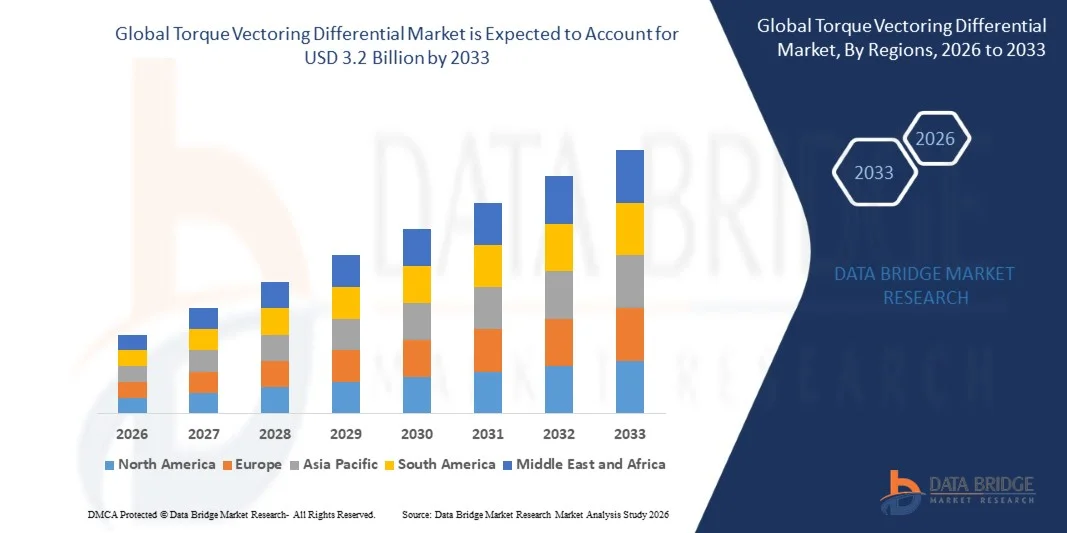
- As per Data Bridge Market Research analysis, the torque vectoring differential market was valued at USD 1.64 billion in 2025 and is projected to reach USD 3.2 billion by 2033, growing at a CAGR of 9.20% from 2026 to 2033.
- The market is experiencing consistent growth driven by rising demand for enhanced vehicle handling and stability, rapid advancements in electronic control and clutch actuation technologies, and expanding applications across performance vehicles, SUVs, and electric drivetrains.
- The increasing adoption of all-wheel-drive and four-wheel-drive platforms, combined with stricter vehicle safety and stability regulations, is compelling automotive OEMs and Tier-1 suppliers to integrate torque vectoring differentials into mainstream vehicle lineups. Electronic torque vectoring systems are replacing traditional mechanical differentials in many markets, offering millisecond-level torque allocation, reduced understeer and oversteer, and improved traction in variable road conditions.
Market Size & Forecast
- Global Market Value (2025): USD 1.64 Billion
- Expected Market Value (2033): USD 3.2 Billion
- Forecast CAGR (2026–2033): 9.20%
- Leading Region in 2025: Europe
- Fastest Growing Region: Asia-Pacific
What are the Major Takeaways of the Torque Vectoring Differential Market?
- Europe dominated the torque vectoring differential market with the largest revenue share of 26.20% in 2025, led by Germany's advanced automotive manufacturing base and widespread integration of torque vectoring in premium and performance vehicle lineups.
- Asia-Pacific is expected to be the fastest-growing region at a CAGR of 11.4% from 2026 to 2033, fueled by rising performance and electric vehicle production, expanding domestic supplier networks, and growing adoption in China, Japan, and India.
- The active torque vectoring system segment led the market with a 72.50% share in 2025, driven by its ability to deliver real-time, electronically controlled torque distribution across a wide range of driving conditions.
- The electronic torque vectoring segment is the fastest-growing technology type, projected to register a CAGR of 11.57%, reflecting the shift from brake-based and mechanical systems toward software-defined torque control.
- The passenger cars segment dominated the vehicle type category with a 68.83% revenue share in 2025, led by automotive OEMs integrating torque vectoring as a differentiator in handling and driving dynamics.
- The all-wheel drive/four-wheel drive segment led the propulsion category with a 57.10% share in 2025 and is also expected to register the fastest CAGR of 11.62%, driven by rising demand for enhanced traction across passenger and performance vehicles.
Report Scope and Torque Vectoring Differential Market Segmentation
|
Attributes |
Torque Vectoring Differential Key Market Insights |
|
Segments Covered |
|
|
Countries Covered |
North America
Europe
Asia-Pacific
Middle East and Africa
South America
|
|
Key Market Players |
|
|
Market Opportunities |
|
|
Value Added Data Infosets |
In addition to insights on market value, growth rate, segmentation, geographic coverage, and major players, reports curated by Data Bridge Market Research also include in-depth expert analysis, geographically represented company-wise production and capacity, distributor and partner network layouts, detailed and updated price trend analysis, and deficit analysis of supply and demand. |
What is the Key Trend in the Torque Vectoring Differential Market?
- Automotive manufacturers are increasingly adopting electric torque vectoring and disconnect (eTVD) systems that integrate seamlessly with battery electric drivetrains, enabling intelligent, wheel-level torque control without traditional mechanical differentials.
- Real-time software calibration allows engineers to fine-tune torque distribution, braking intervention, and stability control with high precision, improving both performance and safety outcomes.
- For instance, in May 2024, BorgWarner introduced its electric Torque Vectoring and Disconnect (eTVD) system for battery electric vehicles, designed to intelligently control wheel torque and enhance vehicle stability and dynamic performance.
- As automakers continue to prioritize driving dynamics, electrification, and software-defined vehicle architectures, the integration of electronic torque vectoring is expected to accelerate, reinforcing it as a core enabling technology for next-generation performance and electric vehicle platforms.
What are the Key Drivers of the Torque Vectoring Differential Market?
- The rapid growth of performance-oriented passenger vehicles and SUVs has significantly increased demand for advanced torque vectoring differentials capable of delivering precise, wheel-independent torque distribution under demanding driving conditions.
- For instance, in April 2024, Lamborghini introduced the Urus SE, the first plug-in hybrid version of its Super SUV, featuring an electric torque vectoring system that enhances performance and adaptability across various driving conditions.
- Automotive OEMs and Tier-1 suppliers are integrating torque vectoring differentials into their AWD platforms to reduce understeer and oversteer, improve safety, and meet tightening vehicle stability regulations.
- For instance, in October 2025, BorgWarner signed contracts with Chery to supply advanced all-wheel-drive technologies, including its Gen VI Cross Wheel Drive (XWD) system with electronic limited-slip differential, for Chery's SUV lineup.
- With the automotive industry increasingly relying on precise torque management for both electrified and combustion platforms, torque vectoring differentials will remain indispensable for the development of next-generation performance and all-wheel-drive vehicles.
Which Factors are Challenging the Growth of the Torque Vectoring Differential Market?
- Advanced torque vectoring differentials require significant upfront investment due to the integration of high-precision electronic control units, clutch actuators, and sensor networks.
- These high costs limit adoption among mass-market vehicle segments, entry-level trims, and manufacturers in emerging economies with cost-sensitive consumer bases.
- For instance, in July 2025, JJE Technologies launched the DL Combo, the first fully integrated disconnect and locker differential system, combining eDisconnect and eLocker features into one compact unit, reflecting the substantial engineering investment required to deliver next-generation torque management infrastructure.
- The high capital investment and recurring calibration costs associated with advanced torque vectoring systems continue to restrict adoption, particularly among smaller OEMs and cost-sensitive markets. This cost barrier slows market penetration in price-sensitive and emerging regions, limiting the widespread deployment of advanced torque vectoring technologies despite growing demand.
How is the Torque Vectoring Differential Market Segmented?
The torque vectoring differential market is segmented on the basis of type, vehicle type, technology, clutch actuation type, propulsion, component, propulsion type, end user, application and sales channel.
- By Type
On the basis of type, the global torque vectoring differential market is segmented into active torque vectoring system (ATVS) and passive torque vectoring system (PTVS). The active torque vectoring system segment dominated the market with a 72.50% share in 2025, owing to its ability to deliver real-time, electronically controlled torque distribution across individual wheels, improving stability, traction, and handling under variable driving conditions. These systems deliver superior responsiveness without complex mechanical linkages, making them the preferred choice for performance vehicles, SUVs, and electric drivetrains.
The active torque vectoring system segment is also projected to register the fastest growth at a CAGR of 11.6% from 2026 to 2033, driven by rising demand for software-defined, electronically controlled torque management across mainstream and premium vehicle platforms.
- By Vehicle Type
On the basis of vehicle type, the global torque vectoring differential market is segmented into passenger cars, light commercial vehicles, and heavy commercial vehicles. The passenger cars segment led the market with a 68.83% share in 2025, supported by extensive integration of torque vectoring in sedans, coupes, and SUVs where handling and driving engagement serve as key purchase differentiators.
The light commercial vehicles segment is expected to experience the fastest growth at a CAGR of 8.9% from 2026 to 2033, driven by rising demand for enhanced traction and stability in delivery fleets and utility vehicles operating across varied terrain and load conditions.
- By Technology
On the basis of technology, the global torque vectoring differential market is segmented into brake-based torque vectoring, differential-based torque vectoring, and electronic torque vectoring. The differential-based torque vectoring segment dominated the market with a share of 47.83% in 2025 due to its widespread adoption by automotive OEMs and performance vehicle manufacturers, increasing demand for direct, mechanically precise torque distribution, and growing integration with all-wheel-drive systems. additionally, rising focus on driving dynamics, traction optimization, and reduced power loss further supports the strong adoption of differential-based torque vectoring solutions.
The electronic torque vectoring segment is anticipated to witness the fastest CAGR of 11.57% from 2026 to 2033, driven by this growth is fueled by the increasing reliance on software-controlled torque distribution for electric and hybrid vehicle platforms. automotive manufacturers, Tier-1 suppliers, and technology providers are adopting electronic torque vectoring to conduct cost-effective, precise, and repeatable torque calibration. additionally, the integration of real-time sensor data and advanced control software is enhancing the accuracy and efficiency of electronic torque vectoring systems, further driving segment growth.
- By Clutch Actuation Type
On the basis of clutch actuation type, the global torque vectoring differential market is segmented into hydraulic clutch and electronic clutch. The hydraulic clutch segment dominated the market with a share of 56.20% in 2025 due to its critical role in delivering high torque transfer capacity and rapid response for performance and all-wheel-drive applications. the widespread adoption of hydraulic actuation in premium and performance vehicles, combined with proven reliability in demanding driving conditions, is driving strong demand for hydraulic clutch solutions. additionally, increasing focus on durability, response time, and integration with existing drivetrain architectures is reinforcing the dominance of this segment across global markets.
The electronic clutch segment is expected to witness the fastest CAGR of 10.8% from 2026 to 2033, driven by the rising need for lightweight, precisely controlled actuation systems compatible with electric and hybrid drivetrains. additionally, the growing emphasis on energy efficiency, packaging flexibility, and software-based calibration in automotive manufacturing is further accelerating the adoption of electronic clutch technologies across OEMs' operations.
- By Propulsion
On the basis of propulsion, the global torque vectoring differential market is segmented into front-wheel drive (FWD), rear-wheel drive (RWD), and all-wheel drive/four-wheel drive (AWD/4WD). The AWD/4WD segment dominated the market with a share of 57.10% in 2025 due to its critical role in providing enhanced traction, stability, and handling across passenger, performance, and off-road vehicle platforms. high adoption is driven by the increasing need for all-weather capability, integration with electronic stability control, and enhanced driving confidence. additionally, growing investment by automotive OEMs to improve vehicle safety, all-terrain capability, and performance differentiation is reinforcing the leading position of this segment in the market.
The AWD/4WD segment is also expected to witness the fastest CAGR of 11.62% from 2026 to 2033, this growth is driven by increasing demand for enhanced traction and driving confidence across SUVs, crossovers, and electric vehicle platforms. advanced torque distribution technologies, including multi-plate clutch systems and electronically controlled couplings, are improving handling precision and stability. additionally, the adoption of these systems in performance vehicles, adventure SUVs, and electric AWD platforms is further accelerating market expansion.
- By Component
On the basis of component, the global torque vectoring differential market is segmented into electronic control unit (ECU), clutch pack & actuator, electric motor, and sensors. The clutch pack & actuator segment dominated the market with a share of 34.60% in 2025 due to its widespread use in mechanically transferring and modulating torque between wheels across both hydraulic and electronic actuation architectures.
The electric motor segment is expected to witness the fastest CAGR of 12.1% from 2026 to 2033, driven by rising integration of dedicated electric actuators in eTVD systems for battery electric vehicles, enabling precise, on-demand torque control without relying on the primary drivetrain.
- By Propulsion Type
On the basis of propulsion type, the global torque vectoring differential market is segmented into internal combustion engine (ICE), hybrid electric vehicle (HEV), battery electric vehicle (BEV), and fuel cell electric vehicle (FCEV). The BEV segment dominated the market with a share of 68.90% in 2025 due to its critical role in enabling independent, motor-level torque control across individual wheels without complex mechanical differentials, which is essential for automotive OEMs developing next-generation electric performance platforms.
The BEV segment is also expected to witness the fastest CAGR of 13.4% from 2026 to 2033, driven by this growth is primarily driven by the increasing adoption of electric powertrains offering inherently faster torque response than mechanical systems, allowing manufacturers to deliver superior handling and stability in electric vehicles.
- By End User
On the basis of end user, the global torque vectoring differential market is segmented into original equipment manufacturers (OEM) and aftermarket. The OEM segment dominated the market with a share of 84.30% in 2025 due to its critical role in factory-integrated torque vectoring systems designed and calibrated specifically for individual vehicle platforms. additionally, established supplier relationships between OEMs and Tier-1 differential manufacturers are reinforcing the dominance of this segment.
The aftermarket segment is expected to witness the fastest CAGR of 9.6% from 2026 to 2033, driven by rising demand from performance vehicle enthusiasts and motorsport applications seeking upgraded torque vectoring hardware and recalibrated control software beyond factory specifications.
- By Application
On the basis of application, the global torque vectoring differential market is segmented into performance & sports vehicles, SUVs & crossovers, and off-road & all-terrain vehicles. The SUVs & crossovers segment dominated the market with a share of 41.20% in 2025 due to widespread OEM adoption of torque vectoring to improve stability and handling in taller, heavier vehicle platforms. rising adoption of AWD-equipped SUVs across global markets, combined with increasing demand for confident all-weather driving, is enabling manufacturers to enhance vehicle safety credentials. additionally, increasing investment by automotive OEMs and Tier-1 suppliers is accelerating adoption and reinforcing this segment's leading position in the market.
The off-road & all-terrain vehicles segment is expected to witness the fastest CAGR of 10.9% from 2026 to 2033, driven by this growth is driven by the increasing adoption of electronically controlled torque vectoring differentials in adventure and off-road vehicle platforms, which enhance wheel-by-wheel traction control over challenging terrain, making these systems more efficient and valuable for next-generation off-road vehicle architectures.
- By Sales Channel
On the basis of sales channel, the global torque vectoring differential market is segmented into direct/OEM supply and distributors & aftermarket retailers. The direct/OEM supply segment dominated the market with a share of 81.70% in 2025 due to its critical role in ensuring precision-calibrated integration of torque vectoring hardware and software during vehicle assembly. the widespread presence of long-term OEM supplier contracts facilitates faster production cycles and reinforces this segment's leading market position.
The distributors & aftermarket retailers segment is expected to witness the fastest CAGR of 9.4% from 2026 to 2033, driven by this growth is primarily driven by the increasing demand for performance upgrade kits and replacement torque vectoring components among motorsport and enthusiast vehicle owners.
Which Region Holds the Largest Share of the Torque Vectoring Differential Market?
- Europe dominated the torque vectoring differential market and accounted for the largest revenue share of 26.20% in 2025, supported by Germany's extensive automotive manufacturing infrastructure, strong presence of premium and performance vehicle OEMs, and advanced driveline engineering capabilities.
- The region also benefits from stringent vehicle safety and stability regulations, high adoption of electronically controlled AWD platforms, and growing use of torque vectoring across passenger, performance, and electric vehicle applications. Increasing focus on driving dynamics and electrification continues to strengthen Europe's leadership position in the global market.
Germany Torque Vectoring Differential Market Insight
The Germany torque vectoring differential market is experiencing steady growth, supported by the country's strong automotive manufacturing base, advanced engineering capabilities, and increasing adoption of next-generation torque management technologies. Automotive OEMs and Tier-1 suppliers are increasingly utilizing electronic torque vectoring for performance calibration, stability control, and electric vehicle development. Continuous advancements in software-defined vehicle control and strong OEM focus on driving dynamics are further driving market growth in Germany.
U.K. Torque Vectoring Differential Market Insight
The U.K. torque vectoring differential market is expanding steadily due to the presence of established performance and luxury vehicle manufacturers, growing investment in advanced driveline research, and increasing adoption of electronically controlled torque vectoring systems. Rising demand for cost-effective, high-precision handling solutions and integration of AI and sensor-based calibration technologies are improving system performance, positioning the U.K. as a key innovation hub in the torque vectoring differential industry.
Asia-Pacific Torque Vectoring Differential Market Insight
The Asia-Pacific torque vectoring differential market is expected to witness rapid growth, driven by increasing performance and electric vehicle production, expanding automotive component manufacturing, and rising investments in driveline technology infrastructure across countries such as China, Japan, and India. Growing awareness regarding vehicle safety, rising adoption of advanced torque vectoring technologies, and increasing demand for scalable, cost-effective drivetrain solutions are supporting regional market expansion. Additionally, the growing presence of automotive R&D centers and domestic supplier networks is accelerating torque vectoring adoption across commercial and passenger vehicle sectors.
China Torque Vectoring Differential Market Insight
The China torque vectoring differential market is witnessing consistent growth due to rising investments in advanced driveline technologies, expanding electric vehicle manufacturing, and increasing domestic OEM competition. Automotive manufacturers, Tier-1 suppliers, and technology providers are increasingly adopting electronic torque vectoring for vehicle testing, performance calibration, and R&D purposes. Moreover, increasing integration of AI-enabled control software and the country's focus on efficient, high-performance electric mobility solutions are further contributing to market growth.
Japan Torque Vectoring Differential Market Insight
The Japan torque vectoring differential market is growing steadily, driven by the country's strong precision engineering base, expanding hybrid and electric vehicle production, and rising government focus on vehicle safety and driving stability. Growing adoption of electronically controlled and AI-enabled torque vectoring platforms across passenger and performance vehicle sectors is significantly boosting market demand. In addition, rising investments in automotive R&D, increasing awareness regarding stability control systems, and rapid technological advancements are positioning Japan as one of the leading innovation centers for torque vectoring differentials globally.
Which are the Top Companies in the Torque Vectoring Differential Market?
The torque vectoring differential industry is primarily led by well-established companies, including:
- BorgWarner Inc. (U.S.)
- GKN Automotive Limited (U.K.)
- ZF Friedrichshafen AG (Germany)
- JTEKT Corporation (Japan)
- American Axle & Manufacturing Holdings, Inc. (U.S.)
- Dana Incorporated (U.S.)
- Continental AG (Germany)
- Robert Bosch GmbH (Germany)
- Univance Corporation (Japan)
- Eaton Corporation plc (Ireland)
- Magna International Inc. (Canada)
- Schaeffler AG (Germany)
- Linamar Corporation (Canada)
- Toyota Motor Corporation (Japan)
- Nissan Motor Corporation (Japan)
- Hyundai Mobis Co., Ltd. (South Korea)
- AISIN Corporation (Japan)
- Haldex AB (Sweden)
- GKN Driveline (U.K.)
- JJE Technologies (China)
- Getrag Ford Transmissions (Germany)
- Ricardo plc (U.K.)
- Xtrac Limited (U.K.)
- Punch Powertrain (Belgium)
What are Latest Developments in the Torque Vectoring Differential Market?
- In October 2025, BorgWarner signed contracts with Chery to supply advanced all-wheel-drive technologies, including the torque-on-demand transfer case with mechanical lock (Mlock TOD) and the Gen VI Cross Wheel Drive (XWD) system with electronic limited-slip differential, for Chery's SUV lineup, strengthening BorgWarner's position as a leading AWD and torque vectoring technology supplier in the Chinese market.
- In July 2025, GKN Automotive unveiled its latest torque vectoring technology designed specifically for hybrid vehicles, aimed at improving fuel efficiency and driving dynamics while positioning GKN as a frontrunner in the electrified torque vectoring segment.
- In July 2025, JJE Technologies launched the DL Combo, the first fully integrated disconnect and locker differential system, combining eDisconnect and eLocker features into one compact unit, giving electrified all-wheel-drive vehicles improved off-road performance and lower energy consumption.
- In May 2024, BorgWarner introduced its electric Torque Vectoring and Disconnect (eTVD) system for battery electric vehicles, designed to intelligently control wheel torque and enhance vehicle stability and dynamic performance.
- In May 2024, Lamborghini introduced the Urus SE, the first plug-in hybrid version of its Super SUV, featuring an electric torque vectoring system that enhances performance and adaptability across various driving conditions, demonstrating the growing integration of torque vectoring differentials in electrified performance platforms.

- Interactive Data Analysis Dashboard
- Company Analysis Dashboard for high growth potential opportunities
- Research Analyst Access for customization & queries
- Competitor Analysis with Interactive dashboard
- Latest News, Updates & Trend analysis
- Harness the Power of Benchmark Analysis for Comprehensive Competitor Tracking
Data collection and base year analysis are done using data collection modules with large sample sizes. The stage includes obtaining market information or related data through various sources and strategies. It includes examining and planning all the data acquired from the past in advance. It likewise envelops the examination of information inconsistencies seen across different information sources. The market data is analysed and estimated using market statistical and coherent models. Also, market share analysis and key trend analysis are the major success factors in the market report. To know more, please request an analyst call or drop down your inquiry.
The key research methodology used by DBMR research team is data triangulation which involves data mining, analysis of the impact of data variables on the market and primary (industry expert) validation. Data models include Vendor Positioning Grid, Market Time Line Analysis, Market Overview and Guide, Company Positioning Grid, Patent Analysis, Pricing Analysis, Company Market Share Analysis, Standards of Measurement, Global versus Regional and Vendor Share Analysis. To know more about the research methodology, drop in an inquiry to speak to our industry experts.
Data Bridge Market Research is a leader in advanced formative research. We take pride in servicing our existing and new customers with data and analysis that match and suits their goal. The report can be customized to include price trend analysis of target brands understanding the market for additional countries (ask for the list of countries), clinical trial results data, literature review, refurbished market and product base analysis. Market analysis of target competitors can be analyzed from technology-based analysis to market portfolio strategies. We can add as many competitors that you require data about in the format and data style you are looking for. Our team of analysts can also provide you data in crude raw excel files pivot tables (Fact book) or can assist you in creating presentations from the data sets available in the report.













