


Trace Metal Analysis Market Overview
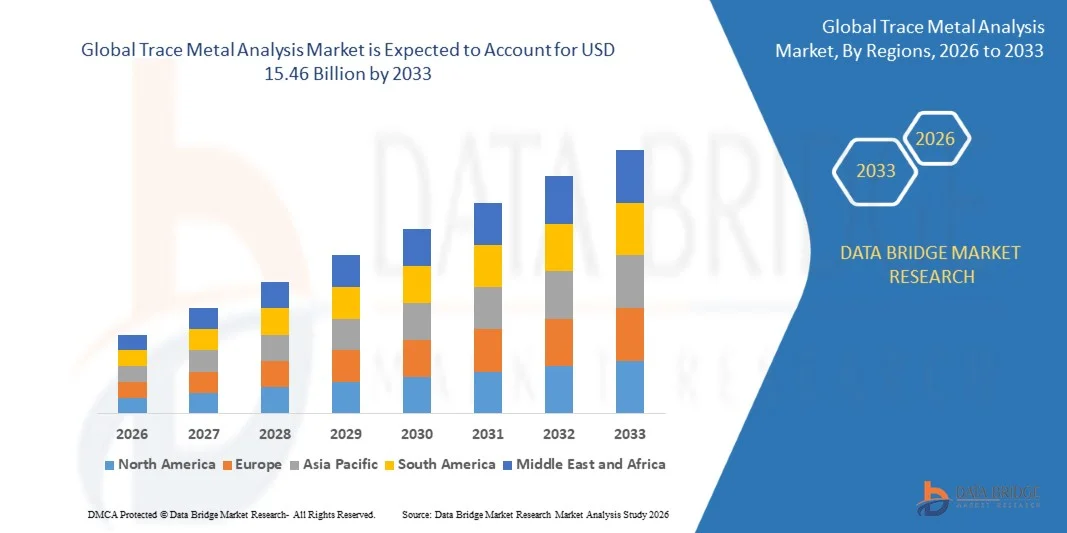
As per Data Bridge Market Research Analysis the trace metal analysis market was valued at USD 6.65 billion in 2025 and is projected to reach USD 15.46 billion by 2033, growing at a CAGR of 9.30% from 2026 to 2033. Trace metal analysis refers to the detection and quantification of low-level metal impurities and elemental contaminants in samples such as water, soil, food, pharmaceutical products, cosmetics, metals, semiconductors and biological materials.
The market is expanding due to stricter quality and safety regulations, rising awareness of food and environmental contamination, growth in pharmaceutical and biotechnology testing, and increasing adoption of advanced elemental analysis platforms such as ICP-MS, ICP-OES, AAS and XRF. Demand is also supported by the need for fast, accurate, multi-element analysis in contract testing laboratories, industrial quality control laboratories and research facilities.
Market Size and Forecast
- Global Market Value (2025): USD 6.14 Billion
- Expected Market Value (2033): USD 13.80 Billion
- Forecast CAGR (2025-2033): 9.42%
- Leading Region: North America
- Fastest-Growing Region: Asia-Pacific
Key Market Trends and Insights
- Asia-Pacific dominated the trace metal analysis market with the largest revenue share in 2025, primarily driven by rapid industrialization with expanding pharmaceutical, food-processing, semiconductor, mining, and electronics industries.
- North America trace metal analysis market is expected to witness the fastest growth rate from 2026 to 2033, supported by advanced laboratory infrastructure, major instrument manufacturers, strong pharmaceutical and biotechnology research, extensive contract-testing networks, and strict food, drinking-water, environmental, and industrial quality standards.
- The benchtop systems segment held the largest market revenue share of approximately 63.5% in 2025, driven by high sensitivity, better reproducibility, automated sample handling, multi-element capability, and widespread use in regulated testing laboratories, pharmaceutical companies, environmental facilities, semiconductor laboratories, and research institutes.
- The portable systems segment is projected to register the fastest growth at a CAGR of approximately 11.7% from 2026 to 2033, driven by increasing demand for on-site environmental screening, mining exploration, recycling inspection, alloy identification, emergency response, and rapid industrial quality checks.
- The environmental testing segment held the largest market revenue share of approximately 34.5% in 2025, driven by routine monitoring of drinking water, wastewater, soil, sludge, air particulates, industrial discharge, and contaminated sites for heavy metals and trace elemental pollutants.
- The pharmaceutical and biotechnology products testing segment is projected to register the fastest growth at a CAGR of approximately 11.3% from 2026 to 2033, driven by elemental impurity requirements for active ingredients, excipients, finished dosage forms, biologics, medical devices, process materials, and packaging components.
Report Scope and Trace Metal Analysis Market Segmentation
|
Attributes |
Trace Metal Analysis Key Market Insights |
|
Segments Covered |
|
|
Countries Covered |
North America
Europe
Asia-Pacific
Middle East and Africa
South America
|
|
Key Market Players |
|
|
Market Opportunities |
|
|
Value Added Data Infosets |
In addition to the market insights such as market value, growth rate, market segments, geographical coverage, market players, and market scenario, the market report curated by the Data Bridge Market Research team includes in-depth expert analysis, import/export analysis, pricing analysis, production consumption analysis, and pestle analysis. |
Trace Metal Market Trends
Trend: Rising Adoption Of High-Sensitivity, Automated, And Interference-Resistant ICP-MS Technologies
Growing demand for highly accurate elemental analysis, lower detection limits, and improved laboratory productivity is accelerating the adoption of advanced ICP-MS technologies across environmental, pharmaceutical, food, industrial, and contract-testing laboratories worldwide. Laboratories are increasingly moving beyond traditional single-element testing toward high-sensitivity multi-element analysis capable of detecting trace contaminants at extremely low concentrations. Advanced ICP-MS systems equipped with collision and reaction cell technologies, automated quality-control functions, and intelligent workflow management are improving analytical performance while reducing operator workload.
The expansion of environmental monitoring programs, stricter contaminant regulations, increasing sample volumes, and shortages of experienced laboratory personnel are creating sustained demand for automated and software-assisted analytical platforms. Instrument manufacturers continue introducing systems designed to simplify complex analytical workflows and improve throughput. For instance, in May 2026, Agilent Technologies introduced the 9500 Triple Quadrupole ICP-MS platform for environmental, food, pharmaceutical, specialty chemical, advanced materials, and contract-testing laboratories. The system was designed to simplify interference removal, improve productivity, reduce sample reruns, and streamline complex analytical methods. This development reflects growing industry investment in high-performance analytical instruments capable of delivering reliable results across demanding testing applications.
The increasing shift toward automated, high-sensitivity, and interference-resistant analytical workflows is expected to reinforce long-term demand for advanced trace metal analysis solutions, positioning instrument manufacturers to benefit from expanding regulatory testing requirements and growing laboratory automation initiatives.
Trace Metal Analysis Market Dynamics
Key Market Driver: Stringent Safety, Quality, And Environmental Regulations
The global trace metal analysis market continues to be driven by increasingly stringent regulations governing elemental contaminants in pharmaceuticals, food products, drinking water, cosmetics, medical devices, environmental samples, and industrial materials. Regulatory agencies and international standards organizations require laboratories to monitor contaminants such as lead, arsenic, cadmium, mercury, chromium, and nickel at extremely low concentrations to ensure consumer safety and environmental protection.
Government agencies continue strengthening contaminant monitoring requirements across multiple industries. For instance, in January 2025, the U.S. Food and Drug Administration (FDA) issued final guidance establishing action levels for lead in several categories of processed foods intended for babies and young children. The guidance reinforced the importance of highly sensitive and reliable trace metal testing throughout food production, regulatory surveillance, and quality assurance programs.
As governments continue expanding contaminant regulations, environmental monitoring programs, and impurity-control requirements, laboratories are expected to increase investment in advanced analytical technologies, supporting sustained demand for trace metal testing instruments, laboratory services, and regulatory compliance solutions.
Key Restraint/Challenge: High Operational Costs And Complex Sample Preparation Requirements
Trace metal analysis frequently requires extensive sample preparation procedures, including digestion, extraction, dilution, matrix matching, contamination control, calibration, and quality assurance processes before instrumental analysis can be performed. Complex matrices such as pharmaceuticals, industrial materials, geological samples, and high-salt environmental samples often require specialized digestion techniques and advanced interference-management strategies that increase analytical complexity and operating costs.
Laboratories must also manage ongoing expenses related to consumables, gases, reagents, reference standards, maintenance contracts, instrument servicing, and highly skilled personnel. Instrument manufacturers are responding by developing systems that reduce operational complexity and improve efficiency. For instance, Shimadzu positions its ICPMS-2040 and ICPMS-2050 Series with Mini-Torch technology, automated rinsing functions, and workflow automation features designed to reduce argon consumption, shorten measurement times, and minimize operator intervention while maintaining analytical performance.
Despite growing testing demand, high ownership costs and complex sample preparation requirements are expected to remain significant challenges, particularly for smaller laboratories with limited budgets and technical resources throughout the forecast period.
Key Market Opportunity: Expansion Of Outsourced Testing And Contract Laboratory Services
The increasing complexity of trace metal testing and the substantial investment required for advanced analytical instrumentation are creating significant opportunities for outsourced testing providers and contract laboratory networks. Pharmaceutical manufacturers, food producers, environmental organizations, mining companies, and industrial manufacturers increasingly rely on accredited third-party laboratories to obtain regulatory-compliant analytical results without maintaining costly in-house testing infrastructure.
Leading testing organizations continue expanding laboratory networks and analytical capabilities to address growing demand. For instance, in April 2025, SGS expanded its laboratory capabilities by strengthening high-precision analytical services for critical and rare-earth elements using advanced digestion and ICP-MS workflows. In addition, Bureau Veritas strengthened its minerals-testing portfolio through the acquisition of GeoAssay in Chile during 2025, reflecting continued investment in outsourced analytical services and laboratory network expansion.
As regulatory requirements become increasingly complex and testing volumes continue to grow, expanding use of outsourced analytical services, laboratory acquisitions, and specialized testing programs is expected to create substantial long-term growth opportunities for the global trace metal analysis market.
Trace Metal Analysis Market Scope
The market is segmented on the basis of type, application, and end user.
- By Type
On the basis of type, the market is divided into benchtop systems and portable systems. The benchtop systems segment held the largest market revenue share of approximately 63.5% in 2025, driven by high sensitivity, better reproducibility, automated sample handling, multi-element capability, and widespread use in regulated testing laboratories, pharmaceutical companies, environmental facilities, semiconductor laboratories, and research institutes.
The portable systems segment is projected to register the fastest growth at a CAGR of approximately 11.7% from 2026 to 2033, driven by increasing demand for on-site environmental screening, mining exploration, recycling inspection, alloy identification, emergency response, and rapid industrial quality checks.
- By Application
On the basis of application, the market is divided into environmental testing, food and beverage testing, pharmaceutical and biotechnology products testing, mining and metallurgy, semiconductor and electronics testing, industrial quality control, and research and academic testing. The environmental testing segment held the largest market revenue share of approximately 34.5% in 2025, driven by routine monitoring of drinking water, wastewater, soil, sludge, air particulates, industrial discharge, and contaminated sites for heavy metals and trace elemental pollutants.
The pharmaceutical and biotechnology products testing segment is projected to register the fastest growth at a CAGR of approximately 11.3% from 2026 to 2033, driven by elemental impurity requirements for active ingredients, excipients, finished dosage forms, biologics, medical devices, process materials, and packaging components.
- By End User
On the basis of end user, the market is divided into testing laboratories, pharmaceutical and biotechnology companies, food and beverage companies, environmental agencies, mining and metal processing companies, semiconductor manufacturers, and academic and research institutes. The testing laboratories segment held the largest market revenue share of approximately 41.5% in 2025, driven by multi-industry demand for accredited testing, validated methods, independent results, rapid turnaround, specialized analysts, and access to high-cost instrumentation without direct capital investment.
The pharmaceutical and biotechnology companies segment is projected to register the fastest growth at a CAGR of approximately 11.3% from 2026 to 2033, driven by expanding drug development, biologics manufacturing, raw-material qualification, process monitoring, release testing, and risk-based control of elemental impurities.
Trace Metal Analysis Market Regional Analysis
Asia-Pacific Trace Metal Analysis Market Insight
Asia-Pacific dominated the trace metal analysis market with the largest revenue share in 2025, primarily driven by rapid industrialization with expanding pharmaceutical, food-processing, semiconductor, mining, and electronics industries. China, India, Japan, and South Korea are investing in analytical laboratories, environmental monitoring, export-quality testing, and high-purity manufacturing. Demand is also rising for water and soil surveillance, critical-mineral characterization, pharmaceutical impurity control, and semiconductor-grade materials analysis. These factors are expected to support strong adoption of ICP-MS, ICP-OES, XRF, and contract laboratory services through 2033.
China Trace Metal Analysis Market Insight
China dominated the trace metal analysis market with the largest revenue share in 2025 is a major trace metal analysis market due to its large manufacturing base, pharmaceutical production, electronics and semiconductor supply chains, mining activity, food exports, and environmental monitoring programs. Laboratories use elemental analysis for industrial quality control, wastewater compliance, high-purity materials, agricultural products, and export certification. The country is also expected to record one of the strongest national growth rates as domestic laboratories upgrade from basic screening to higher-sensitivity multi-element platforms. Continued investment in advanced manufacturing and pollution control will support demand for automated ICP-MS workflows and outsourced testing services.
Japan Trace Metal Analysis Market Insight
Japan is expected to witness the fastest growth rate from 2026 to 2033, has a mature analytical-instrument ecosystem supported by advanced electronics, automotive, pharmaceutical, materials, food, and environmental industries. National drinking-water quality requirements and routine safety monitoring create recurring demand for low-level elemental testing. Government support for semiconductor investment and high-purity production also increases the importance of contamination control because trace metals can affect device performance and yield. Domestic instrument expertise and strong laboratory quality systems are expected to sustain adoption of high-sensitivity ICP-MS, ICP-OES, and automated sample-preparation solutions.
North America Trace Metal Analysis Market Insight
North America trace metal analysis market is expected to witness the fastest growth rate from 2026 to 2033, supported by advanced laboratory infrastructure, major instrument manufacturers, strong pharmaceutical and biotechnology research, extensive contract-testing networks, and strict food, drinking-water, environmental, and industrial quality standards. Trace metal testing is widely used in drug development, public-water monitoring, food surveillance, semiconductor manufacturing, mining, and academic research. High adoption of automated ICP-MS and triple-quadrupole systems is expected to help the region maintain its leading revenue position.
U.S. Trace Metal Analysis Market Insight
The U.S. is expected to witness the fastest growth rate from 2026 to 2033, supported by EPA analytical methods, FDA food-safety programs, pharmaceutical elemental-impurity requirements, semiconductor investment, and a large network of commercial laboratories. The 2025 FDA action-level guidance for lead in processed foods for babies and young children increased attention to reliable low-level measurement and supply-chain verification. Environmental laboratories also use standardized ICP-MS procedures for water and waste testing. These regulatory and industrial requirements continue to create demand for validated instruments, reference materials, skilled analysts, and outsourced testing capacity.
Europe Trace Metal Analysis Market Insight
Europe is expected to witness the fastest growth rate from 2026 to 2033 supported by pharmaceutical manufacturing, food-safety systems, environmental surveillance, industrial materials testing, and accredited laboratory networks. The revised EU Drinking Water Directive strengthens risk-based water-quality management and includes chemical parameters that require reliable monitoring. Pharmaceutical laboratories also follow ICH elemental-impurity principles, while electronics, automotive, and specialty-material producers require high-purity testing. Demand is therefore shifting toward automated methods, lower reporting limits, and contract services capable of supporting cross-border regulatory documentation.
Germany Trace Metal Analysis Market Insight
Germany is expected to witness the fastest growth rate from 2026 to 2033 because of its pharmaceutical, chemical, automotive, engineering, food, environmental, and advanced-material industries. The updated German Drinking Water Ordinance introduced stronger quality protections and lower limits for selected contaminants, including chromium, arsenic, and lead, reinforcing the need for sensitive elemental analysis. Food-risk assessment and industrial quality control also support regular testing of metals in raw materials and finished products. Germany’s strong laboratory and manufacturing base is expected to sustain demand for high-throughput ICP-MS and specialized analytical services.
U.K. Trace Metal Analysis Market Insight
The U.K. market is expected to witness the fastest growth rate from 2026 to 2033 supported by pharmaceutical research, universities, food-safety surveillance, environmental testing, specialty chemicals, and commercial analytical laboratories. The Food Standards Agency monitors heavy metals as chemical contaminants and conducts retail surveillance sampling across food categories. Water, soil, waste, medical-product, and industrial testing further expand the addressable market. Continued emphasis on accredited results, supply-chain assurance, and advanced life-science research is expected to support demand for sensitive elemental analysis and independent contract-testing services.
Trace Metal Analysis Market Share
The trace metal market is primarily led by well-established companies, including:
- Thermo Fisher Scientific (U.S.)
- Agilent Technologies (U.S.)
- Shimadzu Corporation (Japan)
- Bruker Corporation (U.S.)
- PerkinElmer (U.S.)
- Analytik Jena (Germany)
- LGC Limited (U.K.)
- Intertek Group (U.K.)
- Eurofins Scientific (Luxembourg)
- SGS S.A. (Switzerland)
- Bureau Veritas (France)
- TÜV SÜD (Germany)
- Rigaku Corporation (Japan)
- Hitachi High-Tech (Japan)
- HORIBA (Japan)
- AMETEK SPECTRO (Germany)
Latest Developments in Trace Metal Analysis Market
- In May 2026, Agilent Technologies unveiled the Agilent 9500 triple-quadrupole ICP-MS system. The platform was designed to improve productivity, simplify advanced interference removal, reduce reruns, and support environmental, food, pharmaceutical, specialty chemical, advanced-material, and contract-testing applications.
- In January 2025, Thermo Fisher Scientific reported that it had launched the Thermo Scientific iCAP MX Series ICP-MS platform during the fourth quarter of 2024. The system was introduced to streamline trace elemental analysis and strengthen laboratory productivity across environmental, food, industrial, and research workflows.

- Interactive Data Analysis Dashboard
- Company Analysis Dashboard for high growth potential opportunities
- Research Analyst Access for customization & queries
- Competitor Analysis with Interactive dashboard
- Latest News, Updates & Trend analysis
- Harness the Power of Benchmark Analysis for Comprehensive Competitor Tracking
Data collection and base year analysis are done using data collection modules with large sample sizes. The stage includes obtaining market information or related data through various sources and strategies. It includes examining and planning all the data acquired from the past in advance. It likewise envelops the examination of information inconsistencies seen across different information sources. The market data is analysed and estimated using market statistical and coherent models. Also, market share analysis and key trend analysis are the major success factors in the market report. To know more, please request an analyst call or drop down your inquiry.
The key research methodology used by DBMR research team is data triangulation which involves data mining, analysis of the impact of data variables on the market and primary (industry expert) validation. Data models include Vendor Positioning Grid, Market Time Line Analysis, Market Overview and Guide, Company Positioning Grid, Patent Analysis, Pricing Analysis, Company Market Share Analysis, Standards of Measurement, Global versus Regional and Vendor Share Analysis. To know more about the research methodology, drop in an inquiry to speak to our industry experts.
Data Bridge Market Research is a leader in advanced formative research. We take pride in servicing our existing and new customers with data and analysis that match and suits their goal. The report can be customized to include price trend analysis of target brands understanding the market for additional countries (ask for the list of countries), clinical trial results data, literature review, refurbished market and product base analysis. Market analysis of target competitors can be analyzed from technology-based analysis to market portfolio strategies. We can add as many competitors that you require data about in the format and data style you are looking for. Our team of analysts can also provide you data in crude raw excel files pivot tables (Fact book) or can assist you in creating presentations from the data sets available in the report.













