


What is the Traction Motor Market Size and Growth Rate?
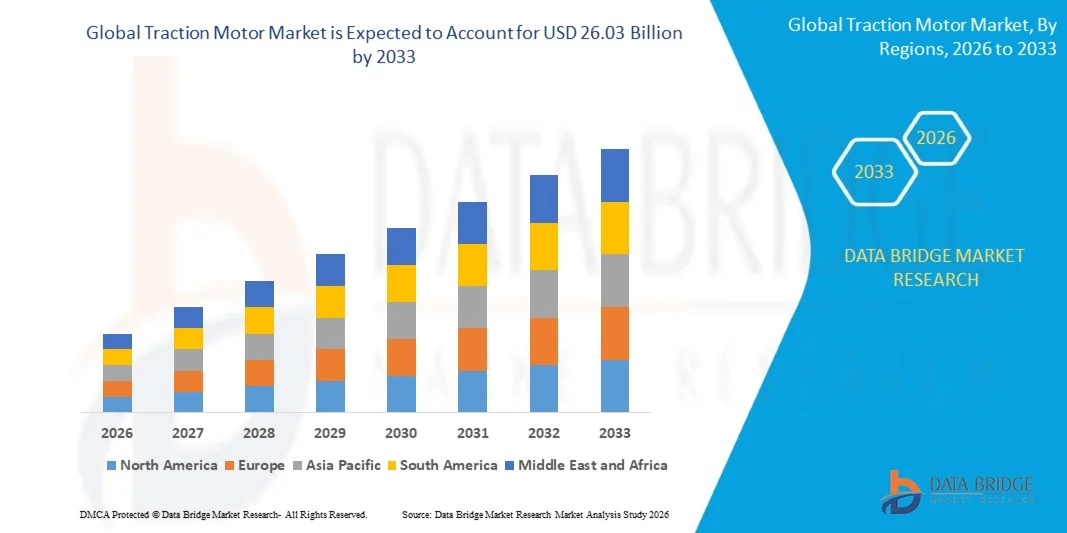
- As per Data Bridge Market Research analysis the traction motor market was valued at USD 15.73 billion in 2025 and is projected to reach USD 26.03 billion by 2033, growing at a CAGR of 6.50% from 2026 to 2033.
- The market is experiencing steady growth driven by the increasing adoption of electric and hybrid vehicles, expanding investments in railway electrification, and rising demand for energy-efficient propulsion systems across transportation and industrial applications.
- Growing government initiatives to reduce carbon emissions, advancements in permanent magnet and A.C. induction motor technologies, and the rapid expansion of electric mobility and industrial automation are accelerating demand for high-performance traction motors across passenger vehicles, commercial vehicles, rail transport, construction equipment, elevators, escalators, and other end-use applications.
Market Size & Forecast
- Market Value (2025): USD 15.73 Billion
- Expected Market Value (2033): USD 26.03 Billion
- Forecast CAGR (2026–2033): 6.50%
- Leading Region in 2025: North America
- Fastest Growing Region: Asia-Pacific
What are the Major Takeaways of the Traction Motor Market?
- North America dominated the traction motor market with the largest revenue share of more than 45% in 2025, supported by the rapid adoption of electric vehicles, extensive investments in railway electrification, and the presence of leading automotive and industrial motor manufacturers.
- The Asia-Pacific traction motor market is expected to witness the fastest growth rate from 2026 to 2033, supported by rapid industrialization, expanding electric vehicle production, and significant investments in railway electrification across China, Japan, India, and South Korea.
- The A.C. induction motor segment held the largest market revenue share of approximately 69.5% in 2025 driven by its cost-effectiveness, robust construction, and widespread deployment across electric railways, metro systems, industrial equipment, and electric vehicles. These motors offer high reliability, low maintenance requirements, and strong performance under demanding operating conditions.
- The permanent magnet motor segment is expected to witness the fastest growth at a CAGR of 10.9% from 2026 to 2033 driven by increasing adoption in battery electric vehicles, demand for higher power density, improved energy efficiency, and continuous advancements in rare-earth magnet technologies.
- The passenger cars segment held the largest market revenue share of approximately 59.5% in 2025 driven by the rapid production of electric passenger vehicles, favorable government incentives, growing consumer preference for zero-emission mobility, and expanding charging infrastructure worldwide
- The commercial vehicles segment is expected to witness the fastest growth during the forecast period from 2026 to 2033 driven by increasing electrification of buses, trucks, and delivery fleets, along with stringent emission regulations and investments in sustainable public transportation.
Report Scope and Traction Motor Market Segmentation
|
Attributes |
Traction Motor Key Market Insights |
|
Segments Covered |
|
|
Countries Covered |
North America
Europe
Asia-Pacific
Middle East and Africa
South America
|
|
Key Market Players |
|
|
Market Opportunities |
|
|
Value Added Data Infosets |
In addition to the insights on market scenarios such as market value, growth rate, segmentation, geographical coverage, and major players, the market reports curated by the Data Bridge Market Research also include in-depth expert analysis, geographically represented company-wise production and capacity, network layouts of distributors and partners, detailed and updated price trend analysis and deficit analysis of supply chain and demand. |
What is the Key Trend in the Traction Motor Market?
- Permanent magnet traction motors are increasingly being adopted across electric vehicles, rail transportation, and industrial mobility applications due to their higher power density, improved energy efficiency, and compact design compared to conventional motor technologies.
- For instance, in September 2024, Hitachi Industrial Products commercialized the world's first copper die-cast rotor for railway traction motors, delivering a lighter and more energy-efficient traction motor that supports carbon neutrality and next-generation railway systems.
- Manufacturers are increasingly focusing on lightweight motor architectures, high-efficiency electromagnetic designs, and advanced cooling technologies to improve vehicle range, reduce energy consumption, and enhance overall drivetrain performance.
- For instance, in February 2025, BorgWarner secured four new electric motor projects with three major Chinese OEMs for its high-voltage hairpin eMotor technology, supporting next-generation hybrid and battery electric vehicle platforms with production beginning from 2025 onward.
- As governments and automotive manufacturers continue to accelerate vehicle electrification and energy-efficient transportation, demand for high-performance traction motors is expected to grow significantly, reinforcing their role as a critical component of electric mobility and sustainable transportation systems.
What are the Key Drivers of the Traction Motor Market?
- The rapid global adoption of battery electric vehicles (BEVs), hybrid electric vehicles (HEVs), and electrified rail networks is significantly increasing demand for high-efficiency traction motors capable of delivering greater torque, improved power density, and enhanced energy efficiency.
- For instance, in October 2024, Nidec Corporation announced the development of its E-Axle system integrating high-efficiency traction motors for next-generation electric vehicles, supporting automakers in improving drivetrain efficiency while reducing system size and weight.
- Governments worldwide are promoting zero-emission transportation through stricter emission regulations, EV incentives, and investments in electrified public transport and railway modernization, creating sustained demand for advanced traction motor systems.
- For instance, in May 2024, ABB launched its AMXE250 motor platform for electric buses, designed to deliver higher power density and efficiency while helping commercial vehicle manufacturers accelerate the transition toward zero-emission transportation.
- With continuous advancements in motor efficiency, lightweight materials, and electric drivetrain technologies, traction motors will remain a fundamental component supporting the expansion of electric mobility and industrial electrification.
Which Factors are Challenging the Growth of the Traction Motor Market?
- Traction motor manufacturers continue to face challenges associated with the supply and price volatility of rare earth materials such as neodymium and dysprosium, which are widely used in permanent magnet motors.
- Supply chain disruptions and geopolitical uncertainties have increased concerns regarding the long-term availability of critical raw materials, encouraging manufacturers to explore alternative motor technologies and diversified sourcing strategies.
- For instance, in December 2025, Hitachi established a permanent magnet motor recycling network for elevator traction machines to recover and reuse rare earth magnets, highlighting the industry's growing focus on addressing material supply risks through circular economy initiatives.
- The dependence on critical minerals, combined with fluctuating raw material prices and complex manufacturing processes, continues to increase production costs for traction motors, posing challenges for manufacturers seeking to balance performance, affordability, and supply chain resilience.
How is the Traction Motor Market Segmented?
The market is segmented on the basis of type, vehicle type, application, and end user.
- By Type
On the basis of type, the traction motor market is segmented into A.C. induction motors, permanent magnet motors, and others. The A.C. induction motor segment accounted for the largest market revenue share of approximately 69.5% in 2025. The segment's dominance is primarily attributed to the cost-effectiveness, robust construction, operational reliability, and relatively simple maintenance requirements of A.C. induction motors. These motors are widely deployed across electric railways, metro and light rail systems, industrial machinery, and electric vehicles, where consistent performance and durability are critical. In addition, their ability to operate effectively under demanding environmental and load conditions makes them suitable for applications requiring high reliability and continuous operation. The absence of permanent magnets also reduces exposure to fluctuations in rare-earth material prices, supporting their adoption in cost-sensitive applications. The established manufacturing ecosystem and extensive industry experience with A.C. induction motor technology further contribute to its widespread use across transportation and industrial applications.
The permanent magnet motor segment is expected to register the fastest growth, with a CAGR of 10.9% from 2026 to 2033. This growth is driven by the increasing adoption of permanent magnet motors in battery electric vehicles (BEVs), where high efficiency, compact design, and superior power density are essential for extending driving range and improving overall vehicle performance. Permanent magnet motors offer high torque density and improved energy efficiency compared with several conventional motor technologies, making them increasingly attractive for next-generation electric mobility applications. Furthermore, continuous technological advancements in magnet materials, motor design, thermal management, and power electronics are improving motor performance and reducing efficiency losses. The increasing focus of automotive manufacturers on downsizing, lightweight vehicle architectures, and higher-performance electric drivetrains is also expected to accelerate the adoption of permanent magnet motors during the forecast period.
- By Vehicle Type
On the basis of vehicle type, the traction motor market is segmented into passenger cars, commercial vehicles, and others. The passenger cars segment held the largest market revenue share of approximately 59.5% in 2025, supported by the rapid expansion of electric passenger vehicle production and sales worldwide. Growing consumer awareness of environmental sustainability, favorable government incentives for electric vehicle adoption, stricter vehicle emission standards, and increasing investments in public and private charging infrastructure are contributing to the segment's growth. Automotive manufacturers are also expanding their electric vehicle portfolios across multiple price categories, making electric passenger cars increasingly accessible to a broader consumer base. In addition, improvements in battery technology, driving range, charging capabilities, and vehicle performance are encouraging consumers to transition from conventional internal combustion engine vehicles to electric and hybrid alternatives. These factors are expected to sustain the dominant position of passenger cars in the traction motor market.
The commercial vehicles segment is expected to witness the fastest growth during the forecast period from 2026 to 2033. The growth of this segment is driven by the increasing electrification of buses, trucks, delivery vans, and other commercial fleets, particularly in urban logistics and public transportation. Fleet operators are increasingly adopting electric commercial vehicles to reduce fuel and operating costs, lower maintenance requirements, and comply with increasingly stringent emissions regulations. The expansion of electric bus networks, last-mile delivery operations, and urban freight transportation is creating additional demand for high-performance traction motors capable of supporting heavy loads and frequent operation. Furthermore, government initiatives promoting zero-emission public transportation and investments in sustainable mobility infrastructure are encouraging the deployment of electric commercial vehicles. As battery technology improves and charging infrastructure expands, the commercial vehicle segment is expected to experience strong traction motor demand throughout the forecast period.
- By Application
On the basis of application, the traction motor market is segmented into transportation, industrial machinery and equipment, and others. The transportation segment accounted for the largest market revenue share of approximately 59.2% in 2025. The segment's dominance is primarily supported by the widespread use of traction motors in electric vehicles, railway locomotives, metro systems, light rail networks, electric buses, and other electrified transportation systems. Governments and transportation authorities worldwide are increasing investments in railway modernization, urban transit systems, and sustainable mobility infrastructure to reduce dependence on fossil fuels and limit transportation-related emissions. The growing adoption of electric and hybrid vehicles, combined with the expansion of rail-based public transportation and urban mass transit networks, is generating significant demand for reliable and efficient traction motor systems. In addition, the modernization of aging railway infrastructure and the development of high-speed and electrified rail networks are expected to further reinforce the transportation segment's leading position.
The industrial machinery and equipment segment is expected to witness the fastest growth from 2026 to 2033. This growth is being driven by the increasing adoption of industrial automation, electrification of heavy machinery, and the growing emphasis on energy efficiency across manufacturing, mining, construction, logistics, and material handling operations. Industrial operators are increasingly replacing conventional drive systems with advanced electric motor technologies to improve operational efficiency, reduce energy consumption, and meet sustainability objectives. Traction motors are gaining importance in applications such as automated guided vehicles, electric forklifts, mining equipment, cranes, and other electrically powered industrial machinery that require high torque and precise speed control. The expansion of smart factories and Industry 4.0 technologies is further encouraging the integration of advanced motor systems with digital controls and automation platforms, supporting strong growth opportunities for traction motors in industrial applications.
- By End User
On the basis of end user, the traction motor market is segmented into hybrid vehicles, compact construction equipment, escalators, elevators, and others. The hybrid vehicles segment held the largest market revenue share of approximately 41.5% in 2025. The segment's leading position is attributed to the rising production and adoption of hybrid electric vehicles (HEVs), which use electric traction motors in combination with internal combustion engines to improve fuel efficiency and reduce emissions. Increasing fuel economy requirements, stringent global emission standards, and growing consumer demand for vehicles that offer lower operating costs are encouraging automakers to expand their hybrid vehicle portfolios. In addition, regenerative braking technology enables hybrid vehicles to recover and reuse energy during deceleration, improving overall vehicle efficiency and increasing the importance of traction motors within hybrid powertrains. Continued investments by automotive manufacturers in hybrid propulsion systems, particularly in markets where charging infrastructure for fully electric vehicles remains under development, are expected to support sustained demand for traction motors in hybrid vehicles.
The escalators segment is expected to register the fastest growth during the forecast period from 2026 to 2033. This growth is driven by rapid urbanization, expanding commercial and residential infrastructure, and increasing investments in airports, railway stations, metro systems, shopping centers, and other high-traffic public facilities. As cities become more densely populated, the demand for efficient and reliable vertical transportation systems is increasing, particularly in large commercial and public infrastructure projects. Energy-efficient traction motor systems are gaining importance in escalators as building operators and infrastructure developers seek to reduce electricity consumption and lower long-term operating costs. Technological advancements in motor control systems, variable-frequency drives, and regenerative technologies are further improving the energy efficiency and operational performance of modern escalators. In addition, the expansion of metro and airport infrastructure in emerging economies is expected to create new opportunities for traction motor manufacturers, supporting strong growth in the escalator segment through 2033.
Which Region Holds the Largest Share of the Traction Motor Market?
North America Traction Motor Market Insight
- North America dominated the traction motor market with the largest revenue share of more than 45% in 2025, supported by the rapid adoption of electric vehicles, extensive investments in railway electrification, and the presence of leading automotive and industrial motor manufacturers.
- The region continues to benefit from stringent emission regulations, favorable government incentives for zero-emission transportation, and increasing deployment of traction motors across passenger vehicles, commercial vehicles, rail systems, and industrial applications. Growing investments in advanced electric drivetrain technologies and charging infrastructure further reinforce North America's leadership in the global traction motor market.
U.S. Traction Motor Market Insight
The U.S. traction motor market captured the largest revenue share in 2025 within North America, fueled by the accelerating production of battery electric vehicles (BEVs), hybrid electric vehicles (HEVs), and electric commercial vehicles. Automotive manufacturers are increasingly investing in high-efficiency electric propulsion systems to comply with stringent fuel economy and emission standards. Moreover, expanding investments in rail modernization, industrial automation, and domestic EV manufacturing, supported by government initiatives, continue to drive demand for advanced traction motor technologies across multiple end-use industries.
Europe Traction Motor Market Insight
The Europe traction motor market is expected to witness the fastest growth rate from 2026 to 2033, primarily driven by ambitious carbon neutrality targets, stringent vehicle emission regulations, and increasing investments in electric mobility and sustainable transportation infrastructure. The growing adoption of battery electric vehicles, electrified railways, and energy-efficient industrial machinery is accelerating demand for high-performance traction motors. In addition, continuous technological advancements in permanent magnet motors and electric drivetrains are supporting market expansion across the region.
U.K. Traction Motor Market Insight
The U.K. traction motor market is expected to witness the fastest growth rate from 2026 to 2033, driven by the country's transition toward zero-emission transportation and increasing investments in electric vehicle manufacturing and charging infrastructure. Government policies promoting EV adoption, together with the electrification of public transport and commercial vehicle fleets, are encouraging the deployment of advanced traction motor systems. Growing research and development activities in electric propulsion technologies are also expected to contribute to sustained market growth.
Germany Traction Motor Market Insight
The Germany traction motor market is expected to witness the fastest growth rate from 2026 to 2033, fueled by its strong automotive manufacturing base and leadership in electric vehicle innovation. The country's major automotive OEMs are investing heavily in next-generation electric drivetrains, high-efficiency traction motors, and sustainable mobility solutions. Furthermore, Germany's focus on industrial automation, railway modernization, and advanced manufacturing technologies continues to support the widespread adoption of traction motors across transportation and industrial sectors.
Asia-Pacific Traction Motor Market Insight
The Asia-Pacific traction motor market is expected to witness the fastest growth rate from 2026 to 2033, supported by rapid industrialization, expanding electric vehicle production, and significant investments in railway electrification across China, Japan, India, and South Korea. Favorable government policies promoting clean transportation, increasing battery manufacturing capacity, and the presence of major traction motor manufacturers are accelerating market growth. Additionally, the region's expanding automotive manufacturing ecosystem and rising demand for energy-efficient mobility solutions continue to strengthen its position in the global market.
Japan Traction Motor Market Insight
The Japan traction motor market is expected to witness the fastest growth rate from 2026 to 2033 due to the country's leadership in hybrid and electric vehicle technologies and its continuous focus on innovation in electric propulsion systems. Japanese manufacturers are investing in lightweight, high-efficiency permanent magnet motors and integrated electric drive units to improve vehicle performance and energy efficiency. Furthermore, the modernization of railway infrastructure and advancements in industrial automation are expected to support long-term market expansion.
China Traction Motor Market Insight
The China traction motor market accounted for the largest market revenue share in Asia Pacific in 2025, attributed to the country's position as the world's largest producer and consumer of electric vehicles. Strong government support for new energy vehicles, extensive investments in battery manufacturing, railway electrification, and domestic automotive production continue to drive demand for traction motors. Additionally, the presence of leading electric vehicle manufacturers and a well-established supply chain for electric powertrain components further strengthens China's dominance in the regional traction motor market.
Which are the Top Companies in Traction Motor Market?
The traction motor industry is primarily led by well-established companies, including:
- ABB Ltd. (Switzerland)
- Siemens AG (Germany)
- Nidec Corporation (Japan)
- Toshiba Corporation (Japan)
- Mitsubishi Electric Corporation (Japan)
- Hitachi, Ltd. (Japan)
- WEG S.A. (Brazil)
- Dana Incorporated (U.S.)
- BorgWarner Inc. (U.S.)
- ZF Friedrichshafen AG (Germany)
- Cummins Inc. (U.S.)
- Robert Bosch GmbH (Germany)
- Schaeffler AG (Germany)
- Mahle GmbH (Germany)
- Parker Hannifin Corporation (U.S.)
What are Latest Developments in Traction Motor Market?
- In June 2024, Siemens AG announced a new high-efficiency traction motor for railway applications, designed to reduce energy consumption by up to 10% while improving operational reliability and lowering maintenance requirements. The innovation supports sustainable rail transportation by enhancing overall system efficiency, reducing operating costs, and helping railway operators achieve their decarbonization goals.
- In April 2024, Toshiba Corporation introduced an advanced permanent magnet traction motor featuring integrated AI-based diagnostics for predictive maintenance. The new motor enables real-time performance monitoring, improves operational efficiency, extends equipment lifespan, minimizes unplanned downtime, and supports the growing demand for intelligent electric mobility and industrial transportation systems.
- In July 2021, Mercedes-Benz announced the acquisition of YASA Motors Ltd., a leading developer of high-performance axial-flux electric motor technology, to strengthen its electric mobility strategy. Under the agreement, YASA became a wholly owned subsidiary of Mercedes-Benz while continuing to advance next-generation electric drive technologies. The acquisition enables Mercedes-Benz to accelerate the development of compact, lightweight, and high-efficiency traction motors for future electric vehicles, enhancing vehicle performance, driving range, and overall drivetrain efficiency.

- Interactive Data Analysis Dashboard
- Company Analysis Dashboard for high growth potential opportunities
- Research Analyst Access for customization & queries
- Competitor Analysis with Interactive dashboard
- Latest News, Updates & Trend analysis
- Harness the Power of Benchmark Analysis for Comprehensive Competitor Tracking
Global Traction Motor Market, Supply Chain Analysis and Ecosystem Framework
To support market growth and help clients navigate the impact of geopolitical shifts, DBMR has integrated in-depth supply chain analysis into its Global Traction Motor Market research reports. This addition empowers clients to respond effectively to global changes affecting their industries. The supply chain analysis section includes detailed insights such as Global Traction Motor Market consumption and production by country, price trend analysis, the impact of tariffs and geopolitical developments, and import and export trends by country and HSN code. It also highlights major suppliers with data on production capacity and company profiles, as well as key importers and exporters. In addition to research, DBMR offers specialized supply chain consulting services backed by over a decade of experience, providing solutions like supplier discovery, supplier risk assessment, price trend analysis, impact evaluation of inflation and trade route changes, and comprehensive market trend analysis.
Data collection and base year analysis are done using data collection modules with large sample sizes. The stage includes obtaining market information or related data through various sources and strategies. It includes examining and planning all the data acquired from the past in advance. It likewise envelops the examination of information inconsistencies seen across different information sources. The market data is analysed and estimated using market statistical and coherent models. Also, market share analysis and key trend analysis are the major success factors in the market report. To know more, please request an analyst call or drop down your inquiry.
The key research methodology used by DBMR research team is data triangulation which involves data mining, analysis of the impact of data variables on the market and primary (industry expert) validation. Data models include Vendor Positioning Grid, Market Time Line Analysis, Market Overview and Guide, Company Positioning Grid, Patent Analysis, Pricing Analysis, Company Market Share Analysis, Standards of Measurement, Global versus Regional and Vendor Share Analysis. To know more about the research methodology, drop in an inquiry to speak to our industry experts.
Data Bridge Market Research is a leader in advanced formative research. We take pride in servicing our existing and new customers with data and analysis that match and suits their goal. The report can be customized to include price trend analysis of target brands understanding the market for additional countries (ask for the list of countries), clinical trial results data, literature review, refurbished market and product base analysis. Market analysis of target competitors can be analyzed from technology-based analysis to market portfolio strategies. We can add as many competitors that you require data about in the format and data style you are looking for. Our team of analysts can also provide you data in crude raw excel files pivot tables (Fact book) or can assist you in creating presentations from the data sets available in the report.













