Tractor Implements Market Overview
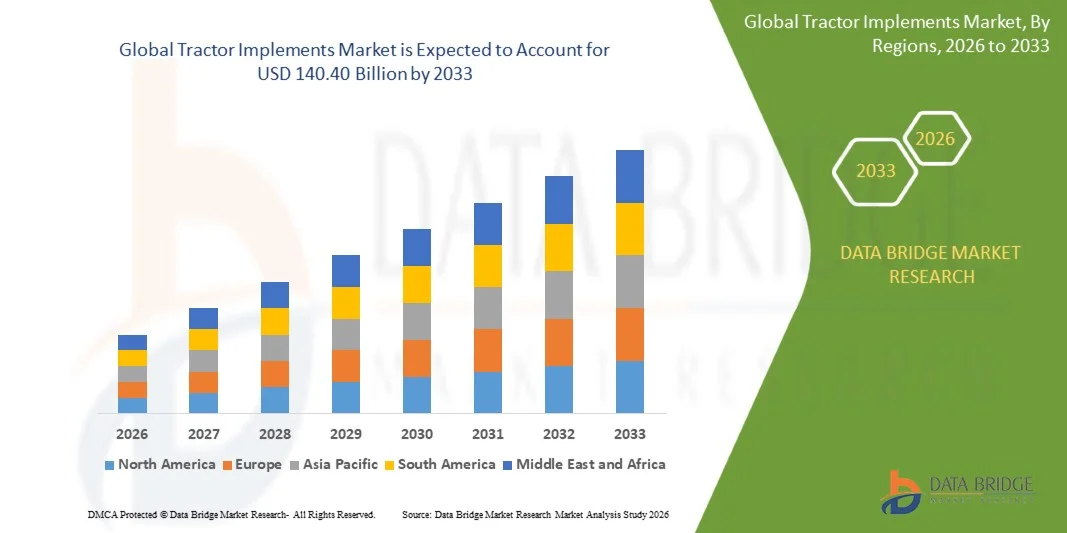
As per Data Bridge Market Research analysis, the tractor implements market was valued at USD 85.48 billion in 2025 and is projected to reach USD 140.40 billion by 2033, growing at a CAGR of 6.4% from 2026 to 2033. The market is experiencing consistent growth driven by increasing agricultural mechanization, rising adoption of advanced farming equipment, growing demand for improved farm productivity, and the need for efficient agricultural operations. Tractor implements, including tillage, irrigation and crop protection, sowing and planting, and harvesting equipment, are witnessing higher adoption as farmers seek to enhance operational efficiency and reduce manual labor dependency.
The increasing demand for higher crop yields, expansion of commercial farming activities, and government initiatives supporting agricultural modernization are encouraging farmers and agricultural enterprises to invest in tractor-mounted equipment. The integration of advanced technologies, including precision farming solutions, automation, and smart agricultural machinery, is further transforming the tractor implements landscape. These implements provide cost-effective, efficient, and versatile solutions for various farming activities, supporting sustainable agricultural practices and improving overall farm productivity.
Market Size & Forecast
- Global Market Value (2025): USD 85.48 Billion
- Expected Market Value (2033): USD 140.40 Billion
- Forecast CAGR (2026–2033): 6.4%
- Leading Region in 2025: Asia-Pacific
- Fastest Growing Region: North America
Key Market Trends & Insights
- Asia-Pacific dominated the tractor implements market with the largest revenue share of 42.5% in 2025, supported by increasing agricultural mechanization, expanding farming activities, government initiatives promoting modern agricultural equipment, and rising adoption of tractor-mounted implements across China, India, and Southeast Asian countries
- The tillage segment led the market with a 35.40% share in 2025, driven by the extensive adoption of plows, cultivators, harrows, and other soil preparation equipment used in primary and secondary tillage operations
- North America is expected to be the fastest-growing region at a CAGR of 6.8% from 2026 to 2033, fueled by increasing adoption of precision agriculture technologies, replacement of traditional equipment, and rising demand for advanced mechanized farming solutions
- Sowing and planting are the fastest-growing phase type, projected to register a CAGR of 7.5%, reflecting the surge in adoption of precision farming technologies and the rising need for accurate seed placement and improved crop establishment
- The powered segment dominated the power category with a 55.60% revenue share in 2025, led by increasing demand for efficient agricultural equipment capable of performing complex farming operations with higher productivity
- 4-wheel drive accounted for 60.65% of the market, preferred by increasing adoption of high-powered tractors for large-scale farming operations and heavy-duty agricultural applications
- The 2-wheel drive segment is the fastest-growing drive category, with a CAGR of 5.0%, driven by increasing adoption among small and medium-sized farms due to affordability, lower maintenance costs, and ease of operation.
Report Scope and Tractor Implements Market Segmentation
|
Attributes |
Tractor Implements Key Market Insights |
|
Segments Covered |
|
|
Countries Covered |
North America
Europe
Asia-Pacific
Middle East and Africa
South America
|
|
Key Market Players |
|
|
Market Opportunities |
|
|
Value Added Data Infosets |
In addition to the insights on market scenarios such as market value, growth rate, segmentation, geographical coverage, and major players, the market reports curated by the Data Bridge Market Research also include import export analysis, production capacity overview, production consumption analysis, price trend analysis, climate change scenario, supply chain analysis, value chain analysis, raw material/consumables overview, vendor selection criteria, PESTLE Analysis, Porter Analysis, and regulatory framework. |
Tractor Implements Market Trends
Trend: Rising Adoption of Smart and Precision Agriculture Implements
Farmers and agricultural enterprises are increasingly adopting smart tractor implements integrated with GPS, IoT, automation, and precision farming technologies to improve operational efficiency, optimize input utilization, and enhance crop productivity. Advanced implements equipped with sensors and digital control systems enable accurate field operations, reduce resource wastage, and support data-driven farming practices. The growing shift toward sustainable agriculture and mechanized farming is accelerating the adoption of technologically advanced tractor attachments across developed and emerging agricultural markets. For instance, in February 2025, John Deere announced the launch of its Precision Essentials hardware kit, including G5/G5Plus displays, StarFire 7500 receivers, and JDLink modems, designed to reduce upfront costs and improve access to precision agriculture technologies, machine automation, and farm data management.
The increasing integration of digital technologies into agricultural machinery is creating new growth opportunities for tractor implements manufacturers by enabling efficient, precise, and sustainable farming operations.
Tractor Implements Market Dynamics
Key Market Driver: Increasing Agricultural Mechanization and Demand for Higher Farm Productivity
The rising need to improve agricultural output, reduce dependence on manual labor, and enhance operational efficiency is driving the adoption of tractor implements globally. Governments and agricultural organizations are promoting farm mechanization programs, particularly in developing economies, to increase productivity and support modern farming practices. Tractor implements enable farmers to perform multiple operations, including tillage, sowing, planting, harvesting, and crop protection, with improved efficiency and reduced operational costs. For instance, in December 2024, the Government of India continued promoting agricultural mechanization through the Sub-Mission on Agricultural Mechanization (SMAM), focusing on increasing access to modern agricultural machinery, supporting Custom Hiring Centres, and providing financial assistance for farm equipment adoption to improve productivity and reduce manual labor dependency.
Expanding agricultural mechanization initiatives and the need for improved productivity are expected to remain major growth drivers for the global tractor implements market.
Key Restraint/Challenge: High Cost of Advanced Tractor Implements and Limited Affordability Among Small Farmers
A significant challenge in the tractor implements market is the high initial investment associated with advanced machinery, including precision-enabled implements, automated attachments, and technologically integrated equipment. Small and marginal farmers often face financial constraints, limiting their ability to adopt modern agricultural machinery. In addition, maintenance requirements, availability of skilled operators, and limited access to financing in developing regions further restrict widespread adoption of advanced tractor implements. For instance, in 2024, the Food and Agriculture Organization (FAO) published guidance on sustainable agricultural mechanization for smallholder farmers, highlighting that limited access to finance, high initial investment costs, and affordability constraints remain major barriers to the adoption of agricultural machinery and mechanization technologies in developing regions.
Although advanced tractor implements improve productivity and efficiency, high acquisition costs and financing limitations remain key challenges affecting adoption among small-scale farmers.
Key Market Opportunity: Development of Autonomous and Connected Tractor Implements
The integration of automation, artificial intelligence, IoT connectivity, and autonomous technologies presents significant growth opportunities for tractor implements manufacturers. Connected implements can enable real-time monitoring, automated field operations, predictive maintenance, and improved resource management, supporting the transition toward smart farming ecosystems. Increasing investments in autonomous agricultural machinery are creating opportunities for advanced tractor implements that enhance precision, reduce labor dependency, and improve sustainability. For instance, in January 2025, John Deere revealed new autonomous machines and technologies at CES 2025, including autonomous tractors equipped with second-generation autonomy kits that combine advanced computer vision, artificial intelligence, and cameras to improve machine navigation, productivity, and operational efficiency in agriculture.
The advancement of autonomous and connected agricultural technologies is expected to create significant opportunities for tractor implements companies by transforming traditional farming into data-driven and automated operations.
Tractor Implements Market Scope
The tractor implements market is segmented on the basis of phase type, power, and drive.
- By Phase Type
On the basis of phase type, the tractor implements market is segmented into tillage, irrigation and crop protection, sowing and planting, harvesting and threshing, and others. The tillage segment dominated the market with 35.40% share in 2025, owing to the extensive adoption of plows, cultivators, harrows, and other soil preparation equipment used in primary and secondary tillage operations. Tillage implements are essential for improving soil structure, preparing seedbeds, controlling weeds, and enhancing crop productivity across different farming systems. The segment benefits from increasing agricultural mechanization, particularly in developing economies where farmers are transitioning from manual farming practices to tractor-based operations. Rising demand for higher crop yields and efficient land preparation methods is supporting the widespread use of tillage equipment. Continuous replacement of traditional farming tools with mechanized implements is further strengthening segment growth. The availability of a wide range of tillage attachments compatible with different tractor models continues to support their dominant position in the market.
The sowing and planting segment is projected to register the fastest growth at a CAGR of 7.5% from 2026 to 2033, driven by increasing adoption of precision farming technologies and the rising need for accurate seed placement and improved crop establishment. Modern sowing and planting implements enable farmers to optimize seed usage, reduce operational time, and improve field productivity. Growing demand for advanced planters, seed drills, and precision planting equipment is encouraging manufacturers to develop technologically integrated solutions. Increasing adoption of smart farming practices and GPS-enabled agricultural machinery is further accelerating segment expansion. Government initiatives promoting agricultural mechanization in emerging economies are creating additional growth opportunities. The shift toward efficient and sustainable farming practices is expected to support the rapid adoption of advanced sowing and planting implements.
- By Power
On the basis of power, the tractor implements market is segmented into powered and unpowered implements. The powered segment dominated the market with 55.60% share in 2025, supported by increasing demand for efficient agricultural equipment capable of performing complex farming operations with higher productivity. Powered implements, including rotary tillers, harvesters, and advanced cultivation equipment, provide improved operational efficiency by utilizing tractor power systems for enhanced performance. These implements are widely adopted for commercial farming operations due to their ability to reduce labor requirements and improve field productivity. Rising adoption of mechanized agriculture and increasing farm sizes are contributing to higher demand for powered equipment. Technological advancements in agricultural machinery are improving the efficiency and versatility of powered implements. Their ability to perform multiple agricultural tasks with greater precision continues to support market dominance.
The unpowered segment is expected to witness steady growth at a CAGR of 5.0% from 2026 to 2033, driven by demand from small and medium-scale farmers seeking affordable and easy-to-maintain agricultural equipment. Unpowered implements such as plows, harrows, and cultivators offer cost-effective solutions for basic farming operations without requiring additional power systems. Their lower purchase and maintenance costs make them suitable for developing agricultural markets with limited access to advanced machinery. Increasing tractor ownership among smallholder farmers is supporting adoption of compatible unpowered attachments. Government-supported mechanization programs are also encouraging farmers to improve productivity through affordable equipment solutions. The segment continues to remain important due to its accessibility and suitability for diverse farming applications.
- By Drive
On the basis of drive, the tractor implements market is segmented into 2-wheel drive and 4-wheel drive tractor compatibility. The 4-wheel drive segment dominated the market with 60.65% share in 2025, owing to increasing adoption of high-powered tractors for large-scale farming operations and heavy-duty agricultural applications. Four-wheel-drive tractors provide improved traction, stability, and performance, making them suitable for operating advanced implements in challenging soil and terrain conditions. Growing demand for commercial farming, precision agriculture, and high-capacity machinery is supporting the adoption of 4-wheel-drive systems. These tractors enable efficient utilization of heavy implements used in tillage, planting, and harvesting activities. Rising farm mechanization in developed and emerging markets is further contributing to segment growth. The ability to handle larger implements and improve operational efficiency strengthens the dominance of 4-wheel-drive tractor systems.
The 2-wheel drive segment is projected to experience consistent growth at a CAGR of 5.0% from 2026 to 2033, supported by increasing adoption among small and medium-sized farms due to affordability, lower maintenance costs, and ease of operation. Two-wheel-drive tractors remain widely used for light and medium agricultural activities, particularly in regions where farm sizes are smaller and operating costs are a key consideration. Growing tractor penetration in developing countries is supporting demand for compatible implements designed for 2-wheel-drive systems. These tractors provide economical solutions for basic field operations such as cultivation, sowing, and transportation. Government agricultural mechanization initiatives are improving accessibility of smaller tractors and related implements. Their cost advantages continue to drive adoption among budget-conscious farmers.
Tractor Implements Market Regional Analysis
Asia-Pacific dominated the tractor implements market with the largest revenue share of 42.5% in 2025, supported by increasing agricultural mechanization, expanding farming activities, government initiatives promoting modern agricultural equipment, and rising adoption of tractor-mounted implements across China, India, and Southeast Asian countries. The region benefits from the presence of major agricultural economies, including China and India, where growing food demand and the need for improved farm productivity are accelerating equipment adoption. Increasing investments in precision farming technologies, smart agricultural solutions, and farm modernization programs are further supporting market development. Growing adoption of advanced tillage, sowing, and harvesting implements, along with rising demand for efficient crop production systems, continues to strengthen Asia-Pacific’s leadership position in the global market.
U.S. Tractor Implements Market Insight
The U.S. tractor implements market is witnessing steady growth due to rising adoption of advanced agricultural machinery, increasing farm mechanization, and growing demand for precision farming solutions. The country’s large-scale commercial farming sector, along with strong presence of agricultural equipment manufacturers and technology providers, is driving demand for advanced tillage, planting, and harvesting implements. In addition, increasing adoption of autonomous and smart farming technologies is accelerating equipment modernization across farms. According to the U.S. Department of Agriculture (USDA), farm equipment and machinery investments continue to support productivity improvements, while precision agriculture adoption is increasing across U.S. farms.
Europe Tractor Implements Market Insight
The Europe tractor implements market remains a significant contributor to global revenue, driven by advanced agricultural practices, high farm mechanization levels, and increasing adoption of sustainable farming technologies. The widespread use of precision agriculture equipment, efficient crop production systems, and modern tractor attachments is supporting market expansion across the region. Increasing investments in smart farming solutions, coupled with European Union initiatives promoting agricultural modernization and sustainability, continue to enhance the adoption of advanced tractor implements throughout Europe. According to the European Commission, the Common Agricultural Policy (CAP) Strategic Plans support the modernization, sustainability, and competitiveness of European agriculture by promoting investments, innovation, and digitalization, including the adoption of precision farming technologies and digital tools across EU farms
U.K. Tractor Implements Market Insight
The U.K. tractor implements market is experiencing steady growth, supported by increasing adoption of mechanized farming equipment, precision agriculture technologies, and sustainable agricultural practices. Growing demand for efficient cultivation, planting, and crop management solutions is encouraging farmers to upgrade traditional equipment with advanced tractor-compatible implements. Furthermore, government initiatives focused on improving farm productivity and encouraging technology adoption are contributing to market development. For instance, the U.K. Government’s Farming Equipment and Technology Fund (FETF) provides grants for farmers to purchase innovative agricultural equipment and improve productivity.
Germany Tractor Implements Market Insight
The Germany tractor implements market is expanding steadily due to the country’s strong agricultural machinery manufacturing base, advanced farming practices, and increasing adoption of precision agriculture solutions. Farmers and agricultural enterprises are increasingly utilizing advanced implements for efficient soil preparation, planting, harvesting, and resource management. Continuous innovation in agricultural machinery, automation, and digital farming technologies, along with Germany’s focus on sustainable agriculture, is further driving market growth. In November 2023, Agritechnica 2023 was held in Hanover, Germany, where 2,811 exhibitors from 52 countries showcased advanced agricultural machinery, including tractors, implements, automation systems, smart farming technologies, and autonomous agricultural solutions, highlighting Germany’s strong position in agricultural machinery innovation.
North America Tractor Implements Market Insight
The North America tractor implements market is witnessing steady growth due to high levels of agricultural mechanization, increasing adoption of precision farming technologies, and rising demand for advanced farm equipment. The region’s large-scale commercial farming operations, strong presence of leading agricultural machinery manufacturers, and increasing use of smart farming solutions are driving demand for advanced tillage, planting, harvesting, and crop protection implements. Growing focus on improving farm productivity, reducing labor dependency, and optimizing resource utilization is further supporting market expansion. According to the U.S. Department of Agriculture (USDA) Economic Research Service, precision agriculture adoption has increased significantly in U.S. farms, with automated guidance systems used on more than 50% of acreage for major crops such as corn, cotton, rice, sorghum, soybeans, and winter wheat, supporting the adoption of advanced tractor implements and smart farming equipment.
Japan Tractor Implements Market Insight
The Japan tractor implements market is witnessing consistent growth due to rising adoption of advanced agricultural technologies, labor-saving machinery, and precision farming solutions. Agricultural enterprises are increasingly utilizing efficient implements to address labor shortages, improve productivity, and support sustainable farming practices. Moreover, Japan’s focus on smart agriculture, automation, and robotics is encouraging the integration of advanced technologies into farming equipment. Japan’s Ministry of Agriculture, Forestry and Fisheries (MAFF) promotes Smart Agriculture initiatives by utilizing advanced technologies such as robots, artificial intelligence (AI), Internet of Things (IoT), and agricultural data platforms to improve productivity, reduce labor requirements, and enhance farming efficiency.
China Tractor Implements Market Insight
The China tractor implements market is growing rapidly, driven by increasing agricultural mechanization, large-scale farming expansion, and government initiatives supporting agricultural modernization. Rising demand for efficient farming equipment, including tillage, planting, and harvesting implements, is significantly boosting market growth. Increasing adoption of precision agriculture technologies and smart farming solutions is further accelerating equipment upgrades among farmers and agricultural enterprises. According to China’s Ministry of Agriculture and Rural Affairs, the country continues to promote agricultural mechanization development through policies supporting machinery upgrades and modernization of farming operations.
Tractor Implements Market Share
The tractor implements industry is primarily led by well-established companies, including:
- Deere & Company (U.S.)
- CNH Industrial N.V. (U.K.)
- AGCO Corporation (U.S.)
- KUBOTA Corporation (Japan)
- CLAAS KGaA mbH (Germany)
- Mahindra & Mahindra Ltd. (India)
- Tractors and Farm Equipment Limited (India)
- Sonalika (India)
- Kverneland AS (Norway)
- KUHN SAS (France)
- Maschio Gaspardo SpA. (Italy)
- SDF S.p.A. (Italy)
- Bucher Industries AG (Switzerland)
- Lemken GmbH & Co. KG (Germany)
- Alamo Group Inc. (U.S.)
- Great Plains Manufacturing, Inc. (U.S.)
- BOMET Sp. z o.o. (Poland)
- KONGSKILDE-SEKO SRL (Denmark)
- YANMAR HOLDINGS CO., LTD. (Japan)
- JC Bamford Excavators Ltd. (U.K.)
Latest Developments in Tractor Implements Market
- In June 2025, John Deere launched its new F8 and F9 Series self-propelled forage harvesters, incorporating advanced automation, improved data-driven intelligence, and enhanced operational efficiency features. The new machines were developed to improve forage quality, increase productivity, and provide farmers with advanced harvesting capabilities through integrated technology solutions. This development reflects the continued advancement of agricultural machinery toward connected, automated, and high-efficiency farming operations
- in July 2024, CNH Industrial’s India operations announced the production milestone of 700,000 tractors at its Greater Noida manufacturing facility, highlighting the company’s expanding agricultural equipment presence in emerging markets. The facility produces tractors ranging from 35 to 120 horsepower along with engines, power take-offs, and axles, supporting agricultural mechanization across domestic and international markets. This milestone reflects increasing demand for tractor-based farming solutions and related implements across Asia-Pacific and other developing agricultural regions
- In February 2024, John Deere announced one of its largest product launches at Commodity Classic, introducing new Model Year 2025 agricultural equipment solutions, including autonomy-ready 9RX series tractors, C-Series air carts for improved seeding productivity, and AI-enabled See & Spray Premium weed-sensing technology. These solutions integrate automation, artificial intelligence, and precision farming technologies to improve planting accuracy, optimize crop protection applications, and enhance overall farm productivity
- In December 2022, CNH Industrial introduced new automation and autonomy solutions through its Case IH and New Holland Agriculture brands, including advanced driver assistance systems, autonomous farming technologies, and automated equipment solutions. These innovations were developed to improve farm productivity, reduce operational challenges, and support farmers through connected and intelligent agricultural machinery. The development reflects the increasing shift toward automated tractors and technology-enabled implements in global agriculture
- In October 2021, Kubota and Topcon announced a collaboration research agreement focused on smart agriculture technologies to improve farming efficiency through digital solutions. The collaboration aimed to combine Kubota’s agricultural machinery expertise with Topcon’s positioning and sensing technologies to support precision farming and data-driven agricultural operations. This initiative reflects the increasing development of connected farming ecosystems and advanced tractor implement technologies

- Interactive Data Analysis Dashboard
- Company Analysis Dashboard for high growth potential opportunities
- Research Analyst Access for customization & queries
- Competitor Analysis with Interactive dashboard
- Latest News, Updates & Trend analysis
- Harness the Power of Benchmark Analysis for Comprehensive Competitor Tracking
Data collection and base year analysis are done using data collection modules with large sample sizes. The stage includes obtaining market information or related data through various sources and strategies. It includes examining and planning all the data acquired from the past in advance. It likewise envelops the examination of information inconsistencies seen across different information sources. The market data is analysed and estimated using market statistical and coherent models. Also, market share analysis and key trend analysis are the major success factors in the market report. To know more, please request an analyst call or drop down your inquiry.
The key research methodology used by DBMR research team is data triangulation which involves data mining, analysis of the impact of data variables on the market and primary (industry expert) validation. Data models include Vendor Positioning Grid, Market Time Line Analysis, Market Overview and Guide, Company Positioning Grid, Patent Analysis, Pricing Analysis, Company Market Share Analysis, Standards of Measurement, Global versus Regional and Vendor Share Analysis. To know more about the research methodology, drop in an inquiry to speak to our industry experts.
Data Bridge Market Research is a leader in advanced formative research. We take pride in servicing our existing and new customers with data and analysis that match and suits their goal. The report can be customized to include price trend analysis of target brands understanding the market for additional countries (ask for the list of countries), clinical trial results data, literature review, refurbished market and product base analysis. Market analysis of target competitors can be analyzed from technology-based analysis to market portfolio strategies. We can add as many competitors that you require data about in the format and data style you are looking for. Our team of analysts can also provide you data in crude raw excel files pivot tables (Fact book) or can assist you in creating presentations from the data sets available in the report.