


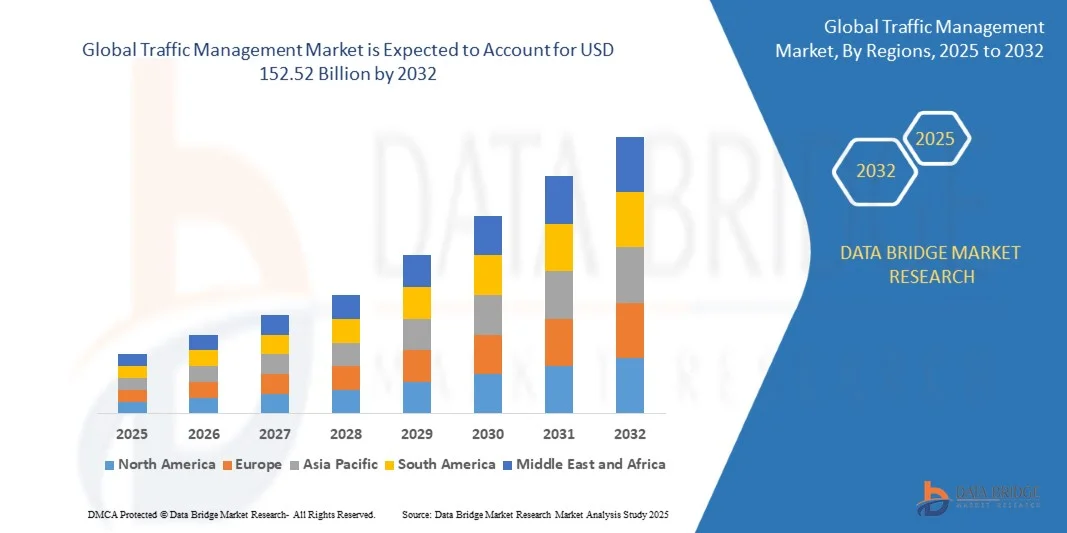
What is the Global Traffic Management Market Size and Growth Rate?
- The global traffic management market size was valued at USD 52.72 billion in 2024 and is expected to reach USD 152.52 billion by 2032, at a CAGR of 14.20% during the forecast period
- The population of on-road vehicles, particularly passenger vehicles, is steadily increasing and is expected to reach two billion by 2040. This increases traffic density, resulting in wasted time and fuel, noise pollution, and road accidents. Because of the high concentration of traffic in many cities around the world, a proper traffic planning and control system is required. This has highlighted the importance of traffic management systems
What are the Major Takeaways of Traffic Management Market?
- Big data analytics and the internet of things (IoT) are becoming increasingly important in smart traffic and smart cities. In traffic management, the Internet of Things (IoT) refers to smart, connected devices such as sensors, vehicle-mounted information systems, and even private mobile phones
- These devices transmit data to a central system for analysis via the internet. Big data analysts analyse this information and use it to improve traffic management and vehicle flow. IoT technology devices, such as sensors and detectors distributed throughout the city and embedded in infrastructure, are used in smart cities for real-time analysis
- North America dominated the traffic management market with the largest revenue share of 33.54% in 2024, driven by the rising deployment of intelligent transportation systems (ITS), government investments in smart city initiatives, and a growing need to address urban congestion
- The Asia-Pacific traffic management market is projected to expand at the fastest CAGR of 11.69% between 2025 and 2032, fueled by increasing urbanization, rising vehicle ownership, and government-led smart city programs in countries such as China, India, and Japan
- The Smart Signalling segment dominated the market with the largest revenue share of 41.5% in 2024, driven by its critical role in optimizing traffic flows and reducing congestion in densely populated urban areas
Report Scope and Traffic Management Market Segmentation
|
Attributes |
Traffic Management Key Market Insights |
|
Segments Covered |
|
|
Countries Covered |
North America
Europe
Asia-Pacific
Middle East and Africa
South America
|
|
Key Market Players |
|
|
Market Opportunities |
|
|
Value Added Data Infosets |
In addition to the insights on market scenarios such as market value, growth rate, segmentation, geographical coverage, and major players, the market reports curated by the Data Bridge Market Research also include in-depth expert analysis, pricing analysis, brand share analysis, consumer survey, demography analysis, supply chain analysis, value chain analysis, raw material/consumables overview, vendor selection criteria, PESTLE Analysis, Porter Analysis, and regulatory framework. |
What is the Key Trend in the Traffic Management Market?
AI-Enabled Traffic Optimization and Smart Mobility Integration
- A major trend shaping the global traffic management market is the growing adoption of artificial intelligence (AI) and machine learning (ML) for real-time traffic flow optimization, predictive analytics, and smart mobility solutions. These technologies enable cities to reduce congestion, enhance road safety, and improve travel efficiency
- For instance, Siemens Mobility has deployed AI-powered adaptive traffic control systems in several European cities, enabling signal adjustments based on real-time traffic density, which reduces delays and improves fuel efficiency. Similarly, SWARCO integrates AI-based sensors with cloud platforms for dynamic traffic management
- AI-driven systems also enhance incident detection, congestion forecasting, and automated rerouting, thereby improving emergency response times. Predictive capabilities allow cities to anticipate peak traffic hours and optimize infrastructure usage. Furthermore, the integration with smart mobility platforms, such as connected vehicles and public transport, supports seamless multimodal travel experiences
- The convergence of AI, IoT, and cloud computing in Traffic Management systems creates opportunities for unified platforms where traffic lights, tolling, and surveillance are managed together. This integration ensures smoother, safer, and eco-friendly transportation networks
- Companies such as Kapsch TrafficCom are actively developing AI-driven Traffic Management solutions integrated with vehicle-to-everything (V2X) communication, enabling autonomous vehicle support and real-time decision-making
- The rising demand for intelligent, sustainable, and adaptive Traffic Management systems underscores a clear shift towards smarter cities. This trend is expected to reshape global transportation infrastructure by making it more connected, automated, and data-driven
What are the Key Drivers of Traffic Management Market?
- The rapid increase in urbanization, coupled with the surging number of vehicles on roads, is a major driver of the Traffic Management market, as cities strive to mitigate congestion, reduce emissions, and enhance safety
- For instance, in February 2024, Thales Group announced advancements in AI-powered integrated traffic management platforms to support smart city initiatives in Europe, emphasizing improved efficiency and sustainable transport operations. Such developments from leading companies are expected to accelerate market expansion
- Growing government investments in smart infrastructure projects and intelligent transportation systems (ITS) further stimulate adoption, as countries seek to modernize their road networks and reduce traffic accidents. Traffic Management solutions offer advanced capabilities such as dynamic signal control, adaptive routing, and accident detection
- The shift towards green mobility, supported by stringent emission regulations, is also boosting demand, as optimized traffic flow contributes to fuel efficiency and lower carbon footprints. The integration of Traffic Management with smart public transport systems adds to its importance in urban planning
- Moreover, the convenience of real-time data access, automated rerouting, and centralized monitoring platforms is driving adoption across metropolitan areas, highways, and logistics hubs. Increasing reliance on mobile applications and GPS navigation systems further supports the uptake of intelligent Traffic Management solutions
Which Factor is Challenging the Growth of the Traffic Management Market?
- The high cost of deployment and maintenance of advanced Traffic Management systems poses a significant challenge, particularly for developing economies. The need for large-scale infrastructure upgrades, sensor networks, and integration with legacy systems makes adoption capital intensive
- For instance, budget constraints in several emerging economies have delayed smart city projects, slowing down Traffic Management deployments. This remains a key restraint for broader global adoption
- In addition, data privacy and cybersecurity vulnerabilities represent a growing concern, as Traffic Management systems rely on interconnected IoT platforms and cloud-based services. Any breach in these systems could compromise sensitive mobility data and disrupt city operations. Companies such as Huawei and Cisco emphasize secure data transmission and encryption to address these issues
- Interoperability challenges between various vendors’ systems also hinder seamless integration, limiting scalability in some regions. Furthermore, resistance from traditional infrastructure operators and a lack of skilled personnel in AI-driven systems can slow the pace of modernization
- While costs are expected to decline over time with technological advancements, overcoming funding gaps, enhancing cybersecurity, and ensuring standardization will be critical for the sustained growth of the Traffic Management industry
How is the Traffic Management Market Segmented?
The market is segmented on the basis of solution, hardware, service and system.
By Solution
On the basis of solution, the Traffic Management market is segmented into Smart Signalling, Route Guiding, Traffic Analytics, and Smart Surveillance. The Smart Signalling segment dominated the market with the largest revenue share of 41.5% in 2024, driven by its critical role in optimizing traffic flows and reducing congestion in densely populated urban areas. Cities increasingly deploy adaptive traffic signals that use sensors and AI to adjust light timings in real-time, improving road efficiency and lowering emissions.
The Traffic Analytics segment is projected to witness the fastest CAGR of 22.4% from 2025 to 2032, as demand rises for data-driven insights in urban planning and congestion management. With the integration of IoT, AI, and cloud platforms, Traffic Analytics enables predictive modeling and real-time monitoring, helping authorities make proactive decisions. The growing focus on smart cities and sustainable mobility is expected to accelerate adoption of analytics-powered solutions worldwide.
By Hardware
On the basis of hardware, the Traffic Management market is segmented into Display Boards, Sensors, Surveillance Cameras, and Others. The Sensors segment accounted for the largest market share of 38.9% in 2024, owing to their central role in detecting vehicle density, speed, and traffic flow, enabling real-time adaptive management. Governments and city planners are heavily investing in sensor networks to improve road safety, reduce accidents, and streamline mobility solutions.
The Surveillance Cameras segment is anticipated to witness the fastest CAGR of 21.1% during 2025–2032, fueled by increasing investments in AI-powered video analytics for traffic enforcement and monitoring. These systems help authorities detect violations, identify congestion hotspots, and ensure compliance with traffic laws. The integration of cameras with cloud-based platforms and machine vision is further enhancing their efficiency. The rising focus on safety, coupled with smart surveillance initiatives, is expected to propel this segment significantly in the coming years.
By Service
On the basis of service, the Traffic Management market is segmented into Consulting, Deployment and Integration, and Support and Maintenance. The Deployment and Integration segment dominated with the largest market revenue share of 44.7% in 2024, driven by the large-scale rollouts of intelligent traffic management systems across metropolitan cities. Governments and enterprises prioritize expert integration services to ensure seamless interoperability among sensors, signaling systems, and analytics platforms.
The Support and Maintenance segment is forecast to grow at the fastest CAGR of 20.6% from 2025 to 2032, as cities and enterprises increasingly recognize the importance of continuous system upgrades, cybersecurity protection, and technical support. With traffic management systems becoming more complex, long-term maintenance ensures uninterrupted performance, enhanced safety, and reduced downtime. Growing demand for cloud-based remote support and predictive maintenance models is expected to further accelerate growth in this segment throughout the forecast period.
By System
On the basis of system, the Traffic Management market is segmented into Urban Traffic Management and Control (UTMC) System, Adaptive Traffic Control (ATC) System, Journey Time Management (JTM) System, Predictive Traffic Modelling (PTM) System, Incident Detection and Location (IDL) System, and Dynamic Traffic Management (DTM) System. The Urban Traffic Management and Control (UTMC) System dominated the market with a share of 36.8% in 2024, as it forms the backbone of smart city projects, integrating multiple subsystems for coordinated operations. Its wide application in large metropolitan networks drives consistent demand.
The Predictive Traffic Modelling (PTM) System segment is expected to record the fastest CAGR of 23.2% between 2025 and 2032, owing to the rising need for forecasting congestion patterns and optimizing infrastructure investments. Leveraging AI, big data, and IoT, PTM systems enable city authorities to simulate traffic scenarios, reduce bottlenecks, and improve long-term mobility strategies. Its adoption is set to surge as urban centers embrace proactive traffic planning.
Which Region Holds the Largest Share of the Traffic Management Market?
- North America dominated the traffic management market with the largest revenue share of 33.54% in 2024, driven by the rising deployment of intelligent transportation systems (ITS), government investments in smart city initiatives, and a growing need to address urban congestion
- Consumers and governments in the region prioritize real-time monitoring, advanced traffic analytics, and AI-powered traffic control systems for improving mobility and reducing emissions
- This strong adoption is further supported by high disposable incomes, a mature automotive ecosystem, and the preference for connected infrastructure, positioning Traffic Management as a critical enabler of modern mobility
U.S. Traffic Management Market Insight
The U.S. traffic management market captured 81% of the North American revenue share in 2024, supported by federal and state investments in transportation infrastructure modernization. The growing integration of AI, IoT, and cloud platforms in traffic systems enables predictive congestion management and enhances road safety. The U.S. market also benefits from a strong focus on reducing carbon emissions through adaptive traffic signaling and vehicle-to-infrastructure (V2I) communication. Rapid adoption of smart mobility solutions and public-private partnerships are further propelling the U.S. as a leader in Traffic Management innovation.
Europe Traffic Management Market Insight
The Europe traffic management market is expected to expand at a strong CAGR throughout the forecast period, driven by stringent EU regulations for sustainable mobility, road safety, and emissions reduction. The region’s rapid urbanization and the push for smart cities have created robust demand for adaptive signaling, predictive traffic analytics, and intelligent surveillance systems. Countries across Europe are incorporating Traffic Management technologies into both new infrastructure projects and urban retrofits. The emphasis on energy-efficient and sustainable systems is strengthening adoption in residential, commercial, and industrial zones asuch as.
U.K. Traffic Management Market Insight
The U.K. traffic management market is projected to grow at a noteworthy CAGR, fueled by government initiatives to ease urban congestion and the nationwide adoption of smart city frameworks. Concerns about pollution and traffic safety are encouraging local authorities to adopt adaptive traffic control systems and connected surveillance. With strong investments in digital infrastructure and transport modernization, coupled with the rise of electric vehicles (EVs) and autonomous driving trials, the U.K. continues to see expanding demand for advanced Traffic Management solutions.
Germany Traffic Management Market Insight
The Germany traffic management market is anticipated to grow at a considerable CAGR, underpinned by the country’s focus on technological innovation, sustainability, and smart mobility. Germany’s advanced automotive industry and well-developed infrastructure provide a strong foundation for deploying AI-powered traffic systems. The government’s push toward reducing congestion and emissions in major cities, alongside initiatives for connected and automated driving, supports strong adoption. Integration with broader smart city projects ensures demand across both metropolitan and suburban regions.
Which Region is the Fastest Growing Region in the Traffic Management Market?
The Asia-Pacific traffic management market is projected to expand at the fastest CAGR of 11.69% between 2025 and 2032, fueled by increasing urbanization, rising vehicle ownership, and government-led smart city programs in countries such as China, India, and Japan. Strong economic growth and infrastructure modernization are boosting investments in ITS, AI-driven traffic control, and congestion management systems. The region’s large population base and growing focus on safety and sustainability are accelerating adoption.
Japan Traffic Management Market Insight
The Japan traffic management market is gaining traction due to its high-tech ecosystem, rapid urbanization, and emphasis on convenience. The adoption of AI-powered traffic systems and IoT-enabled road infrastructure is addressing congestion in densely populated cities. Japan’s aging population is also spurring investments in safer, more automated mobility solutions. Integration of traffic systems with autonomous vehicle testing and connected infrastructure further supports steady market growth in the country.
China Traffic Management Market Insight
The China traffic management market accounted for the largest share in Asia-Pacific in 2024, driven by rapid urbanization, strong government backing for smart cities, and expanding middle-class demand for safer and more efficient transportation systems. China has emerged as a global leader in smart infrastructure, with heavy investments in AI, big data, and 5G-enabled Traffic Management platforms. Affordable domestic manufacturing and large-scale deployment of adaptive traffic signals and surveillance networks make China a key growth engine in the regional market.
Which are the Top Companies in Traffic Management Market?
The traffic management industry is primarily led by well-established companies, including:
- Cisco Systems, Inc. (U.S.)
- SWARCO (Austria)
- Kapsch TrafficCom AG (Austria)
- Thales (France)
- Q-Free A.S.A. (Norway)
- PTV Planung Transport Verkehr GmbH (Germany)
- Teledyne FLIR LLC (U.S.)
- Cubic Corporation (U.S.)
- TomTom International B.V. (Netherlands)
- Alibaba Group Holding Limited (China)
- Huawei Technologies Co., Ltd. (China)
- TransCore (U.S.)
- Chevron Corporation (England)
- Oriux (U.S.)
- Invarion Inc. (U.S.)
What are the Recent Developments in Global Traffic Management Market?
- In April 2024, CAL Analytics, in collaboration with the Ohio Department of Transportation (ODOT), launched a low-altitude air traffic management system for drones to support statewide operations, marking a significant step in advancing drone integration and traffic safety
- In March 2024, Kitchener-Waterloo-based traffic management software startup Miovision acquired Beaverton, Oregon-based Traffic Technology Services (TTS) for an undisclosed amount, strengthening its portfolio and expanding its footprint in the traffic management solutions market
- In March 2024, Neuraspace, a pioneer in artificial intelligence-driven space traffic management solutions, partnered with satellite manufacturer NanoAvionics to embed its advanced system into NanoAvionics' small satellite mission services, paving the way for enhanced safety and sustainable space operations
- In December 2023, Yunex Traffic launched its advanced traffic management system (ATMS), Yutraffic Studio, a cloud-based platform in the U.S. designed to tackle traffic challenges with tools for planning, monitoring, and optimization, thereby ensuring smarter and future-ready mobility solutions
- In September 2023, Peachtree Corners, one of the U.S.'s pioneering smart cities, partnered with ITC Intelligent Traffic Control Ltd (ITC) to deploy an agnostic software solution integrating existing infrastructure to monitor and predict congestion, demonstrating a forward-looking approach to enhancing safety, sustainability, and urban efficiency

- Interactive Data Analysis Dashboard
- Company Analysis Dashboard for high growth potential opportunities
- Research Analyst Access for customization & queries
- Competitor Analysis with Interactive dashboard
- Latest News, Updates & Trend analysis
- Harness the Power of Benchmark Analysis for Comprehensive Competitor Tracking
Data collection and base year analysis are done using data collection modules with large sample sizes. The stage includes obtaining market information or related data through various sources and strategies. It includes examining and planning all the data acquired from the past in advance. It likewise envelops the examination of information inconsistencies seen across different information sources. The market data is analysed and estimated using market statistical and coherent models. Also, market share analysis and key trend analysis are the major success factors in the market report. To know more, please request an analyst call or drop down your inquiry.
The key research methodology used by DBMR research team is data triangulation which involves data mining, analysis of the impact of data variables on the market and primary (industry expert) validation. Data models include Vendor Positioning Grid, Market Time Line Analysis, Market Overview and Guide, Company Positioning Grid, Patent Analysis, Pricing Analysis, Company Market Share Analysis, Standards of Measurement, Global versus Regional and Vendor Share Analysis. To know more about the research methodology, drop in an inquiry to speak to our industry experts.
Data Bridge Market Research is a leader in advanced formative research. We take pride in servicing our existing and new customers with data and analysis that match and suits their goal. The report can be customized to include price trend analysis of target brands understanding the market for additional countries (ask for the list of countries), clinical trial results data, literature review, refurbished market and product base analysis. Market analysis of target competitors can be analyzed from technology-based analysis to market portfolio strategies. We can add as many competitors that you require data about in the format and data style you are looking for. Our team of analysts can also provide you data in crude raw excel files pivot tables (Fact book) or can assist you in creating presentations from the data sets available in the report.













