


Train Lighting Market Overview
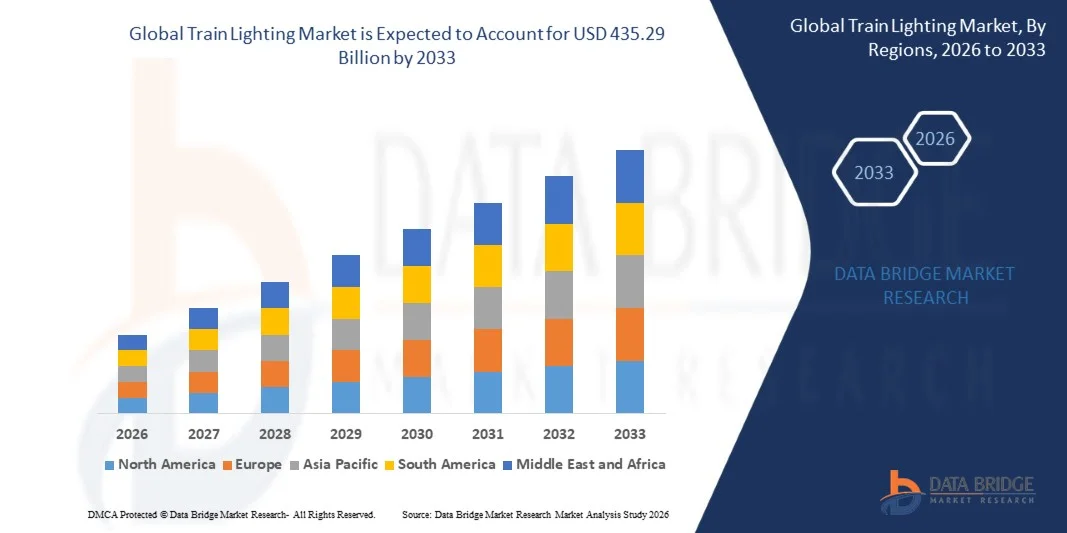
The Train Lighting Market was valued at USD 367.18 billion in 2025 and is projected to reach USD 435.29 billion by 2033, growing at a CAGR of 2.15% from 2026 to 2033. The market is experiencing steady growth driven by increasing investments in railway modernization projects, rising adoption of energy-efficient LED lighting systems, and growing demand for enhanced passenger comfort and safety across metro, high-speed rail, and conventional train networks. Railway operators are increasingly replacing traditional fluorescent and halogen lighting systems with advanced LED technologies to improve energy efficiency, reduce maintenance costs, and support sustainability goals.
The rapid expansion of urban transit infrastructure, combined with increasing government investments in smart railway systems and high-speed rail connectivity, is further accelerating market demand globally. Modern train lighting solutions incorporating intelligent control systems, ambient lighting, and emergency illumination technologies are becoming increasingly important in improving passenger experience and operational efficiency. In addition, growing focus on railway electrification, stringent transportation safety regulations, and rising deployment of connected rail infrastructure are supporting adoption of advanced train lighting systems across both developed and emerging railway markets.
Key Market Trends & Insights
- North America dominated the train lighting market with the largest revenue share of 34.7% in 2025, supported by strong investments in railway fleet modernization, increasing adoption of intelligent LED lighting systems, and growing demand for sustainable transportation infrastructure. The region’s advanced railway networks and focus on passenger safety, operational efficiency, and low-maintenance lighting technologies are accelerating deployment of modern train lighting solutions across both passenger and freight transportation systems.
- Asia-Pacific is expected to be the fastest-growing region, recording a CAGR of 3.4% from 2026 to 2033. Growth is driven by rapid urbanization, expansion of metro and high-speed rail projects, and increasing government investments in railway infrastructure development across China, India, Japan, and South Korea. Rising deployment of smart city transportation systems and large-scale railway electrification programs are further supporting regional market expansion.
- The Metro segment held the largest market revenue share of approximately 24.6% in 2025 driven by rapid urban transit expansion, increasing metro rail projects, and rising investments in smart public transportation infrastructure across Asia-Pacific, Europe, and the Middle East. Metro trains require advanced interior and exterior LED lighting systems to improve passenger safety, energy efficiency, and operational visibility in densely populated urban transportation networks.
- The EMU segment accounted for approximately 18.3% market share in 2025 due to increasing electrification of railway systems and expansion of high-speed rail infrastructure globally. Passenger Coach and Light Rail segments collectively represented around 21.5% share supported by modernization of conventional rail fleets and increasing demand for comfortable passenger transportation systems. The Monorail and TRAM segments are projected to witness steady growth due to increasing adoption of urban mobility solutions in smart city development projects.
- The Interior Train Lighting segment dominated the market with approximately 67.4% share in 2025 driven by rising focus on passenger comfort, ambient lighting systems, reading illumination, and energy-efficient cabin lighting technologies. Railway operators are increasingly investing in intelligent interior LED systems integrated with automatic brightness adjustment and emergency lighting capabilities to improve passenger experience and reduce operational energy consumption.
- The Exterior Train Lighting segment accounted for approximately 32.6% market share in 2025 supported by increasing deployment of high-performance headlights, marker lights, and signal lighting systems to improve operational visibility and transportation safety. Rising adoption of LED-based exterior train lights for low maintenance and extended operational lifespan is further accelerating segment growth globally.
- The Cabin Lights segment held the largest market revenue share of approximately 22.8% in 2025 driven by increasing demand for passenger comfort and modern interior lighting systems across metro, high-speed rail, and long-distance passenger trains.
- The Train Headlights segment accounted for approximately 16.7% market share in 2025 due to stringent railway safety regulations and increasing demand for high-visibility lighting systems in both passenger and freight transportation networks. Emergency Lighting Systems and Train Main Lights collectively represented around 19.5% share supported by mandatory railway safety compliance standards and increasing modernization of train fleets globally. Reading Lights and LED Spotlights are witnessing increasing adoption in premium passenger transportation services and luxury rail infrastructure projects.
- The LED segment dominated the market with approximately 58.9% share in 2025 driven by superior energy efficiency, longer operational lifespan, reduced maintenance requirements, and improved illumination quality compared to conventional train lighting technologies. Railway operators are increasingly replacing fluorescent and halogen systems with LED lighting to reduce energy consumption and support sustainability targets.
- The Fluorescent segment accounted for approximately 18.4% market share in 2025 due to continued deployment in aging railway fleets and conventional passenger rail systems. HID and Xenon technologies collectively represented around 14.6% share supported by their application in high-intensity train headlight systems. The Halogen segment continues to decline gradually due to increasing adoption of energy-efficient LED alternatives across modern railway infrastructure projects.
- The Battery segment held the largest market revenue share of approximately 44.3% in 2025 driven by increasing integration of battery-supported LED lighting systems, emergency backup lighting, and energy storage solutions across electric trains and metro networks. Advancements in lithium-ion railway battery technologies are further supporting segment growth by improving lighting system reliability and operational efficiency.
- The Rectifier segment accounted for approximately 31.2% market share in 2025 supported by rising demand for stable power conversion systems in modern train lighting infrastructure. The Alternator segment represented around 24.5% share due to continued deployment in diesel locomotives and conventional rail systems where onboard power generation remains essential for train lighting operations.
Market Size & Forecast
- Global Market Value (2025): USD 367.18 Billion
- Expected Market Value (2033): USD 435.29 Billion
- Forecast CAGR (2026–2033): 2.15%
- Leading Region in 2025: North America
- Fastest Growing Region: Asia-Pacific
Report Scope and Train Lighting Market Segmentation
|
Attributes |
Train Lighting Key Market Insights |
|
Segments Covered |
|
|
Countries Covered |
North America
Europe
Asia-Pacific
Middle East and Africa
South America
|
|
Key Market Players |
• Toshiba Infrastructure Systems & Solutions Corporation (Japan) |
|
Market Opportunities |
|
|
Value Added Data Infosets |
In addition to the market insights such as market value, growth rate, market segments, geographical coverage, market players, and market scenario, the market report curated by the Data Bridge Market Research team includes in-depth expert analysis, import/export analysis, pricing analysis, production consumption analysis, and pestle analysis. |
Train Lighting Market Trends
Trend: Increasing Adoption Of Smart And Energy-Efficient LED Railway Lighting Systems
Increasing investments in railway modernization, smart transportation infrastructure, and sustainable mobility solutions are significantly driving demand for advanced train lighting systems across metro, high-speed rail, and passenger transportation networks. Conventional fluorescent and halogen train lighting systems consume higher energy, require frequent maintenance, and offer lower operational lifespan, encouraging railway operators to adopt LED-based lighting technologies with improved energy efficiency and durability.
In modern metro and high-speed rail systems, operators are increasingly integrating intelligent LED lighting systems, For instance for passenger cabins, vestibules, and emergency illumination, to improve passenger comfort, operational visibility, and energy management efficiency. In urban transit infrastructure, adaptive lighting technologies with automatic brightness adjustment and smart control integration are being deployed to reduce electricity consumption and improve maintenance performance across railway fleets.
The rapid expansion of urban rail networks and smart city transportation projects is also increasing demand for lightweight and low-power train lighting systems capable of supporting long operational cycles. In addition, railway operators across Europe and Asia-Pacific are increasingly adopting connected lighting infrastructure integrated with predictive maintenance systems to improve operational reliability and passenger safety. Industry modernization projects conducted in 2025 across China and Germany integrating advanced LED train lighting systems into metro fleets demonstrated energy consumption reductions of nearly 35–45% compared to conventional fluorescent railway lighting technologies
Train Lighting Market Dynamics
Key Market Driver: Rising Investments In Railway Electrification And Passenger Safety Infrastructure
Governments and railway authorities worldwide are increasingly investing in railway electrification, high-speed rail development, and smart transportation infrastructure to improve operational efficiency, reduce carbon emissions, and strengthen public transportation networks. Modern railway systems require advanced train lighting technologies capable of supporting passenger comfort, emergency safety, and energy-efficient rail operations.
Railway operators across Asia-Pacific, Europe, and the Middle East are increasingly replacing traditional train lighting systems with LED-based solutions to reduce operational maintenance costs and improve lighting reliability. For instance, metro rail projects in India, China, and France are integrating intelligent interior and exterior train lighting systems to support modern passenger transportation standards and railway safety regulations.
Similarly, railway fleet modernization initiatives are accelerating deployment of emergency lighting systems, smart cabin illumination, and automated train headlights to improve operational safety in urban and intercity rail transportation. Real-world railway modernization deployments conducted in Japan and Germany during 2024 integrating LED-based lighting systems into passenger rail fleets demonstrated maintenance cost reductions of approximately 20–30% and operational lifespan improvements exceeding 50,000 lighting hours
Key Restraint/Challenge: High Retrofit Costs And Complex Railway Integration Requirements
Advanced train lighting systems require significant upfront investment associated with LED retrofitting, smart lighting control infrastructure, and railway-grade electrical integration standards. Older railway fleets often require extensive rewiring, component replacement, and system compatibility upgrades before modern lighting technologies can be deployed effectively, increasing modernization costs for railway operators.
In addition, compliance with stringent railway safety certifications, vibration resistance standards, and fire protection regulations increases manufacturing complexity and overall installation expenses. Smaller railway operators and emerging economies often face budget limitations that restrict rapid replacement of conventional lighting systems despite long-term energy-saving benefits.
Commercial railway infrastructure benchmarking studies indicate that full-scale LED retrofit programs for passenger rail systems can increase short-term capital expenditure by approximately 18–25% compared to conventional train lighting replacement projects, particularly in aging railway networks requiring electrical system modernization
Key Market Opportunity: Expansion Of Smart Rail Infrastructure And Connected Passenger Experience Solutions
Modern railway networks increasingly require intelligent lighting systems capable of supporting smart transportation infrastructure, passenger comfort optimization, and digital railway management systems. Conventional train lighting technologies are unable to provide adaptive illumination, predictive maintenance integration, and energy optimization capabilities required in next-generation railway operations, creating strong opportunities for advanced LED and connected lighting technologies.
Railway companies are increasingly deploying intelligent train lighting systems, For instance adaptive cabin lighting, automated emergency illumination, and sensor-based energy management systems, to improve passenger experience and operational efficiency without significantly increasing energy consumption. In metro and high-speed rail applications, rising focus on premium passenger interiors and digitally connected transportation systems is accelerating demand for programmable ambient lighting and low-maintenance LED technologies.
In addition, advancements in IoT-enabled railway monitoring systems and smart lighting control platforms are improving lighting performance management across large transportation fleets, opening opportunities across Asia-Pacific, Europe, and North America. Smart railway infrastructure pilot programs conducted in 2025 across South Korea and the U.A.E. reported energy savings of nearly 30–40% after integrating AI-assisted LED lighting management systems into metro and urban rail transportation networks.
Train Lighting Market Scope
The market is segmented on the basis of rolling stock type, position, application, technology, and component.
• By Rolling Stock Type
On the basis of rolling stock type, the train lighting market is segmented into Diesel Locomotive, DMU, Electric Locomotive, EMU, Metro, Light Rail, TRAM, Monorail, Passenger Coach, and Freight Wagon. The Metro segment held the largest market revenue share of approximately 24.6% in 2025 driven by rapid urban transit expansion, increasing metro rail projects, and rising investments in smart public transportation infrastructure across Asia-Pacific, Europe, and the Middle East. Metro trains require advanced interior and exterior LED lighting systems to improve passenger safety, energy efficiency, and operational visibility in densely populated urban transportation networks.
The EMU segment accounted for approximately 18.3% market share in 2025 due to increasing electrification of railway systems and expansion of high-speed rail infrastructure globally. Passenger Coach and Light Rail segments collectively represented around 21.5% share supported by modernization of conventional rail fleets and increasing demand for comfortable passenger transportation systems. The Monorail and TRAM segments are projected to witness steady growth due to increasing adoption of urban mobility solutions in smart city development projects.
• By Position
On the basis of position, the train lighting market is segmented into Interior Train Lighting and Exterior Train Lighting. The Interior Train Lighting segment dominated the market with approximately 67.4% share in 2025 driven by rising focus on passenger comfort, ambient lighting systems, reading illumination, and energy-efficient cabin lighting technologies. Railway operators are increasingly investing in intelligent interior LED systems integrated with automatic brightness adjustment and emergency lighting capabilities to improve passenger experience and reduce operational energy consumption.
The Exterior Train Lighting segment accounted for approximately 32.6% market share in 2025 supported by increasing deployment of high-performance headlights, marker lights, and signal lighting systems to improve operational visibility and transportation safety. Rising adoption of LED-based exterior train lights for low maintenance and extended operational lifespan is further accelerating segment growth globally.
• By Application
On the basis of application, the train lighting market is segmented into Cabin Lights, Door Lights, Emergency Lighting Systems, Reading Lights, Toilet Lights, Train Headlights, Train Indicator Lights, Train LED Spotlights, Train Main Lights, Marker Lights, Vestibule Lights, and Other Train Lights. The Cabin Lights segment held the largest market revenue share of approximately 22.8% in 2025 driven by increasing demand for passenger comfort and modern interior lighting systems across metro, high-speed rail, and long-distance passenger trains.
The Train Headlights segment accounted for approximately 16.7% market share in 2025 due to stringent railway safety regulations and increasing demand for high-visibility lighting systems in both passenger and freight transportation networks. Emergency Lighting Systems and Train Main Lights collectively represented around 19.5% share supported by mandatory railway safety compliance standards and increasing modernization of train fleets globally. Reading Lights and LED Spotlights are witnessing increasing adoption in premium passenger transportation services and luxury rail infrastructure projects.
• By Technology
On the basis of technology, the train lighting market is segmented into Halogen, Xenon, HID, Fluorescent, and LED. The LED segment dominated the market with approximately 58.9% share in 2025 driven by superior energy efficiency, longer operational lifespan, reduced maintenance requirements, and improved illumination quality compared to conventional train lighting technologies. Railway operators are increasingly replacing fluorescent and halogen systems with LED lighting to reduce energy consumption and support sustainability targets.
The Fluorescent segment accounted for approximately 18.4% market share in 2025 due to continued deployment in aging railway fleets and conventional passenger rail systems. HID and Xenon technologies collectively represented around 14.6% share supported by their application in high-intensity train headlight systems. The Halogen segment continues to decline gradually due to increasing adoption of energy-efficient LED alternatives across modern railway infrastructure projects.
• By Component
On the basis of component, the train lighting market is segmented into Alternator, Battery, and Rectifier. The Battery segment held the largest market revenue share of approximately 44.3% in 2025 driven by increasing integration of battery-supported LED lighting systems, emergency backup lighting, and energy storage solutions across electric trains and metro networks. Advancements in lithium-ion railway battery technologies are further supporting segment growth by improving lighting system reliability and operational efficiency.
The Rectifier segment accounted for approximately 31.2% market share in 2025 supported by rising demand for stable power conversion systems in modern train lighting infrastructure. The Alternator segment represented around 24.5% share due to continued deployment in diesel locomotives and conventional rail systems where onboard power generation remains essential for train lighting operations.
Train Lighting Market Regional Analysis
North America Train Lighting Market Insight
North America dominated the train lighting market with the largest revenue share of 34.7% in 2025, supported by increasing investments in railway modernization, expansion of urban transit systems, and rising adoption of energy-efficient LED train lighting technologies. Railway operators in the region highly prioritize passenger safety, operational efficiency, and sustainable transportation infrastructure, accelerating deployment of intelligent interior and exterior train lighting systems. The growing replacement of conventional fluorescent lighting with smart LED solutions across passenger and freight rail networks is further supporting market expansion across both public and private transportation sectors.
U.S. Train Lighting Market Insight
The U.S. train lighting market captured the largest revenue share in 2025 within North America, fueled by ongoing railway infrastructure upgrades and increasing investments in metro and commuter rail modernization programs. Railway operators are increasingly focusing on improving passenger comfort and transportation safety through deployment of advanced cabin lighting, emergency illumination systems, and energy-efficient LED technologies. The growing adoption of connected railway infrastructure and predictive maintenance systems is further propelling demand for intelligent train lighting solutions across urban transit and long-distance passenger rail applications.
Europe Train Lighting Market Insight
The Europe train lighting market is expected to witness the fastest growth rate from 2026 to 2033, primarily driven by strong investments in high-speed rail infrastructure, stringent railway energy-efficiency regulations, and increasing focus on sustainable transportation systems. European railway operators are rapidly replacing traditional train lighting technologies with advanced LED systems to reduce operational energy consumption and maintenance costs. The region is experiencing strong growth across metro, tram, and intercity rail applications, with intelligent train lighting systems increasingly integrated into modern railway fleet modernization projects.
U.K. Train Lighting Market Insight
The U.K. train lighting market is expected to witness strong growth from 2026 to 2033, driven by increasing investments in smart rail infrastructure and growing demand for modern passenger transportation systems. Railway operators are increasingly deploying energy-efficient LED cabin lighting, emergency lighting systems, and automated train illumination technologies to improve passenger comfort and operational visibility. In addition, the U.K.’s expanding urban rail modernization projects and focus on reducing transportation-related carbon emissions are expected to continue supporting market growth.
Germany Train Lighting Market Insight
The Germany train lighting market is expected to witness strong growth from 2026 to 2033, fueled by increasing railway electrification projects and strong demand for technologically advanced transportation infrastructure. Germany’s highly developed railway network and focus on sustainable mobility solutions are promoting rapid adoption of intelligent train lighting systems across high-speed rail, metro, and passenger transportation networks. The integration of connected lighting technologies with smart railway management systems is also becoming increasingly prevalent, aligning with the country’s emphasis on energy efficiency and transportation innovation.
Asia-Pacific Train Lighting Market Insight
The Asia-Pacific train lighting market is expected to witness the fastest growth rate from 2026 to 2033, supported by rapid urbanization, increasing metro rail projects, and strong government investments in railway infrastructure development across countries such as China, India, Japan, and South Korea. The region’s growing focus on smart city transportation systems and expansion of urban public transit networks is accelerating demand for advanced train lighting technologies. Furthermore, Asia-Pacific remains a major manufacturing hub for railway components and LED technologies, improving affordability and accessibility of modern train lighting systems across regional transportation markets.
Japan Train Lighting Market Insight
The Japan train lighting market is expected to witness strong growth from 2026 to 2033 due to the country’s advanced railway infrastructure, extensive high-speed rail network, and increasing adoption of energy-efficient transportation technologies. Japanese railway operators place strong emphasis on passenger comfort, operational reliability, and railway safety, driving adoption of intelligent LED cabin lighting and automated emergency illumination systems. The integration of smart lighting technologies with connected railway control systems is further supporting market expansion across metro and bullet train transportation networks.
China Train Lighting Market Insight
The China train lighting market accounted for the largest market revenue share in Asia-Pacific in 2025, attributed to the country’s massive railway infrastructure expansion, rapid urban transit development, and strong government investment in high-speed rail modernization projects. China remains one of the world’s largest railway equipment manufacturing markets, with increasing deployment of energy-efficient LED lighting systems across metro, bullet train, and passenger rail networks. The push toward smart transportation infrastructure and growing adoption of intelligent rail technologies are key factors propelling the train lighting market in China.
Train Lighting Market Share
The Train Lighting industry is primarily led by well-established companies, including:
• Toshiba Infrastructure Systems & Solutions Corporation (Japan)
• General Electric (U.S.)
• Hitachi Ltd (Japan)
• KOITO MANUFACTURING CO., LTD (Japan)
• Grupo Antolin (Spain)
• Dräxlmaier Group (Germany)
• Teknoware Oy (Finland)
• Verdict Media Limited. (U.K.)
• J.B. Industries (U.S.)
• Kerala Electrical & Allied Engineering Co. Ltd. (India)
• Green Site Products (U.S.)
• GiantFocal (China)
• Amtek Group (India)
• North Star Lighting, LLC (U.S.)
• Bulbtronics (U.S.)
• Bigston Manufacturing Corporation (Taiwan)
Latest Developments in Train Lighting Market
- In September 2025, INPS introduced precision-engineered backlit control panels integrated with embedded LED lighting technology to improve operational visibility, user interface functionality, and modern train interior aesthetics. The innovation enhanced durability and illumination efficiency while supporting increasing demand for advanced smart lighting solutions across modern railway infrastructure projects
- In June 2025, INPS launched a modular LED lighting solution designed specifically for autorack railcars to improve cargo loading visibility, worker safety, and operational efficiency during rail transportation activities. The development strengthened adoption of energy-efficient railway lighting technologies and supported the ongoing modernization of freight rail infrastructure with low-maintenance and high-performance LED systems

- Interactive Data Analysis Dashboard
- Company Analysis Dashboard for high growth potential opportunities
- Research Analyst Access for customization & queries
- Competitor Analysis with Interactive dashboard
- Latest News, Updates & Trend analysis
- Harness the Power of Benchmark Analysis for Comprehensive Competitor Tracking
Data collection and base year analysis are done using data collection modules with large sample sizes. The stage includes obtaining market information or related data through various sources and strategies. It includes examining and planning all the data acquired from the past in advance. It likewise envelops the examination of information inconsistencies seen across different information sources. The market data is analysed and estimated using market statistical and coherent models. Also, market share analysis and key trend analysis are the major success factors in the market report. To know more, please request an analyst call or drop down your inquiry.
The key research methodology used by DBMR research team is data triangulation which involves data mining, analysis of the impact of data variables on the market and primary (industry expert) validation. Data models include Vendor Positioning Grid, Market Time Line Analysis, Market Overview and Guide, Company Positioning Grid, Patent Analysis, Pricing Analysis, Company Market Share Analysis, Standards of Measurement, Global versus Regional and Vendor Share Analysis. To know more about the research methodology, drop in an inquiry to speak to our industry experts.
Data Bridge Market Research is a leader in advanced formative research. We take pride in servicing our existing and new customers with data and analysis that match and suits their goal. The report can be customized to include price trend analysis of target brands understanding the market for additional countries (ask for the list of countries), clinical trial results data, literature review, refurbished market and product base analysis. Market analysis of target competitors can be analyzed from technology-based analysis to market portfolio strategies. We can add as many competitors that you require data about in the format and data style you are looking for. Our team of analysts can also provide you data in crude raw excel files pivot tables (Fact book) or can assist you in creating presentations from the data sets available in the report.













