What is the Train Seat Market Size and Growth Rate?
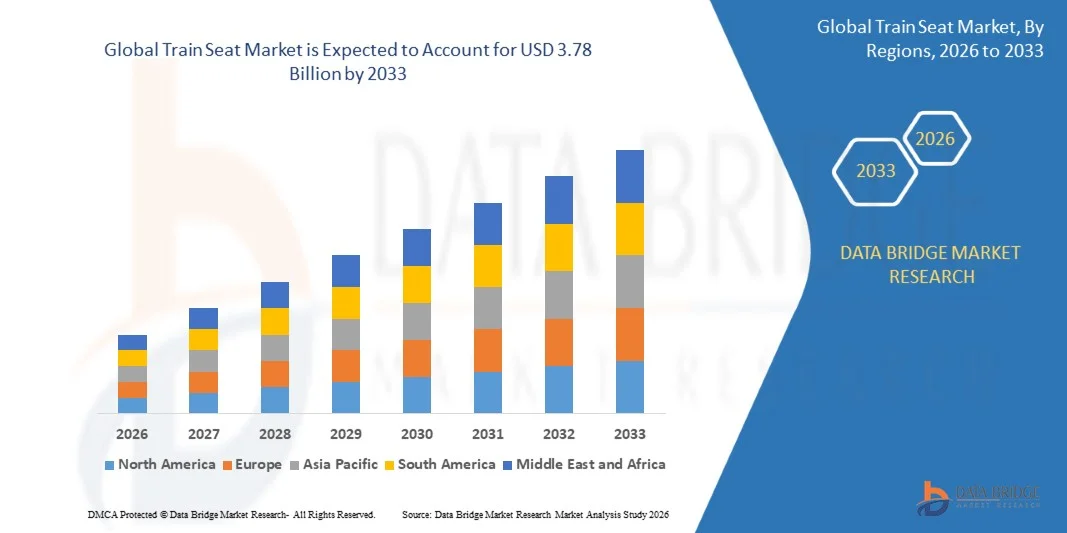
- As per Data Bridge Market Research analysis, the train seat market was valued at USD 2.52 billion in 2025 and is projected to reach USD 3.78 billion by 2033, growing at a CAGR of 5.20% from 2026 to 2033.
- The market is experiencing consistent growth driven by the increasing demand for comfortable, safe, and ergonomically designed seating solutions across high-speed trains, passenger trains, metro systems, light rail, and other urban transit networks, alongside ongoing railway modernization and expansion of rail transportation infrastructure.
- The growing emphasis on passenger comfort, lightweight materials, improved seat durability, and enhanced onboard amenities is encouraging train manufacturers and railway operators to adopt advanced seating technologies. Innovations in ergonomic designs, modular seat configurations, Fire Protection Materials, antimicrobial fabrics, adjustable reclining systems, and smart seating solutions are increasingly being integrated into new and upgraded rail coaches, supporting improved passenger experience and operational efficiency.
Market Size & Forecast
- Global Market Value (2025): USD 2.52 Billion
- Expected Market Value (2033): USD 3.78 Billion
- Forecast CAGR (2026–2033): 5.20%
- Leading Region in 2025: Asia-Pacific
- Fastest Growing Region: Middle East and Africa
What are the Major Takeaways of the Train Seat Market?
- Asia-Pacific dominated the train seat market with the largest revenue share of 37.3% in 2025, supported by extensive railway networks, expansion of high-speed rail and metro systems, increasing fleet modernization, and continued investments in passenger rail infrastructure across China, India, Japan, and South Korea.
- Middle East and Africa is expected to be the fastest-growing region at a CAGR of 5.4% from 2026 to 2031, driven by railway infrastructure development, new intercity rail corridors, fleet modernization, and increasing investments in passenger and high-speed rail projects.
- The passenger train segment led the market with a 46.6% share in 2025, driven by the extensive deployment of passenger trains for regional and intercity transportation and the large installed base requiring new seating systems, replacement seats, and refurbishment.
- The high-speed train segment is the fastest-growing train type, projected to register a CAGR of 5.5%, supported by continued expansion of high-speed rail networks, increasing passenger expectations for comfort, and demand for lightweight, ergonomic, and premium seating solutions.
- Fabric upholstery dominated the material segment with a 50.7% revenue share in 2025, supported by its combination of passenger comfort, durability, design flexibility, breathability, and suitability for stringent railway fire-safety requirements.
- Composite materials are among the fastest-growing material categories, with a CAGR of 5.5%, driven by the increasing focus on lightweight train interiors, improved energy efficiency, durability, fire safety, and weight reduction across modern rolling stock.
- Economy/standard seating accounted for 62.6% of the market share in 2025, reflecting its widespread deployment across passenger, commuter, metro, and regional railway systems where high seating capacity, durability, and cost efficiency remain important procurement requirements.
- Premium-economy seating is projected to be one of the fastest-growing seat-type categories, registering a CAGR of 5.4%, driven by increasing demand for enhanced passenger comfort, improved ergonomics, reclining functionality, and upgraded seating configurations in intercity and high-speed rail services.
- OEM supply dominated the sales channel with a 72.5% share in 2025, supported by new train manufacturing programs, rolling-stock expansion, and the integration of complete seating systems during original vehicle production. The aftermarket replacement segment is expected to grow at a 5.5% CAGR, supported by fleet refurbishment and replacement of aging seats..
Report Scope and Train Seat Market Segmentation
|
Attributes |
Train Seat Key Market Insights |
|
Segments Covered |
|
|
Countries Covered |
North America
Europe
Asia-Pacific
Middle East and Africa
South America
|
|
Key Market Players |
|
|
Market Opportunities |
|
|
Value Added Data Infosets |
In addition to the market insights such as market value, growth rate, market segments, geographical coverage, market players, and market scenario, the market report curated by the Data Bridge Market Research team includes in-depth expert analysis, import/export analysis, pricing analysis, production consumption analysis, and pestle analysis. |
What is the Key Trend in the Train Seat Market?
- Train seat manufacturers are increasingly adopting lightweight materials, ergonomic designs, and modular seating architectures to improve passenger comfort while reducing overall railcar weight and supporting energy efficiency. Advanced composites, lightweight frames, improved cushioning, and optimized seat structures are gaining attention across high-speed, intercity, metro, and regional rail applications.
- For instance, April 2026, Great Western Railway commenced in-service testing of the EcoSeat, a recyclable, foam-free rail seat using pocket-spring technology, highlighting the growing emphasis on recyclable and circular seating solutions.
- Train seating systems are increasingly incorporating smart and connected features, including seat-occupancy detection, passenger information interfaces, charging ports, and other connectivity functions. These technologies are supporting improved passenger experience and providing operators with additional information for capacity and service management.
- Manufacturers are increasingly combining recycled fabrics, antimicrobial surfaces, fire-resistant upholstery, and recyclable structural components to address sustainability, hygiene, durability, and railway safety requirements. The use of sustainable materials is becoming particularly important in new rolling-stock procurement and refurbishment programs.
- For instance, March 2025, Camira Fabrics introduced its Rivet 2.0 railway upholstery fabric range containing 40% recycled polyester and certified to EN 45545-2 HL3, reflecting the increasing use of recycled-content materials in railway seating.
- Advanced digital engineering techniques, including CAD modeling, finite element analysis, and multiobjective optimization, are increasingly being used to develop train seats with lower weight, improved mechanical performance, enhanced ergonomics, and optimized manufacturing characteristics.
What are the Key Drivers of the Train Seat Market?
- Rising investment in railway infrastructure and fleet modernization is driving demand for new and upgraded train seating systems across high-speed, passenger, metro, regional, and urban rail networks. Expansion of rail networks and refurbishment of existing rolling stock is increasing the requirement for durable, comfortable, and technologically advanced seats.
- For instance, in January 2025, China Railway indicated that fixed-asset investment in China's railway sector was expected to reach 590 billion yuan in 2025, supporting continued demand for rolling-stock components and interior systems.
- Increasing passenger expectations for comfort and ergonomics are encouraging railway operators and manufacturers to introduce seats with improved lumbar support, cushioning, legroom, reclining functionality, and customized configurations, particularly across long-distance and high-speed rail services.
- The growing focus on lightweight train structures and energy efficiency is accelerating the adoption of composite materials, lightweight metal frames, and optimized seat structures. Reducing seat weight can contribute to lower overall vehicle mass while maintaining required structural and passenger-comfort characteristics.
- Increasing demand for sustainable and recyclable railway interiors is encouraging manufacturers to develop foam-free, recyclable, recycled-content, and low-emission seating materials. These solutions support railway operators' broader sustainability and circular-economy objectives.
- Growing high-speed rail, metro, and urban transit development is further supporting demand for advanced seating systems, as new rolling-stock projects require lightweight, fire-safe, durable, accessible, and passenger-oriented interiors.
Which Factors are Challenging the Growth of the Train Seat Market?
- High manufacturing costs and stringent durability requirements remain major challenges because train seats must withstand intensive passenger use, frequent cleaning, mechanical stresses, moisture, and environmental exposure while maintaining comfort and appearance over long service periods.
- Stringent fire-safety and regulatory requirements can increase material-selection, testing, certification, and development costs. Railway seating materials must meet requirements relating to flame spread, smoke generation, toxicity, structural performance, and accessibility depending on the applicable market and rail system.
- The increasing use of lightweight composite materials also creates technical challenges because manufacturers must balance weight reduction with fire resistance, mechanical strength, manufacturability, durability, and passenger safety. Recent research highlights the difficulty of simultaneously optimizing these characteristics in polymer-based railway composites.
- Volatility in raw-material prices and supply-chain requirements can increase production costs for seat manufacturers, particularly for specialized fabrics, foams, polymers, composites, metals, and other certified railway-grade materials.
- Balancing passenger comfort, seating capacity, weight, and cost remains a challenge for railway operators. Premium ergonomic features can increase seat value and passenger comfort but may require additional space, materials, engineering, and maintenance expenditure.
- Consequently, train-seat manufacturers are increasingly focusing on modular designs, recyclable materials, lightweight structures, durable upholstery, fire-safe components, and optimized manufacturing processes to address cost, regulatory, sustainability, and performance requirements simultaneously.
How is the Train Seat Market Segmented?
The train seat market is segmented on the basis of train type, seat type, material, and sales channel.
- By Train Type
On the basis of train type, the train seat market is segmented into passenger train, high-speed train, light rapid transit, monorail, and tram. The passenger train segment dominated the market with a 46.62% share in 2025, supported by the extensive use of passenger trains across regional, intercity, commuter, and long-distance rail networks. Passenger trains require large volumes of seating systems across standard, premium, reclining, and other configurations, creating substantial demand for durable, ergonomic, and easy-to-maintain seats. Fleet modernization and refurbishment programs are further supporting demand for replacement and upgraded passenger seating.
The high-speed train segment is projected to witness the fastest growth at a CAGR of 5.46% during the forecast period, driven by continued expansion of high-speed rail corridors and increasing passenger expectations for comfort, ergonomics, reduced vibration, optimized legroom, and premium seating features. High-speed trains require specialized seats that combine lightweight construction, structural strength, fire safety, passenger comfort, and enhanced durability. Increasing investment in high-speed rail infrastructure across Asia-Pacific, Europe, and other regions is expected to further support the segment.
- By Seat Type
On the basis of seat type, the train seat market is segmented into economy/standard, premium economy, business/first, and fold-down/bench seats. The economy/standard segment dominated the market with a 62.58% share in 2025, supported by its widespread deployment across passenger trains, commuter rail, metro systems, and regional services. Standard seating provides a balance between passenger capacity, durability, maintenance requirements, and cost efficiency, making it suitable for high-volume rail transportation.
The premium economy segment is projected to witness the fastest growth at a CAGR of 5.40% during the forecast period, driven by rising demand for improved passenger comfort, enhanced cushioning, greater legroom, reclining functionality, ergonomic support, and upgraded upholstery. Premium seating is gaining importance in high-speed and intercity services as railway operators seek to differentiate passenger classes and improve the overall travel experience.
- By Material
On the basis of material, the train seat market is segmented into metal frames, fabric upholstery, Synthetic Leather and composites and others. The fabric upholstery segment dominated the market with a 50.74% share in 2025, supported by its combination of passenger comfort, design flexibility, durability, cleanability, and suitability for large-scale railway applications. Fabric upholstery is widely used across passenger, commuter, regional, and high-speed rail seating systems. Increasing adoption of recycled yarns, antimicrobial finishes, and fire-resistant fabrics is further supporting the segment.
The composites and others segment is projected to witness the fastest growth at a CAGR of 5.49% during the forecast period, driven by increasing demand for lightweight railway interiors, improved energy efficiency, structural durability, and sustainable seat construction. Advanced composite materials can reduce seat weight while maintaining the mechanical performance required for railway applications. Research on optimized train-seat structures has also demonstrated significant potential for weight reduction while maintaining structural and ergonomic requirements.
- By Sales Channel
On the basis of sales channel, the train seat market is segmented into OEM supply and aftermarket replacement. The OEM supply segment dominated the market with a 72.45% share in 2025, supported by the integration of train seats into newly manufactured passenger coaches, high-speed trains, metro vehicles, trams, and other rolling-stock platforms. OEM procurement enables seat manufacturers to supply customized seating systems according to train design, passenger-class configuration, safety requirements, and interior specifications.
The aftermarket replacement segment is projected to witness the fastest growth at a CAGR of 5.52% during the forecast period, driven by aging rail fleets, refurbishment programs, replacement of worn seating systems, and upgrades to improve passenger comfort and interior appearance. Railway operators are increasingly using refurbishment programs to modernize existing fleets without replacing complete rolling-stock assets, creating additional opportunities for replacement and retrofit seating systems.
Which Region Holds the Largest Share of the Train Seat Market?
- Asia-Pacific dominated the train seat market with the largest revenue share of 37.25% in 2025, supported by extensive railway networks, rapid expansion of high-speed rail and metro systems, fleet modernization, and substantial investments in passenger rail infrastructure across China, India, Japan, and South Korea.
- The region also benefits from continued expansion of urban rail transportation, increasing high-speed rail capacity, strong domestic rolling-stock manufacturing, and growing passenger traffic. In 2025, global passenger rail traffic increased by around 4.5%, while Indian Railways recorded 7.7% passenger-traffic growth, reinforcing demand for new and upgraded train interiors and seating systems across Asia-Pacific.
U.S. Train Seat Market Insight
The U.S. train seat market is witnessing steady growth due to investments in commuter rail modernization, intercity passenger rail development, refurbishment of aging rolling stock, and improvements in passenger comfort and accessibility. The U.S. market reached USD 529.1 million in 2025, according to Global Market Insights. The deployment of new rolling stock, including Amtrak's NextGen Acela trains, is also supporting demand for wider, more comfortable, technologically enhanced, and ergonomically designed seating systems.
Asia-Pacific Train Seat Market Insight
The Asia-Pacific train seat market is experiencing strong growth, driven by extensive high-speed rail expansion, rapid metro-network development, increasing urbanization, and continued investment in railway modernization across China, India, Japan, and South Korea. The region accounted for 37.25% of the global train seats market in 2025, supported particularly by China's high-speed rail network expansion and India's growing Vande Bharat fleet. Increasing domestic rolling-stock manufacturing and demand for lightweight, durable, ergonomic, and fire-resistant seating systems are further supporting regional market expansion.
Japan Train Seat Market Insight
The Japan train seat market is witnessing consistent demand due to the country's extensive railway network, established high-speed rail system, regular fleet renewal, and strong emphasis on passenger comfort and interior quality. The country's Shinkansen network supports demand for premium and ergonomically designed seating, while regular modernization of passenger and urban rail fleets creates opportunities for advanced, lightweight, durable, and aesthetically designed seat systems. Japan's mature railway ecosystem also supports the adoption of higher-value seating solutions and advanced railway interiors.
China Train Seat Market Insight
The China train seat market is expanding strongly, supported by the country's extensive high-speed railway network, large-scale urban rail development, and substantial domestic rolling-stock manufacturing capacity. Continued investment in high-speed rail and metro infrastructure is increasing demand for new seating systems, while large fleet sizes create additional opportunities for refurbishment and replacement. China's role as a major railway equipment manufacturing center and the continued expansion of passenger rail infrastructure are further supporting demand for lightweight, durable, ergonomic, and fire-safe train seats.
U.K. Train Seat Market Insight
The U.K. train seat market is supported by a mature passenger rail network, fleet modernization programs, refurbishment of existing rolling stock, and increasing emphasis on passenger comfort, accessibility, durability, and sustainable railway interiors. The country's established rail infrastructure generates continuing demand for both OEM seating systems and aftermarket replacement seats. Broader European rail modernization and investment in sustainable transportation are also supporting demand for upgraded train interiors and seating solutions.
Germany Train Seat Market Insight
The Germany train seat market is expanding steadily due to its extensive railway network, mature rolling-stock industry, fleet modernization requirements, and strong focus on high-quality and sustainable rail transportation. Germany's established passenger and high-speed rail infrastructure supports demand for ergonomic, lightweight, durable, and fire-resistant seating systems. Ongoing European rail modernization and the emphasis on sustainable transportation are further supporting investments in advanced railway interiors and replacement seating systems.
Which are the Top Companies in Train Seat Market?
The Train Seat industry is primarily led by well-established companies, including:
- GRAMMER AG (Germany)
- FISA Fabbrica Italiana Sedili Auto S.p.A. (Italy)
- Kiel Group (Germany)
- Compin-Fainsa (France/Spain)
- Sears Seating (U.S.)
- Freedman Seating Company (U.S.)
- Magna International Inc. (Canada)
- Recaro Aircraft Seating GmbH (Germany)
- Camira Fabrics Ltd. (U.K.)
- TMI Automotive Products GmbH (Germany)
- CIMC ENRIC Holdings Limited (China)
- KAPPA Engineering (Italy)
- Borflex Rex (France)
- FISA Fabbrica Italiana Sedili Auto S.p.A. (Italy)
- Sandler AG (Germany)
- Tata AutoComp Systems Limited (India)
- Transcal Limited (U.K.)
- Marelli Holdings Co., Ltd. (Japan)
- Schaeffler AG (Germany)
What are Latest Developments in Train Seat Market?
- In April 2026, Great Western Railway commenced in-service testing of EcoSeat, a recyclable and foam-free railway seat designed to support more sustainable train interiors. The seat uses pocket-spring technology instead of conventional foam and is designed to improve recyclability while maintaining passenger comfort and durability. The development highlights the growing adoption of sustainable materials and circular-design principles in railway seating.
- In March 2025, Camira Fabrics introduced the Rivet 2.0 railway upholstery fabric range, incorporating 40% recycled polyester and achieving EN 45545-2 HL3 certification. The fabric range was developed for demanding rail applications, combining recycled content with the fire-safety requirements applicable to railway interiors. The launch demonstrates increasing demand for durable, certified, and more sustainable upholstery materials for train seats.
- In January 2025, China Railway announced plans for approximately 590 billion yuan in railway fixed-asset investment during 2025. The investment supported continued expansion and modernization of the country's railway infrastructure, including high-speed and passenger rail networks. The development is expected to support demand for railway interior components, including passenger seating, through new rolling-stock procurement and fleet modernization.
- In August 2025, Amtrak continued the rollout of its NextGen Acela trains, featuring redesigned passenger interiors and wider seats as part of the modernization of its high-speed rail service. The new trains incorporate upgraded passenger amenities, including improved seating, onboard connectivity, and enhanced interior features. The development reflects the increasing focus on passenger comfort and upgraded seating solutions in high-speed rail applications.
- In 2025, Indian Railways continued the expansion and modernization of passenger rolling stock, including the deployment of Vande Bharat trainsets with upgraded passenger interiors and seating configurations. The continued introduction of modern trainsets supports demand for ergonomically designed, durable, lightweight, and passenger-focused seating solutions across India's expanding intercity and high-speed rail network.

- Interactive Data Analysis Dashboard
- Company Analysis Dashboard for high growth potential opportunities
- Research Analyst Access for customization & queries
- Competitor Analysis with Interactive dashboard
- Latest News, Updates & Trend analysis
- Harness the Power of Benchmark Analysis for Comprehensive Competitor Tracking
Data collection and base year analysis are done using data collection modules with large sample sizes. The stage includes obtaining market information or related data through various sources and strategies. It includes examining and planning all the data acquired from the past in advance. It likewise envelops the examination of information inconsistencies seen across different information sources. The market data is analysed and estimated using market statistical and coherent models. Also, market share analysis and key trend analysis are the major success factors in the market report. To know more, please request an analyst call or drop down your inquiry.
The key research methodology used by DBMR research team is data triangulation which involves data mining, analysis of the impact of data variables on the market and primary (industry expert) validation. Data models include Vendor Positioning Grid, Market Time Line Analysis, Market Overview and Guide, Company Positioning Grid, Patent Analysis, Pricing Analysis, Company Market Share Analysis, Standards of Measurement, Global versus Regional and Vendor Share Analysis. To know more about the research methodology, drop in an inquiry to speak to our industry experts.
Data Bridge Market Research is a leader in advanced formative research. We take pride in servicing our existing and new customers with data and analysis that match and suits their goal. The report can be customized to include price trend analysis of target brands understanding the market for additional countries (ask for the list of countries), clinical trial results data, literature review, refurbished market and product base analysis. Market analysis of target competitors can be analyzed from technology-based analysis to market portfolio strategies. We can add as many competitors that you require data about in the format and data style you are looking for. Our team of analysts can also provide you data in crude raw excel files pivot tables (Fact book) or can assist you in creating presentations from the data sets available in the report.