


What is the Trams Market Size and Growth Rate?
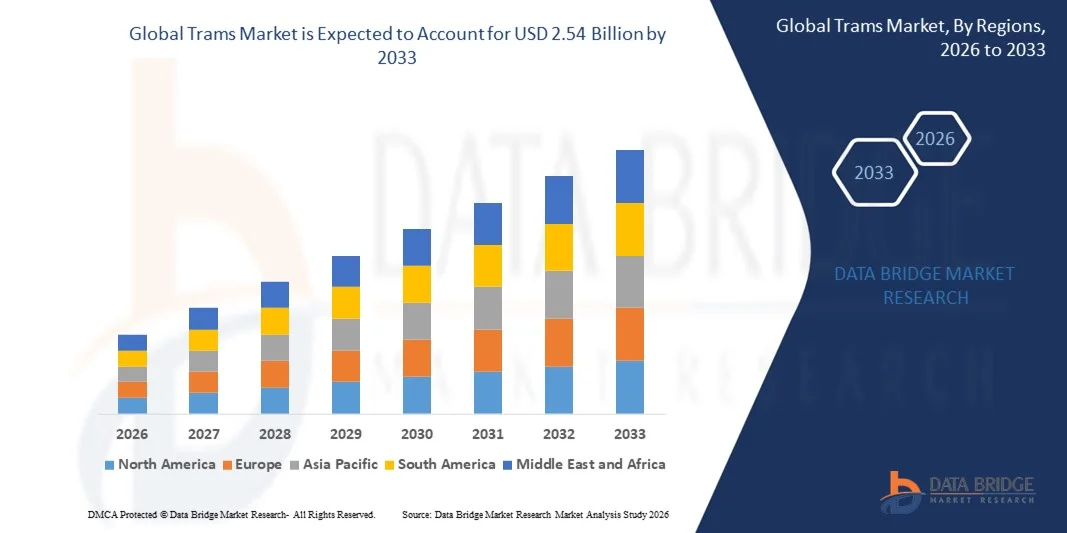
- As per Data Bridge Market Research Analysis the global trams market size was valued at USD 1.83 billion in 2025 and is expected to reach USD 2.54 billion by 2033, at a CAGR of 4.20% during the forecast period
- Increased urbanization coupled with increasing number of commuters in the metropolitan cities has resulted in growth in the trams market value. Growth and expansion of recreational sector owing to increased tourism and automotive industry will also create lucrative growth opportunities for the trams market
Market Size & Forecast
- Global Market Value (2025): USD 1.83 Billion
- Expected Market Value (2033): USD 2.54 Billion
- Forecast CAGR (2026–2033): 4.20%
What are the Major Takeaways of Trams Market?
- Rising migration of people coupled with increased concerns about traffic globally due to overpopulation will also foster the trams market growth. Stringent regulations on vehicular emissions will also propel the trams market growth rate
- Increasing environmental concerns coupled with supportive initiatives by the government are some other important trams market growth determinants
- Europe dominated the trams market with a 44.80% revenue share in 2025, driven by strong urban public transportation networks, continuous expansion of light rail infrastructure, and government-backed sustainability initiatives across Germany, France, Spain, and the U.K
- Asia-Pacific is projected to register the fastest CAGR of 8.69% from 2026 to 2033, driven by rapid urbanization, infrastructure expansion, and increasing government investments in mass transit systems across China, Japan, India, South Korea, and Southeast Asia
- The Articulated Tram segment dominated the market with a 46.5% share in 2025, owing to its higher passenger capacity, flexibility in navigating urban curves, and suitability for high-density city routes
Report Scope and Trams Market Segmentation
|
Attributes |
Trams Key Market Insights |
|
Segments Covered |
|
|
Countries Covered |
North America
Europe
Asia-Pacific
Middle East and Africa
South America
|
|
Key Market Players |
|
|
Market Opportunities |
|
|
Value Added Data Infosets |
In addition to the insights on market scenarios such as market value, growth rate, segmentation, geographical coverage, and major players, the market reports curated by the Data Bridge Market Research also include in-depth expert analysis, pricing analysis, brand share analysis, consumer survey, demography analysis, supply chain analysis, value chain analysis, raw material/consumables overview, vendor selection criteria, PESTLE Analysis, Porter Analysis, and regulatory framework. |
What is the Key Trend in the Trams Market?
Growing Adoption of Energy-Efficient, Smart, and Low-Floor Tram Systems
- The trams market is witnessing strong adoption of low-floor, energy-efficient, and digitally integrated tram systems designed to enhance passenger accessibility, urban mobility, and environmental sustainability
- Manufacturers are introducing lightweight tram bodies, regenerative braking systems, and hybrid or battery-powered propulsion technologies to reduce emissions and improve operational efficiency
- Growing demand for smart city transportation networks and congestion reduction solutions is driving tram deployment across metropolitan areas worldwide
- For instance, companies such as Alstom, Siemens, CRRC, and CAF, Construcciones y Auxiliar de Ferrocarriles, S.A. are introducing next-generation trams with onboard energy storage, digital diagnostics, and predictive maintenance systems
- Increasing integration of IoT-based monitoring, real-time passenger information systems, and automated control technologies is accelerating the shift toward smart tram networks
- As cities focus on decarbonization and sustainable public transit, trams will remain vital for reducing traffic congestion, lowering carbon emissions, and improving urban transportation efficiency
What are the Key Drivers of Trams Market?
- Rising investments in urban infrastructure modernization and sustainable public transportation projects are significantly driving tram network expansions globally
- For instance, during 2024–2025, multiple European and Asian cities announced new tram corridor developments and fleet upgrades to support green mobility initiatives
- Growing concerns regarding air pollution, traffic congestion, and fuel dependency are encouraging governments to prioritize electric tram systems
- Advancements in battery technology, lightweight materials, and regenerative braking systems have strengthened tram efficiency, reliability, and lifecycle cost advantages
- Increasing public-private partnerships and funding programs for smart mobility and rail electrification projects are accelerating procurement of modern tram fleets
- Supported by rapid urbanization and climate-focused transport policies, the Trams market is expected to witness steady long-term growth
Which Factor is Challenging the Growth of the Trams Market?
- High initial capital investment associated with infrastructure development, track installation, signaling systems, and rolling stock procurement limits adoption in developing economies
- For instance, during 2024–2025, rising raw material prices and supply chain constraints increased manufacturing and project implementation costs for tram operators
- Complex regulatory approvals, land acquisition challenges, and long project execution timelines delay deployment of tram systems
- Integration of new tram lines with existing transport infrastructure requires advanced planning and significant financial resources
- Competition from electric buses, metro systems, and bus rapid transit (BRT) solutions creates budget allocation challenges for urban planners
- To address these issues, manufacturers and governments are focusing on modular designs, cost-efficient production, public-private funding models, and digital maintenance systems to enhance long-term viability of tram projects
How is the Trams Market Segmented?
The market is segmented on the basis of type, fuel type, passenger capacity, design, and sales channel.
- By Type
On the basis of type, the Trams market is segmented into Articulated Tram, Double-Decker Tram, Rubber-Tired Tram, and Restaurant Tram. The Articulated Tram segment dominated the market with a 46.5% share in 2025, owing to its higher passenger capacity, flexibility in navigating urban curves, and suitability for high-density city routes. Articulated trams are widely deployed in metropolitan transit systems due to their modular structure, improved stability, and enhanced passenger comfort.
The Rubber-Tired Tram segment is expected to grow at the fastest CAGR from 2026 to 2033, driven by increasing demand for cost-effective urban transit solutions that require lower infrastructure modification. Their ability to operate on dedicated lanes with reduced vibration and noise makes them attractive for modern smart city projects.
- By Fuel Type
On the basis of fuel type, the market is segmented into Electric, Battery Powered, Liquid Fuel, Hybrid, and Others. The Electric segment dominated the market with a 63.8% share in 2025, supported by widespread electrified rail infrastructure and strong government initiatives promoting zero-emission public transportation. Electric trams offer lower operating costs, reduced emissions, and higher energy efficiency.
The Battery Powered segment is projected to grow at the fastest CAGR from 2026 to 2033, fueled by advancements in onboard energy storage, catenary-free operations, and expansion of heritage and urban areas where overhead lines are restricted.
- By Passenger Capacity
On the basis of passenger capacity, the market is segmented into Below 60 Passengers, Between 60 to 150 Passengers, and More than 150 Passengers. The Between 60 to 150 Passengers segment dominated the market with a 49.1% share in 2025, as it provides an optimal balance between operational efficiency and urban passenger demand. These trams are commonly deployed in medium-traffic corridors.
The More than 150 Passengers segment is expected to grow at the fastest CAGR from 2026 to 2033, driven by increasing urban population density and demand for mass transit solutions in megacities.
- By Design
On the basis of design, the market is segmented into Single Ended Trams and Double Ended Trams. The Single Ended Tram segment dominated the market with a 55.4% share in 2025, due to its lower manufacturing cost and suitability for routes with looped track systems.
The Double Ended Tram segment is projected to grow at the fastest CAGR from 2026 to 2033, supported by its operational flexibility, bidirectional capability, and reduced need for turning loops in space-constrained urban environments.
- By Sales Channel
On the basis of sales channel, the market is segmented into Original Equipment Manufacturer (OEM) and Aftermarket. The OEM segment dominated the market with a 71.6% share in 2025, driven by large-scale government procurement contracts and expansion of new tram networks globally.
The Aftermarket segment is expected to grow at the fastest CAGR from 2026 to 2033, fueled by increasing fleet modernization, spare parts replacement, digital system upgrades, and long-term maintenance service agreements.
Which Region Holds the Largest Share of the Trams Market?
- Europe dominated the trams market with a 44.80% revenue share in 2025, driven by strong urban public transportation networks, continuous expansion of light rail infrastructure, and government-backed sustainability initiatives across Germany, France, Spain, and the U.K. High adoption of electric and low-floor trams supports regional goals for carbon neutrality, congestion reduction, and smart city mobility integration
- Leading companies in Europe, such as Alstom, Siemens, CAF, Construcciones y Auxiliar de Ferrocarriles, S.A., and Stadler Rail AG, are introducing energy-efficient trams with onboard batteries, regenerative braking systems, and predictive maintenance technologies, strengthening the region’s leadership
- Strong regulatory frameworks promoting green mobility, advanced rail engineering expertise, and sustained public investment in urban transit modernization further reinforce Europe’s dominant market position
Germany Trams Market Insight
Germany is a major contributor in Europe, supported by well-established tram networks, ongoing fleet modernization programs, and integration of smart signaling systems. Increasing investment in low-emission mobility and digital rail control technologies drives steady demand for next-generation trams.
France Trams Market Insight
France demonstrates strong growth due to continuous expansion of tram corridors in metropolitan cities and government initiatives supporting sustainable urban mobility. Adoption of battery-powered and low-floor tram systems enhances accessibility and environmental performance.
Asia-Pacific Trams Market
Asia-Pacific is projected to register the fastest CAGR of 8.69% from 2026 to 2033, driven by rapid urbanization, infrastructure expansion, and increasing government investments in mass transit systems across China, Japan, India, South Korea, and Southeast Asia. Growing focus on reducing urban congestion and air pollution accelerates tram network development.
China Trams Market Insight
China is the largest contributor in Asia-Pacific due to extensive urban rail investments and strong domestic manufacturing capabilities led by CRRC. Rapid smart city initiatives and electrified transport policies drive significant procurement of modern tram systems.
Japan Trams Market Insight
Japan shows steady growth supported by advanced rail engineering, high safety standards, and modernization of urban transit infrastructure. Adoption of energy-efficient and compact tram systems supports sustainable city development.
India Trams Market Insight
India is emerging as a key growth market due to expanding metro and light rail projects, increasing government funding for urban mobility, and rising focus on eco-friendly public transport systems in major cities
South Korea Trams Market Insight
South Korea contributes significantly with investments in smart transportation, digital signaling integration, and eco-friendly rolling stock. Government-backed infrastructure programs and technological innovation support sustained market expansion across metropolitan regions.
Which are the Top Companies in Trams Market?
The trams industry is primarily led by well-established companies, including:
- Siemens (Germany)
- Alstom (France)
- CRRC (China)
- Hitachi, Ltd. (Japan)
- General Electric Company (U.S.)
- Bombardier Inc. (Canada)
- Kawasaki Heavy Industries, Ltd. (Japan)
- HYUNDAI ROTEM COMPANY (South Korea)
- Toshiba Corporation (Japan)
- CAF, Construcciones y Auxiliar de Ferrocarriles, S.A. (Spain)
- ABB (Switzerland)
- KINKISHARYO International, LLC (U.S.)
- ŠKODA TRANSPORTATION a.s. (Czech Republic)
- The Kinki Sharyo Co.,Ltd. (Japan)
- Vossloh (Germany)
- Stadler Rail AG (Switzerland)
- Durmazlar Makina A.S. (Turkey)
- Brookville Equipment Corporation (U.S.)
What are the Recent Developments in Global Trams Market?
- In April 2025, the European Investment Bank approved a USD 400 million financing package to support the development of a new tram line linking Helsinki’s eastern suburbs, including the construction of a dedicated tram and bus depot along with procurement of modern rolling stock, thereby strengthening sustainable urban mobility infrastructure and long-term public transport capacity in Finland
- In March 2025, Portugal’s Council of Ministers of Portugal sanctioned an additional €150 million to accelerate the Lisbon light-rail and tram extension project along the Odivelas–Loures corridor, reinforcing the country’s commitment to expanding eco-friendly urban transit networks and improving regional connectivity
- In December 2024, the European Investment Bank committed USD 16.5 million to modernize urban transportation systems across Kyiv, Mykolaiv, Odesa, and Ivano-Frankivsk, enabling procurement of new trams, spare parts, and maintenance equipment, thereby supporting infrastructure resilience and sustainable mobility development in Ukraine

- Interactive Data Analysis Dashboard
- Company Analysis Dashboard for high growth potential opportunities
- Research Analyst Access for customization & queries
- Competitor Analysis with Interactive dashboard
- Latest News, Updates & Trend analysis
- Harness the Power of Benchmark Analysis for Comprehensive Competitor Tracking
Data collection and base year analysis are done using data collection modules with large sample sizes. The stage includes obtaining market information or related data through various sources and strategies. It includes examining and planning all the data acquired from the past in advance. It likewise envelops the examination of information inconsistencies seen across different information sources. The market data is analysed and estimated using market statistical and coherent models. Also, market share analysis and key trend analysis are the major success factors in the market report. To know more, please request an analyst call or drop down your inquiry.
The key research methodology used by DBMR research team is data triangulation which involves data mining, analysis of the impact of data variables on the market and primary (industry expert) validation. Data models include Vendor Positioning Grid, Market Time Line Analysis, Market Overview and Guide, Company Positioning Grid, Patent Analysis, Pricing Analysis, Company Market Share Analysis, Standards of Measurement, Global versus Regional and Vendor Share Analysis. To know more about the research methodology, drop in an inquiry to speak to our industry experts.
Data Bridge Market Research is a leader in advanced formative research. We take pride in servicing our existing and new customers with data and analysis that match and suits their goal. The report can be customized to include price trend analysis of target brands understanding the market for additional countries (ask for the list of countries), clinical trial results data, literature review, refurbished market and product base analysis. Market analysis of target competitors can be analyzed from technology-based analysis to market portfolio strategies. We can add as many competitors that you require data about in the format and data style you are looking for. Our team of analysts can also provide you data in crude raw excel files pivot tables (Fact book) or can assist you in creating presentations from the data sets available in the report.













