




Global Transcutaneous Monitors Market
Market Size in USD Billion
CAGR :
% 
 USD
455.50 Billion
USD
734.25 Billion
2025
2033
USD
455.50 Billion
USD
734.25 Billion
2025
2033
 Forecast Period Forecast Period |
2026 –2033 |
 Market Size (Base Year) Market Size (Base Year) |
USD 455.50 Billion |
 Market Size (Forecast Year) Market Size (Forecast Year) |
USD 734.25 Billion |
 CAGR CAGR |
% |
| Major Markets Players |
|
Transcutaneous Monitors Market Size
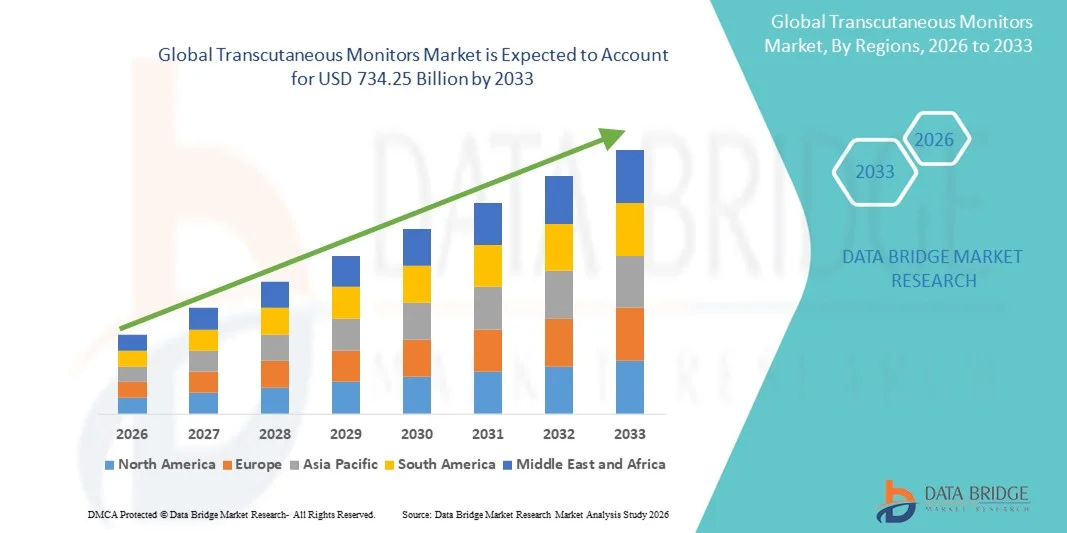
- The global transcutaneous monitors market size was valued at USD 455.5 billion in 2025 and is expected to reach USD 734.25 billion by 2033, at a CAGR of 6.15% during the forecast period
- The market growth is largely fueled by the increasing prevalence of chronic diseases, rising geriatric population, and growing awareness about non-invasive monitoring technologies, leading to higher adoption of transcutaneous monitoring systems in hospitals, clinics, and home care settings
- Furthermore, advancements in sensor technology, wearable devices, and real-time patient monitoring solutions are driving demand for accurate, continuous, and user-friendly transcutaneous monitors. These converging factors are accelerating the uptake of transcutaneous monitoring solutions, thereby significantly boosting the overall growth of the Transcutaneous Monitors market
Transcutaneous Monitors Market Analysis
- Transcutaneous monitors, which are non-invasive devices used to continuously measure physiological parameters such as oxygen, carbon dioxide, or glucose levels through the skin, are increasingly vital in clinical settings, home healthcare, and remote patient monitoring due to their accuracy, real-time data capabilities, and ease of use
- The escalating demand for transcutaneous monitors is primarily fueled by the growing prevalence of chronic diseases, rising geriatric population, increasing awareness about non-invasive patient monitoring, and the adoption of advanced healthcare technologies
- North America dominated the transcutaneous monitors market, accounting for approximately 42.3% of the global revenue share in 2025, supported by high healthcare expenditure, widespread adoption of advanced medical devices, and the presence of key industry players driving innovations in continuous and remote monitoring solutions
- Asia-Pacific is expected to be the fastest-growing region in the transcutaneous monitors market during the forecast period, with an estimated CAGR of 8.1%, due to increasing urbanization, rising healthcare infrastructure investments, and growing demand for advanced patient monitoring solutions across hospitals and home care settings
- The Multi-Channel Transcutaneous Monitors segment dominated the largest market revenue share of 48.5% in 2025, owing to their ability to measure multiple parameters (e.g., oxygen and carbon dioxide) simultaneously in real time
Report Scope and Transcutaneous Monitors Market Segmentation
|
Attributes |
Transcutaneous Monitors Key Market Insights |
|
Segments Covered |
|
|
Countries Covered |
North America
Europe
Asia-Pacific
Middle East and Africa
South America
|
|
Key Market Players |
• Medtronic (Ireland) |
|
Market Opportunities |
|
|
Value Added Data Infosets |
In addition to the insights on market scenarios such as market value, growth rate, segmentation, geographical coverage, and major players, the market reports curated by the Data Bridge Market Research also include in-depth expert analysis, patient epidemiology, pipeline analysis, pricing analysis, and regulatory framework. |
Transcutaneous Monitors Market Trends
Technological Advancements and Miniaturization in Transcutaneous Monitors
- A significant and accelerating trend in the global transcutaneous monitors market is the continuous development of miniaturized, non-invasive, and wearable monitoring systems. These devices provide continuous real-time measurement of physiological parameters such as oxygen saturation, carbon dioxide levels, and other critical biomarkers through the skin
- For instance, next-generation transcutaneous monitors feature compact, lightweight designs that allow patients to move freely while ensuring accurate readings. The integration of high-precision sensors and advanced calibration algorithms ensures reliable performance even in challenging clinical conditions
- Advances in wireless connectivity and data logging allow seamless integration with hospital information systems and remote patient monitoring platforms. Clinicians can track patient trends in real time, facilitating timely interventions and personalized care
- Wearable transcutaneous monitors are increasingly compatible with mobile applications, enabling both healthcare professionals and patients to access and visualize data easily
- The ongoing trend towards miniaturization, portability, and enhanced sensor technology is fundamentally improving patient comfort, adherence, and overall clinical workflow efficiency
- Companies such as Radiometer, SenTec, and Masimo are actively developing devices with smaller footprints, longer battery life, and automated calibration, catering to the growing demand for continuous monitoring in hospitals, neonatal care, and home settings
- Rising awareness among healthcare providers and patients about the benefits of continuous monitoring over intermittent sampling is driving adoption. The convergence of portability, accuracy, and real-time data access is reshaping user expectations for patient monitoring systems
- Technological improvements are making these monitors suitable for use across multiple care settings, including ICU, surgical recovery, neonatal, and home care applications. Miniaturized monitors with non-invasive sensors reduce patient discomfort, lower infection risk, and minimize clinical workload
- This trend towards smart, patient-friendly, and highly accurate monitoring systems is expected to drive innovation and expand the overall market. Increasing investments in R&D for advanced transcutaneous monitoring technologies further support market growth globally
Transcutaneous Monitors Market Dynamics
Driver
Rising Demand for Continuous and Non-Invasive Patient Monitoring
- The increasing prevalence of chronic respiratory and cardiovascular conditions is a major driver for the rising adoption of transcutaneous monitors. These devices provide continuous and accurate measurements of oxygen and carbon dioxide levels without invasive sampling
- For instance, hospitals are increasingly using transcutaneous oxygen monitors for neonatal intensive care units (NICUs) to ensure safe oxygen delivery for premature infants
- Continuous monitoring allows early detection of hypoxia, hypercapnia, or other critical events, improving patient outcomes and reducing complications
- The growing demand for home healthcare and remote monitoring solutions is further supporting market expansion, as patients and caregivers prefer non-invasive, easy-to-use devices for long-term care
- Advances in sensor technology, data integration, and user-friendly interfaces make these monitors essential tools for both hospital and home care settings
- Rising awareness about the benefits of continuous monitoring over intermittent sampling is encouraging adoption across clinics, hospitals, and research institutions. The convenience of portable and wearable devices enhances patient compliance and allows clinicians to monitor multiple patients efficiently
- Regulatory approvals for non-invasive monitoring devices are accelerating availability in key markets. Increasing investments in chronic disease management programs by healthcare providers further drive demand
- Manufacturers are focusing on device accuracy, calibration stability, and ease of use to meet clinical requirements. Overall, the shift toward safer, non-invasive, and patient-friendly monitoring solutions is a critical growth driver for the transcutaneous monitors market
Restraint/Challenge
High Device Costs and Technical Limitations
- The relatively high initial cost of advanced transcutaneous monitors presents a challenge for widespread adoption, particularly in small clinics and developing regions
- For instance, devices from leading manufacturers such as Radiometer and SenTec with multi-parameter sensing capabilities can involve significant upfront investment, which may limit purchase by cost-sensitive healthcare providers
- Technical limitations such as sensor drift, requirement for frequent calibration, and sensitivity to environmental factors can affect accuracy, creating hesitancy among some clinicians
- Maintenance requirements and the need for skilled operators increase operational costs. Battery life and sensor replacement requirements may add to the overall cost of ownership, particularly for continuous monitoring applications
- While prices are gradually decreasing for basic models, premium features like wireless connectivity, automated calibration, or multi-parameter measurement often come with a higher price tag
- Inadequate infrastructure in remote or low-resource settings can limit adoption of these devices
- Addressing these challenges through cost-effective designs, improved sensor stability, and simplified operation is essential for broader market penetration
- Manufacturers are investing in robust, low-maintenance devices to reduce total cost of ownership. Education and training of healthcare personnel on device usage can enhance adoption and confidence
- Overcoming both economic and technical barriers will be vital for sustained market growth in the transcutaneous monitors sector. As innovation continues, affordability and reliability improvements are expected to drive long-term market expansion
Transcutaneous Monitors Market Scope
The market is segmented on the basis of type, application, end user, channel type, and product.
- By Type
On the basis of type, the Transcutaneous Monitors market is segmented into Adult Wound Healing and Neonatal Care. The Adult Wound Healing segment dominated the largest market revenue share of 46.2% in 2025, driven by the increasing prevalence of chronic wounds, diabetic ulcers, and post-surgical recovery cases. These monitors are widely used in hospitals and specialty clinics to provide real-time oxygenation and perfusion measurements, which are critical for wound healing management. Continuous monitoring helps clinicians optimize therapy, reduce healing times, and prevent complications such as tissue necrosis or infections. The availability of portable and user-friendly devices makes it convenient for both inpatient and outpatient care. Increasing awareness about evidence-based wound management and growing geriatric populations further reinforce adoption. Devices in this segment are often integrated with hospital information systems for accurate data logging and trend analysis. Advanced sensor technologies provide high precision and repeatability. Multi-parametric monitoring and automated alerts improve patient care quality. The segment’s widespread clinical adoption ensures its dominance in terms of revenue contribution.
The Neonatal Care segment is expected to witness the fastest CAGR of 13.4% from 2026 to 2033, driven by rising demand for continuous, non-invasive monitoring of oxygen saturation and carbon dioxide levels in premature and critically ill infants. NICUs rely heavily on these monitors to prevent hypoxia or hypercapnia-related complications. Technological improvements such as smaller sensor sizes, gentle adhesives, and accurate calibration have enhanced device reliability and infant safety. Hospitals are increasingly adopting portable, multi-parameter devices to monitor multiple infants simultaneously. The rising incidence of preterm births and neonatal respiratory disorders globally further fuels adoption. Integration with electronic health records enables better trend analysis and clinical decision-making. Enhanced accuracy, longer sensor life, and minimal skin irritation are also supporting rapid segment growth.
- By Application
On the basis of application, the market is segmented into Wound Healing, Blood Gas Monitoring, Sleep Diagnostics, Respiratory Care, Plastic Surgery, Diagnostic in Vascular Ischemia, and Others. The Wound Healing segment dominated the market with a revenue share of 44.7% in 2025, owing to its extensive clinical use for monitoring oxygenation and perfusion in chronic, acute, and post-surgical wounds. These devices help optimize therapeutic interventions, prevent tissue necrosis, and improve patient recovery outcomes. Adoption is driven by hospitals, specialty clinics, and home-care settings for chronic wound management. Devices provide real-time alerts and data logging for clinician review, improving care quality and reducing treatment times. Integration with hospital networks allows seamless tracking of patient progress. The availability of portable and wearable devices enhances patient mobility and comfort. Rising prevalence of diabetes, obesity, and aging populations further supports growth. Increased awareness about evidence-based wound care protocols strengthens demand. Advanced sensors with high accuracy, ease of use, and compatibility with existing clinical workflows maintain segment dominance.
The Blood Gas Monitoring segment is expected to witness the fastest CAGR of 14.2% from 2026 to 2033, fueled by the rising demand for non-invasive, continuous monitoring of oxygen and carbon dioxide levels in critically ill patients. Hospitals and neonatal units are increasingly using these monitors to detect hypoxia or hypercapnia early, improving patient safety. Technological advancements such as wireless data transmission, multi-parameter measurement, and automated calibration enhance reliability. Integration with ICU monitoring systems allows real-time clinical decision-making. Rising prevalence of respiratory and cardiovascular diseases globally drives adoption. Portable devices are preferred for bedside and home-care use. Rapid development of miniaturized sensors ensures high patient comfort. Increasing healthcare investments and adoption in emerging economies further accelerate growth.
- By End User
On the basis of end user, the market is segmented into Hospitals, Ambulatory Surgical Centers, Specialty Clinics, Neonatal Intensive Care, and Diagnostic Centers. The Hospitals segment held the largest market revenue share of 42.9% in 2025, attributed to the extensive use of transcutaneous monitors in critical care, surgery, wound management, and neonatal care units. Hospitals benefit from multi-parameter devices that allow real-time monitoring, improve patient safety, and support evidence-based interventions. Integration with hospital IT systems ensures seamless data logging and trend analysis. Growing chronic disease prevalence, increasing surgical procedures, and enhanced patient monitoring protocols drive adoption. Devices are widely used in ICUs, ORs, and wards for continuous oxygen and carbon dioxide monitoring. Ease of training, robust device design, and clinical reliability further reinforce hospital dominance. Wound care and respiratory monitoring applications also contribute significantly to revenue. The combination of critical care demand and advanced device features ensures segment leadership.
The Neonatal Intensive Care segment is expected to register the fastest CAGR of 13.7% from 2026 to 2033, driven by the growing number of premature births and neonatal respiratory complications. NICUs increasingly rely on continuous non-invasive monitoring to reduce morbidity and mortality risks. Advances in sensor miniaturization, adhesive design, and data accuracy have enhanced safety and clinical confidence. Multi-channel monitoring devices allow simultaneous tracking of multiple parameters for several neonates. Rising awareness of neonatal care standards and hospital accreditation requirements further supports adoption. Technological integration with electronic health records allows trend tracking and early intervention. NICUs in emerging economies are also expanding rapidly, boosting market potential. Growing investment in neonatal healthcare infrastructure underpins rapid growth.
- By Channel Type
On the basis of channel type, the market is segmented into Single Channel Transcutaneous Monitors and Multi-Channel Transcutaneous Monitors. The Multi-Channel Transcutaneous Monitors segment dominated the largest market revenue share of 48.5% in 2025, owing to their ability to measure multiple parameters (e.g., oxygen and carbon dioxide) simultaneously in real time. Hospitals, ICUs, and surgical centers prefer multi-channel devices for continuous, reliable monitoring. Advanced features such as automated calibration, trend analysis, and data logging improve clinical workflow efficiency. Integration with hospital networks ensures centralized monitoring. Multi-channel devices are widely used in critical care, wound management, and neonatal applications, increasing adoption. Improved accuracy, safety, and reliability maintain market dominance. Multi-channel systems support multiple patient use and enable remote monitoring in large clinical setups. Enhanced software interfaces facilitate trend analysis, alarm management, and clinician review. Rising demand for comprehensive patient monitoring solutions reinforces segment leadership.
The Single Channel Transcutaneous Monitors segment is expected to witness the fastest CAGR of 12.8% from 2026 to 2033, driven by their affordability, compact size, and suitability for smaller clinics or outpatient care. These devices focus on a single parameter, such as oxygen saturation, making them easier to operate and maintain. Start-up clinics, specialty care centers, and home-care setups are increasingly adopting these monitors for cost-effective solutions. Lightweight and portable designs enhance usability. Increasing awareness about non-invasive monitoring and growing outpatient healthcare services accelerate demand. Technological improvements in sensor accuracy and battery life further support adoption. The combination of low cost, portability, and adequate functionality ensures rapid growth of the single-channel segment.
- By Product
On the basis of product, the market is segmented into Baby Monitors, Wound Healing Monitors, and Others. The Wound Healing Monitors segment dominated the market with a revenue share of 45.1% in 2025, supported by increasing prevalence of chronic wounds, post-surgical recovery, and diabetic ulcers. These devices help clinicians track perfusion and oxygenation at wound sites, enabling timely intervention and improved patient outcomes. Hospitals and specialty clinics widely adopt these monitors due to their clinical reliability and integration with electronic medical records. Portable and wearable designs improve patient comfort and mobility. Advanced sensors with real-time data analytics enhance therapeutic decision-making. The growing geriatric population and focus on wound care management protocols further reinforce adoption. Multi-parameter measurement capability and software-assisted trend analysis strengthen market leadership. High clinical demand across acute, chronic, and home-care settings ensures segment dominance.
The Baby Monitors segment is expected to witness the fastest CAGR of 13.5% from 2026 to 2033, driven by the rising need for continuous neonatal monitoring in hospitals and NICUs. Increasing incidence of preterm births and neonatal respiratory disorders is accelerating demand. Advances in miniaturized sensors, adhesive design, and accuracy enhance safety and clinical reliability. NICUs increasingly adopt wearable, non-invasive monitors for oxygen saturation and transcutaneous carbon dioxide measurement. Portable, user-friendly designs support bedside monitoring and early intervention. Integration with electronic health records enables real-time clinician review. Rising neonatal care awareness and hospital infrastructure expansion in emerging markets further fuel growth. Multi-parameter monitoring capabilities and reliable trend tracking contribute to rapid adoption of baby monitors.
Transcutaneous Monitors Market Regional Analysis
- North America dominated the transcutaneous monitors market, accounting for approximately 42.3% of the global revenue share in 2025
- Supported by high healthcare expenditure, widespread adoption of advanced medical devices, and the presence of key industry players driving innovations in continuous and remote monitoring solutions
- The region benefits from growing patient awareness, technological advancements in wearable and non-invasive monitoring devices, and increasing integration of telemedicine and digital health platforms
U.S. Transcutaneous Monitors Market Insight
The U.S. transcutaneous monitors market captured the largest revenue share within North America in 2025, fueled by the rapid adoption of connected healthcare devices and increasing demand for continuous patient monitoring. The growing preference for home-based care, telehealth integration, and non-invasive monitoring solutions further propels the market. Additionally, increasing investments in medical research, digital health infrastructure, and healthcare IT systems are contributing to sustained growth in the U.S. market.
Europe Transcutaneous Monitors Market Insight
The Europe transcutaneous monitors market is projected to expand at a substantial CAGR throughout the forecast period, driven by stringent healthcare regulations, rising prevalence of chronic diseases, and the increasing adoption of advanced monitoring technologies in hospitals and home care. Germany, the U.K., and France are key contributors, with strong government initiatives promoting digital health solutions and homecare monitoring systems.
U.K. Transcutaneous Monitors Market Insight
The U.K. transcutaneous monitors market is expected to grow at a notable CAGR during the forecast period, supported by increasing adoption of connected health devices, rising patient awareness, and growing investment in home care and remote monitoring solutions. Healthcare providers are increasingly integrating transcutaneous monitors into telehealth programs to improve patient outcomes and reduce hospital visits.
Germany Transcutaneous Monitors Market Insight
The Germany transcutaneous monitors market is anticipated to expand significantly during the forecast period, driven by the country’s emphasis on digital health, well-developed healthcare infrastructure, and high adoption of technologically advanced, eco-conscious medical devices. Hospitals and clinics are increasingly incorporating transcutaneous monitoring systems to enhance patient care, while research initiatives support innovation in non-invasive monitoring solutions.
Asia-Pacific Transcutaneous Monitors Market Insight
The Asia-Pacific transcutaneous monitors market is expected to be the fastest-growing region, with an estimated CAGR of 8.1%, driven by increasing urbanization, rising healthcare infrastructure investments, and growing demand for advanced patient monitoring solutions across hospitals and home care settings. Countries such as China, Japan, and India are witnessing significant growth due to expanding healthcare facilities, increasing adoption of digital health technologies, and government initiatives promoting remote patient monitoring.
Japan Transcutaneous Monitors Market Insight
The Japan transcutaneous monitors market is gaining momentum due to the country’s high-tech culture, aging population, and rising demand for convenient, non-invasive monitoring solutions. Integration with IoT and home healthcare systems is driving adoption, while hospitals and home care providers increasingly rely on transcutaneous monitors to improve patient outcomes.
China Transcutaneous Monitors Market Insight
The China transcutaneous monitors market accounted for the largest revenue share in the Asia-Pacific region in 2025. The growth is driven by rapid urbanization, expanding middle-class population, increasing healthcare expenditure, and widespread adoption of advanced medical devices. The government’s push for smart healthcare infrastructure and strong domestic manufacturing capabilities further accelerate the adoption of transcutaneous monitoring solutions in hospitals, clinics, and home care settings.
Transcutaneous Monitors Market Share
The Transcutaneous Monitors industry is primarily led by well-established companies, including:
• Medtronic (Ireland)
• Nihon Kohden (Japan)
• Radiometer Medical (Denmark)
• Smiths Medical (U.K.)
• Masimo Corporation (U.S.)
• GE Healthcare (U.S.)
• Drägerwerk AG & Co. KGaA (Germany)
• SenTec AG (Switzerland)
• Nonin Medical (U.S.)
• Kontron Medical (Germany)
• Fukuda Denshi (Japan)
• Edan Instruments (China)
• Mindray Bio-Medical Electronics (China)
• Beijing Choice Electronic Technology (China)
• Oxlab GmbH (Germany)
• Bionet Co., Ltd. (South Korea)
• PerkinElmer (U.S.)
• Arkray, Inc. (Japan)
• CMA Microdialysis AB (Sweden)
• Radiometer Americas (U.S.)
Latest Developments in Global Transcutaneous Monitors Market
- In November 2024, Sentec AG introduced the tCOM+ transcutaneous monitoring system, a new continuous non‑invasive patient monitor that measures transcutaneous CO₂ (tcPCO₂), oxygen saturation (SpO₂), and pulse rate. The system features significant software enhancements for workflow improvement, intuitive touchscreen controls, and compatibility with major patient monitoring and ventilator systems, expanding solutions for critical care and respiratory monitoring
- In March 2025, Sentec AG further emphasized continuous non‑invasive ventilation monitoring with expanded clinical applications, highlighting the tCOM+ system’s role in neonatal and pediatric care, acute respiratory, sleep medicine, and home ventilation management. This development underscores the sustained adoption of transcutaneous monitoring across diverse care settings
- In June 2025, Radiometer’s TCM5 FLEX transcutaneous monitor was featured in market news as a widely deployed advanced continuous monitoring solution, providing real‑time non‑invasive measurements of oxygenation (tcpO₂), ventilation (tcpCO₂), SpO₂, and pulse rate in neonatal and adult intensive care units. The device’s expanded distribution reflects growing clinical preference for multi‑parameter, point‑of‑care transcutaneous monitoring technology
- In January 2025, market reports highlighted steady market growth for transcutaneous monitors, driven by adoption in NICUs and multi‑channel monitoring systems, projecting global sales to reach USD ~455.9 million in 2025 and continue upward. This market insight signals broader industry confidence and increased deployment of advanced transcutaneous monitoring technologies
SKU-
Get online access to the report on the World's First Market Intelligence Cloud

- Interactive Data Analysis Dashboard
- Company Analysis Dashboard for high growth potential opportunities
- Research Analyst Access for customization & queries
- Competitor Analysis with Interactive dashboard
- Latest News, Updates & Trend analysis
- Harness the Power of Benchmark Analysis for Comprehensive Competitor Tracking
Research Methodology
Data collection and base year analysis are done using data collection modules with large sample sizes. The stage includes obtaining market information or related data through various sources and strategies. It includes examining and planning all the data acquired from the past in advance. It likewise envelops the examination of information inconsistencies seen across different information sources. The market data is analysed and estimated using market statistical and coherent models. Also, market share analysis and key trend analysis are the major success factors in the market report. To know more, please request an analyst call or drop down your inquiry.
The key research methodology used by DBMR research team is data triangulation which involves data mining, analysis of the impact of data variables on the market and primary (industry expert) validation. Data models include Vendor Positioning Grid, Market Time Line Analysis, Market Overview and Guide, Company Positioning Grid, Patent Analysis, Pricing Analysis, Company Market Share Analysis, Standards of Measurement, Global versus Regional and Vendor Share Analysis. To know more about the research methodology, drop in an inquiry to speak to our industry experts.
Customization Available
Data Bridge Market Research is a leader in advanced formative research. We take pride in servicing our existing and new customers with data and analysis that match and suits their goal. The report can be customized to include price trend analysis of target brands understanding the market for additional countries (ask for the list of countries), clinical trial results data, literature review, refurbished market and product base analysis. Market analysis of target competitors can be analyzed from technology-based analysis to market portfolio strategies. We can add as many competitors that you require data about in the format and data style you are looking for. Our team of analysts can also provide you data in crude raw excel files pivot tables (Fact book) or can assist you in creating presentations from the data sets available in the report.












