


Transducer for Fetal Heart Rate Market Overview
The Transducer for Fetal Heart Rate Market was valued at USD 5.07 billion in 2025 and is projected to reach USD 9.04 billion by 2033, growing at a CAGR of 7.50 % from 2026 to 2033. The Transducer for Fetal Heart Rate Market is experiencing steady growth driven by the increasing prevalence of high-risk pregnancies, rising demand for early and accurate fetal monitoring, and continuous advancements in obstetric ultrasound and Doppler-based monitoring technologies. The growing emphasis on maternal and fetal safety in hospitals and maternity care centers is accelerating the adoption of advanced fetal heart rate transducers capable of delivering high-sensitivity, real-time monitoring during prenatal and intrapartum care.
In addition, the increasing number of hospital births globally, coupled with expanding access to prenatal care in emerging economies, is supporting market expansion. Healthcare providers are increasingly adopting non-invasive, high-precision fetal monitoring systems integrated with digital healthcare platforms to improve diagnostic accuracy and clinical decision-making. Technological advancements such as wireless transducers, improved signal processing, and AI-assisted fetal monitoring are further enhancing patient outcomes while enabling continuous, comfortable, and reliable fetal heart rate assessment across healthcare settings.
Key Market Trends & Insights
- North America dominated the Transducer for Fetal Heart Rate Market with the largest revenue share of 39.12% in 2025, supported by advanced healthcare infrastructure, high adoption of fetal monitoring technologies, strong presence of specialized maternity and neonatal care hospitals, and favorable reimbursement frameworks. The region also benefits from widespread use of ultrasound-based fetal heart rate monitoring systems, increasing high-risk pregnancies requiring continuous fetal surveillance, and strong integration of digital monitoring solutions in hospital obstetric departments.
- The Non-Invasive segment dominated the market with a 41% share in 2025, owing to its safety, patient comfort, and widespread clinical acceptance in prenatal monitoring.
- Asia-Pacific is expected to be the fastest-growing region at a CAGR of 7.9% from 2026 to 2033, fueled by improving maternal healthcare infrastructure, rising birth rates in select economies, expanding access to prenatal diagnostic services, and increasing government initiatives for maternal and child health. Rapid hospital expansion and growing adoption of portable fetal monitoring devices across China, India, and Southeast Asia are further accelerating regional market growth.
- The Portable Systems segment is witnessing strong growth with an estimated CAGR of 7.3% (2026–2033), driven by increasing demand for flexible, point-of-care fetal monitoring in hospitals, ambulatory settings, and emergency obstetric care. Portability allows continuous fetal heart rate monitoring in both rural and urban healthcare settings, improving maternal outcomes and expanding adoption in resource-limited regions.
- The Antepartum application segment dominated the market with a 46.21% revenue share in 2025, supported by routine prenatal monitoring needs, early detection of fetal distress, and increasing use of non-invasive monitoring techniques during pregnancy. Rising awareness of maternal-fetal health and growing frequency of prenatal check-ups in developed healthcare systems further reinforce segment leadership.
- The Hospitals segment accounted for the largest end-user share of 58.73% in 2025, driven by high patient inflow for maternity care, availability of advanced diagnostic infrastructure, and presence of skilled obstetric specialists. Hospitals remain the primary setting for fetal heart rate monitoring due to their ability to manage high-risk pregnancies and provide continuous fetal surveillance using advanced monitoring systems.
Market Size & Forecast
- Global Market Value (2025): USD 5.07 Billion
- Expected Market Value (2033): USD 9.04 Billion
- Forecast CAGR (2026–2033): 7.50 %
- Leading Region in 2025: North America
- Fastest Growing Region: Asia-Pacific
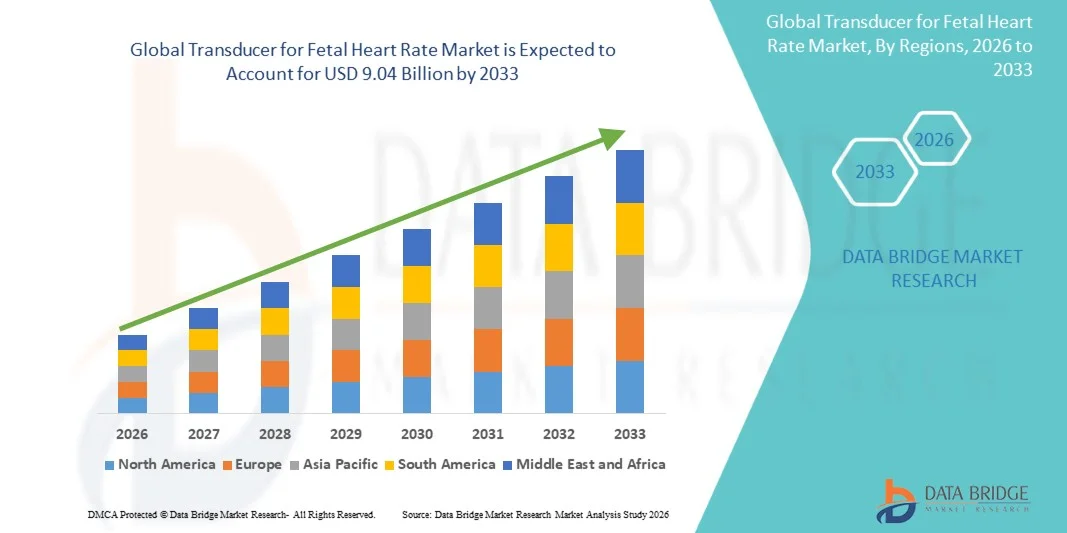
Report Scope and Transducer for Fetal Heart Rate Market Segmentation
|
Attributes |
Transducer for Fetal Heart Rate Key Market Insights |
|
Segments Covered |
|
|
Countries Covered |
North America · U.S. · Canada · Mexico Europe · Germany · France · U.K. · Netherlands · Switzerland · Belgium · Russia · Italy · Spain · Turkey · Rest of Europe Asia-Pacific · China · Japan · India · South Korea · Singapore · Malaysia · Australia · Thailand · Indonesia · Philippines · Rest of Asia-Pacific Middle East and Africa · Saudi Arabia · U.A.E. · South Africa · Egypt · Israel · Rest of Middle East and Africa South America · Brazil · Argentina · Rest of South America |
|
Key Market Players |
• Koninklijke Philips N.V. (Netherlands) |
|
Market Opportunities |
· Expansion of AI-Integrated Fetal Monitoring Systems · Rising Adoption of Remote and Home-Based Prenatal Monitoring · Growth in Emerging Markets with Expanding Maternal Healthcare Infrastructure |
|
Value Added Data Infosets |
In addition to the insights on market scenarios such as market value, growth rate, segmentation, geographical coverage, and major players, the market reports curated by the Data Bridge Market Research also include in-depth expert analysis, geographically represented company-wise production and capacity, network layouts of distributors and partners, detailed and updated price trend analysis and deficit analysis of supply chain and demand. |
Transducer for Fetal Heart Rate Market Trends
Trend: Growth in Advanced Prenatal Monitoring & Remote Fetal Surveillance
Healthcare providers are increasingly adopting high-precision transducers for fetal heart rate monitoring to improve prenatal care accuracy and enable early detection of fetal distress. Hospitals and maternity centers are integrating advanced ultrasound-based and Doppler transducers with digital fetal monitoring systems to ensure continuous and reliable assessment during pregnancy and labor. The integration of wireless and portable fetal heart rate transducers is enabling real-time monitoring in hospitals, ambulatory care centers, and home-care settings. These systems support better maternal mobility while maintaining clinical-grade accuracy, making them increasingly important in high-risk pregnancy management. In addition, the growing use of centralized fetal monitoring systems in labor wards allows clinicians to track multiple patients simultaneously, improving response time and clinical decision-making.
Transducer for Fetal Heart Rate Market Dynamics
Key Market Driver: Rising Prevalence of High-Risk Pregnancies and Advancements in Fetal Monitoring Technologies
The increasing incidence of high-risk pregnancies, including maternal diabetes, hypertension, and advanced maternal age, is significantly driving demand for fetal heart rate transducers. These devices play a critical role in continuous fetal monitoring, enabling early identification of fetal hypoxia, arrhythmias, and distress conditions.
According to global maternal health studies, complications during pregnancy remain a leading cause of neonatal morbidity, strengthening the need for accurate and continuous fetal monitoring systems. Hospitals are increasingly deploying advanced ultrasound transducers and fetal scalp electrodes integrated with digital monitoring platforms. Leading medical device companies are enhancing transducer sensitivity, signal accuracy, and noise reduction capabilities to improve diagnostic reliability during labor and antepartum monitoring.
Key Restraint/Challenge: High Cost of Advanced Fetal Monitoring Systems and Limited Access in Developing Regions
A major challenge in the transducer for fetal heart rate market is the high cost associated with advanced fetal monitoring systems, particularly those integrated with digital telemetry and centralized monitoring platforms. Hospitals and maternity clinics in low- and middle-income countries often face budget constraints, limiting widespread adoption of advanced transducer technologies.
In addition, maintenance costs, calibration requirements, and the need for trained clinical staff further increase the total cost of ownership. Limited healthcare infrastructure in rural and underserved regions also restricts access to continuous fetal monitoring, resulting in delayed diagnosis of fetal complications. Variability in reimbursement policies across regions further affects adoption rates of advanced fetal monitoring equipment.
Key Market Opportunity: Expansion of Telehealth, Wireless Monitoring, and AI-Integrated Fetal Surveillance Systems
The transducer for fetal heart rate market presents significant opportunities through the expansion of telehealth-enabled prenatal care and AI-integrated fetal monitoring systems. Wireless and wearable transducers are increasingly being used for remote monitoring of high-risk pregnancies, enabling continuous data transmission to healthcare providers.
Artificial intelligence is being integrated into fetal monitoring platforms to analyze heart rate patterns, detect early signs of fetal distress, and support clinical decision-making. In addition, cloud-based fetal monitoring systems are enabling real-time data sharing between hospitals, specialists, and remote clinics. Growing investments in maternal healthcare infrastructure across Asia-Pacific and the Middle East are further expanding access to advanced fetal monitoring technologies, creating strong long-term growth potential for the market.
Transducer for Fetal Heart Rate Market Scope
The Transducer for Fetal Heart Rate market is segmented on the basis of Product, Portability, Method, Application, and End User.
By Product
On the basis of product, the Transducer for Fetal Heart Rate Market is segmented into ultrasound transducers, fetal electrodes, telemetry devices, accessories & consumables, and wireless monitoring transducers. The Ultrasound Transducers segment dominated the market with a 44.62% share in 2025, owing to its high diagnostic accuracy, non-invasive monitoring capability, and strong clinical preference in hospitals and maternity centers. These devices are widely used for routine fetal heart rate assessment due to real-time signal detection and improved safety profile. Increasing prevalence of high-risk pregnancies and rising demand for continuous fetal monitoring are further supporting segment growth.
Strong adoption in developed healthcare systems, especially in North America and Europe, is driven by advanced obstetric infrastructure and availability of skilled professionals. Integration with digital imaging and hospital information systems enhances workflow efficiency. In addition, improvements in probe sensitivity and imaging resolution are improving diagnostic reliability. Hospitals are increasingly standardizing ultrasound-based monitoring in prenatal care protocols. Rising global birth rates in emerging economies are further strengthening demand. Government initiatives for maternal healthcare are also supporting adoption.The Wireless Monitoring Transducers segment is expected to witness the fastest growth at a CAGR of 7.8% from 2026 to 2033, driven by increasing demand for remote patient monitoring and telehealth-based prenatal care. Growing adoption of wearable fetal monitoring systems enables continuous tracking outside clinical settings. Rising smartphone integration and cloud-based data sharing are enhancing usability. These systems are increasingly used in homecare and ambulatory monitoring applications. Expansion of digital health infrastructure in Asia-Pacific is accelerating adoption. In addition, improvements in battery life and signal accuracy are supporting clinical reliability. Rising preference for patient-centric care models is fueling demand globally.
By Portability
On the basis of portability, the Transducer for Fetal Heart Rate Market is segmented into portable systems, handheld systems, and bedside monitoring systems. The Portable Systems segment dominated the market with a 52.18% share in 2025, driven by high flexibility, ease of mobility within hospitals, and strong adoption in emergency and labor ward settings. These systems are widely preferred in maternity hospitals due to quick deployment capability and efficient workflow integration. Increasing hospital admissions and demand for real-time fetal monitoring are supporting usage.Portable systems also reduce dependency on fixed infrastructure, making them ideal for mid-sized healthcare facilities. Growing investments in maternal healthcare infrastructure in developing regions are further boosting adoption. Technological advancements have improved device accuracy and reduced size. Integration with central monitoring stations allows better clinical decision-making. Rising preference for compact and efficient devices in obstetric care is strengthening demand. Government funding for maternal health programs is further supporting expansion.\
The Handheld Systems segment is expected to witness the fastest growth at a CAGR of 7.5% from 2026 to 2033, driven by increasing demand for point-of-care diagnostics and home-based fetal monitoring solutions. These devices are gaining popularity among rural healthcare providers due to affordability and ease of use. Rising awareness of prenatal care is boosting adoption in emerging economies. Growth of telemedicine platforms is enabling remote monitoring integration. Improvements in Doppler technology are enhancing detection accuracy. Increasing availability of low-cost devices is expanding market penetration. Expansion of maternal health initiatives in Asia-Pacific and Africa is accelerating growth.
By Method
On the basis of method, the Transducer for Fetal Heart Rate Market is segmented into invasive methods, non-invasive methods, and Doppler-based monitoring methods. The Non-Invasive segment dominated the market with a 63.41% share in 2025, owing to its safety, patient comfort, and widespread clinical acceptance in prenatal monitoring. Non-invasive ultrasound-based monitoring is the standard approach in hospitals and maternity clinics globally. It reduces risk of infection and complications compared to invasive techniques.High adoption is supported by strong preference among healthcare providers for external fetal monitoring. Increasing awareness of maternal safety is boosting usage. Hospitals are integrating non-invasive systems into routine antenatal checkups. Technological improvements are enhancing signal clarity and reducing interference. Rising prevalence of high-risk pregnancies is increasing monitoring frequency. Government guidelines promoting safe prenatal practices are supporting adoption. Expansion of maternal healthcare infrastructure is further strengthening demand.
The Doppler-Based Monitoring segment is expected to witness the fastest growth at a CAGR of 7.2% from 2026 to 2033, driven by increasing use of portable Doppler devices in homecare and ambulatory settings. These devices allow real-time fetal heart rate tracking outside hospitals. Rising demand for self-monitoring during pregnancy is fueling adoption. Integration with mobile health applications is improving accessibility. Technological advancements are enhancing signal detection and battery performance. Growing telehealth adoption is expanding use in remote regions. Increasing awareness of fetal health monitoring is accelerating growth globally.
By Application
On the basis of application, the Transducer for Fetal Heart Rate Market is segmented into antepartum, intrapartum, and high-risk pregnancy monitoring. The Antepartum segment dominated the market with a 58.76% share in 2025, driven by widespread use in routine prenatal care and fetal health assessments. Antepartum monitoring is essential for early detection of fetal distress and developmental abnormalities. Increasing global birth rates and rising awareness of prenatal screening are supporting demand. Hospitals and clinics routinely use fetal heart rate monitoring during pregnancy checkups.Strong healthcare infrastructure in developed economies ensures high adoption rates. Integration with ultrasound imaging systems improves diagnostic accuracy. Government maternal health programs are promoting regular fetal monitoring. Rising maternal age and associated pregnancy risks are increasing monitoring frequency. Expansion of maternity hospitals in emerging economies is boosting usage. Digital health integration is improving data tracking and reporting. Preventive healthcare trends are further strengthening demand.
The High-Risk Pregnancy Monitoring segment is expected to witness the fastest growth at a CAGR of 7.9% from 2026 to 2033, driven by increasing prevalence of gestational diabetes, hypertension, and multiple pregnancies. Advanced maternal age is also contributing to higher risk cases globally. Continuous fetal monitoring systems are increasingly used in ICU and specialized care units. Rising adoption of predictive analytics in obstetrics is enhancing risk detection. Growing awareness of maternal-fetal complications is boosting demand. Expansion of specialized maternity centers is accelerating growth. Government focus on reducing maternal mortality is further supporting adoption.
By End User
On the basis of end user, the Transducer for Fetal Heart Rate Market is segmented into hospitals, maternity & specialty clinics, diagnostic centers, and ambulatory care settings. The Hospitals segment dominated the market with a 61.92% share in 2025, owing to high patient inflow, advanced infrastructure, and availability of skilled obstetric professionals. Hospitals serve as primary centers for prenatal care and fetal monitoring globally. They are equipped with advanced diagnostic and monitoring systems. Increasing childbirth rates in urban healthcare facilities are driving demand.
Hospitals also benefit from strong government funding and reimbursement frameworks. Integration of fetal monitoring systems with electronic health records improves clinical efficiency. Rising prevalence of high-risk pregnancies increases hospital dependency. Availability of emergency obstetric care further strengthens dominance. Expansion of tertiary care hospitals in emerging markets is boosting adoption. Continuous technological upgrades in hospital infrastructure support growth. Strong presence of multidisciplinary care teams enhances clinical outcomes.
The Maternity & Specialty Clinics segment is expected to witness the fastest growth at a CAGR of 7.4% from 2026 to 2033, driven by increasing preference for personalized prenatal care services. These clinics offer focused maternal healthcare with shorter wait times and specialized attention. Rising urbanization and disposable income are supporting demand. Growing awareness of prenatal wellness is increasing clinic visits. Adoption of portable fetal monitoring devices is expanding usage. Expansion of private healthcare networks in Asia-Pacific is accelerating growth. Telehealth integration is further improving accessibility and convenience.
Transducer for Fetal Heart Rate Market Regional Analysis
North America dominated the Transducer for Fetal Heart Rate Market and accounted for the largest revenue share of 39.12% in 2025, supported by advanced healthcare infrastructure, high adoption of fetal monitoring technologies, strong presence of specialized maternity and neonatal care hospitals, and favorable reimbursement frameworks for obstetric care. The region also benefits from widespread use of ultrasound-based fetal heart rate monitoring systems, increasing prevalence of high-risk pregnancies requiring continuous fetal surveillance, and strong integration of digital monitoring solutions in hospital obstetric departments. Rising adoption of wireless and AI-enabled fetal monitoring devices, along with continuous upgrades in perinatal care standards, further strengthens the region’s leadership position in the global market. Increasing focus on maternal health outcomes and early detection of fetal distress continues to drive demand across hospitals and specialty clinics.
U.S. Transducer for Fetal Heart Rate Market Insight
The U.S. Transducer for Fetal Heart Rate market is witnessing strong growth due to rising maternal healthcare spending, increasing prevalence of high-risk pregnancies, and strong adoption of advanced fetal monitoring systems across hospitals and maternity centers. The country’s well-established healthcare infrastructure, along with widespread use of ultrasound-based and telemetry-enabled fetal heart rate monitoring devices, is driving demand across obstetric departments. In addition, strong regulatory oversight by agencies such as the FDA, along with favorable reimbursement policies for prenatal monitoring, is accelerating adoption. Growing integration of AI-assisted fetal monitoring and remote patient monitoring systems is further enhancing clinical decision-making and improving fetal outcomes.
Europe Transducer for Fetal Heart Rate Market Insight
The Europe Transducer for Fetal Heart Rate market remains a major contributor to global revenue, driven by strong public healthcare systems, high awareness of prenatal care, and widespread adoption of advanced obstetric monitoring technologies. Hospitals across the region are increasingly deploying ultrasound-based and electronic fetal monitoring systems to ensure early detection of fetal complications. Government-backed maternal health programs and strict clinical guidelines for prenatal screening further support market growth. In addition, the presence of well-developed maternity care infrastructure and increasing investments in digital health solutions are enhancing fetal monitoring efficiency across European healthcare facilities.
U.K. Transducer for Fetal Heart Rate Market Insight
The U.K. Transducer for Fetal Heart Rate market is experiencing steady growth, supported by the National Health Service (NHS) focus on improving maternal and neonatal outcomes through early fetal monitoring. Increasing adoption of advanced ultrasound transducers and telemetry-based monitoring systems in hospitals and maternity units is contributing to market expansion. Rising awareness regarding prenatal care and growing emphasis on reducing stillbirth rates are further driving demand. Integration of digital health records with fetal monitoring systems is improving workflow efficiency and clinical decision-making across obstetric care settings.
Germany Transducer for Fetal Heart Rate Market Insight
The Germany Transducer for Fetal Heart Rate market is expanding steadily due to the country’s advanced hospital infrastructure, strong focus on maternal healthcare quality, and high adoption of precision diagnostic technologies. Hospitals and maternity clinics are increasingly using high-accuracy ultrasound and fetal electrode-based monitoring systems for continuous fetal assessment. Strong healthcare funding, combined with technological advancements in medical imaging and fetal diagnostics, is supporting market growth. In addition, Germany’s emphasis on clinical efficiency and early risk detection is driving adoption of next-generation fetal monitoring solutions.
Asia-Pacific Transducer for Fetal Heart Rate Market Insight
The Asia-Pacific Transducer for Fetal Heart Rate market is expected to witness rapid growth, driven by improving maternal healthcare infrastructure, rising birth rates in select economies, and increasing government initiatives focused on maternal and child health. Expanding access to prenatal screening services and growing hospital investments in fetal monitoring technologies are supporting regional market expansion. In addition, increasing awareness about prenatal care, coupled with rising adoption of portable and cost-effective fetal monitoring devices across emerging economies such as China, India, and Southeast Asia, is accelerating market growth. The region’s rapid healthcare modernization is further boosting demand for advanced transducer-based monitoring systems.
Japan Transducer for Fetal Heart Rate Market Insight
The Japan Transducer for Fetal Heart Rate market is witnessing consistent growth due to strong healthcare infrastructure, high standards of maternal care, and increasing adoption of advanced fetal monitoring technologies. Hospitals and maternity clinics are widely deploying ultrasound-based fetal heart rate transducers for precise and continuous monitoring. Japan’s focus on early diagnosis, low-risk pregnancies, and advanced obstetric care practices is further supporting market expansion. In addition, integration of digital monitoring systems and AI-assisted diagnostic tools is improving accuracy and efficiency in fetal health assessment.
China Transducer for Fetal Heart Rate Market Insight
The China Transducer for Fetal Heart Rate market is growing rapidly, driven by expanding healthcare infrastructure, rising birth rates in key regions, and increasing government focus on improving maternal and neonatal care. Hospitals are increasingly adopting ultrasound-based and telemetry-enabled fetal monitoring systems to enhance prenatal diagnostics and reduce fetal complications. Strong investments in hospital modernization, along with growing awareness of prenatal screening programs, are accelerating market demand. In addition, rapid adoption of portable fetal monitoring devices in both urban and semi-urban healthcare facilities is positioning China as one of the fastest-growing markets globally.
Transducer for Fetal Heart Rate Market Share
The Transducer for Fetal Heart Rate industry is primarily led by well-established companies, including:
- Koninklijke Philips N.V. (Netherlands)
- GE HealthCare Technologies Inc. (U.S.)
- FUJIFILM Sonosite, Inc. (U.S.)
- Mindray Medical International Limited (China)
- Natus Medical Incorporated (U.S.)
- Drägerwerk AG & Co. KGaA (Germany)
- Huntleigh Healthcare Limited (U.K.)
- Spacelabs Healthcare (U.S.)
- EDAN Instruments, Inc. (China)
- Medtronic plc (Ireland)
- Neoventa Medical AB (Sweden)
- Analogic Corporation (U.S.)
- Bionet Co., Ltd. (South Korea)
- Advanced Instrumentations (U.S.)
- Bistos Co., Ltd. (South Korea)
- Arjo (Sweden)
- Atom Medical Corporation (Japan)
- Siemens Healthineers AG (Germany)
- Comen Medical Instruments Co., Ltd. (China)
- Welch Allyn (Hillrom / Baxter) (U.S.)
- Criticare Technologies Inc. (U.S.)
- Mediana Co., Ltd. (South Korea)
- Nonin Medical Inc. (U.S.)
- Huntleigh Diagnostics (U.K.)
- Shenzhen Biocare Bio-Medical Equipment Co., Ltd. (China)
- Shantou Institute of Ultrasonic Instruments Co., Ltd. (China)
- EdanUSA (U.S.)
- Pulsenmore Ltd. (Israel)
- Obstetrix Medical Group (U.S.)
- Philips Avent (Netherlands)
Latest Developments in Transducer for Fetal Heart Rate Market
- In July 2021, Huntleigh Healthcare (Arjo) enhanced its Sonicaid Freedom wireless fetal monitoring system, improving telemetry-based fetal heart rate tracking capabilities. The update strengthened mobility in labor and delivery settings by enabling continuous fetal monitoring without restricting maternal movement, supporting improved intrapartum care outcomes
- In November 2022, Natus Medical (Neoventa subsidiary) advanced its STAN (ST Analysis) fetal monitoring technology, enhancing integration with fetal ECG-based monitoring systems used alongside traditional transducer-based heart rate monitoring. The development aimed to improve detection of fetal hypoxia during labor and strengthen clinical decision support in maternity care units
- In March 2022, Koninklijke Philips expanded its maternal and fetal monitoring ecosystem under the Avalon CL and IntelliVue platforms, enhancing interoperability between fetal heart rate transducers and central monitoring systems. The upgrade focused on improving real-time fetal data visualization, alarm management, and integration with hospital electronic medical record (EMR) systems to support improved obstetric decision-making
- In May 2023, Mindray introduced upgrades to its maternal and fetal monitoring solutions within the BeneVision and iF series platforms, improving signal accuracy, transducer sensitivity, and centralized monitoring integration. These enhancements were designed to support high-risk pregnancy management and strengthen fetal surveillance capabilities in hospital obstetric departments
- In January 2023, GE HealthCare completed its spin-off from General Electric and began operating as an independent company, strengthening its focus on advanced maternal and fetal monitoring solutions, including the Corometrics fetal monitoring portfolio used for transducer-based fetal heart rate assessment. This transition enhanced the company’s ability to accelerate innovation in obstetric monitoring technologies and expand global deployment across hospital networks.
- In September 2024, Edan Instruments expanded its F-series fetal monitoring portfolio with improved ultrasound transducer sensitivity and enhanced CTG (cardiotocography) data interpretation features. The update focused on improving fetal heart rate detection accuracy and reducing signal noise in high-risk and emergency obstetric environments

- Interactive Data Analysis Dashboard
- Company Analysis Dashboard for high growth potential opportunities
- Research Analyst Access for customization & queries
- Competitor Analysis with Interactive dashboard
- Latest News, Updates & Trend analysis
- Harness the Power of Benchmark Analysis for Comprehensive Competitor Tracking
Data collection and base year analysis are done using data collection modules with large sample sizes. The stage includes obtaining market information or related data through various sources and strategies. It includes examining and planning all the data acquired from the past in advance. It likewise envelops the examination of information inconsistencies seen across different information sources. The market data is analysed and estimated using market statistical and coherent models. Also, market share analysis and key trend analysis are the major success factors in the market report. To know more, please request an analyst call or drop down your inquiry.
The key research methodology used by DBMR research team is data triangulation which involves data mining, analysis of the impact of data variables on the market and primary (industry expert) validation. Data models include Vendor Positioning Grid, Market Time Line Analysis, Market Overview and Guide, Company Positioning Grid, Patent Analysis, Pricing Analysis, Company Market Share Analysis, Standards of Measurement, Global versus Regional and Vendor Share Analysis. To know more about the research methodology, drop in an inquiry to speak to our industry experts.
Data Bridge Market Research is a leader in advanced formative research. We take pride in servicing our existing and new customers with data and analysis that match and suits their goal. The report can be customized to include price trend analysis of target brands understanding the market for additional countries (ask for the list of countries), clinical trial results data, literature review, refurbished market and product base analysis. Market analysis of target competitors can be analyzed from technology-based analysis to market portfolio strategies. We can add as many competitors that you require data about in the format and data style you are looking for. Our team of analysts can also provide you data in crude raw excel files pivot tables (Fact book) or can assist you in creating presentations from the data sets available in the report.













