


What is the Transesophageal Echocardiography Market Size and Growth Rate?
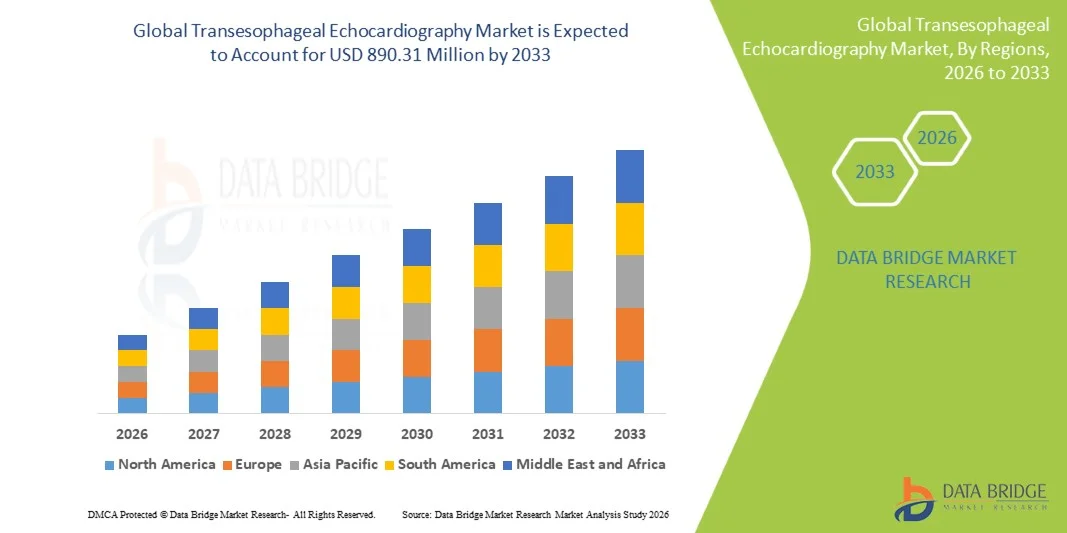
- As per Data Bridge Market Research analysis, the transesophageal echocardiography market was valued at USD 567.10 million in 2025 and is projected to reach USD 890.31 million by 2033, growing at a CAGR of 5.80% from 2026 to 2033.
- The market is experiencing consistent growth driven by the growing prevalence of cardiovascular diseases, increasing use of transesophageal echocardiography in cardiac surgeries, and advancements in 3D and 4D imaging technologies.
- The increasing incidence of heart valve disorders and other structural heart diseases, combined with the growing need for accurate real-time cardiac visualization, is encouraging hospitals and cardiac centers to adopt advanced transesophageal echocardiography systems. 3D/4D TEE and portable technologies are expanding clinical applications by providing detailed cardiac imaging for diagnosis, surgical planning, and intraoperative monitoring.
Market Size & Forecast
- Global Market Value (2025): USD 567.10 Million
- Expected Market Value (2033): USD 890.31 Million
- Forecast CAGR (2026–2033): 5.80%
- Leading Region in 2025: North America
- Fastest Growing Region: Asia Pacific
What are the Major Takeaways of the Transesophageal Echocardiography Market?
- North America dominated the transesophageal echocardiography market with the largest revenue share of 40% in 2025, supported by advanced cardiac-care infrastructure, high procedure volumes, and early adoption of advanced echocardiography technologies.
- Asia-Pacific is expected to be the fastest-growing region at a CAGR of 5.6% from 2026 to 2033, fuelled by expanding healthcare infrastructure, rising cardiovascular disease burden, and increasing adoption of advanced cardiac imaging technologies across China, India, and Japan.
- The 3D transesophageal echocardiography systems segment led the market with a 35.40% share in 2025, driven by its ability to provide detailed real-time visualization of complex cardiac anatomy
- 4D transesophageal echocardiography systems are the fastest-growing product type, projected to register a CAGR of 6.5%, reflecting the surge in demand for real-time volumetric cardiac imaging.
- The 3D/4D segment dominated the technology category with a 36.9% revenue share in 2025, led by strong demand for volumetric cardiac visualization and advanced imaging capabilities
- Cardiac surgery accounted for 30.35% of the market share in 2025, preferred by widespread use of TEE for preoperative assessment, intraoperative monitoring, and postoperative evaluation
- The structural heart procedures segment is the fastest-growing application category, with a CAGR of 7.0%, driven by increasing adoption of transcatheter valve repair, valve replacement, and left atrial appendage closure procedures.
Report Scope and Transesophageal Echocardiography Market Segmentation
|
Attributes |
Transesophageal Echocardiography Key Market Insights |
|
Segments Covered |
|
|
Countries Covered |
North America
Europe
Asia-Pacific
Middle East and Africa
South America
|
|
Key Market Players |
|
|
Market Opportunities |
|
|
Value Added Data Infosets |
In addition to the insights on market scenarios such as market value, growth rate, segmentation, geographical coverage, and major players, the market reports curated by the Data Bridge Market Research also include in-depth expert analysis, patient epidemiology, pipeline analysis, pricing analysis, and regulatory framework. |
What is the Key Trend in the Transesophageal Echocardiography Market?
- The adoption of 3D and 4D transesophageal echocardiography (TEE) is increasing as structural heart procedures require high-resolution, real-time visualization of valves, chambers, and complex cardiac anatomy during interventions.
- For instance, in June 2025, the American Heart Association highlighted that real-time 3D TEE can identify abnormalities and visualize complex lesions with greater accuracy, sensitivity, and specificity than 2D TEE during cardiac surgery.
- Advanced 3D imaging enables clinicians to obtain detailed anatomical views and improve procedural planning, particularly for mitral valve, tricuspid valve, and left atrial appendage interventions.
- Hospitals and structural heart centers are increasingly integrating advanced TEE into minimally invasive cardiac procedures to provide real-time imaging guidance and improve procedural decision-making.
- For instance, in January 2025, the American College of Cardiology published an article recognizing 3D imaging as an important modality for structural heart interventions, including mitral and tricuspid valve procedures and left atrial appendage occlusion.
- As structural heart interventions continue expanding and clinicians demand more precise procedural visualization, adoption of advanced 3D/4D TEE systems is expected to accelerate, reinforcing high-resolution imaging as a core component of modern interventional cardiology
What are the Key Drivers of the Transesophageal Echocardiography Market?
- The rising prevalence of structural and valvular heart diseases has significantly increased demand for TEE systems capable of providing detailed cardiac visualization for diagnosis, treatment planning, and intraoperative guidance.
- For instance, in October 2024, the American College of Cardiology highlighted the growing use of multimodal echocardiographic assessment for tricuspid regurgitation and transcatheter tricuspid interventions, requiring detailed imaging to characterize disease severity and guide treatment decisions
- Cardiac surgeons, interventional cardiologists, and anesthesiologists are increasingly integrating TEE into complex procedures to assess cardiac anatomy, guide interventions, and evaluate procedural outcomes in real time.
- For instance, in August 2023, the American College of Cardiology summarized ESC/EACTS recommendations supporting transcatheter edge-to-edge repair for selected symptomatic patients with severe secondary mitral regurgitation, reinforcing the need for advanced cardiac imaging to assess anatomy and guide structural heart interventions.
- With structural heart interventions becoming increasingly sophisticated and the need for precise real-time cardiac imaging continuing to rise, TEE will remain an indispensable technology for complex cardiovascular diagnosis, procedural guidance, and intraoperative monitoring.
Which Factors are Challenging the Growth of the Transesophageal Echocardiography Market?
- Advanced TEE procedures require specialized equipment, trained echocardiographers, and appropriate anesthesia or sedation, increasing procedural complexity and limiting adoption in smaller healthcare facilities.
- For instance, in January 2025, an article published in the Journal of Cardiothoracic and Vascular Anesthesia examined the use of TEE in patients with prior esophagectomy, highlighting the procedural challenges and potential risks associated with inserting TEE probes in patients with altered esophageal anatomy.
- These requirements can restrict adoption among smaller hospitals and cardiac centers, particularly where specialized interventional cardiology infrastructure and experienced TEE personnel are limited.
- Conventional TEE also faces competition from emerging imaging technologies, including 3D intracardiac echocardiography, which can provide an alternative imaging approach for selected structural heart procedures while avoiding esophageal intubation.
- For instance, in June 2024, an article published in Frontiers in Cardiovascular Medicine highlighted that TEE is semi-invasive and can cause complications related to probe insertion and manipulation, emphasizing the need for standardized procedures and safety measures as TEE use continues to expand
- The procedural risks, anesthesia requirements, specialized training needs, and emergence of alternative imaging modalities continue to challenge widespread TEE adoption, particularly in cost-sensitive healthcare settings and facilities with limited cardiac imaging expertise.
How is the Transesophageal Echocardiography Market Segmented?
The transesophageal echocardiography market is segmented on the basis of product type, technology, application, and end user.
- By Product Type
On the basis of product type, the transesophageal echocardiography market is segmented into 2D transesophageal echocardiography systems, 3D transesophageal echocardiography systems, 4D transesophageal echocardiography systems, and portable transesophageal echocardiography systems. The 3D transesophageal echocardiography systems segment dominated the market with an estimated 35.40% share in 2025, owing to its ability to provide detailed real-time visualization of complex cardiac anatomy. These systems are extensively used for valve assessment, structural heart procedures, and intraoperative guidance. Three-dimensional imaging allows clinicians to visualize cardiac structures from multiple perspectives, improving procedural planning and decision-making. Increasing adoption of minimally invasive valve repair and replacement procedures is further supporting demand for 3D TEE systems. The availability of advanced matrix-array probes and improved image-processing capabilities is also strengthening the segment.
The 4D transesophageal echocardiography systems segment is expected to register the fastest growth at an estimated CAGR of 6.5% from 2026 to 2033, driven by increasing demand for real-time volumetric cardiac imaging. These systems provide dynamic three-dimensional visualization of cardiac structures during complex interventions. They are particularly useful for mitral and tricuspid valve procedures, where detailed anatomical visualization is essential. Increasing adoption of transcatheter structural heart procedures is encouraging hospitals to upgrade to advanced 4D platforms. Improvements in transducer technology, image reconstruction, and real-time rendering are further improving clinical usability. The increasing preference for precise procedural guidance is therefore expected to accelerate adoption of 4D TEE systems.
- By Technology
On the basis of technology, the market is segmented into 2D, 3D/4D, Doppler, and real-time imaging. The 3D/4D segment dominated the market with a 36.9% share in 2025, reflecting strong demand for volumetric cardiac visualization and advanced imaging capabilities. The technology provides detailed visualization of cardiac anatomy that can support diagnosis and procedural guidance. It is particularly valuable for structural heart procedures involving complex valve anatomy. Three-dimensional imaging also allows physicians to evaluate cardiac structures from multiple viewing angles. Growing adoption of minimally invasive cardiac procedures is increasing the importance of advanced imaging technologies. Continued improvements in image quality and real-time rendering are expected to sustain the segment's leading position.
The real-time imaging segment is expected to witness the fastest growth at an estimated CAGR of 6.0% from 2026 to 2033, supported by increasing demand for immediate visualization during cardiac interventions and surgery. Real-time imaging enables clinicians to continuously monitor cardiac structures and procedural changes. It can assist with device positioning, valve assessment, and identification of complications during interventions. Increasing use of TEE in structural heart procedures is creating additional demand for immediate imaging feedback. Advances in processing speed, probe design, and visualization software are improving real-time imaging performance. Growing reliance on image-guided minimally invasive procedures is therefore expected to support rapid adoption of real-time TEE capabilities.
- By Application
On the basis of application, the market is segmented into cardiac surgery, diagnostic cardiology, intraoperative monitoring, structural heart procedures, and intensive care monitoring. The cardiac surgery segment dominated the market with an estimated 30.35% share in 2025, supported by widespread use of TEE for preoperative assessment, intraoperative monitoring, and postoperative evaluation. TEE provides high-resolution visualization of cardiac valves, chambers, ventricular function, and blood flow. It enables surgical teams to assess cardiac function and identify abnormalities during procedures. The technology is particularly valuable in complex valve and congenital heart surgeries requiring immediate imaging feedback. Growing cardiac surgery volumes and increasing use of advanced imaging are supporting continued demand. Its ability to influence intraoperative decisions further reinforces cardiac surgery as a major TEE application.
The structural heart procedures segment is expected to register the fastest growth at an estimated CAGR of 7.0% from 2026 to 2033, driven by increasing adoption of transcatheter valve repair, valve replacement, and left atrial appendage closure procedures. TEE provides detailed visualization before and during minimally invasive structural heart interventions. Three-dimensional imaging is particularly useful for assessing valve anatomy and guiding device placement. Increasing procedure volumes are encouraging hospitals and specialized cardiac centers to invest in advanced TEE systems. The expansion of structural heart programs is also increasing demand for real-time procedural imaging. As minimally invasive cardiovascular interventions continue to expand, structural heart procedures are expected to remain one of the strongest growth areas for TEE.
- By End User
On the basis of end user, the market is segmented into hospitals, cardiac centers, ambulatory surgical centers, diagnostic centers, and academic & research institutes. The hospitals segment dominated the market with an estimated 70.75% share in 2025, supported by extensive cardiac surgery infrastructure, catheterization laboratories, intensive care units, and specialized cardiovascular departments. Hospitals use TEE across cardiac surgery, structural heart interventions, critical care, and diagnostic cardiology. Large hospitals also possess the specialized personnel required to operate and interpret advanced TEE systems. Increasing cardiovascular disease prevalence and expansion of cardiac-care capacity are supporting hospital-based adoption. Demand for advanced 3D/4D imaging is further encouraging hospitals to upgrade their echocardiography infrastructure.
The ambulatory surgical centers segment is expected to witness the fastest growth at an estimated CAGR of8.0% from 2026 to 2033, supported by the increasing shift toward minimally invasive procedures and shorter hospital stays. ASCs are increasingly being considered for selected cardiovascular procedures that can be performed with streamlined clinical workflows. The availability of compact and advanced imaging systems is improving the feasibility of TEE in outpatient procedural environments. Growth in structural heart interventions is creating additional opportunities for specialized imaging outside traditional inpatient settings. Healthcare providers are also seeking more cost-efficient procedural models without compromising imaging quality. Consequently, expanding ambulatory cardiovascular services are expected to support faster adoption of TEE in this end-user segment.
Which Region Holds the Largest Share of the Transesophageal Echocardiography Market?
- North America dominated the transesophageal echocardiography market with the largest revenue share of 40% in 2025, supported by advanced cardiac-care infrastructure, high procedure volumes, and early adoption of advanced echocardiography technologies
- The region also benefits from the high prevalence of cardiovascular diseases, increasing structural heart procedures, established reimbursement infrastructure, and growing use of TEE for cardiac surgery and intraoperative monitoring. Rising adoption of minimally invasive valve interventions and continuous technological advancements in real-time 3D imaging are further strengthening North America's leadership in the global transesophageal echocardiography market.
U.S. Transesophageal Echocardiography Market Insight
The U.S. transesophageal echocardiography market is witnessing strong growth due to rising cardiovascular disease burden, increasing structural heart interventions, and growing adoption of advanced cardiac imaging technologies. The country’s mature healthcare infrastructure, along with widespread use of 3D/4D TEE systems, is driving demand across hospitals, cardiac centers, and specialized cardiovascular facilities. In addition, increasing utilization of TEE for cardiac surgery, valve repair, and intraoperative monitoring is accelerating adoption of advanced echocardiography systems across the U.S.
Asia-Pacific Transesophageal Echocardiography Market Insight
The Asia-Pacific transesophageal echocardiography market is expected to witness rapid growth, driven by expanding cardiovascular healthcare infrastructure, increasing cardiac procedure volumes, and rising investments in advanced diagnostic technologies across countries such as China, India, and Japan. Growing awareness regarding early cardiovascular diagnosis, rising adoption of minimally invasive structural heart procedures, and increasing demand for high-quality cardiac imaging are supporting regional market expansion. In addition, increasing healthcare expenditure and development of specialized cardiac centers are accelerating TEE adoption across the region.
Japan Transesophageal Echocardiography Market Insight
The Japan transesophageal echocardiography market is witnessing consistent growth due to rising demand for advanced cardiovascular diagnosis, cardiac surgery, and structural heart intervention technologies. Hospitals and specialized cardiac centers are increasingly adopting high-resolution TEE systems for valve assessment, intraoperative monitoring, and complex cardiovascular procedures. Moreover, increasing integration of 3D/4D imaging technologies and Japan’s advanced healthcare infrastructure are further contributing to market growth.
China Transesophageal Echocardiography Market Insight
The China transesophageal echocardiography market is growing rapidly, driven by increasing cardiovascular disease prevalence, expanding healthcare infrastructure, and rising demand for advanced cardiac diagnostic technologies. Growing adoption of 3D/4D TEE systems across hospitals and specialized cardiac centers is significantly boosting market demand. In addition, increasing investments in cardiovascular care, rising structural heart procedure volumes, and continued development of advanced medical imaging technologies are positioning China as one of the fastest-growing markets for transesophageal echocardiography globally.
U.K. Transesophageal Echocardiography Market Insight
The U.K. transesophageal echocardiography market is experiencing steady growth, supported by rising utilization of TEE in cardiac surgery, structural heart procedures, and intraoperative cardiovascular monitoring. Increasing investments in advanced echocardiography infrastructure and growing demand for accurate, real-time cardiac visualization are contributing to market growth. Furthermore, integration of 3D/4D imaging and increasing adoption of minimally invasive cardiac interventions are improving diagnostic and procedural capabilities, positioning the U.K. as a key European market for transesophageal echocardiography.
Germany Transesophageal Echocardiography Market Insight
The Germany transesophageal echocardiography market is expanding steadily due to the country’s advanced healthcare infrastructure, strong cardiovascular treatment capabilities, and increasing adoption of next-generation cardiac imaging technologies. Hospitals, cardiac centers, and specialized cardiovascular institutes are increasingly utilizing TEE for cardiac surgery, valve assessment, structural heart interventions, and intraoperative monitoring. Continuous advancements in 3D/4D imaging, sophisticated probe technology, and real-time visualization, along with Germany’s focus on advanced cardiovascular care, are further driving market growth.
Which are the Top Companies in Transesophageal Echocardiography Market?
The transesophageal echocardiography industry is primarily led by well-established companies, including:
- Koninklijke Philips N.V. (Netherlands)
- GE HealthCare (U.S.)
- Siemens Healthineers AG (Germany)
- Shenzhen Mindray Bio-Medical Electronics Co., Ltd. (China)
- CANON MEDICAL SYSTEMS CORPORATION (Japan)
- ESAOTE S.p.A. (Italy)
- SonoScape Medical Corp. (China)
- CHISON Medical Technologies Co., Ltd. (China)
- Visura Technologies Inc. (U.S.)
- CIVCO Medical Solutions (U.S.)
- STERIS (U.S.)
- Nanosonics Limited (Australia)
- Tristel Plc. (U.K.)
- Germitec (France)
- ASP (U.S.)
- ImaCor, Inc. (U.S.)
- CS Medical (U.S.)
- Probo Medical (U.S.)
- Parker Laboratories, Inc. (U.S.)
- Ruhof Corporation (U.S.
What are Latest Developments in Transesophageal Echocardiography Market?
- In May 2025, Philips unveiled AI-powered enhancements for its Compact Ultrasound 5500CV system, adding live 3D TEE imaging compatibility with its X7-2t and X8-2t transducers. The compact cardiovascular ultrasound platform combines AI-enabled automated cardiac measurements with high-resolution TEE imaging, enabling clinicians to support complex catheter-based procedures such as valve repair and closure. The development expands advanced cardiac imaging capabilities into a more compact platform and demonstrates the industry's movement toward combining AI, portability, and real-time 3D TEE.
- In January 2024, Philips announced FDA 510(k) clearance for its X11-4t Mini 3D TEE ultrasound transducer, designed to extend 3D TEE imaging to patients who previously could not benefit from conventional larger probes. The miniaturized transducer was developed for applications including pediatric patients as small as 5 kg, adults at risk of complications, and complex cases such as ICU patients. Philips stated that the smaller probe could improve patient access to detailed 3D cardiac imaging while potentially reducing procedural limitations associated with larger TEE probes.
- In March 2023, Philips showcased its advanced cardiology portfolio at ACC.23, including high-resolution 3D transesophageal echocardiography and echo-fluoro fusion imaging. The technologies were presented for supporting complex cardiovascular procedures by combining advanced echocardiographic visualization with interventional imaging. The development highlighted the increasing integration of 3D TEE and multimodality image guidance for structural heart and interventional cardiology applications.
- In May 2022, Philips released EchoNavigator 4.0, integrating real-time TEE with X-ray fluoroscopy to support structural heart procedures. The system enables interventional teams to combine ultrasound and fluoroscopic information when planning, guiding, treating, and confirming complex procedures such as heart valve repair and replacement. This development strengthened the role of TEE as a real-time procedural guidance technology and demonstrated the industry's shift toward integrated multimodality imaging.
- In July 2021, Philips announced the first patient treatment using its VeriSight Pro real-time 3D intracardiac echocardiography catheter at Mayo Clinic, providing an alternative to conventional TEE for selected structural heart procedures. The catheter uses miniaturized 3D ultrasound technology to provide live 2D and 3D imaging and was used for a left atrial appendage occlusion procedure. Philips reported a 90° × 90° 3D field of view, demonstrating how miniaturized real-time imaging technologies were emerging as alternatives or complements to TEE in minimally invasive cardiac interventions.

- Interactive Data Analysis Dashboard
- Company Analysis Dashboard for high growth potential opportunities
- Research Analyst Access for customization & queries
- Competitor Analysis with Interactive dashboard
- Latest News, Updates & Trend analysis
- Harness the Power of Benchmark Analysis for Comprehensive Competitor Tracking
Data collection and base year analysis are done using data collection modules with large sample sizes. The stage includes obtaining market information or related data through various sources and strategies. It includes examining and planning all the data acquired from the past in advance. It likewise envelops the examination of information inconsistencies seen across different information sources. The market data is analysed and estimated using market statistical and coherent models. Also, market share analysis and key trend analysis are the major success factors in the market report. To know more, please request an analyst call or drop down your inquiry.
The key research methodology used by DBMR research team is data triangulation which involves data mining, analysis of the impact of data variables on the market and primary (industry expert) validation. Data models include Vendor Positioning Grid, Market Time Line Analysis, Market Overview and Guide, Company Positioning Grid, Patent Analysis, Pricing Analysis, Company Market Share Analysis, Standards of Measurement, Global versus Regional and Vendor Share Analysis. To know more about the research methodology, drop in an inquiry to speak to our industry experts.
Data Bridge Market Research is a leader in advanced formative research. We take pride in servicing our existing and new customers with data and analysis that match and suits their goal. The report can be customized to include price trend analysis of target brands understanding the market for additional countries (ask for the list of countries), clinical trial results data, literature review, refurbished market and product base analysis. Market analysis of target competitors can be analyzed from technology-based analysis to market portfolio strategies. We can add as many competitors that you require data about in the format and data style you are looking for. Our team of analysts can also provide you data in crude raw excel files pivot tables (Fact book) or can assist you in creating presentations from the data sets available in the report.













