Transgenic Seeds Market Overview
As per Data Bridge Market Research analysis, the transgenic seeds market was valued at USD 56.47 billion in 2025 and is projected to reach USD 143.86 billion by 2033, growing at a CAGR of 12.40% from 2026 to 2033. The market is experiencing substantial growth driven by the urgent need to increase agricultural productivity and ensure food security for a growing population.
Transgenic seeds, also known as genetically modified (GM) seeds, are engineered to introduce desirable traits such as pest resistance, herbicide tolerance, and improved nutritional content. The increasing adoption of advanced farming techniques, rising cost of agrochemicals, and growing awareness among farmers about the benefits of enhanced seed varieties are fueling market expansion. Key market players are focusing on developing multi-trait seeds that offer combined resistance to pests, diseases, and climatic stresses, thereby reducing dependence on chemical inputs and improving farm profitability.
Key Market Trends & Insights
- North America dominated the transgenic seeds market with the largest revenue share, driven by high adoption rates of GM crops in the U.S. and Canada, with over 90% of corn, soybean, and cotton acres planted with genetically engineered varieties .
- Asia-Pacific is expected to be the fastest-growing region, fueled by rising agricultural activities, supportive government policies, and increasing demand for food security in countries such as China and India
- The insect resistance trait is emerging as a significant and fast-growing segment, driven by the need for sustainable pest control and reducing reliance on chemical insecticides .
- The corn segment dominated the crop type category in 2025, owing to its extensive applications in food, feed, and biofuel production .
- Soybean is a rapidly growing segment, supported by record crush demand and policy support for biodiesel feedstocks .
Market Size & Forecast
- Market Value (2025): USD 56.47 Billion
- Expected Market Value (2033): USD 143.86 Billion
- Forecast CAGR (2026–2033): 12.40%
- Leading Region in 2025: North America
- Fastest Growing Region: Asia-Pacific
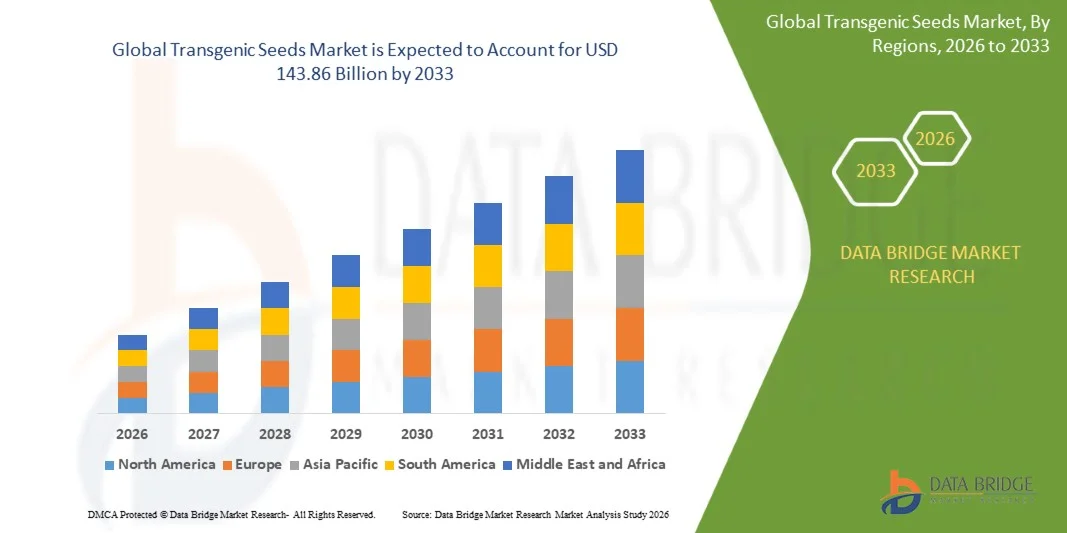
Report Scope and Transgenic Seeds Market Segmentation
|
Attributes |
Transgenic Seeds Market Insights |
|
Segments Covered |
|
|
Countries Covered |
North America
Europe
Asia-Pacific
Middle East and Africa
South America
|
|
Key Market Players |
|
|
Market Opportunities |
|
|
Value Added Data Infosets |
In addition to the insights on market scenarios such as market value, growth rate, segmentation, geographical coverage, and major players, the market reports curated by the Data Bridge Market Research also include import export analysis, production capacity overview, production consumption analysis, price trend analysis, climate change scenario, supply chain analysis, value chain analysis, raw material/consumables overview, vendor selection criteria, PESTLE Analysis, Porter Analysis, and regulatory framework. |
Transgenic Seeds Market Trends
Trend: Growing Adoption of Multi-Trait and Stacked-Trait Seeds
The transgenic seeds market is witnessing increasing adoption of multi-trait (stacked-trait) seeds that combine multiple desirable characteristics, such as herbicide tolerance, insect resistance, drought tolerance, and disease resistance, into a single variety. Compared with single-trait seeds, stacked-trait seeds offer improved crop protection, higher yield stability, and reduced dependence on pesticides, making them highly suitable for large-scale commercial farming. Continuous advancements in biotechnology and precision breeding are further enabling the development of transgenic seeds with enhanced agronomic performance and resilience under changing climatic conditions.
For instance, in May 2025, Bayer received approval in Brazil for its VT PRO4 corn technology, a stacked-trait genetically modified corn combining insect protection with herbicide tolerance to improve productivity and crop protection.
This development reflects the growing industry focus on advanced stacked-trait technologies that help farmers improve yields while simplifying crop management.
Transgenic Seeds Market Dynamics
Key Market Driver: Government Support and Favorable Regulatory Frameworks
Government support and evolving biotechnology regulations continue to drive the growth of the transgenic seeds market. Many countries are investing in agricultural biotechnology to strengthen food security, improve crop productivity, and address climate-related challenges. Supportive regulatory policies, public-private research initiatives, and streamlined approval processes are encouraging biotechnology companies to develop and commercialize improved genetically modified crop varieties with enhanced resistance to pests, diseases, and environmental stress.
For instance, in December 2024, China approved 17 genetically modified and gene-edited crop varieties, including corn, soybean, cotton, rice, and wheat, as part of its strategy to enhance domestic agricultural production and strengthen national food security.
These approvals demonstrate the increasing government support for agricultural biotechnology, creating favorable conditions for the commercialization of advanced transgenic seeds.
Key Market Restraint/Challenge: Stringent Regulatory Requirements and Consumer Acceptance
Complex regulatory approval processes and consumer concerns remain key challenges for the transgenic seeds market. Commercializing genetically modified crops requires extensive environmental and food safety assessments, resulting in lengthy approval timelines and higher development costs. In addition, varying regulatory standards, cultivation restrictions, and labeling requirements across different countries create compliance challenges for biotechnology companies. Consumer skepticism regarding genetically modified foods also continues to influence policy decisions in several markets.
For instance, as of 2026, the European Union continues to maintain one of the world's strictest regulatory frameworks for genetically modified crops, requiring comprehensive risk assessments, mandatory traceability, and labeling requirements before commercialization.
These regulatory and public acceptance challenges continue to slow market expansion, particularly in regions with restrictive biotechnology policies.
Key Market Opportunity: Expansion into Emerging Markets and Specialty Crops
Emerging economies across Asia-Pacific, Africa, and Latin America are creating significant opportunities for the transgenic seeds market as governments seek to improve agricultural productivity and food security. Increasing demand for climate-resilient crops, combined with investments in biotechnology research and supportive agricultural policies, is accelerating the adoption of genetically modified seeds. Beyond major crops such as corn, soybean, and cotton, biotechnology companies are also expanding into specialty crops with improved nutritional value, disease resistance, and environmental stress tolerance.
For instance, in May 2026, Ghana commercialized genetically modified insect-resistant cowpea, becoming one of the latest African countries to cultivate GM food crops and expanding the application of transgenic technology beyond traditional row crops.
This development highlights the growing adoption of transgenic seeds in emerging markets and the expanding opportunities for biotechnology companies to diversify their crop portfolios.
Transgenic Seeds Market Scope
The transgenic seeds market is segmented on the basis of trait and crop type.
- By Trait
On the basis of trait, the global transgenic seeds market is segmented into herbicide tolerance, insect resistance, stacked traits, and others. The herbicide tolerance segment dominated the market with the largest revenue share in 2025, driven by its widespread adoption in major crops such as soybean, corn, canola, and cotton. These seeds enable effective weed management, reduce labor and cultivation costs, and improve crop productivity, making them the preferred choice among commercial farmers across major agricultural regions.
The stacked traits segment is expected to register the fastest CAGR during the forecast period of 2026 to 2033, owing to the increasing demand for seeds that combine multiple beneficial traits, including herbicide tolerance, insect resistance, and stress tolerance. Growing investments in biotechnology, rising pest resistance, and the need for higher-yielding, climate-resilient crops are expected to accelerate the adoption of stacked-trait transgenic seeds.
- By Crop Type
On the basis of crop type, the global transgenic seeds market is segmented into corn, soybean, cotton, canola, rice, and others. The corn segment accounted for the largest market share in 2025, supported by its extensive cultivation worldwide and the high adoption of genetically modified corn varieties offering herbicide tolerance and insect resistance. Strong demand from food, feed, and biofuel industries, along with continuous advancements in transgenic corn technologies, continues to drive segment growth.
The soybean segment is anticipated to witness the fastest CAGR during the forecast period of 2026 to 2033, driven by increasing global demand for soybean-based food products, animal feed, and biodiesel. Rising adoption of herbicide-tolerant and stacked-trait soybean varieties, particularly in North and South America, along with expanding cultivation in emerging agricultural economies, is expected to support rapid market growth.
Transgenic Seeds Market Regional Analysis
North America dominated the global transgenic seeds market and accounted for the largest revenue share in 2025, driven by the widespread adoption of genetically modified crops, advanced farming practices, and supportive regulatory frameworks. The United States remains the largest producer and consumer of transgenic seeds, with genetically modified corn, soybean, cotton, and canola extensively cultivated across the country. High investments in agricultural biotechnology, strong research capabilities, and the presence of leading seed companies continue to strengthen the region's market leadership. In addition, increasing demand for high-yielding and climate-resilient crop varieties supports sustained market growth.
Asia-Pacific Transgenic Seeds Market Insight
Asia-Pacific is expected to register the fastest growth during the forecast period, driven by rising food demand, rapid population growth, and increasing investments in agricultural modernization. Countries such as China and India are expanding biotechnology research and gradually strengthening regulatory support for genetically modified and gene-edited crops to improve food security and agricultural productivity. Growing government initiatives, expanding cultivation of GM crops, and increasing collaborations between research institutions and biotechnology companies are expected to accelerate the adoption of transgenic seeds across the region.
Middle East and Africa Transgenic Seeds Market Insight
The Middle East and Africa is expected to witness steady growth in the transgenic seeds market, supported by increasing efforts to improve food security, enhance agricultural productivity, and address climate-related challenges. Countries such as South Africa are leading the adoption of genetically modified crops due to established regulatory frameworks and commercial cultivation of GM maize, soybean, and cotton. Meanwhile, several African countries are gradually expanding the adoption of biotechnology through supportive government initiatives, research collaborations, and investments in climate-resilient agriculture, creating new growth opportunities for the regional market.
Transgenic Seeds Market Share
The transgenic seeds industry is primarily led by well-established companies, including:
- Bayer AG (Germany)
- Corteva, Inc. (U.S.)
- Syngenta AG (Switzerland)
- BASF SE (Germany)
- KWS SAAT SE & Co. KGaA (Germany)
- Maharashtra Hybrid Seeds Company Private Limited (Mahyco) (India)
- J.R. Simplot Company (U.S.)
- Groupe Limagrain Holding (France)
- Vilmorin & Cie SA (France)
- UPL Limited (India)
Latest Developments in Transgenic Seeds Market
- In February 2023, GDM, a plant genetics company, applied to register 13 soybean varieties in South Africa following the country's approval of a new genetically modified seed technology. The company planned to pre-launch three of these varieties during the year while expanding its presence in South Africa as a strategic entry point for broader growth across the African region. This development highlights the growing opportunity for transgenic seed companies to expand into emerging markets with rising demand for advanced agricultural technologies.
- In January 2023, S&W Seed Company entered into a partnership with Trigall Genetics to expand the development and commercialization of advanced wheat genetics. Through this collaboration, Trigall Genetics integrated S&W's Australia-adapted wheat germplasm into its breeding portfolio to strengthen its presence in major wheat-producing regions worldwide. The partnership supports the expansion of genetically modified and climate-resilient wheat varieties with enhanced tolerance to drought and soil salinity, highlighting the growing opportunity for transgenic seeds in specialty and emerging crop markets.

- Interactive Data Analysis Dashboard
- Company Analysis Dashboard for high growth potential opportunities
- Research Analyst Access for customization & queries
- Competitor Analysis with Interactive dashboard
- Latest News, Updates & Trend analysis
- Harness the Power of Benchmark Analysis for Comprehensive Competitor Tracking
Data collection and base year analysis are done using data collection modules with large sample sizes. The stage includes obtaining market information or related data through various sources and strategies. It includes examining and planning all the data acquired from the past in advance. It likewise envelops the examination of information inconsistencies seen across different information sources. The market data is analysed and estimated using market statistical and coherent models. Also, market share analysis and key trend analysis are the major success factors in the market report. To know more, please request an analyst call or drop down your inquiry.
The key research methodology used by DBMR research team is data triangulation which involves data mining, analysis of the impact of data variables on the market and primary (industry expert) validation. Data models include Vendor Positioning Grid, Market Time Line Analysis, Market Overview and Guide, Company Positioning Grid, Patent Analysis, Pricing Analysis, Company Market Share Analysis, Standards of Measurement, Global versus Regional and Vendor Share Analysis. To know more about the research methodology, drop in an inquiry to speak to our industry experts.
Data Bridge Market Research is a leader in advanced formative research. We take pride in servicing our existing and new customers with data and analysis that match and suits their goal. The report can be customized to include price trend analysis of target brands understanding the market for additional countries (ask for the list of countries), clinical trial results data, literature review, refurbished market and product base analysis. Market analysis of target competitors can be analyzed from technology-based analysis to market portfolio strategies. We can add as many competitors that you require data about in the format and data style you are looking for. Our team of analysts can also provide you data in crude raw excel files pivot tables (Fact book) or can assist you in creating presentations from the data sets available in the report.