


Transmission Fluids Market Size
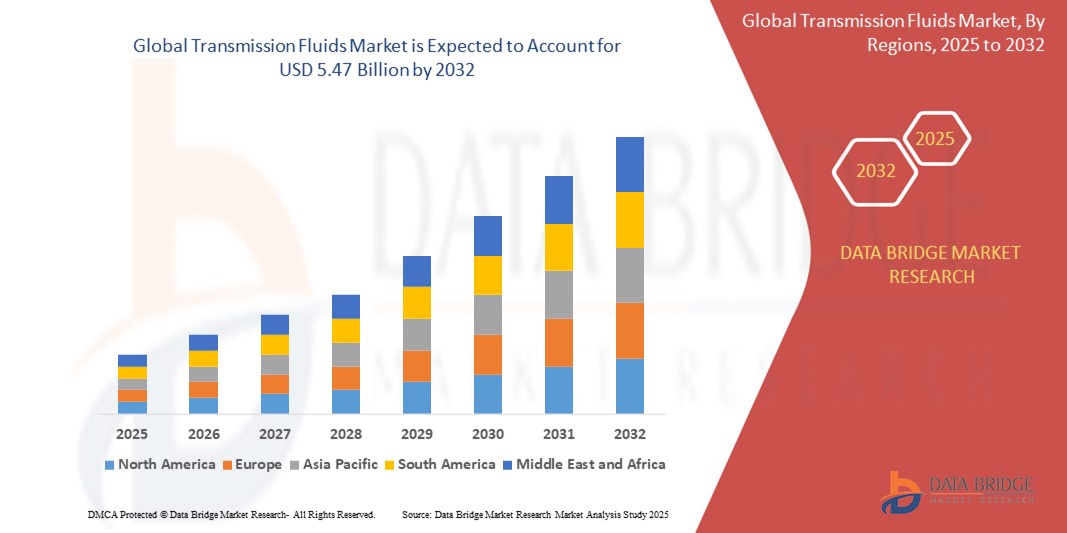
- The global Transmission Fluids market size was valued at USD 3.95 billion in 2024 and is expected to reach USD 5.47 billion by 2032, at a CAGR of 4.20% during the forecast period
- This growth is driven by factors such as the fuel-efficient vehicles, increasing adoption of automatic transmissions, and advancements in transmission fluid formulations to enhance vehicle performance and durability.
Transmission Fluids Market Analysis
- Transmission Fluids are essential lubricants used in vehicles to ensure smooth gear shifts, reduce friction, and enhance the overall performance and longevity of transmission systems. They are crucial in both manual and automatic transmissions across a wide range of vehicle types.
- The demand for these fluids is significantly driven by the growing vehicle parc, increasing adoption of automatic and hybrid vehicles, and the need for enhanced fuel efficiency and vehicle performance.
- North America is expected to dominate the Transmission Fluids market due to the high concentration of automotive manufacturers, stringent fuel economy regulations, and a well-established automotive aftermarket.
- Asia-Pacific is expected to be the fastest-growing region in the Transmission Fluids market during the forecast period due to rapid vehicle production, rising disposable income, and expanding automotive infrastructure in countries like China and India.
- The automatic transmission segment is expected to dominate the market with a significant market share due to increasing consumer preference for driving comfort and technological advancements in transmission systems.
Report Scope and Transmission Fluids Market Segmentation
|
Attributes |
Transmission Fluids Key Market Insights |
|
Segments Covered |
|
|
Countries Covered |
North America
Europe
Asia-Pacific
Middle East and Africa
South America
|
|
Key Market Players |
|
|
Market Opportunities |
|
|
Value Added Data Infosets |
In addition to the insights on market scenarios such as market value, growth rate, segmentation, geographical coverage, and major players, the market reports curated by the Data Bridge Market Research also include import export analysis, production capacity overview, production consumption analysis, price trend analysis, climate change scenario, supply chain analysis, value chain analysis, raw material/consumables overview, vendor selection criteria, PESTLE Analysis, Porter Analysis, and regulatory framework. |
Transmission Fluids Market Trends
“Shift Toward Synthetic and Low-Viscosity Transmission Fluids for Enhanced Efficiency”
- One prominent trend in the transmission fluids market is the increasing adoption of synthetic and low-viscosity fluid formulations to meet the demands of modern high-performance and fuel-efficient vehicles.
- These advanced fluids offer superior thermal stability, oxidation resistance, and frictional properties, contributing to smoother gear shifts, extended drain intervals, and improved fuel economy.
- For instance, OEMs are increasingly recommending low-viscosity automatic transmission fluids (ATFs) such as Dexron VI or Mercon LV for newer vehicle models, which reduce energy losses and align with stringent CO₂ emission regulations.
- These trend is driving innovation in transmission fluid technologies and is expected to significantly influence product development and OEM partnerships over the forecast period.
Transmission Fluids Market Dynamics
Driver
“Rising Vehicle Production and Technological Advancements in Automotive Transmissions”
- The global rise in vehicle production, especially in emerging economies, is a key factor driving the demand for transmission fluids. Modern vehicles require high-performance fluids that can support increasingly complex and efficient transmission systems.
- Advanced automatic, continuously variable (CVT), and dual-clutch transmission (DCT) systems demand specialized fluids to ensure optimal function, durability, and efficiency.
- As consumers demand smoother driving experiences and as OEMs work to meet stringent emission and fuel efficiency regulations, the need for advanced transmission fluids continues to grow.
For instance,
- In 2023, the International Organization of Motor Vehicle Manufacturers (OICA) reported a global vehicle production increase of over 5%, with Asia-Pacific leading growth—driving demand for compatible and efficient transmission fluids.
- As a result of the automotive industry embraces next-generation transmission systems, the demand for high-performance and synthetic transmission fluids is expected to rise significantly.
Opportunity
“Growing Demand for E-Fluids in Electric and Hybrid Vehicles”
- The transition to electric and hybrid vehicles is opening new avenues in the transmission fluids market, particularly with the rising need for specialized e-fluids that offer dielectric properties, cooling capabilities, and compatibility with electric drivetrains.
- E-fluids are engineered to handle higher thermal loads, reduce wear in high-torque EV transmissions, and improve overall energy efficiency.
- As automakers accelerate EV production, transmission fluid manufacturers are investing in R&D to create tailored solutions for this segment.
For instance,
- In January 2024, Shell and Castrol introduced new lines of e-fluids specifically formulated for electric drivetrains, addressing heat transfer, insulation, and lubrication needs.
- The development and adoption of EV-specific transmission fluids represent a substantial growth opportunity for companies that can innovate in this space.
Restraint/Challenge
“Volatile Raw Material Prices and Supply Chain Disruptions”
- The transmission fluids market is highly sensitive to fluctuations in the prices of key raw materials such as base oils and additives, which are primarily derived from crude oil.
- Volatile oil prices and geopolitical tensions can result in unpredictable input costs, squeezing margins for manufacturers and leading to pricing pressures across the value chain.
- In addition, global supply chain disruptions—triggered by events like pandemics, regional conflicts, or trade restrictions—can delay production and distribution, further challenging market stability.
For instance,
- In 2022–2023, the global lubricant industry faced disruptions due to Russia-Ukraine conflict-related oil price spikes and logistics constraints, impacting availability and pricing of synthetic transmission fluids.
- Consequently, such volatility not only affects profitability but also limits the ability of manufacturers to plan long-term strategies and investments.
Transmission Fluids Market Scope
The market is segmented on the basis Type, End Use Industry
|
Segmentation |
Sub-Segmentation |
|
By Type |
|
|
By End Use Industry |
|
In 2025, the Automatic Transmission Fluid is projected to dominate the market with a largest share in Global Transmission Fluids Market
The Automatic Transmission Fluid segment is expected to dominate the Transmission Fluids market with the largest share of 56.22% in 2025 due to its widespread application in modern vehicles and increasing demand for smooth gear shifting and fuel efficiency. Growing automotive production and the adoption of advanced transmission systems further drive its market growth.
The Automotive is expected to account for the largest share during the forecast period in Global Transmission Fluids Market
In 2025, the Automotive segment is expected to dominate the market with the largest market share of 51.31% due to increasing number of vehicles worldwide and rising maintenance requirements. As the primary application for transmission fluids, the growing emphasis on vehicle performance and longevity continues to fuel demand in this segment.
Transmission Fluids Market Regional Analysis
“North America Holds the Largest Share in the Transmission Fluids Market”
- North America dominates the Transmission Fluids market, driven by the high vehicle ownership rate, advanced automotive technologies, and strong presence of major automobile manufacturers and lubricant producers.
- The U.S. holds a significant share due to the large automotive aftermarket, increased consumer preference for automatic transmission vehicles, and the ongoing demand for performance-enhancing transmission fluids.
- The region’s well-developed infrastructure for automotive maintenance and services, along with growing sales of SUVs and luxury vehicles, further fuels demand.
- Additionally, stringent emission regulations and rising focus on fuel efficiency encourage the use of high-quality transmission fluids, supporting market expansion across North America.
“Asia-Pacific is Projected to Register the Highest CAGR in the Transmission Fluids Market”
- The Asia-Pacific region is expected to witness the highest growth rate in the Transmission Fluids market, driven by rapid industrialization, increasing vehicle production, and rising consumer income levels.
- Countries such as China, India, and Japan are emerging as key markets due to expanding automotive fleets and a growing shift toward automatic and semi-automatic transmission vehicles.
- Japan, with its strong automotive innovation and export-oriented industry, contributes significantly through the development and adoption of advanced transmission systems and compatible fluids.
- China and India, with their large populations and booming automotive sectors, are experiencing rising demand for transmission fluids as OEMs and aftermarket players expand. Growing investment in automotive infrastructure and increasing partnerships with international lubricant manufacturers also support market growth.
Transmission Fluids Market Share
The market competitive landscape provides details by competitor. Details included are company overview, company financials, revenue generated, market potential, investment in research and development, new market initiatives, global presence, production sites and facilities, production capacities, company strengths and weaknesses, product launch, product width and breadth, Type dominance. The above data points provided are only related to the companies' focus related to market.
The Major Market Leaders Operating in the Market Are:
- BASF SE (Germany)
- Chevron Corporation (U.S.)
- Exxon Mobil Corporation (U.S.)
- Royal Dutch Shell plc (United Kingdom/Netherlands)
- bp p.l.c. (United Kingdom)
- TotalEnergies SE (France)
- LUKOIL (Russia)
- Petroliam Nasional Berhad (PETRONAS) (Malaysia)
- The Lubrizol Corporation (U.S.)
- FUCHS (Germany)
- Amsoil, Inc. (U.S.)
- Pennzoil (U.S.)
- Valvoline LLC (U.S.)
- PetroChina Company Limited (China)
- Phillips 66 Company (U.S.)
- Calumet Branded Products, LLC (U.S.)
- Evonik Industries AG (Germany)
- Sinopec (China)
- Afton Chemical (U.S.)
- Idemitsu Kosan Co., Ltd. (Japan)
- Millers Oils Ltd. (United Kingdom)
Latest Developments in Global Transmission Fluids Market
- In January 2025, ExxonMobil, a global leader in lubrication technologies, announced the launch of its new high-performance automatic transmission fluid (ATF) for electric vehicles (EVs) designed to enhance the efficiency and longevity of EV drivetrains. The new product, Mobil EV ATF, features advanced synthetic base oils and proprietary additives to improve powertrain performance, reduce energy loss, and extend the operational lifespan of key components in electric vehicles. This launch marks a significant step towards meeting the growing demand for specialized lubricants in the electric vehicle market.
- In December 2024, Shell launched its latest range of multi-vehicle transmission fluids, Shell Spirax S6, which are formulated to deliver improved fuel efficiency and extended service life for automatic and manual transmission systems. The new fluids are compatible with a wide range of passenger and commercial vehicles, and their enhanced formulation helps reduce transmission wear and improve shifting performance under extreme temperatures, catering to both traditional and hybrid vehicle markets.
- In November 2024, Chevron announced the release of its Delo 400 Synthetic Multi-Grade Transmission Fluid, specifically developed for heavy-duty commercial vehicles. The product offers superior performance in a wide range of transmission systems, providing greater efficiency and extending the intervals between fluid changes. The launch aims to meet the increasing demands of commercial fleets and trucking companies focused on cost-effective, long-lasting lubrication solutions.
- In October 2024, Castrol unveiled a new line of advanced transmission fluids, Castrol TRANSMAX, designed for use in the latest-generation automatic transmissions found in modern vehicles. The transmission fluid range has been formulated to meet the requirements of leading automotive manufacturers and is engineered to improve gear-shifting smoothness, reduce fuel consumption, and ensure optimal performance in both standard and performance-oriented vehicles.

- Interactive Data Analysis Dashboard
- Company Analysis Dashboard for high growth potential opportunities
- Research Analyst Access for customization & queries
- Competitor Analysis with Interactive dashboard
- Latest News, Updates & Trend analysis
- Harness the Power of Benchmark Analysis for Comprehensive Competitor Tracking
Global Transmission Fluids Market, Supply Chain Analysis and Ecosystem Framework
To support market growth and help clients navigate the impact of geopolitical shifts, DBMR has integrated in-depth supply chain analysis into its Global Transmission Fluids Market research reports. This addition empowers clients to respond effectively to global changes affecting their industries. The supply chain analysis section includes detailed insights such as Global Transmission Fluids Market consumption and production by country, price trend analysis, the impact of tariffs and geopolitical developments, and import and export trends by country and HSN code. It also highlights major suppliers with data on production capacity and company profiles, as well as key importers and exporters. In addition to research, DBMR offers specialized supply chain consulting services backed by over a decade of experience, providing solutions like supplier discovery, supplier risk assessment, price trend analysis, impact evaluation of inflation and trade route changes, and comprehensive market trend analysis.
Data collection and base year analysis are done using data collection modules with large sample sizes. The stage includes obtaining market information or related data through various sources and strategies. It includes examining and planning all the data acquired from the past in advance. It likewise envelops the examination of information inconsistencies seen across different information sources. The market data is analysed and estimated using market statistical and coherent models. Also, market share analysis and key trend analysis are the major success factors in the market report. To know more, please request an analyst call or drop down your inquiry.
The key research methodology used by DBMR research team is data triangulation which involves data mining, analysis of the impact of data variables on the market and primary (industry expert) validation. Data models include Vendor Positioning Grid, Market Time Line Analysis, Market Overview and Guide, Company Positioning Grid, Patent Analysis, Pricing Analysis, Company Market Share Analysis, Standards of Measurement, Global versus Regional and Vendor Share Analysis. To know more about the research methodology, drop in an inquiry to speak to our industry experts.
Data Bridge Market Research is a leader in advanced formative research. We take pride in servicing our existing and new customers with data and analysis that match and suits their goal. The report can be customized to include price trend analysis of target brands understanding the market for additional countries (ask for the list of countries), clinical trial results data, literature review, refurbished market and product base analysis. Market analysis of target competitors can be analyzed from technology-based analysis to market portfolio strategies. We can add as many competitors that you require data about in the format and data style you are looking for. Our team of analysts can also provide you data in crude raw excel files pivot tables (Fact book) or can assist you in creating presentations from the data sets available in the report.













