


What is the Transportation Management System Market Size and Growth Rate?
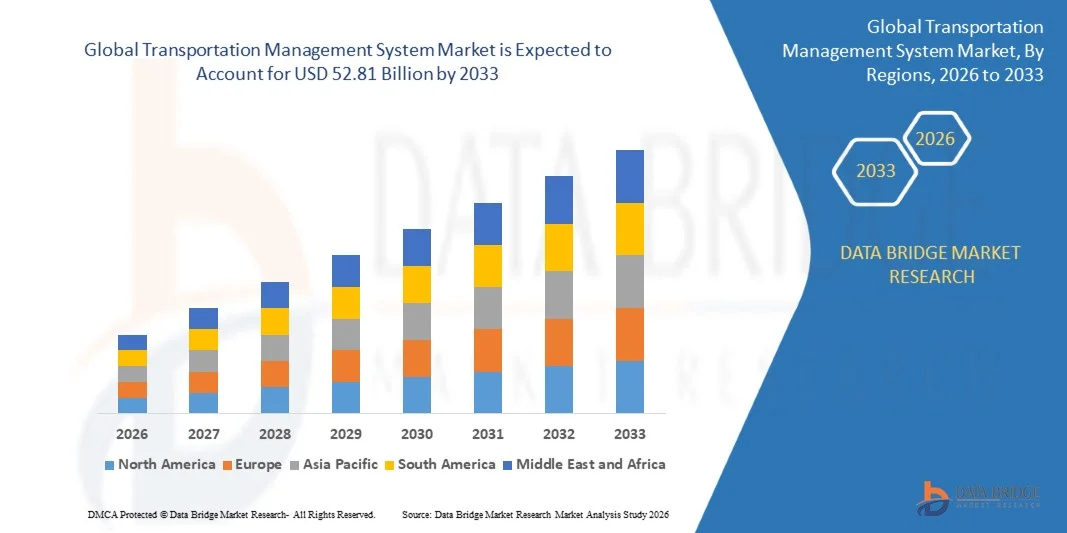
- As per Data Bridge Market Research analysis, the transportation management system market was valued at USD 17.51 billion in 2025 and is projected to reach USD 52.81 billion by 2033, growing at a CAGR of 14.80% from 2026 to 2033.
- The market is experiencing robust growth driven by the rapid expansion of e-commerce, increasing demand for real-time freight visibility, rising adoption of cloud-based transportation management solutions, and the growing need to optimize logistics operations and reduce transportation costs.
- The increasing complexity of global supply chains, rising freight volumes, and the growing emphasis on digitalization and automation are encouraging shippers, logistics providers, and retailers to adopt advanced transportation management systems. AI-powered route optimization, predictive analytics, real-time tracking, and integration with warehouse and enterprise resource planning (ERP) systems are transforming transportation operations by improving delivery efficiency, enhancing customer satisfaction, and reducing operational costs.
Market Size & Forecast
- Market Value (2025): USD 17.51 Billion
- Expected Market Value (2033): USD 52.81 Billion
- Forecast CAGR (2026–2033): 14.80%
- Leading Region in 2025: North America
- Fastest Growing Region: Asia-Pacific
What are the Major Takeaways of the Transportation Management System Market?
- North America dominated the Transportation Management System market in 2025, accounting for the largest revenue share. The region's leadership is attributed to the early adoption of cloud logistics platforms, the strong presence of leading TMS vendors, mature transportation infrastructure, widespread use of AI and IoT in logistics operations, and significant investments in supply chain digitization across the U.S. and Canada.
- Asia-Pacific is projected to be the fastest-growing regional market during 2026 to 2033, supported by the rapid expansion of e-commerce, government investments in smart logistics infrastructure, increasing cross-border trade, digital transformation initiatives, and growing adoption of cloud-based transportation management solutions across China, India, Japan, and Southeast Asia.
- The freight & order management segment dominated the market with a market share of 26.3% in 2025, driven by the growing need for intelligent logistics solutions that enhance customer experience through faster, more efficient order processing and fulfillment. Businesses are increasingly adopting advanced transportation management systems to streamline freight operations, improve inventory visibility, monitor real-time shipment status, and optimize order fulfillment. These capabilities enable organizations to scale operations efficiently, improve service quality, and gain a competitive advantage in an increasingly customer-centric logistics environment.
- The reporting & analytics segment is expected to witness the fastest growth rate from 2026 to 2033, supported by rising demand for data-driven supply chain management and operational visibility. Advanced reporting and analytics capabilities enable organizations to consolidate transportation data, generate customized reports on freight costs, fuel surcharges, taxes, and delivery performance, and derive actionable business insights. These features help companies make informed decisions, improve operational efficiency, optimize transportation spending, and enhance overall logistics performance, thereby driving strong segment growth.
- The on-premise segment dominated the transportation management system market in 2025, driven by its widespread adoption among manufacturing and distribution enterprises that require enhanced data security, greater control over system customization, and direct access to IT infrastructure. Organizations with stringent regulatory and operational requirements continue to prefer on-premise deployments for managing critical transportation and logistics operations.
- The cloud-based segment is expected to witness the fastest growth rate from 2026 to 2033, supported by its lower implementation costs, rapid deployment, scalability, and reduced hardware requirements. Cloud-based TMS solutions enable shippers, carriers, and logistics providers to optimize transportation planning, improve collaboration, and reduce licensing, infrastructure, and maintenance costs, making them an increasingly attractive option for organizations undergoing digital transformation.
Report Scope and Transportation Management System Market Segmentation
|
Attributes |
Transportation Management System Key Market Insights |
|
Segments Covered |
|
|
Countries Covered |
North America
Europe
Asia-Pacific
Middle East and Africa
South America
|
|
Key Market Players |
|
|
Market Opportunities |
|
|
Value Added Data Infosets |
In addition to the market insights such as market value, growth rate, market segments, geographical coverage, market players, and market scenario, the market report curated by the Data Bridge Market Research team includes in-depth expert analysis, import/export analysis, pricing analysis, production consumption analysis, and pestle analysis. |
What is the Key Trend in the Transportation Management System Market?
- Organizations are increasingly adopting AI-powered Transportation Management Systems (TMS) to automate transportation planning, optimize routes, predict disruptions, improve freight visibility, and reduce operational costs. The integration of artificial intelligence, machine learning, predictive analytics, and real-time IoT data is enabling logistics providers to make faster and more accurate transportation decisions while improving supply chain resilience.
- For instance, in May 2025, Uber Freight launched the industry's first AI Logistics Network, embedding a proprietary logistics-specific large language model (LLM) directly into its Transportation Management System (TMS). The platform enables AI-driven carrier selection, shipment planning, freight execution, predictive insights, and supply chain decision-making to improve transportation efficiency and visibility.
- AI-enabled transportation management platforms provide real-time shipment visibility, predictive ETA calculations, dynamic route optimization, automated carrier selection, and freight cost optimization, helping shippers and third-party logistics providers improve delivery performance while reducing fuel consumption and carbon emissions.
- For instance, in February 2025, HERE Technologies introduced HERE WeGo Pro, an AI-enabled truck navigation solution featuring real-time traffic intelligence, predictive ETA calculations, vehicle-specific routing, and multi-stop route optimization for commercial fleets.
- As enterprises continue to prioritize logistics automation, real-time visibility, intelligent decision-making, and resilient supply chains, the adoption of AI-powered Transportation Management Systems is expected to accelerate, making intelligent transportation orchestration a defining trend in the global TMS market.
What are the Key Drivers of the Transportation Management System Market?
- The rapid expansion of e-commerce, omnichannel retail, and global trade has significantly increased the demand for Transportation Management Systems (TMS) capable of optimizing freight operations, improving delivery efficiency, and providing real-time shipment visibility across increasingly complex supply chains.
- For instance, in January 2025, Oracle introduced new AI-powered capabilities within Oracle Fusion Cloud Supply Chain & Manufacturing (SCM), including Oracle Transportation Management (OTM). The update enhances shipment visibility, transportation decision-making, trade compliance, and logistics optimization, enabling organizations to reduce transportation costs and improve end-to-end supply chain efficiency.
- Manufacturers, retailers, logistics providers, and third-party logistics (3PL) companies are increasingly adopting cloud-based TMS platforms to automate route planning, carrier selection, freight auditing, shipment tracking, and transportation cost optimization while enhancing customer service and operational efficiency.
- For instance, in September 2025, Blue Yonder enhanced its Transportation Management solution with Advanced Cognitive Intelligence, integrating generative AI agents, predictive analytics, and a multi-enterprise network to provide AI-powered transportation planning, disruption management, real-time optimization, and collaborative logistics execution for retailers, manufacturers, and logistics service providers.
- The growing integration of artificial intelligence, IoT, telematics, and predictive analytics into transportation management solutions enables organizations to make data-driven logistics decisions, improve fleet utilization, reduce fuel consumption, and strengthen supply chain resilience in dynamic operating environments.
- As organizations continue to prioritize logistics automation, transportation cost reduction, faster deliveries, and resilient digital supply chains, the adoption of advanced Transportation Management Systems is expected to accelerate, making supply chain visibility and intelligent transportation optimization a primary growth driver for the market.
Which Factors are Challenging the Growth of the Transportation Management System Market?
- Advanced Transportation Management Systems (TMS) require significant upfront investment due to software licensing, cloud migration, system customization, employee training, and integration with existing enterprise platforms such as ERP, Warehouse Management Systems (WMS), Enterprise Asset Management (EAM), and carrier networks.
- These implementation and integration costs limit adoption among small and medium-sized enterprises (SMEs), particularly in developing economies where logistics digitization budgets and IT resources remain constrained.
- For instance, in March 2025, The Descartes Systems Group acquired 3GTMS, a cloud-based transportation management solutions provider, for approximately USD 112.7 million. The acquisition was undertaken to integrate complementary transportation planning, carrier connectivity, routing, and execution capabilities, highlighting the significant investment and technical effort required to consolidate enterprise-scale TMS platforms across shippers, freight brokers, and third-party logistics providers
- The high implementation costs, lengthy deployment cycles, and technical complexity associated with integrating Transportation Management Systems into existing enterprise ecosystems continue to restrain market adoption, particularly among cost-sensitive organizations and businesses operating with fragmented legacy infrastructure, despite the growing demand for intelligent logistics and transportation optimization.
How is the Transportation Management System Market Segmented?
The transportation management system market is segmented on the basis of solution, deployment, mode of transportation, and end user,
- By Solution
On the basis of solution, the transportation management system market is segmented into operational planning, fright & order management, payment & claims management, monitoring & tracking, reporting & analytics, and others The freight & order management segment dominated the market with a market share of 26.3% in 2025, driven by the growing need for intelligent logistics solutions that enhance customer experience through faster, more efficient order processing and fulfillment. Businesses are increasingly adopting advanced transportation management systems to streamline freight operations, improve inventory visibility, monitor real-time shipment status, and optimize order fulfillment. These capabilities enable organizations to scale operations efficiently, improve service quality, and gain a competitive advantage in an increasingly customer-centric logistics environment.
The reporting & analytics segment is expected to witness the fastest growth rate from 2026 to 2033, supported by rising demand for data-driven supply chain management and operational visibility. Advanced reporting and analytics capabilities enable organizations to consolidate transportation data, generate customized reports on freight costs, fuel surcharges, taxes, and delivery performance, and derive actionable business insights. These features help companies make informed decisions, improve operational efficiency, optimize transportation spending, and enhance overall logistics performance, thereby driving strong segment growth.
- By Deployment
On the basis of deployment, the transportation management system market is segmented into on-premise and cloud-based. The on-premise segment dominated the transportation management system market in 2025, driven by its widespread adoption among manufacturing and distribution enterprises that require enhanced data security, greater control over system customization, and direct access to IT infrastructure. Organizations with stringent regulatory and operational requirements continue to prefer on-premise deployments for managing critical transportation and logistics operations.
The cloud-based segment is expected to witness the fastest growth rate from 2026 to 2033, supported by its lower implementation costs, rapid deployment, scalability, and reduced hardware requirements. Cloud-based TMS solutions enable shippers, carriers, and logistics providers to optimize transportation planning, improve collaboration, and reduce licensing, infrastructure, and maintenance costs, making them an increasingly attractive option for organizations undergoing digital transformation.
- By Mode of Transportation
On the basis of mode of transportation, the transportation management system market is segmented into roadways, railways, waterways, and airways. The Roadways segment dominated the market in 2025, owing to its cost-effectiveness, operational flexibility, and extensive use for domestic and regional freight transportation. Road transport supports efficient door-to-door delivery and accommodates a wide range of shipment types, while ongoing government investments in road infrastructure across emerging economies continue to strengthen its dominance.
The Railways segment is expected to witness the fastest growth rate from 2026 to 2033, driven by increasing public and private investments in railway modernization and freight infrastructure. Rail transport offers an efficient and economical solution for moving large cargo volumes over long distances, enabling businesses to improve transportation efficiency, reduce transit times, and support sustainable logistics operations.
- By End User
On the basis of end user, the transportation management system market is segmented into retail & ecommerce, manufacturing, logistics, government organizations, and others. The retail & ecommerce segment held the largest market revenue share in 2025, driven by the rapid expansion of online shopping, omnichannel fulfillment, and rising consumer demand for faster deliveries. Retailers increasingly rely on Transportation Management Systems (TMS) to optimize route planning, improve shipment visibility, manage carrier networks, and streamline last-mile delivery operations. The growing need for real-time logistics tracking and cost-efficient transportation management continues to support segment dominance.
The logistics segment is projected to register the fastest growth at a CAGR from 2026 to 2033, driven by the increasing adoption of cloud-based TMS platforms among third-party logistics (3PL) providers, freight forwarders, and transportation service providers. As supply chains become more complex and globally interconnected, logistics companies are investing in advanced transportation management solutions to improve freight visibility, automate planning processes, optimize multimodal transportation networks, and enhance operational efficiency. The rising focus on real-time tracking, AI-driven transportation optimization, and collaborative logistics execution is expected to accelerate segment growth throughout the forecast period.
Which Region Holds the Largest Share of the Transportation Management System Market?
- North America dominated the transportation management system market in 2025, supported by the widespread use of road transportation for freight movement, advanced logistics infrastructure, and the rapid adoption of digital supply chain technologies. Increasing investments by local governments in connected transportation infrastructure and smart mobility initiatives are further enhancing freight efficiency and driving TMS adoption across the region.
- The strong presence of leading transportation management system providers, including IBM Corporation, Blue Yonder (formerly JDA Software Group), Manhattan Associates, and MercuryGate International, continues to foster innovation and accelerate market growth by offering advanced transportation planning, freight optimization, and real-time visibility solutions.
U.S. Transportation Management System Market Insight
The U.S. transportation management system market held a dominant position in 2025, driven by the rapid expansion of e-commerce, increasing supply chain complexity, and widespread adoption of cloud-based transportation management solutions. Growing demand for real-time shipment visibility, route optimization, and cost-efficient logistics operations is encouraging retailers, manufacturers, and third-party logistics (3PL) providers to invest in advanced TMS platforms.
Europe Transportation Management System Market Insight
The Europe transportation management system market is expected to register a moderate CAGR from 2026 to 2033, supported by the region's strong emphasis on sustainable logistics, cross-border trade, and regulatory compliance. Increasing environmental regulations, expanding multimodal transportation networks, and the transition toward digital supply chains are accelerating the adoption of integrated and cloud-based transportation management solutions.
Germany Transportation Management System Market Insight
The Germany transportation management system market is expected to register a moderate CAGR from 2026 to 2033 driven by the country's strong manufacturing sector, export-oriented economy, and increasing adoption of Industry 4.0 technologies. Growing demand for end-to-end supply chain visibility and seamless integration with enterprise resource planning (ERP) and warehouse management systems (WMS) is further supporting market expansion.
U.K. Transportation Management System Market Insight
The U.K. transportation management system market is expected to register a moderate CAGR from 2026 to 2033, fueled by the continued growth of e-commerce and rising consumer expectations for faster, more reliable deliveries. Logistics providers are increasingly adopting TMS solutions featuring real-time tracking, predictive analytics, and automation to enhance operational efficiency and improve customer service.
Asia-Pacific Transportation Management System Market Insight
The Asia-Pacific transportation management system market is expected to register a moderate CAGR from 2026 to 2033, driven by the rapid growth of retail and e-commerce industries across China, India, Singapore, Indonesia, and other emerging economies. Increasing investments in logistics infrastructure, expanding cross-border trade, and regional integration initiatives such as the ASEAN Economic Community (AEC) are accelerating the adoption of advanced transportation management solutions.
China Transportation Management System Market Insight
The China transportation management system market held a substantial market share in 2025, driven by its large manufacturing base, expanding e-commerce ecosystem, and significant investments in smart logistics infrastructure. The growing adoption of digital supply chain technologies and intelligent freight management solutions continues to strengthen the country's position as one of the leading markets for transportation management systems.
Japan Transportation Management System Market Insight
The Japan transportation management system market is expected to witness substantial growth from 2026 to 2033, driven by the country's advanced logistics infrastructure, expanding e-commerce sector, and increasing focus on supply chain digitalization. Businesses are increasingly adopting Transportation Management Systems (TMS) to improve freight visibility, optimize route planning, reduce transportation costs, and enhance delivery efficiency across complex distribution networks. The growing integration of artificial intelligence, IoT, and real-time analytics into logistics operations is further accelerating market adoption. In addition, Japan's emphasis on operational efficiency, labor shortage mitigation, and smart logistics initiatives is encouraging manufacturers, retailers, and logistics providers to invest in advanced transportation management solutions, supporting long-term market growth.
Which are the Top Companies in Transportation Management System Market?
The transportation management system industry is primarily led by well-established companies, including:
- BluJay Solutions Ltd. (U.S.)
- Cargobase (Singapore)
- Cerasis, Inc. (U.S.)
- GoComet (Singapore)
- 3GTMS (U.S.)
- Infor Inc. (U.S.)
- IBM Corporation (U.S.)
- JDA Software Group, Inc. (U.S.)
- Manhattan Associates (U.S.)
- MercuryGate International, Inc. (U.S.)
- Oracle Corporation (U.S.)
- SAP SE (Germany)
- The Descartes Systems Group Inc. (Canada)
- Trimble Transportation Enterprise Solutions, Inc. (U.S.)
What are Latest Developments in Transportation Management System Market?
- In August 2025, project44 launched its Intelligent Transportation Management System (TMS), a cloud-native, AI-powered platform designed to streamline and automate global transportation operations. Built on its Movement Decision Intelligence Platform, the solution supports multimodal transportation, including road, ocean, air, parcel, intermodal, and drayage, while offering AI-driven planning, intelligent carrier selection, real-time rate management, automated load optimization, and seamless integration with order, yard, document, and settlement management systems.
- In February 2025, Rose Rocket introduced TMS.ai at the Manifest 2025 conference in Las Vegas, integrating artificial intelligence at the core of its transportation management platform. The solution enhances logistics operations through AI-powered automation, intelligent decision-making, and improved workflow management, enabling transportation companies to optimize operations and improve overall supply chain efficiency.
- In September 2025, Blue Yonder enhanced its Transportation Management System (TMS) with cognitive intelligence capabilities, enabling smarter decision-making, improved transportation planning, and greater supply chain resilience through AI-driven logistics optimization.
- In August 2025, WiseTech Global completed the acquisition of e2open, strengthening its transportation and supply chain execution software portfolio. The acquisition expanded WiseTech’s global customer base and enhanced its capabilities across transportation management, logistics orchestration, and connected trade workflows, enabling more integrated end-to-end supply chain operations.
- In April 2025, SAP introduced new innovations for its Transportation Management solution, including generative AI-powered freight planning and emissions-aware logistics capabilities to improve transportation efficiency, sustainability, and operational decision-making.

- Interactive Data Analysis Dashboard
- Company Analysis Dashboard for high growth potential opportunities
- Research Analyst Access for customization & queries
- Competitor Analysis with Interactive dashboard
- Latest News, Updates & Trend analysis
- Harness the Power of Benchmark Analysis for Comprehensive Competitor Tracking
Data collection and base year analysis are done using data collection modules with large sample sizes. The stage includes obtaining market information or related data through various sources and strategies. It includes examining and planning all the data acquired from the past in advance. It likewise envelops the examination of information inconsistencies seen across different information sources. The market data is analysed and estimated using market statistical and coherent models. Also, market share analysis and key trend analysis are the major success factors in the market report. To know more, please request an analyst call or drop down your inquiry.
The key research methodology used by DBMR research team is data triangulation which involves data mining, analysis of the impact of data variables on the market and primary (industry expert) validation. Data models include Vendor Positioning Grid, Market Time Line Analysis, Market Overview and Guide, Company Positioning Grid, Patent Analysis, Pricing Analysis, Company Market Share Analysis, Standards of Measurement, Global versus Regional and Vendor Share Analysis. To know more about the research methodology, drop in an inquiry to speak to our industry experts.
Data Bridge Market Research is a leader in advanced formative research. We take pride in servicing our existing and new customers with data and analysis that match and suits their goal. The report can be customized to include price trend analysis of target brands understanding the market for additional countries (ask for the list of countries), clinical trial results data, literature review, refurbished market and product base analysis. Market analysis of target competitors can be analyzed from technology-based analysis to market portfolio strategies. We can add as many competitors that you require data about in the format and data style you are looking for. Our team of analysts can also provide you data in crude raw excel files pivot tables (Fact book) or can assist you in creating presentations from the data sets available in the report.













