


Transportation Technology Market Size
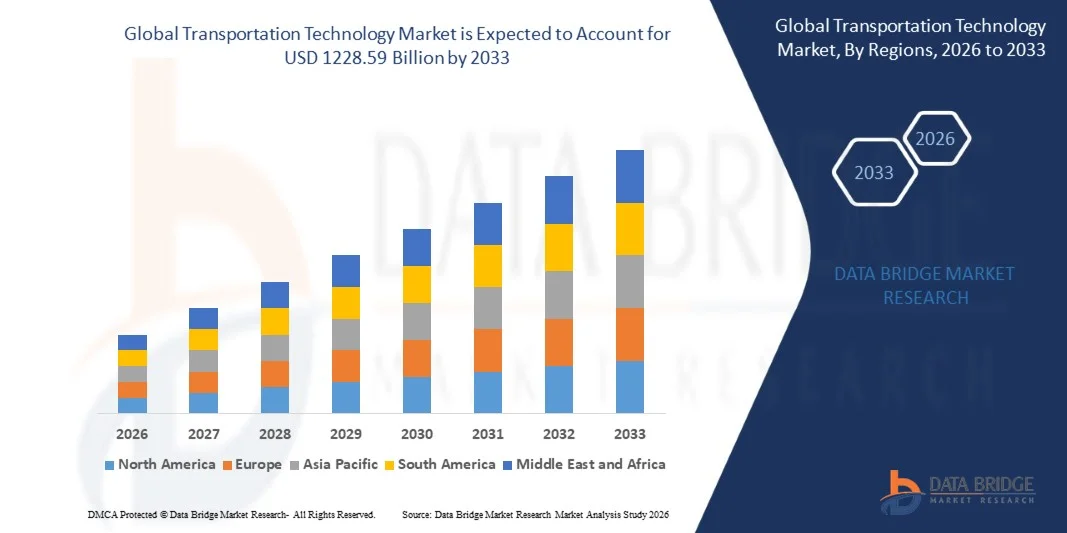
- The global transportation technology market size was valued at USD 218.11 billion in 2025 and is expected to reach USD 1228.59 billion by 2033, at a CAGR of 24.12% during the forecast period
- The market growth is largely fueled by the increasing adoption of intelligent transportation systems, rapid urbanization, and strong government investments in smart mobility infrastructure. Advancements in AI, IoT, and cloud-based platforms are enabling real-time traffic monitoring, predictive analytics, and connected vehicle ecosystems, significantly improving transportation efficiency and safety
- Furthermore, rising demand for efficient traffic management, reduced congestion, and enhanced passenger experience is driving the deployment of smart roadway and railway solutions. Expanding digital transformation initiatives across public and freight transport networks are establishing transportation technology as a core enabler of modern mobility systems, thereby accelerating industry growth
Transportation Technology Market Analysis
- Transportation technology includes advanced digital and connected solutions such as intelligent traffic systems, smart rail operations, predictive maintenance platforms, and integrated mobility management systems that enhance efficiency, safety, and sustainability across transportation networks
- The increasing need for optimized infrastructure utilization, real-time operational visibility, and seamless multimodal connectivity is primarily driving the adoption of transportation technology solutions across roadway, railway, and urban transit systems
- North America dominated the transportation technology market with a share of 36.2% in 2025, due to strong investments in intelligent transportation systems and advanced infrastructure modernization
- Asia-Pacific is expected to be the fastest growing region in the transportation technology market during the forecast period due to rapid urbanization, infrastructure expansion, and increasing government investment in smart city projects
- Roadway segment dominated the market with a market share of 69.9% in 2025, due to rapid urbanization, rising vehicle density, and strong demand for intelligent traffic optimization systems. Governments are increasingly investing in smart road infrastructure, including connected sensors and real-time monitoring solutions, to reduce congestion and improve safety
Report Scope and Transportation Technology Market Segmentation
|
Attributes |
Transportation Technology Key Market Insights |
|
Segments Covered |
|
|
Countries Covered |
North America · U.S. · Canada · Mexico Europe · Germany · France · U.K. · Netherlands · Switzerland · Belgium · Russia · Italy · Spain · Turkey · Rest of Europe Asia-Pacific · China · Japan · India · South Korea · Singapore · Malaysia · Australia · Thailand · Indonesia · Philippines · Rest of Asia-Pacific Middle East and Africa · Saudi Arabia · U.A.E. · South Africa · Egypt · Israel · Rest of Middle East and Africa South America · Brazil · Argentina · Rest of South America |
|
Key Market Players |
· Hitachi Rail Limited (Japan) · Siemens AG (Germany) · Conduent Business Services, LLC (U.S.) · Thales (France) · Advantech Co., Ltd (Taiwan) · Cubic Corporation (U.S.) · SWARCO (Austria) · NEC Corporation (Japan) · Wabtec Corporation (U.S.) · Indra Sistemas, S.A. (Spain) · Kapsch TrafficCom (Austria) · Hitachi, Ltd. (Japan) · NTT DATA Group Corporation (Japan) · Almaviva S.p.A. (Italy) · GMV Innovating Solutions (Spain) · IDEMIA (France) · ENGINEERING Ingegneria Informatica (Italy) · Q-Free ASA (Norway) · Yunex Traffic (Germany) · Init SE (Germany) · Vix Technology (Australia) · KUHN SAS (France) |
|
Market Opportunities |
· Expansion of Smart City and Urban Mobility Projects · Growth in Autonomous and Connected Vehicle Ecosystems |
|
Value Added Data Infosets |
In addition to the market insights such as market value, growth rate, market segments, geographical coverage, market players, and market scenario, the market report curated by the Data Bridge Market Research team includes in-depth expert analysis, import/export analysis, pricing analysis, production consumption analysis, and pestle analysis. |
Transportation Technology Market Trends
“Growth of AI-Driven Smart Mobility and Connected Transport Systems”
- A significant trend in the transportation technology market is the growing deployment of AI-driven smart mobility solutions and connected transport systems across urban and intercity networks, driven by the need for real-time traffic optimization, safety enhancement, and efficient multimodal integration
- For instance, Siemens AG and Thales Group are deploying intelligent traffic management and rail control platforms that integrate AI analytics and IoT connectivity to improve network efficiency and operational visibility. These systems enhance predictive decision-making, reduce congestion, and support safer and more reliable transport operations across large-scale mobility networks
- The integration of connected vehicle technologies and cooperative intelligent transport systems is expanding rapidly as transportation authorities adopt V2X communication frameworks to improve road safety and traffic coordination. This is enabling real-time interaction between vehicles and infrastructure, supporting accident prevention and smoother traffic flow in high-density urban corridors
- Railway operators are increasingly implementing digital rail signaling, automated control systems, and predictive analytics to enhance operational reliability and reduce service disruptions. This is accelerating the transformation of traditional rail networks into intelligent and automated mobility systems capable of handling growing passenger and freight demand
- The expansion of smart city initiatives is further driving the deployment of integrated transportation platforms that combine roadway, railway, and public transit data into unified control systems. This is improving mobility planning, reducing travel time variability, and strengthening overall transport network efficiency
- The market is witnessing increased adoption of cloud-based mobility management platforms that enable centralized monitoring and coordination of transportation assets. This rising digital convergence is reinforcing the transition toward fully connected, AI-enabled transportation ecosystems across global infrastructure networks
Transportation Technology Market Dynamics
Driver
“Rising Investment in Smart Infrastructure and Digital Transport Networks”
- The transportation technology market is strongly driven by increasing investments in smart infrastructure and digital transport networks aimed at modernizing roadway and railway systems for improved efficiency and safety. Governments and private operators are focusing on deploying intelligent systems that enable real-time monitoring, predictive maintenance, and automated traffic control across transport corridors
- For instance, Hitachi Rail Limited and Alstom are actively investing in digital railway modernization projects that incorporate smart signaling, predictive maintenance, and AI-based operations management. These investments are enhancing network reliability, reducing operational delays, and improving overall passenger and freight efficiency across rail systems
- The expansion of smart highways and intelligent traffic management systems is further driving demand for integrated sensor networks, surveillance systems, and adaptive control technologies. These solutions are improving congestion management and enabling more efficient utilization of existing infrastructure capacity
- Public sector initiatives supporting smart city development are accelerating the deployment of connected mobility platforms that integrate traffic, transit, and logistics operations. This is enabling more coordinated transport planning and improving urban mobility efficiency
- Continuous advancements in digital communication technologies such as 5G and edge computing are supporting faster data exchange across transport networks. This is enabling real-time decision-making and improving responsiveness in both roadway and railway operations, reinforcing the market growth driver
Restraint/Challenge
“High Cost and Complexity of System Integration”
- The transportation technology market faces significant challenges due to the high cost and complexity associated with integrating advanced digital systems into existing transportation infrastructure. The need to upgrade legacy systems while ensuring interoperability with modern technologies increases implementation difficulty and capital requirements
- For instance, companies such as Kapsch TrafficCom and Indra Sistemas, S.A. face integration challenges when deploying large-scale intelligent traffic systems across diverse urban and national infrastructure environments. These deployments require extensive customization, coordination, and testing, which increase project timelines and overall costs
- The complexity of synchronizing roadway, railway, and multimodal transport systems across different technologies and standards further increases integration barriers. This creates operational challenges for transport authorities seeking unified mobility management platforms
- High investment requirements for sensors, communication infrastructure, software platforms, and cybersecurity systems also limit rapid adoption, particularly in developing regions. This financial burden slows down large-scale deployment of advanced transportation technologies
- The need for continuous maintenance, software updates, and skilled technical personnel adds to long-term operational expenses. These factors collectively restrain faster adoption of advanced transportation technology solutions despite strong demand growth across global markets
Transportation Technology Market Scope
The market is segmented on the basis of transportation mode, roadway technology, roadway end use, railway technology, and railway end use.
- By Transportation Mode
On the basis of transportation mode, the market is segmented into roadway and railway. The roadway segment dominated the largest market revenue share of 69.9% in 2025, driven by rapid urbanization, rising vehicle density, and strong demand for intelligent traffic optimization systems. Governments are increasingly investing in smart road infrastructure, including connected sensors and real-time monitoring solutions, to reduce congestion and improve safety. Roadway systems also benefit from faster deployment cycles and lower integration complexity compared to rail-based systems, making them widely adopted across urban and intercity networks. The expansion of logistics and freight movement through road networks further strengthens roadway technology adoption. Growing smart city initiatives continue to reinforce the dominance of this segment.
The railway segment is anticipated to witness the fastest growth rate from 2026 to 2033, supported by increasing investments in high-speed rail networks and modernization of aging rail infrastructure. Rail operators are adopting digital signaling, predictive maintenance, and automated control systems to improve operational efficiency and passenger safety. Expansion of sustainable transport initiatives is also accelerating railway electrification and digital transformation. Integration of AI-based monitoring and advanced communication systems enhances reliability and reduces downtime. Rising intercity connectivity demand and government focus on mass transit efficiency are further driving railway technology adoption.
- By Roadway Technology
On the basis of roadway technology, the market is segmented into Cooperative Intelligent Transport Systems (C-ITS), Traffic Management Systems, Road Asset Management, Structural Health Monitoring, Decision Support System (DSS), and Others. The Traffic Management Systems segment dominated the largest market revenue share in 2025, driven by increasing congestion in urban areas and the need for real-time traffic optimization. These systems enable adaptive signal control, congestion monitoring, and improved traffic flow efficiency across major road networks. Governments are deploying AI-enabled surveillance and sensor-based systems to enhance mobility and reduce travel delays. Integration with smart city infrastructure further supports their widespread adoption. The growing need for safety enhancement and emission reduction also contributes to segment leadership.
The Cooperative Intelligent Transport Systems (C-ITS) segment is anticipated to witness the fastest growth rate from 2026 to 2033, driven by rising adoption of connected vehicle infrastructure and V2X communication technologies. C-ITS enables real-time data exchange between vehicles and infrastructure, improving road safety and reducing accident risks. Increasing deployment of 5G networks enhances system responsiveness and reliability. Automotive manufacturers and governments are jointly investing in connected mobility ecosystems. Growing demand for autonomous driving support systems further accelerates C-ITS expansion.
- By Roadway End Use
On the basis of roadway end use, the market is segmented into Bus Station, Highways, Transport Infrastructure, Logistics Management, Transportation, and Others. The Highways segment dominated the largest market revenue share in 2025, driven by extensive deployment of smart monitoring systems for traffic regulation and toll management. Highways serve as critical freight and passenger corridors, requiring advanced surveillance and congestion control technologies. Governments are investing heavily in highway modernization projects incorporating sensors, cameras, and intelligent signage. Integration of real-time analytics improves safety and reduces travel time. Expanding intercity connectivity and logistics movement further strengthens highway dominance.
The Logistics Management segment is anticipated to witness the fastest growth rate from 2026 to 2033, driven by rapid expansion of e-commerce and supply chain digitization. Smart roadway technologies are being integrated into logistics networks to enhance route optimization and fleet tracking efficiency. Companies are increasingly adopting real-time tracking and predictive analytics for delivery management. Rising demand for last-mile delivery efficiency is further boosting adoption. The need for cost reduction and operational transparency accelerates technological integration in logistics operations.
- By Railway Technology
On the basis of railway technology, the market is segmented into Smart Ticketing, Passenger Information Systems, Automatic Fare Collection, Advanced Navigation System, Traveler Information Systems, Traffic Management System, Geographic Information System (GIS), Predictive Maintenance, Rail Analytics, Assistive Technology, Asset Management, Smart Video Surveillance, Safety & Security Systems, Command and Control Systems (CCS), and Structural Health Monitoring. The Predictive Maintenance segment dominated the largest market revenue share in 2025, driven by the increasing need to reduce unplanned downtime and improve asset utilization. Rail operators are using IoT sensors and AI-based analytics to monitor equipment health in real time. This approach significantly reduces maintenance costs and enhances operational safety. Integration with cloud platforms enables centralized monitoring and faster decision-making. Growing focus on efficiency and reliability strengthens this segment’s dominance.
The Smart Ticketing segment is anticipated to witness the fastest growth rate from 2026 to 2033, driven by increasing digitalization of passenger services and rising adoption of contactless payment systems. Smart ticketing solutions enhance passenger convenience by enabling mobile-based booking and automated fare collection. Expansion of integrated transport systems across urban rail networks is accelerating adoption. Governments are promoting cashless and paperless travel experiences for efficiency and sustainability. Increasing smartphone penetration further supports rapid growth of this segment.
- By Railway End Use
On the basis of railway end use, the market is segmented into Railway Station, Public Transportation, Transport Infrastructure, Logistics Management, and Others. The Railway Station segment dominated the largest market revenue share in 2025, driven by extensive deployment of smart surveillance, ticketing, and passenger information systems. Stations serve as central hubs requiring integrated technology for crowd management and safety enhancement. Increasing passenger traffic has led to higher investments in automation and digital monitoring solutions. Integration of real-time data systems improves operational efficiency and passenger experience. Continuous modernization of railway stations supports segment dominance.
The Public Transportation segment is anticipated to witness the fastest growth rate from 2026 to 2033, driven by increasing urban population and demand for efficient mass transit systems. Governments are investing in smart rail networks to reduce congestion and environmental impact. Integration of real-time tracking and automated scheduling improves service reliability. Rising focus on sustainable mobility solutions accelerates adoption of advanced railway technologies. Expansion of metro and suburban rail systems further drives segment growth.
Transportation Technology Market Regional Analysis
- North America dominated the transportation technology market with the largest revenue share of 36.2% in 2025, driven by strong investments in intelligent transportation systems and advanced infrastructure modernization
- The region benefits from early adoption of smart mobility solutions, including AI-based traffic management and connected vehicle technologies. Increasing focus on road safety, congestion reduction, and efficient freight movement further strengthens market growth
- Government-led initiatives for smart cities and digital transportation networks are also accelerating deployment across roadway and railway systems, establishing North America as a leading market
U.S. Transportation Technology Market Insight
The U.S. transportation technology market captured the largest revenue share in North America in 2025, supported by rapid deployment of smart traffic systems and widespread integration of connected mobility solutions. Strong adoption of autonomous vehicle testing, predictive analytics, and cloud-based transport platforms is driving market expansion. Increasing investments in highway modernization and railway digitalization further support growth. The presence of leading technology providers and continuous federal funding for infrastructure upgrades enhance the adoption of advanced transportation technologies across urban and intercity networks.
Europe Transportation Technology Market Insight
Europe transportation technology market is projected to expand at a substantial CAGR throughout the forecast period, driven by stringent regulations on emissions and strong emphasis on sustainable mobility solutions. The region is witnessing growing adoption of intelligent transport systems, electrified rail networks, and integrated multimodal transportation platforms. Increasing urban congestion is pushing governments to invest in real-time traffic management and smart public transit systems. High focus on environmental sustainability and safety standards is further accelerating deployment across roadway and railway infrastructure.
U.K. Transportation Technology Market Insight
The U.K. transportation technology market is anticipated to grow at a notable CAGR during the forecast period, driven by increasing digital transformation of transport infrastructure and rising demand for efficient public mobility systems. Strong investments in smart rail networks and intelligent traffic solutions are supporting market expansion. Government initiatives focused on reducing carbon emissions are also encouraging adoption of electric and connected transport systems. Integration of digital ticketing and real-time passenger information systems further enhances market development.
Germany Transportation Technology Market Insight
The Germany transportation technology market is expected to expand at a considerable CAGR during the forecast period, supported by strong industrial automation capabilities and advanced engineering infrastructure. The country’s focus on smart mobility, autonomous transport systems, and predictive maintenance solutions is driving adoption. Increasing investment in rail modernization and traffic optimization systems further strengthens market growth. Germany’s emphasis on sustainability and digital innovation is accelerating integration of intelligent transportation solutions across both roadway and railway sectors.
Asia-Pacific Transportation Technology Market Insight
Asia-Pacific transportation technology market is poised to grow at the fastest CAGR during the forecast period of 2026 to 2033, driven by rapid urbanization, infrastructure expansion, and increasing government investment in smart city projects. Rising population density and growing transportation demand are encouraging deployment of intelligent traffic systems and advanced rail networks. Expanding digital connectivity and strong adoption of AI and IoT-based mobility solutions are further supporting market growth. The region is also becoming a major hub for cost-efficient manufacturing of transportation technology components, improving accessibility and scalability.
Japan Transportation Technology Market Insight
The Japan transportation technology market is gaining momentum due to its highly advanced infrastructure, strong focus on automation, and increasing adoption of smart mobility solutions. The country emphasizes efficient public transportation systems supported by AI-based scheduling, predictive maintenance, and smart ticketing technologies. Integration of robotics and IoT in railway operations enhances safety and operational efficiency. Japan’s aging population is also driving demand for more accessible and automated transport systems, supporting continued market expansion.
China Transportation Technology Market Insight
The China transportation technology market accounted for the largest revenue share in Asia Pacific in 2025, driven by rapid urban expansion, strong government support for smart city development, and large-scale infrastructure projects. The country is heavily investing in intelligent traffic systems, high-speed rail networks, and connected vehicle technologies. Strong domestic manufacturing capabilities and cost-effective technology deployment are further accelerating adoption. Growing e-commerce logistics demand and urban mobility requirements continue to reinforce China’s dominance in the regional market.
Transportation Technology Market Share
The transportation technology industry is primarily led by well-established companies, including:
- Hitachi Rail Limited (Japan)
- Siemens AG (Germany)
- Conduent Business Services, LLC (U.S.)
- Thales (France)
- Advantech Co., Ltd (Taiwan)
- Cubic Corporation (U.S.)
- SWARCO (Austria)
- NEC Corporation (Japan)
- Wabtec Corporation (U.S.)
- Indra Sistemas, S.A. (Spain)
- Kapsch TrafficCom (Austria)
- Hitachi, Ltd. (Japan)
- NTT DATA Group Corporation (Japan)
- Almaviva S.p.A. (Italy)
- GMV Innovating Solutions (Spain)
- IDEMIA (France)
- ENGINEERING Ingegneria Informatica (Italy)
- Q-Free ASA (Norway)
- Yunex Traffic (Germany)
- Init SE (Germany)
- Vix Technology (Australia)
- KUHN SAS (France)
Latest Developments in Global Transportation Technology Market
- In December 2025, Hitachi, Ltd. partners with Google Cloud to integrate advanced cybersecurity frameworks and AI-driven analytics into railway operations. This development is enhancing operational efficiency through real-time monitoring, predictive decision-making, and higher automation in rail systems. It is also supporting the shift toward autonomous and sustainable trains by improving system resilience and reducing operational disruptions across railway networks
- In December 2025, Conduent Business Services, LLC launched Italy’s first integrated EMV contactless ticketing system across multiple transit operators. This initiative is improving fare payment efficiency by enabling seamless, cashless, and interoperable travel for passengers across transport networks. It is also strengthening transaction security and accelerating digital transformation in public transportation systems while enhancing overall passenger convenience
- In November 2025, Siemens Mobility expanded its AI-powered predictive maintenance platform across major European railway corridors. This expansion is improving asset reliability by enabling early fault detection and reducing unexpected service interruptions in rail operations. It is also optimizing maintenance planning and lowering operational costs, thereby improving efficiency and lifecycle performance of railway infrastructure
- In September 2025, Alstom advanced its digital rail signaling and control systems through large-scale deployment of ERTMS-based modernization projects across key international routes. This development is improving cross-border rail interoperability and enhancing precision in train control and traffic management. It is also increasing network capacity utilization while improving safety standards and reducing delays across interconnected railway systems
- In August 2025, SWARCO acquired Heusch/Boesefeldt GmbH, strengthening its position in highway and tunnel management software solutions within the DACH region. This acquisition is enhancing digital traffic infrastructure capabilities by integrating advanced mobility software into road and tunnel operations. It is also supporting intelligent transport systems and improving construction site management, contributing to more efficient and connected roadway networks

- Interactive Data Analysis Dashboard
- Company Analysis Dashboard for high growth potential opportunities
- Research Analyst Access for customization & queries
- Competitor Analysis with Interactive dashboard
- Latest News, Updates & Trend analysis
- Harness the Power of Benchmark Analysis for Comprehensive Competitor Tracking
Data collection and base year analysis are done using data collection modules with large sample sizes. The stage includes obtaining market information or related data through various sources and strategies. It includes examining and planning all the data acquired from the past in advance. It likewise envelops the examination of information inconsistencies seen across different information sources. The market data is analysed and estimated using market statistical and coherent models. Also, market share analysis and key trend analysis are the major success factors in the market report. To know more, please request an analyst call or drop down your inquiry.
The key research methodology used by DBMR research team is data triangulation which involves data mining, analysis of the impact of data variables on the market and primary (industry expert) validation. Data models include Vendor Positioning Grid, Market Time Line Analysis, Market Overview and Guide, Company Positioning Grid, Patent Analysis, Pricing Analysis, Company Market Share Analysis, Standards of Measurement, Global versus Regional and Vendor Share Analysis. To know more about the research methodology, drop in an inquiry to speak to our industry experts.
Data Bridge Market Research is a leader in advanced formative research. We take pride in servicing our existing and new customers with data and analysis that match and suits their goal. The report can be customized to include price trend analysis of target brands understanding the market for additional countries (ask for the list of countries), clinical trial results data, literature review, refurbished market and product base analysis. Market analysis of target competitors can be analyzed from technology-based analysis to market portfolio strategies. We can add as many competitors that you require data about in the format and data style you are looking for. Our team of analysts can also provide you data in crude raw excel files pivot tables (Fact book) or can assist you in creating presentations from the data sets available in the report.













