


Tray Sealing Film Market Overview
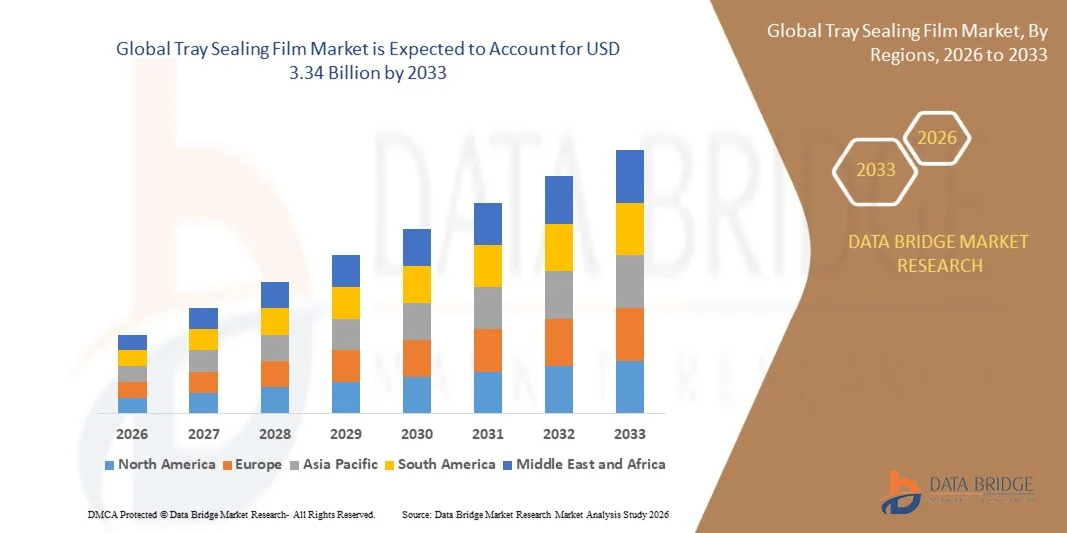
The Tray Sealing Film Market was valued at USD 2.10 billion in 2025 and is projected to reach USD 3.34 billion by 2033, growing at a CAGR of 6.00% from 2026 to 2033. The market is experiencing steady growth driven by rising demand for convenient and extended-shelf-life food packaging solutions, increasing consumption of ready-to-eat meals, and expanding cold chain and retail food distribution networks.
The growing emphasis on food safety, hygiene, and sustainable packaging is encouraging manufacturers to adopt high-barrier, recyclable, and peelable tray sealing films. In addition, advancements in multilayer film technology and modified atmosphere packaging (MAP) compatibility are enhancing product freshness, reducing food waste, and improving operational efficiency for food processors and retailers across global markets.
Key Market Trends & Insights
- North America dominated the Tray Sealing Film Market with a revenue share of 35.20% in 2025, driven by high consumption of convenience and ready-to-eat foods, advanced food packaging technologies, and strong presence of large food manufacturers and retail chains.
- The Polyethylene (PE) segment led the market with a 38.45% share in 2025, driven by its strong sealing performance, cost efficiency, and wide compatibility with food packaging applications.
- Asia-Pacific is expected to be the fastest-growing region at a CAGR of 7.1% from 2026 to 2033, fueled by rapid urbanization, expansion of cold chain logistics, and rising demand for packaged food products in emerging economies such as China and India.
- Ethylene vinyl alcohol (EVOH) are the fastest-growing material type, projected to register a CAGR of 6.9%, reflecting the surge in demand for high-barrier packaging solutions.
- The Modified Atmosphere Packaging segment dominated the film type category with a 44.10% revenue share in 2025, led by its ability to significantly extend product shelf life and maintain food freshness.
- Food and Beverage accounted for 68.5% of the market, preferred by the massive global consumption of packaged and processed foods.
- The Medical and Pharmaceutical segment is the fastest-growing application category, with a CAGR of 6.8%, driven by the increasing demand for sterile and contamination-free packaging solutions.
Market Size & Forecast
- Global Market Value (2025): USD 2.10 Billion
- Expected Market Value (2033): USD 3.34 Billion
- Forecast CAGR (2026–2033): 6.00%
- Leading Region in 2025: North America
- Fastest Growing Region: Asia Pacific
Report Scope and Tray Sealing Film Market Segmentation
|
Attributes |
Tray Sealing Film Key Market Insights |
|
Segments Covered |
|
|
Countries Covered |
North America · U.S. · Canada · Mexico Europe · Germany · France · U.K. · Netherlands · Switzerland · Belgium · Russia · Italy · Spain · Turkey · Rest of Europe Asia-Pacific · China · Japan · India · South Korea · Singapore · Malaysia · Australia · Thailand · Indonesia · Philippines · Rest of Asia-Pacific Middle East and Africa · Saudi Arabia · U.A.E. · South Africa · Egypt · Israel · Rest of Middle East and Africa South America · Brazil · Argentina · Rest of South America |
|
Key Market Players |
· Amcor plc (Switzerland) · Sealed Air Corporation (U.S.) · Mondi plc (U.K.) · Coveris Holdings S.A. (Luxembourg) · Berry Global Group, Inc. (U.S.) · Huhtamaki Oyj (Finland) · Winpak Ltd. (Canada) · Constantia Flexibles Group GmbH (Austria) · Tekni-Plex, Inc. (U.S.) · Taghleef Industries (UAE) · Toray Plastics (America), Inc. (U.S.) · Jindal Films (India) · Cosmo Films Ltd. (India) · UFLEX Limited (India) · Klöckner Pentaplast Group (Luxembourg) · Schur Flexibles Group (Austria) · ProAmpac LLC (U.S.) · TC Transcontinental Packaging (Canada) · Goglio S.p.A. (Italy) · Charter Next Generation (U.S.) |
|
Market Opportunities |
· Rising demand for recyclable mono-material tray sealing films · Expansion of ready-to-eat and chilled meal delivery service · Growth in automated food packaging lines is increasing adoption of high-speed sealable films compatible |
|
Value Added Data Infosets |
In addition to the insights on market scenarios such as market value, growth rate, segmentation, geographical coverage, and major players, the market reports curated by the Data Bridge Market Research also include import export analysis, production capacity overview, production consumption analysis, price trend analysis, climate change scenario, supply chain analysis, value chain analysis, raw material/consumables overview, vendor selection criteria, PESTLE Analysis, Porter Analysis, and regulatory framework. |
Tray Sealing Film Market Trends
Trend: Rising Demand for Sustainable and Recyclable Packaging Solutions
Food manufacturers and retailers are increasingly shifting toward recyclable mono-material and bio-based tray sealing films as sustainability regulations tighten and consumer awareness around plastic waste continues to rise. This shift is not just environmental but also strategic, as brands aim to align with extended producer responsibility (EPR) frameworks and retailer sustainability mandates. Material innovation is focusing on replacing complex multilayer structures with PE-based recyclable alternatives that still maintain oxygen and moisture barrier performance. For instance, major packaged food producers in Europe and North America are progressively replacing conventional non-recyclable lidding films with recyclable PE and PP mono-material structures in chilled meat, dairy, and ready-meal packaging lines to meet retail sustainability targets and reduce landfill dependency.
Tray Sealing Film Market Dynamics
Key Market Driver: Expanding Demand for Packaged and Ready-to-Eat Foods
The increasing urban population, busier lifestyles, and growing preference for convenient meal solutions are significantly accelerating demand for tray sealing films across global food supply chains. These films play a critical role in preserving freshness, preventing contamination, and extending shelf life, especially for perishable categories such as meat, seafood, dairy, and fresh produce. The rise of supermarket chains, quick-service restaurants, and online grocery platforms has further strengthened adoption, as efficient packaging becomes essential for logistics and shelf presentation. For instance, large retail chains and meal kit companies in North America and Asia-Pacific are increasingly deploying modified atmosphere packaging (MAP) tray sealing systems to maintain product integrity during long-distance transportation and reduce food spoilage across cold chain networks.
Key Restraint/Challenge: Volatility in Raw Material Prices and Cost Pressures
The tray sealing film industry is highly sensitive to fluctuations in petrochemical feedstock prices, particularly polyethylene, polypropylene, and polyester resins, which directly influence production costs. This volatility is compounded by energy price instability, transportation costs, and supply chain disruptions, making long-term pricing agreements difficult for manufacturers and converters. Smaller and mid-sized packaging companies face additional pressure as they struggle to absorb cost increases without losing competitiveness against large integrated players.
For instance, packaging converters in regions such as Asia-Pacific and Europe have experienced repeated cost surges in resin procurement, leading to renegotiation of supply contracts with food processors and sometimes temporary shifts toward downgauged film structures to control expenses.
Key Market Opportunity: Growth in Smart and High-Barrier Packaging Technologies
The major emerging opportunity in the tray sealing film market lies in the development of advanced high-barrier and intelligent packaging solutions that enhance both product protection and consumer experience. Manufacturers are increasingly focusing on multilayer and nanotechnology-enhanced films that improve oxygen, moisture, and aroma resistance while maintaining seal integrity under automated high-speed packaging lines. At the same time, integration of smart packaging features such as freshness indicators, leak detection layers, and QR-enabled traceability is gaining traction in premium food segments. For instance, packaging innovators in North America and Europe are developing next-generation peelable high-barrier tray films designed specifically for automated MAP systems used in premium ready meals, organic foods, and high-value protein products to extend shelf life and reduce food waste while improving supply chain visibility.
Tray Sealing Film Market Scope
The tray sealing film market is segmented on the basis of material type, film type, and application.
- By Material Type
On the basis of material type, the Tray Sealing Film Market is segmented into polyethylene (PE), polypropylene (PP), polyethylene terephthalate (PET), polyvinyl chloride (PVC), ethylene vinyl alcohol (EVOH), and others. The Polyethylene (PE) segment dominated the market with a 38.45% share in 2025, owing to its strong sealing performance, cost efficiency, and wide compatibility with food packaging applications. PE films are extensively used in fresh food, dairy, and ready-meal packaging due to their excellent moisture resistance and flexibility. They also offer good machinability in high-speed automated sealing lines, making them suitable for large-scale food processors and retail packaging operations. Growing demand for recyclable mono-material packaging is further strengthening PE adoption as it aligns with sustainability goals. Continuous improvements in downgauging technology are helping reduce material usage without compromising performance. In addition, its wide availability and lower production cost make it the preferred material across both developed and emerging markets.
The EVOH segment is expected to be the fastest-growing material type, registering a CAGR of 6.9% from 2026 to 2033, driven by rising demand for high-barrier packaging solutions. EVOH provides exceptional oxygen barrier properties, making it ideal for extending shelf life of perishable food products. It is increasingly used in multilayer tray sealing films for meat, seafood, and processed food packaging. The material is gaining traction as manufacturers focus on reducing food waste through improved preservation technologies. Advancements in co-extrusion techniques are enhancing its compatibility with recyclable structures. Its adoption is also increasing in premium packaged food segments where product freshness is a key differentiator.
- By Film Type
On the basis of film type, the Tray Sealing Film Market is segmented into peelable films, resealable films, and modified atmosphere packaging (MAP) films. The Modified Atmosphere Packaging (MAP) segment dominated the market with a 44.10% share in 2025, driven by its ability to significantly extend product shelf life and maintain food freshness. MAP films are widely used in packaging meat, poultry, seafood, and fresh produce by controlling oxygen and carbon dioxide levels inside trays. This technology reduces microbial growth and slows down spoilage, making it essential for cold chain distribution. Retailers and food manufacturers increasingly prefer MAP-compatible films to minimize food waste and improve supply chain efficiency. The growing demand for packaged fresh foods in supermarkets and convenience stores is further supporting this segment. Continuous innovation in barrier film structures is enhancing MAP performance across multiple applications.
The Peelable films segment is expected to be the fastest-growing at a CAGR of 6.5% from 2026 to 2033, driven by rising consumer preference for convenience packaging. These films allow easy opening without compromising seal integrity, improving user experience in ready-to-eat meals and single-serve products. Food manufacturers are increasingly adopting peelable solutions to enhance product differentiation and branding. Technological advancements are enabling controlled peel strength while maintaining strong barrier protection. Growth in home delivery meal services and chilled packaged foods is further accelerating demand. In addition, compatibility with automated sealing systems makes peelable films suitable for high-volume production environments.
- By Application
On the basis of application, the Tray Sealing Film Market is segmented into industrial goods, consumer products packaging, medical and pharmaceutical, food and beverage, and automotive parts. The Food and Beverage segment dominated the market with a 68.57% share in 2025, owing to massive global consumption of packaged and processed foods. Tray sealing films are extensively used in fresh meat, seafood, dairy, bakery, and ready-to-eat meals to ensure hygiene and extend shelf life. The expansion of supermarkets, hypermarkets, and online grocery platforms is significantly driving demand. Increasing consumer preference for convenience foods is further strengthening this segment. Strict food safety regulations across developed and emerging markets are also promoting adoption of high-barrier packaging films. Continuous innovation in MAP and peelable technologies is enhancing product efficiency in this segment.
The Medical and Pharmaceutical segment is expected to be the fastest-growing at a CAGR of 6.8% from 2026 to 2033, driven by increasing demand for sterile and contamination-free packaging solutions. Tray sealing films are widely used for packaging medical devices, diagnostic kits, and sterile pharmaceutical products. The need for tamper-evident and high-barrier packaging is supporting growth in this segment. Rising healthcare spending and expansion of pharmaceutical manufacturing are further accelerating adoption. Advanced film materials are being developed to meet stringent regulatory compliance standards. Growth in home healthcare and point-of-care diagnostics is also contributing to rising demand.
Tray Sealing Film Market Regional Analysis
North America dominated the Tray Sealing Film Market with a revenue share of 35.20% in 2025, driven by high consumption of convenience and ready-to-eat foods, advanced food packaging technologies, and strong presence of large food manufacturers and retail chains. The region also benefits from a highly developed retail and quick-service restaurant network, driving consistent demand for tray sealing solutions across fresh, frozen, and ready-to-eat food categories. Increasing focus on food safety standards, shelf-life extension, and sustainable packaging solutions is further strengthening market penetration. Growing investments by major food manufacturers in automated packaging lines and MAP-compatible sealing systems continue to reinforce North America’s leadership position in the global market.
U.S. Tray Sealing Film Market Insight
The U.S. tray sealing film market is witnessing strong growth due to rising consumption of convenience and ready-to-eat foods, expansion of large-scale food processing industries, and increasing adoption of advanced food packaging technologies. The country’s well-developed retail infrastructure, strong presence of quick-service restaurants, and high demand for packaged fresh and frozen food products are driving consistent usage of tray sealing films. In addition, growing emphasis on food safety standards, shelf-life extension, and sustainable packaging solutions is accelerating the shift toward recyclable and high-barrier film structures across major food categories. Continuous investments in automated MAP-compatible sealing systems and innovative packaging formats are further strengthening market growth in the U.S.
Europe Tray Sealing Film Market Insight
The Europe tray sealing film market remains a major contributor to global revenue, driven by strict food safety regulations, strong sustainability mandates, and high demand for packaged fresh food products. The widespread use of recyclable and bio-based packaging materials in retail and foodservice sectors is supporting market expansion across the region. Increasing investments in circular economy initiatives and advanced food packaging technologies, along with strong consumer preference for environmentally friendly packaging, are further enhancing adoption. In addition, the presence of leading food manufacturers and packaging innovators continues to strengthen Europe’s position as a key hub for sustainable tray sealing film development.
U.K. Tray Sealing Film Market Insight
The U.K. tray sealing film market is experiencing steady growth, supported by rising demand for packaged chilled foods, expanding supermarket chains, and increasing focus on reducing food waste. The growing popularity of ready-meal consumption and online grocery delivery services is significantly boosting demand for efficient tray sealing solutions. In addition, strong regulatory emphasis on plastic reduction and recyclability is encouraging adoption of mono-material and eco-friendly film structures. Continuous innovation in peelable and high-barrier packaging formats, along with advanced automated sealing technologies, is enhancing packaging efficiency and product shelf life in the U.K. market.
Germany Tray Sealing Film Market Insight
The Germany tray sealing film market is expanding steadily due to the country’s strong food processing industry, advanced packaging technology base, and strict environmental regulations. Food manufacturers and retailers are increasingly adopting high-performance recyclable films to meet sustainability targets and reduce packaging waste. The demand for high-barrier packaging solutions in meat, dairy, and fresh produce segments is further driving market growth. In addition, continuous innovation in multilayer film structures, combined with strong focus on automation and efficiency in packaging lines, is strengthening Germany’s position as a key market in Europe.
Asia-Pacific Tray Sealing Film Market Insight
The Asia-Pacific tray sealing film market is expected to witness rapid growth, driven by increasing urbanization, rising disposable incomes, and expanding consumption of packaged and convenience foods across major economies such as China, India, and Japan. Growing retail penetration, rapid expansion of cold chain logistics, and increasing demand for ready-to-eat and fresh packaged food products are supporting regional market expansion. In addition, rising awareness regarding food safety, increasing adoption of modern packaging technologies, and strong growth in organized retail and e-commerce food delivery channels are accelerating tray sealing film adoption across the region.
Japan Tray Sealing Film Market Insight
The Japan tray sealing film market is witnessing consistent growth due to high demand for premium packaged food products, strong emphasis on food safety, and advanced food packaging technologies. The country’s aging population and busy urban lifestyle are driving consumption of ready-to-eat and convenience meals, increasing reliance on tray sealing solutions. In addition, continuous innovation in high-barrier and recyclable packaging materials, along with strong adoption of automated packaging systems, is supporting market development. The focus on reducing food waste and maintaining product freshness is further enhancing the use of advanced tray sealing films in Japan.
China Tray Sealing Film Market Insight
The China tray sealing film market is growing rapidly, driven by expanding urban population, rising consumption of packaged foods, and strong growth in modern retail and e-commerce food delivery platforms. Increasing demand for safe, hygienic, and long-shelf-life food packaging is significantly boosting adoption of tray sealing films across meat, seafood, dairy, and ready-meal segments. Government initiatives promoting food safety standards and cold chain infrastructure development are further supporting market expansion. In addition, rising investments in advanced packaging technologies and increasing shift toward sustainable and recyclable materials are positioning China as one of the fastest-growing markets globally.
Tray Sealing Film Market Share
The tray sealing film industry is primarily led by well-established companies, including:
- Amcor plc (Switzerland)
- Sealed Air Corporation (U.S.)
- Mondi plc (U.K.)
- Coveris Holdings S.A. (Luxembourg)
- Berry Global Group, Inc. (U.S.)
- Huhtamaki Oyj (Finland)
- Winpak Ltd. (Canada)
- Constantia Flexibles Group GmbH (Austria)
- Tekni-Plex, Inc. (U.S.)
- Taghleef Industries (UAE)
- Toray Plastics (America), Inc. (U.S.)
- Jindal Films (India)
- Cosmo Films Ltd. (India)
- UFLEX Limited (India)
- Klöckner Pentaplast Group (Luxembourg)
- Schur Flexibles Group (Austria)
- ProAmpac LLC (U.S.)
- TC Transcontinental Packaging (Canada)
- Goglio S.p.A. (Italy)
- Charter Next Generation (U.S.)
Latest Developments in Tray Sealing Film Market
- In May 2025, Coveris launched its next-generation MonoFlexBP recyclable mono-material lidding film, designed for tray sealing applications in chilled food packaging. The solution offers high barrier protection, strong seal integrity, and compatibility with existing tray sealing lines while enabling full recyclability within PE waste streams. This development supports the growing demand for circular packaging solutions in the European food retail sector and helps reduce reliance on multi-layer, non-recyclable structures
- In March 2025, KM Packaging introduced K-Peel 4G mono-PET lidding film, engineered for APET and rPET tray sealing applications in fresh and processed food packaging. The film delivers low seal initiation temperature, improved peel performance, and enhanced clarity, making it suitable for high-speed automated sealing lines. This innovation strengthens KM Packaging’s position in sustainable high-performance lidding films for retail food applications
- In August 2024, Sealed Air expanded its CRYOVAC® food packaging portfolio with advanced lidding film and tray sealing solutions designed to improve shelf life, reduce food waste, and enhance product visibility. The upgraded films incorporate high-barrier structures and anti-fog properties, making them ideal for meat, seafood, and ready-meal applications. This development reinforces Sealed Air’s focus on sustainable and performance-driven food packaging technologies
- In July 2023, Mondi strengthened its sustainable packaging offering by advancing mono-material recyclable film solutions for food packaging, including tray sealing-compatible structures. These developments focus on replacing conventional multi-layer plastics with recyclable PP and PE-based alternatives while maintaining barrier performance. This innovation aligns with increasing regulatory pressure and retailer sustainability commitments across Europe
- In April 2022, Amcor announced expansion of its recyclable flexible packaging and lidding film portfolio, including solutions suitable for tray sealing applications in fresh food and dairy packaging. The development emphasizes lightweight structures, improved recyclability, and compatibility with modified atmosphere packaging systems. This initiative supports Amcor’s broader goal of making all packaging recyclable or reusable

- Interactive Data Analysis Dashboard
- Company Analysis Dashboard for high growth potential opportunities
- Research Analyst Access for customization & queries
- Competitor Analysis with Interactive dashboard
- Latest News, Updates & Trend analysis
- Harness the Power of Benchmark Analysis for Comprehensive Competitor Tracking
Global Tray Sealing Film Market, Supply Chain Analysis and Ecosystem Framework
To support market growth and help clients navigate the impact of geopolitical shifts, DBMR has integrated in-depth supply chain analysis into its Global Tray Sealing Film Market research reports. This addition empowers clients to respond effectively to global changes affecting their industries. The supply chain analysis section includes detailed insights such as Global Tray Sealing Film Market consumption and production by country, price trend analysis, the impact of tariffs and geopolitical developments, and import and export trends by country and HSN code. It also highlights major suppliers with data on production capacity and company profiles, as well as key importers and exporters. In addition to research, DBMR offers specialized supply chain consulting services backed by over a decade of experience, providing solutions like supplier discovery, supplier risk assessment, price trend analysis, impact evaluation of inflation and trade route changes, and comprehensive market trend analysis.
Data collection and base year analysis are done using data collection modules with large sample sizes. The stage includes obtaining market information or related data through various sources and strategies. It includes examining and planning all the data acquired from the past in advance. It likewise envelops the examination of information inconsistencies seen across different information sources. The market data is analysed and estimated using market statistical and coherent models. Also, market share analysis and key trend analysis are the major success factors in the market report. To know more, please request an analyst call or drop down your inquiry.
The key research methodology used by DBMR research team is data triangulation which involves data mining, analysis of the impact of data variables on the market and primary (industry expert) validation. Data models include Vendor Positioning Grid, Market Time Line Analysis, Market Overview and Guide, Company Positioning Grid, Patent Analysis, Pricing Analysis, Company Market Share Analysis, Standards of Measurement, Global versus Regional and Vendor Share Analysis. To know more about the research methodology, drop in an inquiry to speak to our industry experts.
Data Bridge Market Research is a leader in advanced formative research. We take pride in servicing our existing and new customers with data and analysis that match and suits their goal. The report can be customized to include price trend analysis of target brands understanding the market for additional countries (ask for the list of countries), clinical trial results data, literature review, refurbished market and product base analysis. Market analysis of target competitors can be analyzed from technology-based analysis to market portfolio strategies. We can add as many competitors that you require data about in the format and data style you are looking for. Our team of analysts can also provide you data in crude raw excel files pivot tables (Fact book) or can assist you in creating presentations from the data sets available in the report.













