


Treatment Planning Software Market Overview
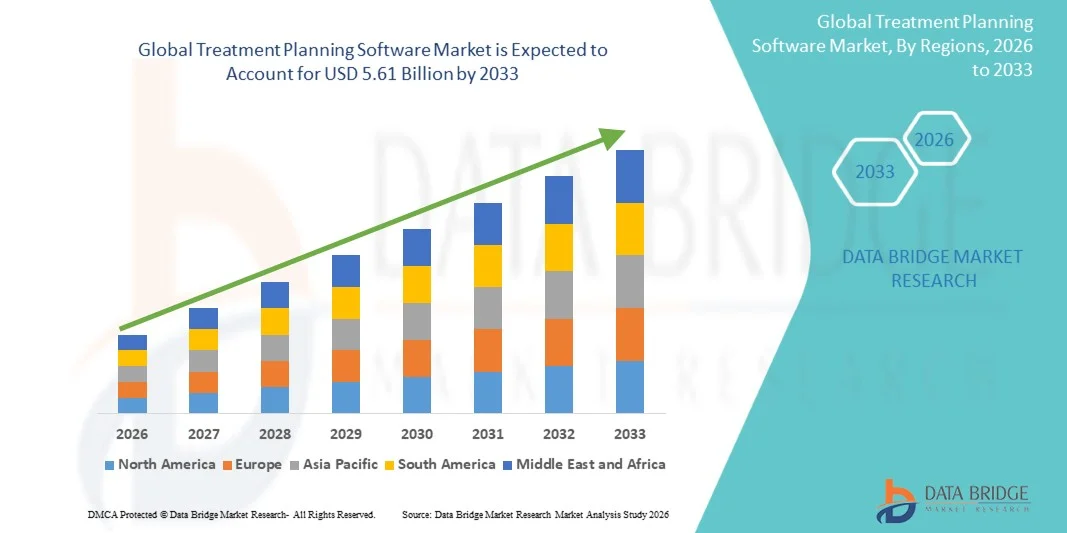
The Treatment Planning Software Market was valued at USD 2.82 billion in 2025 and is projected to reach USD 5.61 billion by 2033, growing at a CAGR of 9.00% from 2026 to 2033. The market is experiencing steady growth driven by the increasing adoption of precision medicine, rising incidence of cancer and chronic diseases, and continuous advancements in medical imaging, artificial intelligence, and radiation therapy technologies.
The growing demand for accurate and personalized treatment planning, combined with the need to improve clinical outcomes and operational efficiency, is encouraging hospitals, cancer centers, and specialty clinics to invest in advanced software solutions. AI-powered treatment planning platforms and cloud-based systems are increasingly replacing conventional manual workflows in many healthcare settings, enabling faster decision-making, enhanced treatment accuracy, and streamlined multidisciplinary care coordination. In addition, the expanding use of treatment planning software in radiation oncology, surgical planning, cardiology, and other therapeutic applications continues to support market expansion worldwide.
Key Market Trends & Insights
- North America dominated the Treatment Planning Software Market with the largest revenue share of 38.46% in 2025, supported by advanced healthcare infrastructure, widespread adoption of digital health technologies, and a strong presence of leading oncology solution providers.
- The Auto-Contouring Software segment led the market with a 38.64% share in 2025, driven by its ability to significantly reduce manual workload and improve the accuracy of treatment planning procedures.
- Asia-Pacific is expected to be the fastest-growing region at a CAGR of 8.1% from 2026 to 2033, fueled by expanding healthcare investments, rising cancer incidence, and accelerating adoption of healthcare IT solutions across China, India, and Southeast Asia.
- Multi-Modality Software are the fastest-growing software type, projected to register a CAGR of 8.6%, reflecting the surge in demand for integrated treatment planning using multiple imaging modalities.
- The Radiation Treatment Planning Software dominated the product type category with a 42.81% revenue share in 2025, led by the increasing global burden of cancer and the widespread use of radiation therapy in treatment protocols.
- On-Premise accounted for 57.14% of the market, preferred by its strong data security capabilities and widespread adoption among hospitals and cancer treatment centers.
- The Cloud-Based segment is the fastest-growing deployment mode, with a CAGR of 8.8%, driven by the increasing demand for scalability, remote accessibility, and cost-efficient software deployment models.
Market Size & Forecast
- Global Market Value (2025): USD 2.82 Billion
- Expected Market Value (2033): USD 5.61 Billion
- Forecast CAGR (2026–2033): 9.00%
- Leading Region in 2025: North America
- Fastest Growing Region: Asia Pacific
Report Scope and Treatment Planning Software Market Segmentation
|
Attributes |
Treatment Planning Software Key Market Insights |
|
Segments Covered |
|
|
Countries Covered |
North America · U.S. · Canada · Mexico Europe · Germany · France · U.K. · Netherlands · Switzerland · Belgium · Russia · Italy · Spain · Turkey · Rest of Europe Asia-Pacific · China · Japan · India · South Korea · Singapore · Malaysia · Australia · Thailand · Indonesia · Philippines · Rest of Asia-Pacific Middle East and Africa · Saudi Arabia · U.A.E. · South Africa · Egypt · Israel · Rest of Middle East and Africa South America · Brazil · Argentina · Rest of South America |
|
Key Market Players |
· Varian Medical Systems, Inc. (U.S.) · RaySearch Laboratories AB (Sweden) · Elekta AB (Sweden) · Accuray Incorporated (U.S.) · Brainlab AG (Germany) · MIM Software Inc. (U.S.) · Mirada Medical Ltd (U.K.) · Standard Imaging, Inc. (U.S.) · Limbus AI Inc. (Canada) · MVision AI Oy (Finland) · Oncentra B.V. (Netherlands) · Leo Cancer Care Ltd (U.K.) · ProKnow Systems, LLC (U.S.) · C-RAD AB (Sweden) · Therapanacea SAS (France) · Aquilab SAS (France) · LAP GmbH Laser Applikationen (Germany) · Vision RT Ltd (U.K.) · SOPHiA GENETICS SA (Switzerland) · MedCom GmbH (Germany) |
|
Market Opportunities |
· Growing adoption of AI-driven adaptive treatment planning · Expansion of cloud-based treatment planning platforms · Increasing integration of multimodal imaging, genomics, and precision medicine |
|
Value Added Data Infosets |
In addition to the insights on market scenarios such as market value, growth rate, segmentation, geographical coverage, and major players, the market reports curated by the Data Bridge Market Research also include in-depth expert analysis, patient epidemiology, pipeline analysis, pricing analysis, and regulatory framework. |
Treatment Planning Software Market Trends
Trend: Growing Adoption of Artificial Intelligence in Personalized Treatment Planning
Healthcare providers are increasingly adopting AI-powered treatment planning software to improve clinical decision-making, optimize therapy selection, and enhance patient outcomes while reducing planning time and workflow complexity. The integration of machine learning algorithms enables precise analysis of imaging, clinical, and patient-specific data to support personalized treatment strategies across oncology and other specialties. Hospitals and cancer centers are similarly leveraging advanced planning platforms to standardize care delivery through data-driven protocols, while cloud computing and predictive analytics technologies create intelligent environments that closely support real-world clinical decision-making. For instance, in January 2025, Siemens Healthineers expanded AI-enabled oncology workflow capabilities within its digital health portfolio, helping clinicians accelerate treatment planning and improve precision in cancer care.
Treatment Planning Software Market Dynamics
Key Market Driver: Rising Demand for Precision Oncology and Advanced Radiation Therapy
The increasing prevalence of cancer and the growing adoption of precision medicine have created substantial demand for advanced treatment planning software that can optimize radiation dose delivery, support multidisciplinary care, and improve treatment outcomes across diverse patient populations. Hospitals, cancer centers, and healthcare networks are deploying treatment planning platforms as a core component of their clinical workflow, reducing planning variability, accelerating treatment timelines, and enhancing overall patient safety. The continued expansion of image-guided and adaptive radiation therapy technologies is further strengthening the importance of sophisticated planning solutions within modern healthcare systems. For instance, in 2024, Varian continued advancing adaptive radiotherapy planning technologies that enable clinicians to personalize treatment plans based on patient-specific anatomical changes throughout therapy.
Key Restraint/Challenge: High Implementation Costs and Complex System Integration Requirements
A significant restraint in the Treatment Planning Software Market is the substantial investment required for advanced planning platforms. Modern systems integrate sophisticated imaging tools, dose calculation engines, clinical databases, and interoperability capabilities, demanding considerable expenditure for deployment, customization, training, and ongoing maintenance. The total cost of ownership extends to software upgrades, cybersecurity measures, regulatory compliance, and technical support, making adoption challenging for smaller hospitals, specialty clinics, and healthcare providers operating within constrained budgets. Integration with legacy information systems and diverse imaging infrastructure further increases implementation complexity across many healthcare environments.
For instance, several regional healthcare providers across emerging markets have delayed treatment planning software modernization projects due to budget limitations and the significant costs associated with integrating new platforms with existing hospital information systems.
Key Market Opportunity: Expansion of AI-Driven Adaptive and Cloud-Based Treatment Planning Platforms
The integration of artificial intelligence in treatment planning presents a significant market opportunity. AI-enabled platforms can automate contouring processes, generate adaptive treatment recommendations, and provide real-time clinical insights while supporting highly personalized patient care. The development of cloud-based treatment planning environments and interoperable healthcare ecosystems is further democratizing access to advanced clinical capabilities, opening growth opportunities across underserved healthcare markets in Asia-Pacific, Latin America, and the Middle East. For instance, in 2025, Elekta continued expanding cloud-connected oncology software solutions designed to improve treatment planning accessibility and collaboration across geographically distributed healthcare networks.
Treatment Planning Software Market Scope
The treatment planning software market is segmented on the basis of software type, product type, deployment mode, and end user.
- By Software Type
On the basis of software type, the Treatment Planning Software Market is segmented into auto-contouring software, multi-modality software, PET/CT deformable software, and DICOM-RT software. The Auto-Contouring Software segment dominated the market with a 38.64% share in 2025, owing to its ability to significantly reduce manual workload and improve the accuracy of treatment planning procedures. These solutions utilize artificial intelligence and advanced image processing algorithms to automatically delineate tumors and organs at risk. Growing demand for workflow automation in radiation oncology departments is accelerating adoption globally. Auto-contouring software also helps minimize inter-observer variability, ensuring consistent treatment outcomes across healthcare facilities. Continuous improvements in deep learning models are enhancing contouring precision and reducing planning time. The segment remains the preferred choice among hospitals and cancer centers seeking higher efficiency and optimized clinical productivity.
The Multi-Modality Software segment is projected to register the fastest growth at a CAGR of 8.6% from 2026 to 2033, driven by increasing demand for integrated treatment planning using multiple imaging modalities. These platforms combine data from CT, MRI, PET, and other imaging technologies to provide comprehensive anatomical and functional insights. The growing adoption of precision medicine is encouraging clinicians to utilize multi-modality systems for more personalized treatment approaches. Advancements in image fusion and registration technologies are further improving planning accuracy. Healthcare providers are increasingly investing in integrated diagnostic and therapeutic workflows, supporting segment expansion. Rising complexity of cancer treatment protocols and the need for enhanced visualization capabilities continue to accelerate growth.
- By Product Type
On the basis of product type, the Treatment Planning Software Market is segmented into radiation treatment planning software, surgical treatment planning software, oncology treatment planning software, orthopedic treatment planning software, dental treatment planning software, and other treatment planning software. The Radiation Treatment Planning Software segment dominated the market with a 42.81% share in 2025, driven by the increasing global burden of cancer and the widespread use of radiation therapy in treatment protocols. These solutions enable clinicians to calculate precise radiation doses while minimizing exposure to surrounding healthy tissues. Growing adoption of intensity-modulated radiation therapy (IMRT), stereotactic radiosurgery, and adaptive radiotherapy is strengthening demand. Continuous technological advancements in dose optimization algorithms are enhancing treatment accuracy and patient outcomes. Hospitals and cancer treatment centers rely heavily on these systems to improve workflow efficiency and clinical effectiveness. The segment continues to benefit from expanding oncology infrastructure worldwide.
The Oncology Treatment Planning Software segment is anticipated to witness the fastest growth at a CAGR of 8.4% from 2026 to 2033, supported by rising demand for personalized cancer care and multidisciplinary treatment management. These platforms integrate imaging, pathology, genomic, and clinical data to support comprehensive treatment decisions. Increasing adoption of precision oncology and targeted therapies is creating strong demand for advanced planning tools. Artificial intelligence integration is enabling predictive analytics and individualized treatment recommendations. Growing investments in cancer care infrastructure across emerging economies are further accelerating adoption. The segment is expected to gain momentum as healthcare providers focus on improving survival rates and treatment outcomes.
- By Deployment Mode
On the basis of deployment mode, the Treatment Planning Software Market is segmented into on-premise, cloud-based, and hybrid. The On-Premise segment accounted for the largest market share of 57.14% in 2025, owing to its strong data security capabilities and widespread adoption among hospitals and cancer treatment centers. Healthcare providers often prefer on-premise deployments to maintain direct control over sensitive patient information and regulatory compliance requirements. These systems offer seamless integration with existing hospital information systems and imaging infrastructure. Large healthcare organizations benefit from enhanced customization and performance optimization. On-premise solutions also provide reliable access with minimal dependence on external networks. Their established presence within healthcare facilities continues to support market leadership.
The Cloud-Based segment is expected to register the fastest growth at a CAGR of 8.8% during 2026–2033, driven by increasing demand for scalability, remote accessibility, and cost-efficient software deployment models. Cloud platforms enable healthcare providers to access treatment planning applications from multiple locations while facilitating collaboration among clinical teams. The growing adoption of telehealth and digital healthcare ecosystems is supporting implementation. Cloud solutions reduce infrastructure costs and simplify software maintenance and updates. Advancements in cybersecurity and regulatory-compliant cloud environments are increasing user confidence. Expanding healthcare digitization initiatives worldwide are expected to accelerate segment growth significantly.
- By End User
On the basis of end user, the Treatment Planning Software Market is segmented into hospitals, cancer research institute, and diagnostic and treatment centers. The Hospitals segment dominated the market with a 49.26% share in 2025, driven by high patient volumes, extensive oncology services, and significant investments in advanced healthcare technologies. Hospitals serve as primary treatment centers for cancer and other complex diseases requiring sophisticated planning solutions. The availability of multidisciplinary clinical teams supports comprehensive treatment planning and execution. Growing adoption of precision medicine and image-guided therapies is further increasing software utilization. Hospitals also possess the financial resources necessary to implement advanced treatment planning platforms. Continuous modernization of healthcare infrastructure contributes to the segment’s leading position.
The Cancer Research Institute segment is projected to witness the fastest growth at a CAGR of 8.2% from 2026 to 2033, supported by increasing research activities focused on personalized medicine, advanced oncology therapies, and innovative treatment approaches. These institutes require sophisticated software platforms to analyze clinical, imaging, and genomic datasets for treatment optimization. Rising public and private funding for cancer research is expanding technology adoption. Collaboration between research organizations, healthcare providers, and software developers is accelerating innovation. Artificial intelligence and machine learning applications are creating new opportunities for advanced treatment planning studies. The growing emphasis on translational research and precision oncology continues to drive rapid segment expansion.
Treatment Planning Software Market Regional Analysis
North America dominated the Treatment Planning Software Market with the largest revenue share of 38.46% in 2025, supported by advanced healthcare infrastructure, widespread adoption of digital health technologies, and a strong presence of leading oncology solution providers. The region also benefits from high adoption of AI-enabled treatment planning platforms, favorable reimbursement frameworks, and growing use of software across cancer care, surgical planning, and precision medicine applications. Increasing focus on personalized treatment approaches and integration of advanced imaging technologies continues to strengthen North America’s leadership position in the global market.
U.S. Treatment Planning Software Market Insight
The U.S. treatment planning software market is witnessing strong growth due to rising investments in advanced oncology care programs, precision medicine initiatives, and digital healthcare technologies. The country’s mature healthcare ecosystem, along with increasing adoption of AI-powered, cloud-based, and image-guided treatment planning systems, is driving demand across hospitals, cancer centers, and research institutions. In addition, growing emphasis on improving treatment outcomes and enhancing clinical workflow efficiency is accelerating software adoption across healthcare providers and oncology networks.
Europe Treatment Planning Software Market Insight
The Europe treatment planning software market remains a major contributor to global revenue, driven by strong government support, technological innovation, and high demand for advanced oncology and surgical planning solutions. The widespread use of treatment planning platforms in cancer care centers, hospitals, and research organizations is supporting market expansion across the region. Increasing investments in precision medicine technologies, coupled with stringent healthcare quality standards and a highly skilled clinical workforce, continue to enhance the adoption of treatment planning software throughout Europe.
U.K. Treatment Planning Software Market Insight
The U.K. treatment planning software market is experiencing steady growth, supported by rising adoption of digital healthcare technologies in oncology, radiotherapy, and surgical planning applications. Increasing investments in advanced healthcare infrastructure and growing demand for accurate, data-driven treatment solutions are contributing to market growth. Furthermore, integration of AI, cloud computing, and predictive analytics technologies is improving planning accuracy and clinical efficiency, positioning the U.K. as a key innovation hub in the treatment planning software industry.
Germany Treatment Planning Software Market Insight
The Germany treatment planning software market is expanding steadily due to the country’s strong healthcare infrastructure, advanced research capabilities, and increasing adoption of next-generation clinical software technologies. Hospitals, cancer treatment centers, and research institutes are increasingly utilizing treatment planning platforms for therapy optimization, clinical decision support, and patient management activities. Continuous advancements in medical imaging, AI integration, and precision medicine technologies, along with strong government focus on healthcare innovation and quality care, are further driving market growth in Germany.
Asia-Pacific Treatment Planning Software Market Insight
The Asia-Pacific treatment planning software market is expected to witness rapid growth, driven by increasing healthcare expenditure, expanding cancer care infrastructure, and rising investments in healthcare digitization across countries such as China, India, and Japan. Growing awareness regarding personalized treatment approaches, rising adoption of advanced planning technologies, and increasing demand for scalable and cost-effective healthcare solutions are supporting regional market expansion. In addition, the growing presence of specialty treatment centers and healthcare research activities is accelerating software adoption across clinical and academic sectors.
Japan Treatment Planning Software Market Insight
The Japan treatment planning software market is witnessing consistent growth due to rising investments in advanced healthcare technologies, oncology innovation, and precision medicine initiatives. Healthcare providers, cancer treatment centers, and research institutes are increasingly adopting sophisticated planning platforms for treatment optimization, clinical workflow enhancement, and research activities. Moreover, increasing integration of AI-powered technologies and the country’s focus on efficient and high-quality patient care solutions are further contributing to market growth.
China Treatment Planning Software Market Insight
The China treatment planning software market is growing rapidly, driven by increasing healthcare modernization, expanding hospital infrastructure, and rising government focus on cancer management and digital healthcare transformation. Growing adoption of AI-enabled and cloud-based treatment planning platforms across hospitals, oncology centers, and research institutions is significantly boosting market demand. In addition, rising investments in healthcare IT, increasing awareness regarding personalized treatment strategies, and rapid technological advancements are positioning China as one of the fastest-growing markets for treatment planning software globally.
Treatment Planning Software Market Share
The treatment planning software industry is primarily led by well-established companies, including:
- Varian Medical Systems, Inc. (U.S.)
- RaySearch Laboratories AB (Sweden)
- Elekta AB (Sweden)
- Accuray Incorporated (U.S.)
- Brainlab AG (Germany)
- MIM Software Inc. (U.S.)
- Mirada Medical Ltd (U.K.)
- Standard Imaging, Inc. (U.S.)
- Limbus AI Inc. (Canada)
- MVision AI Oy (Finland)
- Oncentra B.V. (Netherlands)
- Leo Cancer Care Ltd (U.K.)
- ProKnow Systems, LLC (U.S.)
- C-RAD AB (Sweden)
- Therapanacea SAS (France)
- Aquilab SAS (France)
- LAP GmbH Laser Applikationen (Germany)
- Vision RT Ltd (U.K.)
- SOPHiA GENETICS SA (Switzerland)
- MedCom GmbH (Germany)
Latest Developments in Treatment Planning Software Market
- In September 2024, RaySearch Laboratories announced that Belgium-based Iridium Network became the first center in the world to treat a patient using RayCare integrated with Varian TrueBeam systems. The milestone demonstrated enhanced interoperability between oncology information systems and treatment delivery platforms, supporting more streamlined and efficient radiotherapy workflows
- In July 2024, RaySearch Laboratories announced the launch of RayStation 2024B, the latest version of its treatment planning software. The release introduced automated image import, deep-learning segmentation, and rapid adaptive replanning capabilities, enabling clinicians to perform more efficient adaptive radiotherapy and improve treatment planning accuracy
- In July 2024, RaySearch Laboratories showcased new advancements in RayStation, RayCare, and RayIntelligence at the AAPM 2024 conference. The company highlighted enhanced deep-learning segmentation models, rapid automated plan adaptation, and real-time adaptive radiotherapy capabilities designed to improve clinical efficiency and treatment precision
- In May 2024, RaySearch Laboratories presented new treatment planning innovations at ESTRO 2024, including fast automated replanning, automatic image import, and enhanced deep-learning image segmentation models. These developments were designed to improve planning efficiency and support increasingly personalized radiation therapy workflows
- In December 2023, RaySearch Laboratories announced the launch of RayStation 2024A, a new version of its comprehensive treatment planning system. The software introduced enhanced clinical workflow capabilities, improved support for combined photon-proton treatment planning, and expanded planning goal evaluation functions, helping clinicians optimize complex radiation therapy plans

- Interactive Data Analysis Dashboard
- Company Analysis Dashboard for high growth potential opportunities
- Research Analyst Access for customization & queries
- Competitor Analysis with Interactive dashboard
- Latest News, Updates & Trend analysis
- Harness the Power of Benchmark Analysis for Comprehensive Competitor Tracking
Data collection and base year analysis are done using data collection modules with large sample sizes. The stage includes obtaining market information or related data through various sources and strategies. It includes examining and planning all the data acquired from the past in advance. It likewise envelops the examination of information inconsistencies seen across different information sources. The market data is analysed and estimated using market statistical and coherent models. Also, market share analysis and key trend analysis are the major success factors in the market report. To know more, please request an analyst call or drop down your inquiry.
The key research methodology used by DBMR research team is data triangulation which involves data mining, analysis of the impact of data variables on the market and primary (industry expert) validation. Data models include Vendor Positioning Grid, Market Time Line Analysis, Market Overview and Guide, Company Positioning Grid, Patent Analysis, Pricing Analysis, Company Market Share Analysis, Standards of Measurement, Global versus Regional and Vendor Share Analysis. To know more about the research methodology, drop in an inquiry to speak to our industry experts.
Data Bridge Market Research is a leader in advanced formative research. We take pride in servicing our existing and new customers with data and analysis that match and suits their goal. The report can be customized to include price trend analysis of target brands understanding the market for additional countries (ask for the list of countries), clinical trial results data, literature review, refurbished market and product base analysis. Market analysis of target competitors can be analyzed from technology-based analysis to market portfolio strategies. We can add as many competitors that you require data about in the format and data style you are looking for. Our team of analysts can also provide you data in crude raw excel files pivot tables (Fact book) or can assist you in creating presentations from the data sets available in the report.













