


Global Truck Rental Market
Market Size in USD Billion
CAGR :
% 
 USD
1.47 Billion
USD
2.20 Billion
2025
2033
USD
1.47 Billion
USD
2.20 Billion
2025
2033
 Forecast Period Forecast Period |
2026 –2033 |
 Market Size (Base Year) Market Size (Base Year) |
USD 1.47 Billion |
 Market Size (Forecast Year) Market Size (Forecast Year) |
USD 2.20 Billion |
 CAGR CAGR |
% |
| Major Markets Players |
|
Truck Rental Market Size
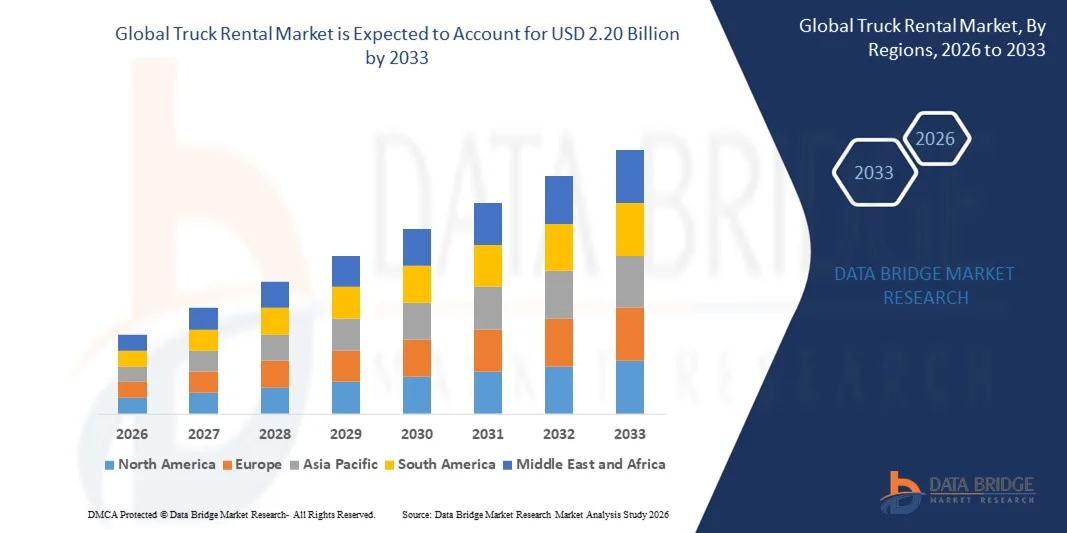
- The global truck rental market size was valued at USD 1.47 billion in 2025 and is expected to reach USD 2.20 billion by 2033, at a CAGR of 5.20% during the forecast period
- The market growth is largely fuelled by the rising demand for transportation services, increasing e-commerce activities, and the expansion of logistics and supply chain networks
Truck Rental Market Analysis
- The truck rental market is experiencing steady growth due to the increasing demand for transportation solutions across various industries. Businesses are opting for truck rentals to reduce ownership costs and improve operational flexibility
- The market is also benefiting from the rise of e-commerce and online retail, leading to a surge in logistics and delivery needs. As these sectors expand, the demand for rental trucks to manage inventory and transportation efficiently continues to grow
- North America dominated the truck rental market with the largest revenue share of 38.5% in 2025, driven by the expanding logistics, e-commerce, and construction sectors, as well as rising demand for flexible fleet solutions.
- Asia-Pacific region is expected to witness the highest growth rate in the global truck rental market, driven by increasing urbanization, rising demand for commercial transport, government support for logistics infrastructure, and the adoption of digital fleet management and IoT-enabled trucks
- The medium-duty segment held the largest market revenue share in 2025, driven by its versatility for urban logistics, last-mile deliveries, and small to medium commercial operations. Medium-duty trucks offer an optimal balance of payload capacity, fuel efficiency, and maneuverability, making them a popular choice among rental customers. The increasing adoption of connected vehicle technologies and telematics in medium-duty trucks is further enhancing their operational efficiency and safety, strengthening their market dominance
Report Scope and Truck Rental Market Segmentation
|
Attributes |
Truck Rental Key Market Insights |
|
Segments Covered |
|
|
Countries Covered |
North America
Europe
Asia-Pacific
Middle East and Africa
South America
|
|
Key Market Players |
|
|
Market Opportunities |
|
|
Value Added Data Infosets |
In addition to the market insights such as market value, growth rate, market segments, geographical coverage, market players, and market scenario, the market report curated by the Data Bridge Market Research team includes in-depth expert analysis, import/export analysis, pricing analysis, production consumption analysis, and pestle analysis. |
Truck Rental Market Trends
Rising Adoption Of Digital Fleet Management And Telematics
- The increasing integration of digital platforms and telematics solutions is significantly shaping the truck rental market. Businesses are adopting real-time tracking, route optimization, and predictive maintenance to improve fleet efficiency, reduce downtime, and enhance operational transparency
- The demand for automated booking, scheduling, and fleet analytics platforms has grown, allowing customers to manage rentals more efficiently and make data-driven decisions. This trend is encouraging providers to invest in IoT-enabled trucks and cloud-based fleet management systems
- Sustainability trends are influencing truck rental offerings, with a growing number of fleets being upgraded to low-emission or electric vehicles. Rental companies are highlighting these solutions to appeal to environmentally conscious businesses and comply with regulatory standards
- For instance, in 2024, Ryder System, Inc. in the U.S. and PACCAR Leasing in Europe expanded their truck rental services with IoT-enabled vehicles and real-time fleet monitoring platforms. These initiatives aimed to improve operational efficiency, reduce downtime, and enhance client satisfaction
- Continuous innovation in telematics, fleet digitization, and eco-friendly trucks is helping rental companies differentiate their services, increase customer retention, and support long-term market growth. Advanced analytics are also enabling predictive maintenance, reducing operational costs, and improving overall fleet reliability
Truck Rental Market Dynamics
Driver
Growing Demand For Flexible And Cost-Efficient Fleet Solutions
- Rising demand for scalable and outsourced transportation solutions is a major driver for the truck rental market. Businesses increasingly prefer renting trucks to avoid capital-intensive purchases, reduce maintenance costs, and handle fluctuating transport needs. This approach also allows small and medium enterprises (SMEs) to compete with larger logistics providers without heavy upfront investment, improving overall supply chain efficiency
- Expanding logistics, e-commerce, and construction operations are further fueling demand, as truck rentals provide quick access to vehicles without long-term commitments, enabling companies to scale operations efficiently. Seasonal spikes, last-mile delivery requirements, and temporary project needs make rental trucks a convenient and agile solution for diverse business models
- Rental providers are offering customized solutions, including short-term leases, long-term contracts, and specialized trucks, to cater to different industry requirements and operational challenges. These tailored offerings often include refrigerated trucks, flatbeds, or heavy-duty vehicles, giving businesses the flexibility to match the right vehicle type to specific tasks and improve productivity
- For instance, in 2023, Penske Truck Leasing in the U.S. and LeasePlan in Europe increased their short-term and on-demand truck rental offerings to meet seasonal and project-based demand. This helped businesses manage costs, improve delivery timelines, and maintain operational flexibility. In addition, integrating telematics and fleet management solutions enabled clients to monitor usage, optimize routes, and reduce operational inefficiencies
- The combination of cost efficiency, operational flexibility, and tailored solutions is expected to continue driving global adoption of truck rental services. In addition, increasing adoption of connected fleets and digital platforms ensures better operational visibility, reduces idle time, and enhances ROI for rental customers. These innovations also support sustainability initiatives by improving fuel efficiency and lowering carbon emissions across the fleet
Restraint/Challenge
High Operational Costs And Limited Awareness Of Green Truck Rental Options
- The relatively higher cost of electric and hybrid trucks compared to conventional vehicles remains a key challenge, limiting adoption among cost-sensitive customers. High initial investment, charging infrastructure requirements, and maintenance complexities contribute to elevated pricing
- Awareness regarding sustainable truck rental solutions is still uneven, particularly in developing markets where traditional diesel fleets dominate. Limited knowledge of operational benefits and environmental impact restricts adoption across certain industries
- Supply chain and fleet management challenges also impact market growth, as rental operators must maintain large vehicle inventories, ensure timely maintenance, and comply with safety and emission regulations. Logistical complexities and limited availability of specialized trucks increase operational costs
- For instance, in 2024, fleet rental providers in India and Southeast Asia reported slower uptake of electric and hybrid trucks due to higher costs, limited charging infrastructure, and low market awareness. These factors prompted some corporates to continue relying on owned or leased diesel fleets, affecting visibility and expansion of sustainable truck rental services
- Overcoming these challenges will require cost-efficient fleet acquisition, expanded infrastructure, and focused educational initiatives for businesses and operators. Collaboration with governments, logistics companies, and technology providers can help unlock the long-term growth potential of the global truck rental market. Moreover, developing cost-competitive rental models and strengthening digital fleet management solutions will be essential for widespread adoption
Truck Rental Market Scope
The truck rental market is segmented on the basis of truck type, rental duration, propulsion type, and service provider.
- By Truck
On the basis of truck type, the market is segmented into light-duty, medium-duty, and heavy-duty trucks. The medium-duty segment held the largest market revenue share in 2025, driven by its versatility for urban logistics, last-mile deliveries, and small to medium commercial operations. Medium-duty trucks offer an optimal balance of payload capacity, fuel efficiency, and maneuverability, making them a popular choice among rental customers. The increasing adoption of connected vehicle technologies and telematics in medium-duty trucks is further enhancing their operational efficiency and safety, strengthening their market dominance.
The light-duty segment is expected to witness the fastest growth rate from 2026 to 2033, owing to rising demand from e-commerce, small businesses, and last-mile delivery operators. Light-duty trucks are appreciated for their cost efficiency, ease of operation, and suitability for short-distance and frequent trips. Rental providers are increasingly customizing light-duty fleets with IoT-enabled tracking and fuel-efficient engines, which helps businesses optimize deliveries and reduce operational costs.
- By Duration
On the basis of rental duration, the market is segmented into short-term and long-term rentals. The short-term segment dominated in 2025, fueled by the need for flexible transportation solutions for seasonal demand, project-based assignments, and temporary workforce operations. Short-term rentals allow companies to quickly scale fleets without large capital investments, supporting cost efficiency and operational agility.
The long-term rental segment is expected to grow at the highest CAGR during 2026–2033, supported by companies seeking predictable costs, reduced maintenance responsibilities, and consistent vehicle availability for ongoing operations. Long-term contracts also provide businesses with the flexibility to upgrade fleets with newer models, implement telematics solutions, and integrate sustainability-focused vehicles without significant upfront investments.
- By Propulsion
On the basis of propulsion, the market is segmented into internal combustion engine (ICE) and electric trucks. ICE trucks held the largest revenue share in 2025 due to established infrastructure, widespread availability, and cost advantages in conventional operations. ICE trucks continue to serve as the backbone for traditional rental operations, with strong service networks and familiarity among drivers supporting their dominance.
The electric truck segment is anticipated to witness the fastest growth from 2026 to 2033, driven by stricter emission regulations, corporate sustainability initiatives, and growing adoption of eco-friendly logistics solutions. Electric trucks offer lower operating costs, reduced noise pollution, and eligibility for government incentives, making them attractive for urban deliveries and last-mile logistics. Rental companies are increasingly adding electric fleets to meet ESG commitments and customer expectations.
- By Service Provider
On the basis of service provider, the market is segmented into rental and leasing companies, OEM captives, and third-party service providers. Rental and leasing companies held the largest share in 2025, benefiting from established networks, diverse fleet options, and tailored services for different industries. These companies are also investing in digital platforms, real-time fleet monitoring, and customer-centric services to retain clients and improve operational efficiency.
OEM captive fleets and third-party service providers are expected to register higher growth from 2026 to 2033, as manufacturers and specialized operators expand offerings with connected fleets, telematics solutions, and flexible rental models. These providers are increasingly collaborating with technology companies to integrate AI-based route optimization, predictive maintenance, and sustainable vehicle options, enhancing fleet performance and customer satisfaction.
- By Truck Capacity
On the basis of truck capacity, the truck rental market is segmented into Class 6 and Below, and Class 7 and Above. The Class 6 and Below segment held the largest market revenue share in 2025, driven by the high demand for light-duty trucks for last-mile delivery, small-scale logistics, and short-distance transport operations. These vehicles offer cost efficiency, easy maneuverability, and suitability for urban and intra-city operations, making them a preferred choice for many commercial and e-commerce businesses.
The Class 7 and Above segment is expected to witness the fastest growth rate from 2026 to 2033, driven by increasing demand for medium- and heavy-duty trucks in construction, industrial transport, and long-haul logistics. These trucks provide higher payload capacity and durability for bulk transportation, making them ideal for large-scale commercial operations and project-based rentals.
- By End User
On the basis of end user, the market is segmented into Commercial Customers and Non-Commercial Customers. The commercial segment held the largest market revenue share in 2025, fueled by expanding e-commerce, retail, and logistics operations requiring flexible, cost-effective transportation solutions. Commercial users benefit from short-term rentals, specialized trucks, and digital fleet management platforms that enhance operational efficiency.
The non-commercial segment is expected to witness the fastest growth rate from 2026 to 2033, driven by increased demand from small businesses, self-employed operators, and seasonal users who prefer renting trucks instead of making capital-intensive purchases. Non-commercial customers are adopting rental solutions for DIY moving, local deliveries, and project-specific transport needs, supported by easy access to short-term and on-demand rental services.
Truck Rental Market Regional Analysis
- North America dominated the truck rental market with the largest revenue share of 38.5% in 2025, driven by the expanding logistics, e-commerce, and construction sectors, as well as rising demand for flexible fleet solutions.
- Businesses in the region highly value the operational flexibility, cost efficiency, and scalability offered by rental trucks, which help manage seasonal demand and reduce capital expenditure.
- This widespread adoption is further supported by advanced telematics, digital fleet management platforms, and the growing preference for eco-friendly vehicles, establishing truck rental as a favored solution for both SMEs and large enterprises.
U.S. Truck Rental Market Insight
The U.S. truck rental market captured the largest revenue share in 2025 within North America, fueled by the need for scalable and outsourced transportation solutions. Companies increasingly prefer renting trucks to reduce maintenance costs, manage fluctuating transport demand, and avoid capital-intensive fleet purchases. The growing integration of digital platforms and IoT-enabled fleet management solutions, combined with rising demand for short-term and on-demand rentals, is further driving market expansion. In addition, rental providers are investing in electric and low-emission trucks to meet sustainability goals.
Europe Truck Rental Market Insight
The Europe truck rental market is expected to witness the fastest growth rate from 2026 to 2033, primarily driven by strict environmental regulations and increasing urban logistics requirements. Businesses are adopting rental solutions to improve fleet flexibility while reducing emissions and operational costs. The rising use of telematics, predictive maintenance, and route optimization is fostering adoption, and rental companies are expanding their offerings across commercial, industrial, and e-commerce applications. The trend towards electrification and smart fleet solutions is expected to further accelerate growth in the region.
U.K. Truck Rental Market Insight
The U.K. truck rental market is expected to witness the fastest growth rate from 2026 to 2033, fueled by the demand for cost-efficient and flexible transportation solutions. Seasonal peaks in construction and logistics, combined with the adoption of connected fleet technologies, are encouraging businesses to leverage short-term rentals. The U.K.’s well-established rental infrastructure and e-commerce growth are enabling providers to expand services with electric and hybrid trucks, enhancing operational efficiency and reducing environmental impact.
Germany Truck Rental Market Insight
The Germany truck rental market is expected to witness significant growth from 2026 to 2033, driven by stringent emission norms and rising awareness of sustainable transportation. Rental providers are increasingly offering eco-friendly and telematics-enabled trucks for industrial and logistics applications. Germany’s strong infrastructure, combined with digitization of fleet management, supports efficient operations and predictive maintenance, promoting adoption among commercial enterprises. The integration of connected and low-emission trucks is also strengthening Germany’s position as a key market in Europe.
Asia-Pacific Truck Rental Market Insight
The Asia-Pacific truck rental market is expected to witness the highest growth rate from 2026 to 2033, driven by rapid industrialization, urbanization, and rising e-commerce demand in countries such as China, India, and Japan. Businesses are increasingly relying on rental fleets to meet fluctuating logistics and construction requirements while optimizing operational costs. The adoption of digital fleet management, real-time tracking, and low-emission trucks is accelerating market growth. Furthermore, APAC is emerging as a manufacturing hub for rental trucks, making solutions more affordable and accessible across the region.
Japan Truck Rental Market Insight
The Japan truck rental market is expected to witness robust growth from 2026 to 2033 due to the country’s technologically advanced logistics systems, high urban density, and focus on sustainability. Rental fleets with IoT-enabled tracking, predictive maintenance, and electric trucks are being increasingly adopted in urban delivery and industrial applications. Aging population trends are also encouraging the use of flexible rental solutions to meet labor and transport efficiency needs. Japan’s emphasis on green logistics and connected vehicle technologies is expected to further propel market expansion.
China Truck Rental Market Insight
The China truck rental market accounted for the largest revenue share in Asia-Pacific in 2025, driven by rapid urbanization, e-commerce growth, and rising logistics demand. Companies are increasingly renting light, medium, and heavy-duty trucks to manage supply chain flexibility, reduce capital expenditure, and meet environmental regulations. The push for smart cities and adoption of digital fleet management platforms is boosting efficiency and cost-effectiveness. Strong domestic manufacturing capabilities and the availability of electric and low-emission trucks further enhance the market potential in China.
Truck Rental Market Share
The Truck Rental industry is primarily led by well-established companies, including:
- Enterprise Holdings, Inc. (U.S.)
- The Hertz Corporation (U.S.)
- Penske (U.S.)
- Ryder System, Inc. (U.S.)
- Avis Rent A Car System, LLC (U.S.)
- NationaLease (U.S.)
- Daimler Truck AG (Germany)
- United Rentals, Inc. (U.S.)
- Bush Truck Leasing (U.S.)
- Kenworth Sales Company (U.S.)
Latest Developments in Global Truck Rental Market
- In February 2024, Flexter.com (Canada) and Green Motion (UK) announced a strategic partnership to enhance the global short-term truck rental reservation process. This collaboration integrates Green Motion's extensive fleet—including compact vans to heavy-duty trucks—into Flexter's platform, providing real-time availability and transparent pricing. The partnership aims to improve accessibility and convenience for customers seeking eco-friendly, short-term truck rental solutions worldwide. By offering a diverse range of vehicles and a seamless booking experience, this alliance is poised to transform the short-term truck rental industry, benefiting both businesses and individual customers
- In July 2024, NHR Group (New Zealand) and Hertz (U.S.) announced a strategic partnership to enhance truck and van rental services across New Zealand. As the major franchise operator for Hertz and Thrifty commercial rentals in the country, NHR Group will operate five co-branded locations in Manukau, Pukekohe, Albany, Waikato, and Christchurch, with plans to expand into Queenstown. This collaboration aims to provide a comprehensive range of vehicles—including trucks, vans, buses, and passenger cars—through both companies' networks. By combining NHR Group's local expertise with Hertz's global brand recognition, the partnership seeks to meet the growing demand in sectors such as logistics, civil works, government, and the film industry, thereby strengthening the commercial vehicle rental market in New Zealand
SKU-
Get online access to the report on the World's First Market Intelligence Cloud

- Interactive Data Analysis Dashboard
- Company Analysis Dashboard for high growth potential opportunities
- Research Analyst Access for customization & queries
- Competitor Analysis with Interactive dashboard
- Latest News, Updates & Trend analysis
- Harness the Power of Benchmark Analysis for Comprehensive Competitor Tracking
Research Methodology
Data collection and base year analysis are done using data collection modules with large sample sizes. The stage includes obtaining market information or related data through various sources and strategies. It includes examining and planning all the data acquired from the past in advance. It likewise envelops the examination of information inconsistencies seen across different information sources. The market data is analysed and estimated using market statistical and coherent models. Also, market share analysis and key trend analysis are the major success factors in the market report. To know more, please request an analyst call or drop down your inquiry.
The key research methodology used by DBMR research team is data triangulation which involves data mining, analysis of the impact of data variables on the market and primary (industry expert) validation. Data models include Vendor Positioning Grid, Market Time Line Analysis, Market Overview and Guide, Company Positioning Grid, Patent Analysis, Pricing Analysis, Company Market Share Analysis, Standards of Measurement, Global versus Regional and Vendor Share Analysis. To know more about the research methodology, drop in an inquiry to speak to our industry experts.
Customization Available
Data Bridge Market Research is a leader in advanced formative research. We take pride in servicing our existing and new customers with data and analysis that match and suits their goal. The report can be customized to include price trend analysis of target brands understanding the market for additional countries (ask for the list of countries), clinical trial results data, literature review, refurbished market and product base analysis. Market analysis of target competitors can be analyzed from technology-based analysis to market portfolio strategies. We can add as many competitors that you require data about in the format and data style you are looking for. Our team of analysts can also provide you data in crude raw excel files pivot tables (Fact book) or can assist you in creating presentations from the data sets available in the report.












