


Tube Feeding Nutrition Market Size
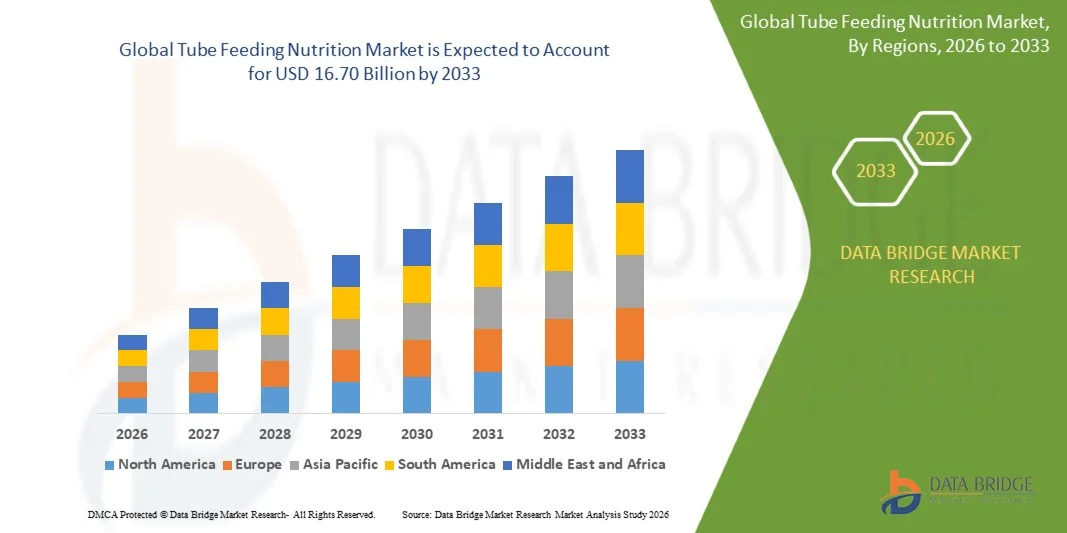
- The global Tube Feeding Nutrition market size was valued at USD 8.79 billion in 2025 and is expected to reach USD 16.70 billion by 2033, at a CAGR of 8.36% during the forecast period
- The market growth is largely fueled by the rising prevalence of chronic diseases such as cancer, neurological disorders, gastrointestinal conditions, and age-related complications that require long-term clinical nutritional support through enteral feeding systems
- Furthermore, increasing geriatric population, growing incidence of disease-related malnutrition, and expanding use of home healthcare services are driving higher adoption of tube feeding solutions across hospital and homecare settings. These converging factors are accelerating the demand for specialized medical nutrition products, thereby significantly boosting the industry’s growth
Tube Feeding Nutrition Market Analysis
- Tube feeding nutrition refers to the delivery of liquid nutrition directly into the stomach or small intestine through a feeding tube, designed for patients who are unable to consume food orally due to medical conditions or surgical recovery needs. These formulations are developed to provide complete, balanced nutrition including proteins, carbohydrates, fats, vitamins, and minerals for clinical care
- The escalating demand for tube feeding nutrition is primarily fueled by the increasing number of critically ill patients, rising awareness of clinical nutrition therapy in hospitals, and growing shift toward personalized and disease-specific enteral feeding formulas to improve patient outcomes and recovery efficiency
- North America dominated the Tube Feeding Nutrition market with a share of 35.7% in 2025, due to rising prevalence of chronic diseases requiring clinical nutritional support and strong adoption of advanced enteral feeding solutions
- Asia-Pacific is expected to be the fastest growing region in the Tube Feeding Nutrition market during the forecast period due to rising healthcare awareness, expanding hospital infrastructure, and increasing prevalence of lifestyle related chronic diseases
- Gastrostomy Tubes (G-tubes) segment dominated the market with a market share of 42.5% in 2025, due to their long-term clinical preference for patients requiring extended nutritional support. These tubes are widely used in hospital and homecare settings due to their stability, reduced aspiration risk, and improved patient comfort compared to nasal routes
Report Scope and Tube Feeding Nutrition Market Segmentation
|
Attributes |
Tube Feeding Nutrition Key Market Insights |
|
Segments Covered |
|
|
Countries Covered |
North America
Europe
Asia-Pacific
Middle East and Africa
South America
|
|
Key Market Players |
|
|
Market Opportunities |
|
|
Value Added Data Infosets |
In addition to the insights on market scenarios such as market value, growth rate, segmentation, geographical coverage, and major players, the market reports curated by the Data Bridge Market Research also include in-depth expert analysis, pricing analysis, brand share analysis, consumer survey, demography analysis, supply chain analysis, value chain analysis, raw material/consumables overview, vendor selection criteria, PESTLE Analysis, Porter Analysis, and regulatory framework. |
Tube Feeding Nutrition Market Trends
“Rising Shift Toward Home-Based Enteral Nutrition Care”
- A significant trend in the tube feeding nutrition market is the growing shift toward home-based enteral nutrition care, driven by the increasing preference for decentralized healthcare delivery and long-term nutritional management outside hospital settings. This transition is enhancing patient comfort while reducing hospital burden and healthcare costs associated with prolonged clinical admissions
- For instance, Fresenius Kabi and Abbott Nutrition provide home enteral feeding solutions and clinical support programs that enable patients with long-term nutritional requirements to receive tube feeding therapy in home care environments. Such structured support systems improve treatment continuity and help caregivers manage nutrition therapy more effectively in non-clinical settings
- The adoption of home-based tube feeding is expanding due to the rising incidence of chronic diseases and post-surgical recovery cases requiring long-term nutritional intervention. This is encouraging healthcare providers to develop patient-centric nutrition models that support early discharge and home recovery protocols
- Hospitals and care providers are increasingly collaborating with home healthcare agencies to ensure safe administration of enteral nutrition therapies. This integration is improving monitoring efficiency and reducing complications associated with improper feeding practices outside clinical environments
- Technological advancements in portable feeding pumps and ready-to-use enteral formulas are further strengthening this trend by simplifying administration procedures. These innovations are enabling patients and caregivers to manage nutritional intake with greater accuracy and convenience
- The growing emphasis on quality of life improvement for patients with neurological disorders, cancer, and gastrointestinal conditions is reinforcing the demand for home-based tube feeding solutions. This shift is steadily transforming the delivery model of clinical nutrition toward more flexible and patient-friendly care systems
Tube Feeding Nutrition Market Dynamics
Driver
“Growing Prevalence of Chronic and Critical Illness”
- The increasing prevalence of chronic and critical illnesses such as cancer, stroke, neurological disorders, and gastrointestinal diseases is significantly driving demand in the tube feeding nutrition market. These conditions often impair normal oral intake, creating a strong need for enteral nutrition support in both hospital and home care settings
- For instance, Nestlé Health Science provides specialized medical nutrition products such as Isosource and Peptamen that are widely used in hospitals and long-term care facilities for patients requiring tube feeding support. These solutions help meet nutritional requirements in critically ill patients who cannot consume adequate nutrition orally
- The rising geriatric population is further contributing to higher demand for tube feeding nutrition as elderly individuals are more prone to swallowing difficulties and chronic health conditions. This demographic shift is increasing reliance on clinical nutrition therapies across healthcare systems
- Hospitals are witnessing a higher intake of patients requiring intensive care nutrition support due to surgical complications and long-term illness management. This is boosting the use of enteral feeding formulas designed for specific disease conditions and recovery phases
- The growing global disease burden is sustaining long-term demand for enteral nutrition solutions, positioning tube feeding nutrition as a critical component of modern clinical treatment protocols
Restraint/Challenge
“High Risk of Complications and Limited Patient Compliance”
- A major challenge in the tube feeding nutrition market is the high risk of complications associated with enteral feeding procedures, including infections, tube blockage, aspiration, and gastrointestinal intolerance. These risks require strict monitoring and skilled administration to ensure patient safety and treatment effectiveness
- For instance, hospitals such as the Mayo Clinic have established specialized enteral nutrition protocols and trained clinical teams to minimize complications during tube feeding therapy. Despite such measures, managing risks remains complex, particularly in home care environments where medical supervision is limited
- Patient compliance is another significant challenge, as long-term dependence on tube feeding can lead to discomfort, psychological resistance, and improper handling of feeding equipment. This often affects adherence to prescribed nutritional regimens and impacts treatment outcomes
- Caregivers and home users may face difficulties in correctly administering feeds, maintaining hygiene standards, and managing feeding schedules. These operational challenges increase the likelihood of errors and reduce overall therapy effectiveness
- The combination of clinical risks and compliance issues continues to restrain broader adoption of tube feeding nutrition solutions, emphasizing the need for improved training, safer delivery systems, and enhanced patient support mechanisms
Tube Feeding Nutrition Market Scope
The market is segmented on the basis of product type, formulation type, and application.
• By Product Type
On the basis of product type, the Tube Feeding Nutrition market is segmented into Nasogastric (NG) Tubes, Nasojejunal (NJ) Tubes, Gastrostomy Tubes (G-tubes), Jejunostomy Tubes (J-tubes), Oroenteric Tubes, and Gastrostomy-Jejunostomy (GJ) Tubes. The Gastrostomy Tubes (G-tubes) segment dominated the largest market revenue share of 42.5% in 2025, driven by their long-term clinical preference for patients requiring extended nutritional support. These tubes are widely used in hospital and homecare settings due to their stability, reduced aspiration risk, and improved patient comfort compared to nasal routes. Their strong adoption is further supported by increasing cases of neurological disorders and swallowing impairments that require long-duration enteral feeding. Healthcare providers also prefer G-tubes due to lower replacement frequency and better patient compliance in chronic care management.
The Jejunostomy Tubes (J-tubes) segment is anticipated to witness the fastest growth rate from 2026 to 2033, driven by rising demand in high-risk patients who cannot tolerate gastric feeding. These tubes are increasingly used in critical care and post-surgical nutrition management, particularly for patients with gastric motility disorders and severe gastrointestinal complications. Hospitals are adopting J-tubes due to their ability to deliver nutrition directly into the small intestine, reducing aspiration risk and improving nutrient absorption. Growth is further supported by advancements in minimally invasive placement techniques and increasing ICU admissions globally.
• By Formulation Type
On the basis of formulation type, the Tube Feeding Nutrition market is segmented into Standard Formulas, Disease-Specific Formulas, Elemental Formulas, Polymeric Formulas, and Semi-Elemental Formulas. The Standard Formulas segment dominated the largest market revenue share in 2025, driven by their broad applicability across a wide patient population requiring general nutritional support. These formulas are widely used in hospitals and homecare settings due to their balanced nutrient composition, cost-effectiveness, and ease of administration. Their dominance is further supported by strong clinical preference for routine enteral feeding in non-complex cases. Increasing hospitalization rates and long-term care needs continue to strengthen demand for standard formulations globally.
The Disease-Specific Formulas segment is anticipated to witness the fastest growth rate from 2026 to 2033, driven by rising prevalence of chronic and metabolic diseases requiring targeted nutritional intervention. These formulas are specifically designed for conditions such as diabetes, renal disorders, oncology, and respiratory illnesses, improving patient outcomes through tailored nutrient profiles. Healthcare providers are increasingly adopting disease-specific nutrition to support faster recovery and reduce complications. Growth is further accelerated by rising awareness of personalized clinical nutrition and expanding critical care patient populations.
• By Application
On the basis of application, the Tube Feeding Nutrition market is segmented into Oncology, Gastroenterology, Neurology, Critical Care, Diabetes and Metabolic Disorders, and Other Chronic Disease Conditions. The Critical Care segment dominated the largest market revenue share in 2025, driven by high demand for enteral nutrition in ICU and emergency care settings. Patients in critical condition often cannot consume food orally, making tube feeding essential for survival and recovery support. Hospitals rely heavily on enteral nutrition in ventilated and post-surgical patients to maintain metabolic balance and reduce complications. Increasing ICU admissions, trauma cases, and post-operative care requirements continue to reinforce segment dominance.
The Oncology segment is anticipated to witness the fastest growth rate from 2026 to 2033, driven by rising cancer prevalence and treatment-related malnutrition. Cancer patients undergoing chemotherapy and radiation frequently experience difficulty in oral intake, increasing reliance on tube feeding solutions. Enteral nutrition helps maintain body weight, improve immunity, and enhance treatment tolerance, making it a critical supportive therapy. Growth is further supported by increasing cancer survival rates and expanding oncology care infrastructure worldwide.
Tube Feeding Nutrition Market Regional Analysis
- North America dominated the Tube Feeding Nutrition market with the largest revenue share of 35.7% in 2025, driven by rising prevalence of chronic diseases requiring clinical nutritional support and strong adoption of advanced enteral feeding solutions
- Patients and healthcare providers in the region increasingly prefer specialized tube feeding formulas designed for improved tolerance, better nutrient absorption, and condition-specific recovery support across hospital and homecare settings
- This widespread adoption is further supported by well-established healthcare infrastructure, high healthcare spending, and strong availability of insurance coverage for medical nutrition therapy, making tube feeding a standard component of long-term clinical care
U.S. Tube Feeding Nutrition Market Insight
The U.S. tube feeding nutrition market captured the largest revenue share in North America in 2025 driven by a high burden of critical illnesses such as cancer, neurological disorders, and gastrointestinal conditions requiring long-term enteral nutrition support. Healthcare providers in the country are increasingly shifting toward personalized medical nutrition plans that improve patient outcomes and reduce hospitalization duration, while demand for home-based care is also rising. For instance Abbott Nutrition has been expanding its specialized enteral feeding product portfolio to support hospital and home-based nutrition care programs across the U.S. market. Strong reimbursement frameworks and advanced home healthcare services further accelerate adoption of tube feeding solutions in both acute and chronic care settings.
Europe Tube Feeding Nutrition Market Insight
The Europe tube feeding nutrition market is projected to expand at a substantial CAGR during the forecast period driven by rising geriatric population and increasing incidence of disease-related malnutrition across healthcare facilities. Growing emphasis on clinical nutrition guidelines and hospital nutrition screening programs is supporting wider use of enteral feeding therapies in long-term care and rehabilitation centers. The region is also witnessing higher demand for home enteral nutrition services as patients shift toward outpatient recovery models supported by government healthcare systems. Increasing product innovation focusing on fiber enriched and disease specific formulas is further strengthening market growth across key European countries.
U.K. Tube Feeding Nutrition Market Insight
The U.K. tube feeding nutrition market is anticipated to grow at a noteworthy CAGR driven by rising awareness of clinical nutrition in critical care and expanding use of home enteral feeding programs. Concerns related to hospital readmission rates and malnutrition in elderly populations are encouraging adoption of structured tube feeding protocols in both public and private healthcare settings. The U.K. healthcare system is increasingly integrating nutrition support teams to ensure better management of patients requiring long term feeding assistance. Strong NHS support for clinical nutrition therapy continues to enhance accessibility of tube feeding solutions across hospitals and community care.
Germany Tube Feeding Nutrition Market Insight
The Germany tube feeding nutrition market is expected to expand at a considerable CAGR driven by strong focus on medical innovation and high standards of patient care in hospital nutrition management. Increasing cases of chronic diseases and post-surgical recovery needs are boosting demand for specialized enteral nutrition formulas in clinical settings. Healthcare providers in Germany emphasize precision based nutritional therapy which supports adoption of advanced tube feeding products tailored for metabolic and digestive conditions. The country’s strong medical infrastructure and emphasis on quality driven healthcare solutions further support sustained market expansion.
Asia-Pacific Tube Feeding Nutrition Market Insight
The Asia-Pacific tube feeding nutrition market is poised to grow at the fastest CAGR during 2026 to 2033 driven by rising healthcare awareness, expanding hospital infrastructure, and increasing prevalence of lifestyle related chronic diseases. Growing elderly population across countries such as China, Japan, and India is significantly increasing demand for clinical nutrition support including enteral feeding solutions. For instance Nestlé Health Science has been expanding its enteral nutrition distribution networks across Asia-Pacific to meet rising hospital and homecare demand. Government initiatives to improve healthcare access and increasing investments in critical care facilities are further accelerating market penetration in the region.
Japan Tube Feeding Nutrition Market Insight
The Japan tube feeding nutrition market is gaining momentum due to rapidly aging population and high prevalence of age related swallowing disorders requiring long term enteral feeding support. Hospitals and long term care facilities in Japan are increasingly adopting technologically advanced feeding systems to improve patient safety and nutritional outcomes. Integration of tube feeding solutions with digital health monitoring systems is enhancing precision in nutritional delivery and patient management. Strong focus on elderly care infrastructure continues to drive sustained demand for specialized medical nutrition products.
China Tube Feeding Nutrition Market Insight
The China tube feeding nutrition market accounted for the largest revenue share in Asia-Pacific in 2025 driven by rapid healthcare infrastructure expansion and increasing burden of chronic diseases. Growing hospital admissions for cancer, stroke, and gastrointestinal disorders is significantly increasing use of enteral nutrition therapies across urban healthcare centers. Domestic manufacturers are expanding production of cost effective tube feeding formulas making medical nutrition more accessible to a wider patient base. Government focus on improving clinical nutrition standards and hospital care quality is further supporting long term market growth.
Tube Feeding Nutrition Market Share
The Tube Feeding Nutrition industry is primarily led by well-established companies, including:
- Abbott Laboratories (U.S.)
- Nestlé Health Science (Switzerland)
- Fresenius Kabi AG (Germany)
- Danone S.A. (France)
- B. Braun Melsungen AG (Germany)
- Mead Johnson Nutrition (U.S.)
- Cardinal Health Inc. (U.S.)
- Fresenius SE & Co. KGaA (Germany)
- Nutricia (Netherlands)
- Otsuka Pharmaceutical Co., Ltd. (Japan)
- Meiji Holdings Co., Ltd. (Japan)
- Global Health Products Inc. (U.S.)
- Applied Medical Technology Inc. (U.S.)
- Victus Inc. (U.S.)
- Kate Farms Inc. (U.S.)
Latest Developments in Global Tube Feeding Nutrition Market
- In April 2025, Arla Foods Ingredients expanded its Lacprodan MicelPure Medical portfolio to strengthen high-quality ingredient supply for medical nutrition applications, particularly tube feeding solutions. The launch of micellar casein isolate designed for clinical requirements is expected to improve protein purity, digestibility, and nutritional efficiency in enteral formulas. This development supports rising demand for advanced, science-driven medical nutrition products in hospitals and long-term care settings, enhancing patient recovery outcomes and formulation precision
- In March 2024, Nestlé Health Science introduced an upgraded enteral nutrition platform focused on personalized tube feeding formulas tailored to specific disease conditions such as oncology, neurology, and critical care. This innovation is expected to strengthen the shift toward disease-specific medical nutrition by improving clinical outcomes and enabling more targeted nutrient delivery. It also supports healthcare providers in optimizing patient recovery through precision-based nutritional management in both hospital and homecare environments
- In June 2023, Fresenius Kabi launched an enhanced line of energy-dense enteral nutrition formulas designed for critically ill patients requiring high caloric and protein intake in limited feeding volumes. This development is expected to improve nutritional efficiency in intensive care settings by reducing feeding burden while ensuring adequate energy supply. It further strengthens clinical nutrition protocols for long-term hospitalized patients, supporting better recovery and reduced complications
- In early 2022, LiveWorld partnered with Real Food Blends to support the launch of Real Food Blends Mini, a snack-size tube feeding option made from whole food ingredients aimed at improving digestive health in tube-fed patients. This development is expected to enhance patient acceptance of enteral nutrition by offering more natural, food-based options that support bowel function. It also contributes to improved quality of life and long-term adherence to tube feeding regimens in homecare settings
- In October 2021, Abbott introduced plant-based, vegetable- and fruit-rich formulations specifically designed for feeding tube users, marking a shift toward cleaner-label medical nutrition solutions. This development is expected to expand dietary variety in tube feeding while improving patient tolerance and aligning with growing demand for plant-forward clinical nutrition. It also supports broader market adoption of more natural, minimally processed enteral feeding options in both institutional and homecare environments

- Interactive Data Analysis Dashboard
- Company Analysis Dashboard for high growth potential opportunities
- Research Analyst Access for customization & queries
- Competitor Analysis with Interactive dashboard
- Latest News, Updates & Trend analysis
- Harness the Power of Benchmark Analysis for Comprehensive Competitor Tracking
Global Tube Feeding Nutrition Market, Supply Chain Analysis and Ecosystem Framework
To support market growth and help clients navigate the impact of geopolitical shifts, DBMR has integrated in-depth supply chain analysis into its Global Tube Feeding Nutrition Market research reports. This addition empowers clients to respond effectively to global changes affecting their industries. The supply chain analysis section includes detailed insights such as Global Tube Feeding Nutrition Market consumption and production by country, price trend analysis, the impact of tariffs and geopolitical developments, and import and export trends by country and HSN code. It also highlights major suppliers with data on production capacity and company profiles, as well as key importers and exporters. In addition to research, DBMR offers specialized supply chain consulting services backed by over a decade of experience, providing solutions like supplier discovery, supplier risk assessment, price trend analysis, impact evaluation of inflation and trade route changes, and comprehensive market trend analysis.
Data collection and base year analysis are done using data collection modules with large sample sizes. The stage includes obtaining market information or related data through various sources and strategies. It includes examining and planning all the data acquired from the past in advance. It likewise envelops the examination of information inconsistencies seen across different information sources. The market data is analysed and estimated using market statistical and coherent models. Also, market share analysis and key trend analysis are the major success factors in the market report. To know more, please request an analyst call or drop down your inquiry.
The key research methodology used by DBMR research team is data triangulation which involves data mining, analysis of the impact of data variables on the market and primary (industry expert) validation. Data models include Vendor Positioning Grid, Market Time Line Analysis, Market Overview and Guide, Company Positioning Grid, Patent Analysis, Pricing Analysis, Company Market Share Analysis, Standards of Measurement, Global versus Regional and Vendor Share Analysis. To know more about the research methodology, drop in an inquiry to speak to our industry experts.
Data Bridge Market Research is a leader in advanced formative research. We take pride in servicing our existing and new customers with data and analysis that match and suits their goal. The report can be customized to include price trend analysis of target brands understanding the market for additional countries (ask for the list of countries), clinical trial results data, literature review, refurbished market and product base analysis. Market analysis of target competitors can be analyzed from technology-based analysis to market portfolio strategies. We can add as many competitors that you require data about in the format and data style you are looking for. Our team of analysts can also provide you data in crude raw excel files pivot tables (Fact book) or can assist you in creating presentations from the data sets available in the report.













