


What is the Tumor Microenvironment Targeted Therapy Market Size and Growth Rate ?
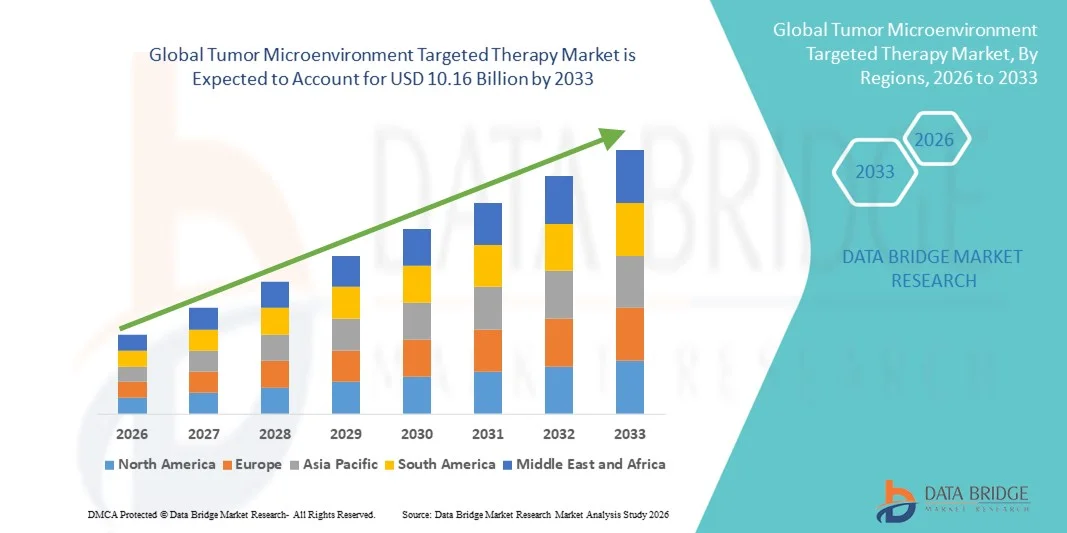
- As per Data Bridge Market Research Analysis the global tumor microenvironment targeted therapy market size was valued at USD 3.21 billion in 2025 and is expected to reach USD 10.16 billion by 2033, at a CAGR of 15.50% during the forecast period
- The market growth is largely fueled by the increasing incidence of cancer globally and growing research investments in immuno‑oncology and tumor microenvironment modulation technologies, which are enhancing precision oncology approaches and novel therapeutic development
- Furthermore, rising demand for advanced therapies that can target the tumor microenvironment more effectively improving clinical outcomes while reducing systemic side effects is driving uptake across both clinical and research settings, thereby significantly boosting industry expansion
Market Size & Forecast
- Global Market Value (2025): USD 3.21 billion
- Expected Market Value (2033): USD 10.16 billion
- Forecast CAGR (2026–2033): 15.50%
What are the Major Takeaways of Tumor Microenvironment Targeted Therapy Market ?
- Tumor microenvironment targeted therapies, designed to modulate or exploit the tumor microenvironment for cancer treatment, are becoming increasingly vital components of modern oncology due to their ability to enhance immune response, improve treatment specificity, and reduce systemic toxicity in both clinical and research settings
- The escalating demand for these therapies is primarily fueled by the rising incidence of cancer globally, growing investments in immuno-oncology research, and increasing adoption of precision medicine approaches that focus on the tumor microenvironment to improve patient outcomes
- North America dominated the tumor microenvironment targeted therapy market with the largest revenue share of 42.7% in 2025, characterized by advanced healthcare infrastructure, significant R&D investments, and the presence of key biotechnology and pharmaceutical players, with the U.S. witnessing substantial growth in therapy approvals and clinical trials driven by innovations in immunomodulatory and cell-based therapies
- Asia-Pacific is expected to be the fastest-growing during the forecast period, driven by increasing healthcare investments, rising awareness about advanced cancer therapies, and expanding oncology infrastructure in countries such as China, Japan, and India
- Monoclonal antibodies segment dominated the market with a share of 38.9% in 2025, driven by their established efficacy in targeting specific immune cells and tumor-associated components while being widely adopted in clinical oncology practice
Report Scope and Tumor Microenvironment Targeted Therapy Market Segmentation
|
Attributes |
Tumor Microenvironment Targeted Therapy Key Market Insights |
|
Segments Covered |
|
|
Countries Covered |
North America
Europe
Asia-Pacific
Middle East and Africa
South America
|
|
Key Market Players |
|
|
Market Opportunities |
|
|
Value Added Data Infosets |
In addition to the insights on market scenarios such as market value, growth rate, segmentation, geographical coverage, and major players, the market reports curated by the Data Bridge Market Research also include in-depth expert analysis, patient epidemiology, pipeline analysis, pricing analysis, and regulatory framework |
What is the Key Trend in the Tumor Microenvironment Targeted Therapy Market ?
Advancements in Combination and Immuno-Oncology Therapies
- A significant and accelerating trend in the global tumor microenvironment targeted therapy market is the development of combination therapies that target both the tumor microenvironment and immune checkpoints, enhancing treatment efficacy in resistant cancers
- For instance, pembrolizumab combined with tumor microenvironment modulators is showing improved response rates in certain solid tumors, providing new therapeutic options for patients with refractory cancers
- Integration of advanced immuno-oncology approaches enables therapies to not only attack cancer cells directly but also reprogram the tumor microenvironment, improving long-term outcomes and reducing systemic toxicity
- The adoption of biomarker-driven therapy selection and precision medicine approaches allows clinicians to tailor treatments based on the unique tumor microenvironment profile of each patient, increasing treatment personalization
- This trend towards more targeted, adaptive, and combination-based strategies is fundamentally reshaping clinical oncology practices, encouraging companies such as BioNTech and Genmab to focus on therapies that modulate immune components and tumor-associated stromal cells
- The demand for therapies that can intelligently interact with the tumor microenvironment is growing rapidly across both clinical and research settings, as healthcare providers prioritize efficacy, safety, and patient-specific outcomes
- Collaborations between biotech firms and academic research centers are accelerating the development of novel tumor microenvironment-targeted therapies, enabling faster clinical translation of preclinical discoveries
Tumor Microenvironment Targeted Therapy Market Dynamics
Driver
Rising Cancer Incidence and Precision Medicine Adoption
- The increasing prevalence of cancer globally, combined with growing investments in precision medicine and immuno-oncology research, is a significant driver for the heightened demand for tumor microenvironment targeted therapies
- For instance, in 2025, Moderna initiated multiple clinical trials for mRNA-based immunotherapies targeting the tumor microenvironment, aiming to enhance anti-tumor immune responses
- As healthcare systems seek therapies that improve survival outcomes and reduce adverse effects, tumor microenvironment targeted therapies provide advanced mechanisms such as immune modulation, combination therapy potential, and reduced off-target toxicity
- Furthermore, the growing adoption of precision medicine approaches and molecular profiling is making tumor microenvironment targeted therapies an integral part of modern oncology, enabling personalized treatment strategies
- Increased funding, public awareness of advanced cancer treatments, and the expansion of clinical trial networks further propel the adoption of these therapies in both developed and emerging markets
- Growing collaborations between pharmaceutical companies and academic institutions are driving the rapid introduction of next-generation therapies targeting specific tumor microenvironment components
- Expanding government support and oncology research grants, particularly in North America and Europe, are further enabling R&D activities and clinical trials for innovative tumor microenvironment therapies
Restraint/Challenge
High Development Costs and Regulatory Hurdles
- Concerns surrounding the high cost and long development timelines of tumor microenvironment targeted therapies pose a significant challenge to broader market penetration
- For instance, the complex manufacturing process and multi-phase clinical trials for combination immunotherapies can delay approvals and increase financial risk for developers
- Addressing regulatory compliance, safety monitoring, and demonstrating clinical efficacy in heterogeneous patient populations is crucial for gaining approvals and market access
- The relatively high treatment cost compared to conventional therapies can be a barrier for adoption, particularly in developing regions or for patients without sufficient healthcare coverage
- While innovation continues to advance the field, the perceived premium and accessibility challenges may still limit widespread adoption, especially for smaller biotech firms lacking large-scale production capacity
- Overcoming these challenges through strategic collaborations, streamlined clinical development pathways, and insurance coverage expansion will be vital for sustained market growth
- Limited long-term safety and efficacy data for newer therapies may cause hesitancy among clinicians and patients, slowing adoption rates in certain markets
- Market entry barriers for emerging companies, including stringent regulatory requirements and competition from established players, continue to constrain overall market expansion
How is the Tumor Microenvironment Targeted Therapy Market Segmented ?
The market is segmented on the basis of cancer type, target, therapy type, and end user.
- By Cancer Type
On the basis of cancer type, the tumor microenvironment targeted therapy market is segmented into lung cancer, colorectal cancer, breast cancer, prostate cancer, bladder cancer, kidney cancer, and other cancer types. The lung cancer segment dominated the market with the largest revenue share in 2025, driven by the high global prevalence of lung cancer and the strong adoption of immunotherapies targeting the tumor microenvironment in non-small cell lung cancer (NSCLC). Significant clinical research activity, increasing approvals of checkpoint inhibitors, and combination regimens targeting immune cells within the tumor microenvironment contribute to its dominance. In addition, strong reimbursement frameworks in developed regions support higher treatment uptake. The availability of biomarker-based therapy selection further enhances treatment precision in lung cancer. Continuous innovation in immuno-oncology has solidified lung cancer as the leading segment in revenue contribution.
The breast cancer segment is anticipated to witness the fastest growth rate from 2026 to 2033, fueled by rising incidence rates and increasing focus on targeting the tumor microenvironment in aggressive subtypes such as triple-negative breast cancer (TNBC). Growing research on stromal modulation and immune cell targeting is expanding therapeutic possibilities in this segment. Increased awareness, early diagnosis programs, and expanding clinical trial pipelines are supporting growth. Pharmaceutical companies are actively developing combination therapies specifically for breast cancer microenvironment modulation. Advancements in personalized medicine and molecular profiling are further accelerating adoption. These factors collectively position breast cancer as the fastest-growing cancer type segment.
- By Target
On the basis of target, the market is segmented into T cells, tumor-associated macrophages, myeloid-derived suppressor cells, cancer-associated fibroblasts, regulatory T cells, and other cellular targets. The T cells segment held the largest market revenue share in 2025, driven by the widespread adoption of immune checkpoint inhibitors and adoptive T-cell therapies. Therapies targeting T cells have demonstrated strong clinical efficacy across multiple cancer types. Significant R&D investments and regulatory approvals for T-cell–modulating drugs contribute to segment leadership. The established success of PD-1 and CTLA-4 inhibitors strengthens this segment’s dominance. Moreover, expanding indications across solid and hematologic malignancies support sustained demand. Continuous innovation in engineered T-cell therapies further enhances market share.
The tumor-associated macrophages (TAMs) segment is expected to witness the fastest CAGR from 2026 to 2033, driven by increasing recognition of macrophages’ role in tumor progression and immune suppression. Emerging therapies focused on reprogramming TAMs are gaining attention in clinical development pipelines. Research highlighting macrophage plasticity has opened new therapeutic avenues. Biotech firms are investing in next-generation agents targeting macrophage signaling pathways. Growing preclinical and early-phase trial data are strengthening confidence in TAM-focused strategies. This expanding research focus is projected to accelerate growth within this segment.
- By Therapy Type
On the basis of therapy type, the market is segmented into monoclonal antibodies, cytokines, cancer vaccines, oncolytic viruses, adoptive cell therapies, and other therapies. The monoclonal antibodies segment dominated the market in 2025 with a market share of 38.9%, driven by their proven efficacy in targeting immune checkpoints and tumor microenvironment components. These therapies benefit from established regulatory approvals and broad clinical acceptance. Strong commercial success of checkpoint inhibitors significantly contributes to revenue generation. Pharmaceutical companies continue expanding indications for antibody-based therapies. Their compatibility with combination regimens enhances therapeutic effectiveness. Widespread physician familiarity and reimbursement support further strengthen segment dominance.
The adoptive cell therapies segment is anticipated to register the fastest growth rate during the forecast period, supported by advancements in CAR-T and TCR-based technologies. Increasing investment in cell engineering and personalized immunotherapy platforms is accelerating development. Clinical successes in hematologic cancers are encouraging expansion into solid tumors. Growing regulatory support for breakthrough therapies is boosting commercialization prospects. Technological improvements in manufacturing and scalability are improving accessibility. These advancements collectively drive rapid expansion of adoptive cell therapies.
- By End User
On the basis of end user, the market is segmented into biopharmaceutical & biotechnology companies, hospitals, diagnostic laboratories, research institutes, contract research organizations (CROs), and other end users. The biopharmaceutical & biotechnology companies segment accounted for the largest revenue share in 2025, driven by extensive R&D activities and commercialization of tumor microenvironment-targeted therapies. These companies lead clinical trials, product approvals, and strategic collaborations. Strong investment flows and venture funding support pipeline expansion. Large-scale manufacturing capabilities enable market penetration. Strategic licensing agreements and partnerships enhance global distribution. Continuous innovation sustains this segment’s leading position.
The contract research organizations (CROs) segment is expected to witness the fastest growth during the forecast period, fueled by increasing outsourcing of clinical trials and research activities. Biotech firms rely on CROs for cost-effective and efficient trial management. Rising complexity of oncology studies increases demand for specialized research support. Expanding global trial networks enhance patient recruitment capabilities. Regulatory expertise offered by CROs accelerates approval timelines. Growing collaboration between pharma companies and CROs drives rapid segment expansion.
Which Region Holds the Largest Share of the Tumor Microenvironment Targeted Therapy Market ?
- North America dominated the tumor microenvironment targeted therapy market with the largest revenue share of 42.7% in 2025, characterized by advanced healthcare infrastructure, significant R&D investments, and the presence of key biotechnology and pharmaceutical players
- Healthcare providers in the region highly value advanced immunotherapies, precision medicine approaches, and biomarker-driven treatment strategies that enhance clinical outcomes while reducing systemic toxicity
- This widespread adoption is further supported by substantial R&D investments, the presence of leading biopharmaceutical companies, favorable reimbursement frameworks, and a robust clinical trial ecosystem, establishing tumor microenvironment targeted therapies as a critical component of modern cancer treatment across hospitals and research institutions
U.S. Tumor Microenvironment Targeted Therapy Market Insight
The U.S. tumor microenvironment targeted therapy market captured the largest revenue share within North America in 2025, fueled by strong oncology research funding, rapid adoption of immuno-oncology therapies, and a high concentration of leading biopharmaceutical companies. Healthcare providers are increasingly prioritizing precision medicine approaches that modulate the tumor microenvironment to improve survival outcomes. The expanding pipeline of checkpoint inhibitors and cell-based therapies further propels the market. Moreover, extensive clinical trial activity, favorable reimbursement frameworks, and regulatory support for breakthrough cancer therapies are significantly contributing to market expansion.
Europe Tumor Microenvironment Targeted Therapy Market Insight
The Europe tumor microenvironment targeted therapy market is projected to expand at a substantial CAGR throughout the forecast period, primarily driven by increasing cancer prevalence and strong government support for oncology research. The rise in personalized medicine initiatives and advanced diagnostic capabilities is fostering therapy adoption. European healthcare systems emphasize innovative, targeted treatments that enhance efficacy while minimizing adverse effects. The region is witnessing steady growth across major economies, with therapies increasingly incorporated into standardized oncology treatment protocols and research collaborations.
U.K. Tumor Microenvironment Targeted Therapy Market Insight
The U.K. tumor microenvironment targeted therapy market is anticipated to grow at a noteworthy CAGR during the forecast period, driven by expanding cancer research programs and increasing access to immunotherapy treatments. In addition, rising awareness of advanced oncology solutions is encouraging hospitals and research institutions to adopt tumor microenvironment-modulating therapies. The U.K.’s strong academic research base and collaboration between public institutions and biotech firms are expected to continue stimulating market growth.
Germany Tumor Microenvironment Targeted Therapy Market Insight
The Germany tumor microenvironment targeted therapy market is expected to expand at a considerable CAGR during the forecast period, fueled by rising demand for innovative oncology treatments and strong investment in biomedical research. Germany’s advanced healthcare infrastructure and emphasis on technological innovation promote the adoption of precision immunotherapies. The integration of molecular diagnostics with targeted therapies is becoming increasingly prevalent, with a strong preference for clinically validated and safety-focused treatment solutions aligning with national healthcare standards.
Asia-Pacific Tumor Microenvironment Targeted Therapy Market Insight
The Asia-Pacific tumor microenvironment targeted therapy market is poised to grow at the fastest CAGR during the forecast period of 2026 to 2033, driven by rising cancer incidence, increasing healthcare expenditure, and expanding access to advanced oncology treatments in countries such as China, Japan, and India. The region's growing focus on precision medicine, supported by government healthcare reforms and research funding, is driving therapy adoption. Furthermore, as APAC strengthens its biotechnology manufacturing and clinical research capabilities, accessibility to tumor microenvironment targeted therapies is expanding to a broader patient population.
Japan Tumor Microenvironment Targeted Therapy Market Insight
The Japan tumor microenvironment targeted therapy market is gaining momentum due to the country’s advanced medical technology ecosystem, aging population, and strong demand for effective cancer treatments. The Japanese market places significant emphasis on innovation and safety, and therapy adoption is driven by increasing integration of immuno-oncology approaches within hospital systems. The collaboration between pharmaceutical companies and research institutes is fueling growth. Moreover, Japan’s regulatory support for novel cancer therapies is likely to spur continued demand in both clinical and research sectors.
India Tumor Microenvironment Targeted Therapy Market Insight
The India tumor microenvironment targeted therapy market accounted for a significant market revenue share in Asia Pacific in 2025, attributed to the country's rising cancer burden, expanding healthcare infrastructure, and increasing adoption of advanced oncology treatments. India is emerging as a key hub for clinical trials and biotechnology research, with tumor microenvironment therapies gaining traction in tertiary care hospitals. The push toward improved cancer care accessibility, along with government health initiatives and growing domestic pharmaceutical capabilities, are key factors propelling the market in India.
Which are the Top Companies in Tumor Microenvironment Targeted Therapy Market ?
The Tumor Microenvironment Targeted Therapy industry is primarily led by well-established companies, including:
- Merck & Co., Inc. (U.S.)
- Bristol Myers Squibb (U.S.)
- AstraZeneca (U.K.)
- F. Hoffmann-La Roche Ltd (Switzerland)
- Novartis AG (Switzerland)
- Pfizer Inc. (U.S.)
- Johnson & Johnson Services, Inc. (U.S.)
- Eli Lilly and Company (U.S.)
- Amgen Inc. (U.S.)
- Gilead Sciences, Inc. (U.S.)
- Regeneron Pharmaceuticals, Inc. (U.S.)
- Sanofi (France)
- GSK plc (U.K.)
- BeiGene, Ltd. (China)
- Incyte Corporation (U.S.)
- Exelixis, Inc. (U.S.)
- Blueprint Medicines Corporation (U.S.)
- Seagen Inc. (U.S.)
- Bayer AG (Germany)
- AbbVie Inc. (U.S.)
What are the Recent Developments in Global Tumor Microenvironment Targeted Therapy Market?
- In June 2025, Chinese scientists uncovered a previously unknown immune-activating function of low-dose methotrexate within the tumor microenvironment, showing that it can enhance the efficacy of immunotherapy and radiotherapy by inhibiting ENPP1, potentially overcoming resistance to immune checkpoint blockade therapies. This discovery opens avenues for combining traditional drugs with modern immuno-oncology treatments
- In September 2024, Cellworks Group announced results showing that combining personalized tumor microenvironment modeling with computational biosimulation significantly improved predictions of immunotherapy response in NSCLC patients, signaling advances in precision oncology and treatment tailoring based on TME characteristics. The study highlighted how integrative modeling of the tumor microenvironment can refine clinical decision-making for immunotherapy
- In April 2024, Aubex Therapeutics, a U.S. biotechnology company, officially launched with a dedicated R&D program focused on developing novel compounds that directly target and modulate the tumor microenvironment to improve cancer treatment outcomes across solid tumors such as breast, lung, and pancreatic cancers. This launch marked a strategic move toward addressing the fibrotic and immunosuppressive features of the TME with innovative therapeutic approaches
- In April 2024, researchers reported the development of CAF-targeted nanoemulsions that reprogram the tumor microenvironment and significantly enhance checkpoint blockade immunotherapy efficacy in CAF-rich colorectal tumor models, illustrating progress in TME modulation strategies. This preclinical work demonstrated improved cytotoxic T-cell infiltration and tumor suppression through simultaneous immunogenic enhancement and TME remodeling
- In June 2023, Coherus BioSciences completed the acquisition of Surface Oncology, a clinical-stage immuno-oncology company developing next-generation therapies targeting the tumor microenvironment, adding multiple differentiated immunotherapy assets to its pipeline for lung, liver, and solid tumors. This deal expanded Coherus’ immuno-oncology portfolio and emphasized the strategic importance of TME-focused agents

- Interactive Data Analysis Dashboard
- Company Analysis Dashboard for high growth potential opportunities
- Research Analyst Access for customization & queries
- Competitor Analysis with Interactive dashboard
- Latest News, Updates & Trend analysis
- Harness the Power of Benchmark Analysis for Comprehensive Competitor Tracking
Data collection and base year analysis are done using data collection modules with large sample sizes. The stage includes obtaining market information or related data through various sources and strategies. It includes examining and planning all the data acquired from the past in advance. It likewise envelops the examination of information inconsistencies seen across different information sources. The market data is analysed and estimated using market statistical and coherent models. Also, market share analysis and key trend analysis are the major success factors in the market report. To know more, please request an analyst call or drop down your inquiry.
The key research methodology used by DBMR research team is data triangulation which involves data mining, analysis of the impact of data variables on the market and primary (industry expert) validation. Data models include Vendor Positioning Grid, Market Time Line Analysis, Market Overview and Guide, Company Positioning Grid, Patent Analysis, Pricing Analysis, Company Market Share Analysis, Standards of Measurement, Global versus Regional and Vendor Share Analysis. To know more about the research methodology, drop in an inquiry to speak to our industry experts.
Data Bridge Market Research is a leader in advanced formative research. We take pride in servicing our existing and new customers with data and analysis that match and suits their goal. The report can be customized to include price trend analysis of target brands understanding the market for additional countries (ask for the list of countries), clinical trial results data, literature review, refurbished market and product base analysis. Market analysis of target competitors can be analyzed from technology-based analysis to market portfolio strategies. We can add as many competitors that you require data about in the format and data style you are looking for. Our team of analysts can also provide you data in crude raw excel files pivot tables (Fact book) or can assist you in creating presentations from the data sets available in the report.












