


Tunable Laser Market Size
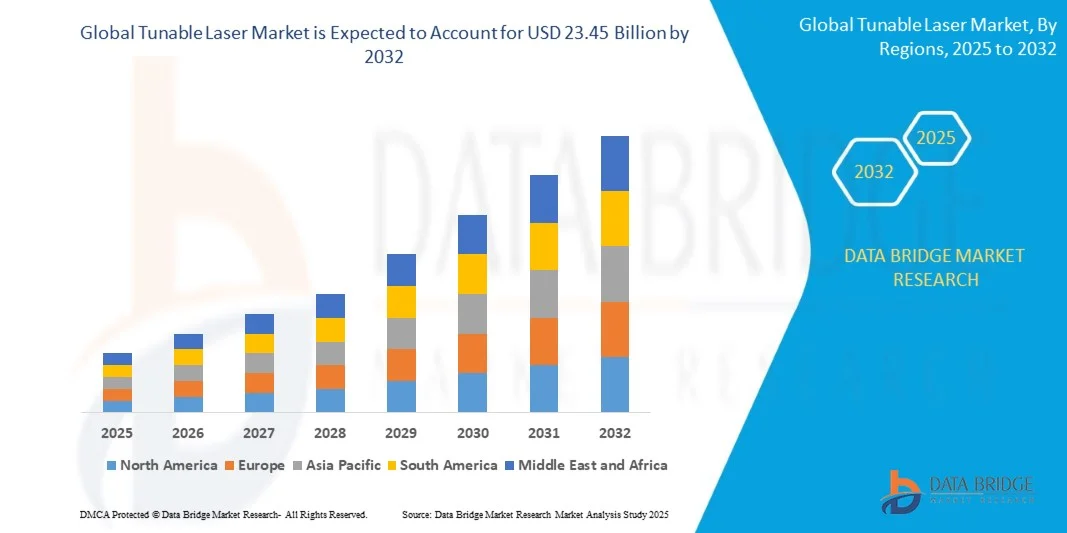
- The global tunable laser market size was valued at USD 11.86 billion in 2024 and is expected to reach USD 23.45 billion by 2032, at a CAGR of 8.9% during the forecast period
- The market growth is largely fueled by the increasing adoption of tunable lasers across telecommunications, industrial manufacturing, healthcare, and scientific research, driven by technological advancements in optical systems and photonics integration
- Furthermore, rising demand for high-precision, energy-efficient, and versatile laser solutions in applications such as spectroscopy, LiDAR, DWDM optical networks, and medical diagnostics is accelerating the uptake of tunable laser systems, thereby significantly boosting the market's expansion
Tunable Laser Market Analysis
- Tunable lasers are advanced light sources that allow adjustable wavelength output, enabling precise control for applications in communication networks, material processing, medical imaging, and research instrumentation. These systems provide high stability, accuracy, and integration with complex optical setups, enhancing performance across industries
- The escalating demand for tunable lasers is primarily driven by the need for flexible, high-performance, and cost-efficient laser solutions, coupled with growing industrial automation, expansion of optical communication infrastructure, and increasing investments in R&D across photonics and advanced manufacturing sectors
- North America dominated the tunable laser market in 2024, due to strong adoption in electronics, aerospace, and telecommunication sectors, as well as significant R&D investments
- Asia-Pacific is expected to be the fastest growing region in the tunable laser market during the forecast period due to rapid industrialization, growing electronics manufacturing, and increasing R&D activities in countries such as China, Japan, and India
- 1000nm-1500nm segment dominated the market with a market share of 45.8% in 2024, due to strong demand in optical communications, LiDAR, and remote sensing. Lasers in this range provide optimal transmission through fiber optic networks, high sensitivity for sensing applications, and reliable performance for industrial processing. Their compatibility with widely used photonic systems and instrumentation enhances their adoption across research, industrial, and telecommunication sectors
Report Scope and Tunable Laser Market Segmentation
|
Attributes |
Tunable Laser Key Market Insights |
|
Segments Covered |
|
|
Countries Covered |
North America
Europe
Asia-Pacific
Middle East and Africa
South America
|
|
Key Market Players |
|
|
Market Opportunities |
|
|
Value Added Data Infosets |
In addition to the insights on market scenarios such as market value, growth rate, segmentation, geographical coverage, and major players, the market reports curated by the Data Bridge Market Research also include in-depth expert analysis, geographically represented company-wise production and capacity, network layouts of distributors and partners, detailed and updated price trend analysis and deficit analysis of supply chain and demand. |
Tunable Laser Market Trends
“Adoption in Optical Communication and LiDAR”
- The tunable laser market is experiencing strong growth due to widespread adoption in optical communication systems and LiDAR technologies. Tunable lasers allow precise wavelength adjustment, making them essential for high-bandwidth networks, advanced sensing applications, and dynamic testing environments in industries moving toward high-speed digitalization
- For instance, Keysight Technologies offers tunable lasers optimized for optical communication testing, enabling service providers and manufacturers to validate network performance. Similarly, Santec provides tunable laser solutions used in LiDAR systems for autonomous vehicles, enhancing real-time detection and accurate mapping capabilities
- In optical communication, tunable lasers empower data centers and telecoms to handle growing bandwidth requirements with efficiency. Their ability to dynamically adjust wavelengths reduces inventory costs related to fixed-wavelength lasers and supports dense wavelength division multiplexing (DWDM) systems for scalable communication infrastructure
- Within LiDAR systems, tunable lasers improve object detection accuracy and resolution by controlling laser output over specific wavelength ranges. This function is critical in emerging fields such as autonomous driving, robotics, and geospatial mapping, where precision and reliability are paramount
- Tunable lasers also demonstrate advantages in research, defense, and medical diagnostics by offering flexibility in wavelength selection, which supports experiments, spectroscopy, and advanced imaging techniques. This multifunctionality makes them applicable across diverse high-tech sectors
- Overall, the increasing adoption of tunable lasers in optical communication and LiDAR highlights their indispensable role in next-generation connectivity and sensing technologies. Their precision, adaptability, and reliability firmly position them as enablers of innovation across multiple industries
Tunable Laser Market Dynamics
Driver
“Demand for Precise, Energy-Efficient Lasers”
- The rising requirement for precision and energy efficiency in laser applications is a core driver boosting the tunable laser market. These lasers offer the advantage of accurate wavelength tuning, energy optimization, and adaptiveness, making them vital for telecommunications, research, and industrial manufacturing
- For instance, Finisar, a VIAVI company, produces tunable lasers for telecom applications that allow carriers to manage bandwidth demand efficiently while reducing power consumption. Companies such as Coherent are also developing tunable laser technologies that combine accuracy with energy-efficient operations suitable for advanced industrial and research applications
- The ability of tunable lasers to offer flexible wavelength control improves service scalability in optical communication networks while supporting energy-efficient infrastructure. This ensures cost savings over time and also aligns with sustainability goals in high-energy-consuming sectors such as telecom and data centers
- Their adoption in industries such as healthcare, environmental sensing, and materials processing emphasizes their importance where high precision and low power consumption are equally critical. Tunable lasers deliver both consistent performance and long-term efficiency improvements for critical operations
- The market’s increasing focus on combining accuracy with energy optimization solidifies tunable lasers as a preferred choice over conventional alternatives. Their capability to enhance operational efficiency while reducing energy impact ensures their growing relevance across dynamic technological applications
Restraint/Challenge
“High Cost and Technical Complexity”
- The high cost of tunable lasers remains a significant restraint to market growth, as advanced designs require specialized materials, intricate components, and precision manufacturing processes. Prices are considerably higher than fixed lasers, limiting adoption in cost-sensitive applications and emerging markets
- For instance, tunable laser systems offered by companies such as Keysight and Santec are priced at premiums that appeal mainly to high-end telecom, research, and automotive sectors. This cost factor restricts penetration into smaller-scale industrial or consumer-based applications where budget constraints are prominent
- The technical complexity of tunable lasers also hinders adoption, as integrating them into advanced systems requires skilled professionals, calibration expertise, and compatibility with specialized equipment. These requirements increase both deployment costs and maintenance efforts over time
- Longer development cycles and reliability challenges in harsh operational environments further add difficulty for broader industry adoption. Enterprises operating on legacy systems or traditional components may find these complexities a deterrent to transitioning toward tunable laser solutions
- To overcome such challenges, manufacturers must focus on cost reduction through scaled production, modular designs, and simplified integration methods. Addressing both high costs and technical complexity will be crucial to fostering wider applications of tunable lasers across telecom, automotive, healthcare, and research markets
Tunable Laser Market Scope
The market is segmented on the basis of type, technology, wavelength, application, end-user, and sales channel.
• By Type
On the basis of type, the tunable laser market is segmented into solid-state tunable lasers, gas tunable lasers, fiber tunable lasers, liquid tunable lasers, free-electron lasers (FEL), nanoseconds pulsed OPO, and others. The solid-state tunable lasers segment dominated the market in 2024, accounting for the largest revenue share, driven by their high stability, broad tunability, and suitability for precision applications such as spectroscopy and medical diagnostics. These lasers are widely preferred in research and industrial settings due to their robust performance, long lifespan, and ability to integrate with various optical systems. Growing adoption in scientific research and healthcare applications further reinforces their market dominance.
The fiber tunable lasers segment is anticipated to witness the fastest growth from 2025 to 2032, propelled by increasing demand in telecommunications and optical sensing applications. Fiber tunable lasers offer high efficiency, compact form factors, and excellent beam quality, making them ideal for network infrastructure, high-speed data transmission, and remote sensing. Their flexibility, low maintenance, and compatibility with existing fiber optic networks also contribute to rapid adoption in both commercial and industrial segments.
• By Technology
Based on technology, the market is segmented into external cavity diode lasers, distributed Bragg reflector (DBR) lasers, distributed feedback (DFB) lasers, vertical cavity surface-emitting lasers (VCSELs), micro-electromechanical system (MEMS) lasers, and others. The external cavity diode laser (ECDL) segment dominated the market in 2024, owing to its superior wavelength tunability, narrow linewidth, and precision control. ECDLs are widely used in spectroscopy, sensing, and scientific research, where stable and adjustable output is critical. The technology’s ability to integrate with other optical instruments and its suitability for laboratory and industrial applications further supports its leadership.
The MEMS laser segment is projected to witness the fastest growth due to advancements in miniaturization and integration of micro-scale optical systems. MEMS-based tunable lasers are increasingly adopted in consumer electronics, medical diagnostics, and telecommunications for compact, high-performance, and cost-efficient solutions. Their low power consumption, scalability, and precision tuning capabilities make them attractive for emerging applications, driving rapid market expansion.
• By Wavelength
By wavelength, the market is categorized into less than 1000 nm, 1000–1500 nm, and more than 1500 nm. The 1000–1500 nm segment dominated the market with a share of 45.8% in 2024, supported by strong demand in optical communications, LiDAR, and remote sensing. Lasers in this range provide optimal transmission through fiber optic networks, high sensitivity for sensing applications, and reliable performance for industrial processing. Their compatibility with widely used photonic systems and instrumentation enhances their adoption across research, industrial, and telecommunication sectors.
The more than 1500 nm segment is expected to record the fastest growth, driven by emerging applications in medical diagnostics, spectroscopy, and defense technologies. Lasers operating at higher wavelengths offer deeper tissue penetration for medical imaging, reduced attenuation in certain fiber optic networks, and advanced sensing capabilities, boosting adoption across diverse end users.
• By Application
On the basis of application, the tunable laser market is segmented into micro-processing, drilling, cutting, welding, engraving and marking, communication, and others. The communication segment dominated the market in 2024, fueled by the rapid expansion of optical networks, increasing data traffic, and the need for high-speed, reliable connectivity. Tunable lasers in this sector enable wavelength-selective switching, high bandwidth, and scalable network performance, making them crucial for telecommunications and data center infrastructure.
The micro-processing segment is projected to witness the fastest growth, driven by adoption in precision manufacturing, electronics, and advanced material processing. Tunable lasers provide high precision, repeatability, and flexibility, making them suitable for micromachining, semiconductor fabrication, and delicate industrial processes. Increasing automation and miniaturization trends in manufacturing further accelerate their demand.
• By End User
By end user, the market is segmented into electronics and semiconductors, automotive, aerospace, telecommunication and networking devices, medical, manufacturing, packaging, and others. The electronics and semiconductors segment dominated in 2024, due to growing requirements for precision testing, material processing, and inspection in semiconductor fabrication. Tunable lasers enable high-resolution analysis, quality control, and efficient microfabrication, making them indispensable in this highly competitive sector.
The medical segment is expected to grow the fastest as demand rises for tunable lasers in diagnostics, imaging, and minimally invasive procedures. Lasers in healthcare offer targeted treatment, precision imaging, and improved patient outcomes, with increasing investments in advanced medical technologies driving market expansion.
• By Sales Channel
On the basis of sales channel, the market is segmented into OEM and aftermarket. The OEM segment dominated the market in 2024, as original equipment manufacturers integrate tunable lasers into industrial machinery, telecom infrastructure, and research instruments at the point of sale. This ensures optimized performance, system reliability, and long-term support for end users, reinforcing OEM dominance.
The aftermarket segment is projected to witness the fastest growth, driven by rising demand for upgrades, replacements, and retrofitting of existing systems. Aftermarket solutions provide flexibility, cost efficiency, and quick deployment for industries seeking to enhance performance without investing in entirely new systems, making it an increasingly attractive option.
Tunable Laser Market Regional Analysis
- North America dominated the tunable laser market with the largest revenue share in 2024, driven by strong adoption in electronics, aerospace, and telecommunication sectors, as well as significant R&D investments
- Organizations in the region highly value precision, reliability, and advanced tunable laser technologies for applications ranging from semiconductor testing to communication networks
- This adoption is further supported by a well-established industrial infrastructure, high disposable incomes, and government-backed initiatives promoting advanced photonics and scientific research
U.S. Tunable Laser Market Insight
The U.S. tunable laser market captured the largest revenue share in North America in 2024, fueled by robust demand in telecommunications, medical imaging, and research applications. The growing preference for compact, high-performance lasers for industrial and laboratory use is driving market expansion. Moreover, the integration of tunable lasers into optical networks, LiDAR systems, and precision instrumentation is significantly contributing to market growth, supported by strong private and government investments in photonics technologies.
Europe Tunable Laser Market Insight
The Europe tunable laser market is projected to grow steadily during the forecast period, driven by rising industrial automation, scientific research, and stringent regulations in telecommunications and healthcare sectors. Increasing adoption of tunable lasers in manufacturing, medical diagnostics, and aerospace applications is supporting market expansion. Countries across the region are witnessing significant investments in photonics infrastructure, with research institutions and commercial enterprises increasingly integrating tunable laser solutions for enhanced precision and efficiency.
U.K. Tunable Laser Market Insight
The U.K. tunable laser market is expected to grow at a notable CAGR during the forecast period, driven by the rising need for precision lasers in electronics manufacturing, defense, and healthcare. The country’s emphasis on technological innovation, coupled with government-supported research initiatives, is stimulating adoption. In addition, increasing demand from laboratories and industrial R&D centers for high-performance tunable laser systems further propels market growth.
Germany Tunable Laser Market Insight
The Germany tunable laser market is anticipated to expand at a significant CAGR, supported by the country’s strong industrial base, advanced research infrastructure, and focus on high-tech manufacturing. Tunable lasers are increasingly utilized in aerospace, automotive, and medical sectors for precise material processing and instrumentation. The adoption of energy-efficient and environmentally friendly laser technologies also aligns with Germany’s sustainability and innovation priorities, reinforcing market demand.
Asia-Pacific Tunable Laser Market Insight
The Asia-Pacific tunable laser market is poised to grow at the fastest CAGR during 2025–2032, driven by rapid industrialization, growing electronics manufacturing, and increasing R&D activities in countries such as China, Japan, and India. The region is witnessing rising adoption in telecom, healthcare, and industrial applications, supported by government initiatives promoting technological innovation. Furthermore, Asia-Pacific’s emergence as a manufacturing hub for optical components is enhancing affordability and accessibility of tunable laser systems.
Japan Tunable Laser Market Insight
The Japan tunable laser market is gaining momentum due to the country’s advanced technological ecosystem, high R&D intensity, and growing use in medical, communication, and manufacturing applications. The integration of tunable lasers with precision instruments, LiDAR systems, and photonics-based devices is fueling growth. In addition, the aging population and demand for highly reliable, easy-to-use laser solutions in both commercial and industrial sectors further drive market expansion.
China Tunable Laser Market Insight
The China tunable laser market accounted for the largest market revenue share in Asia-Pacific in 2024, supported by rapid industrialization, high technological adoption, and strong domestic manufacturing capabilities. Tunable lasers are widely deployed across telecommunication networks, electronics manufacturing, and research laboratories. The push towards smart factories, coupled with cost-effective solutions from domestic producers, is a key factor accelerating market growth in China.
Tunable Laser Market Share
The tunable laser industry is primarily led by well-established companies, including:
- Daylight Solutions (U.S.)
- EKSPLA (Lithuania)
- HÜBNER Photonics (Germany)
- TOPTICA Photonics AG (Germany)
- Keysight Technologies (U.S.)
- Luna Innovations Incorporated (U.S.)
- LUMIBIRD (France)
- II-VI Incorporated (U.S.)
- NeoPhotonics Corporation (U.S.)
- SANTEC CORPORATION (Japan)
- EXFO Inc. (Canada)
- Thorlabs, Inc. (U.S.)
- VIAVI Solutions Inc. (U.S.)
- Newport Corporation (U.S.)
- Lumentum Operations LLC (U.S.)
- Radiant Light S.L. (Spain)
- Freedom Photonics LLC (U.S.)
- Changchun New Industries Optoelectronics Tech. Co., Ltd. (China)
- Sacher Lasertechnik GmbH (Germany)
- AMETEK, Inc. (U.S.)
- Coherent, Inc. (U.S.)
Latest Developments in Tunable Laser Market
- In April 2024, II-VI Incorporated reported significant sales growth in its tunable laser product line, reflecting the rising demand for high-performance photonic solutions across telecommunications, industrial, and scientific research sectors. This growth highlights the increasing adoption of tunable lasers driven by advancements in optical networking and precision measurement technologies. The company’s expanded product portfolio and enhanced manufacturing capabilities are expected to strengthen market presence and support overall market expansion
- In June 2024, a major breakthrough in tunable laser technology was achieved, enhancing performance, efficiency, and energy consumption of tunable laser systems. This innovation enables the development of more compact, cost-effective, and versatile lasers, expanding their applications across telecommunications, medical diagnostics, and environmental monitoring. The advancement is anticipated to accelerate adoption in emerging industrial and research sectors, further fueling market growth
- In February 2024, Opton Laser introduced a new range of tunable dye and Ti:sapphire lasers, offering improved wavelength tunability and stability for precision applications. These lasers cater to growing demand in spectroscopy, microscopy, and material processing, providing reliable performance for both research and industrial use. The launch strengthens Opton Laser’s competitive position and addresses evolving requirements for advanced tunable laser systems
- In October 2023, EFFECT Photonics announced the successful validation of its fully integrated InP-based tunable laser photonic integrated circuit, powering its digital Pico integrated tunable laser assembly (pITLA). Tunable lasers from EFFECT Photonics are essential to coherent optical systems enabling Dense Wavelength Division Multiplexing (DWDM), which allows network operators to significantly increase capacity without expanding fiber infrastructure. This innovation enhances network efficiency and supports broader adoption of advanced optical communication solutions
- In October 2023, NIRRIN Technologies showcased three at-line/in-line applications of its HPTLS tunable laser system, including buffer validation, ultrafiber/de-fiber endpoint detection, and dilution-free protein quantification. By combining near-infrared spectral technology with tunable laser sources, NIRRIN delivers precise, quantifiable protein signatures with high accuracy and dynamic range. This advancement is expected to boost adoption in bio-processing and analytical applications, strengthening the role of tunable lasers in life sciences and industrial biotechnology

- Interactive Data Analysis Dashboard
- Company Analysis Dashboard for high growth potential opportunities
- Research Analyst Access for customization & queries
- Competitor Analysis with Interactive dashboard
- Latest News, Updates & Trend analysis
- Harness the Power of Benchmark Analysis for Comprehensive Competitor Tracking
Global Tunable Laser Market, Supply Chain Analysis and Ecosystem Framework
To support market growth and help clients navigate the impact of geopolitical shifts, DBMR has integrated in-depth supply chain analysis into its Global Tunable Laser Market research reports. This addition empowers clients to respond effectively to global changes affecting their industries. The supply chain analysis section includes detailed insights such as Global Tunable Laser Market consumption and production by country, price trend analysis, the impact of tariffs and geopolitical developments, and import and export trends by country and HSN code. It also highlights major suppliers with data on production capacity and company profiles, as well as key importers and exporters. In addition to research, DBMR offers specialized supply chain consulting services backed by over a decade of experience, providing solutions like supplier discovery, supplier risk assessment, price trend analysis, impact evaluation of inflation and trade route changes, and comprehensive market trend analysis.
Data collection and base year analysis are done using data collection modules with large sample sizes. The stage includes obtaining market information or related data through various sources and strategies. It includes examining and planning all the data acquired from the past in advance. It likewise envelops the examination of information inconsistencies seen across different information sources. The market data is analysed and estimated using market statistical and coherent models. Also, market share analysis and key trend analysis are the major success factors in the market report. To know more, please request an analyst call or drop down your inquiry.
The key research methodology used by DBMR research team is data triangulation which involves data mining, analysis of the impact of data variables on the market and primary (industry expert) validation. Data models include Vendor Positioning Grid, Market Time Line Analysis, Market Overview and Guide, Company Positioning Grid, Patent Analysis, Pricing Analysis, Company Market Share Analysis, Standards of Measurement, Global versus Regional and Vendor Share Analysis. To know more about the research methodology, drop in an inquiry to speak to our industry experts.
Data Bridge Market Research is a leader in advanced formative research. We take pride in servicing our existing and new customers with data and analysis that match and suits their goal. The report can be customized to include price trend analysis of target brands understanding the market for additional countries (ask for the list of countries), clinical trial results data, literature review, refurbished market and product base analysis. Market analysis of target competitors can be analyzed from technology-based analysis to market portfolio strategies. We can add as many competitors that you require data about in the format and data style you are looking for. Our team of analysts can also provide you data in crude raw excel files pivot tables (Fact book) or can assist you in creating presentations from the data sets available in the report.













