


Turbofan Engines Market Size
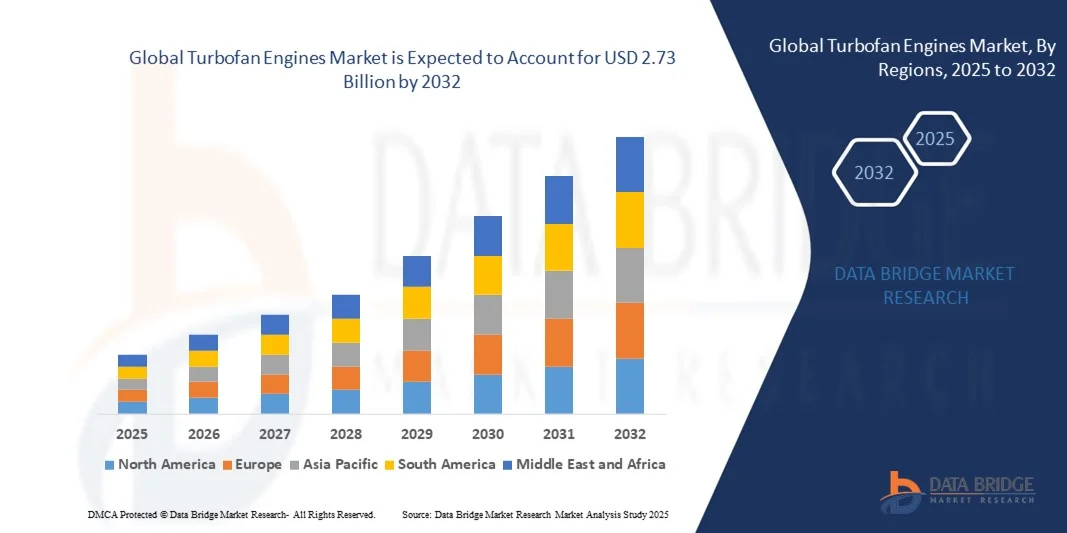
- The global turbofan engines market size was valued at USD 1.57 billion in 2024 and is expected to reach USD 2.73 billion by 2032, at a CAGR of 7.20% during the forecast period
- The market growth is largely fueled by the increasing demand for fuel-efficient, high-thrust engines in commercial and military aviation, driven by fleet expansion, modernization programs, and rising air travel across the globe
- Furthermore, growing investments in defense aviation, regional aircraft manufacturing, and unmanned aerial vehicles (UAVs) are accelerating the adoption of advanced turbofan engines. These converging factors are significantly boosting market growth and establishing turbofan engines as the preferred propulsion solution for both commercial and military aircraft
Turbofan Engines Market Analysis
- Turbofan engines are a type of jet engine designed to provide high thrust while optimizing fuel efficiency and reducing noise emissions. These engines are widely used in commercial airliners, military aircraft, business jets, and UAVs due to their reliability, performance, and compliance with environmental regulations
- The escalating demand for turbofan engines is primarily fueled by global airline fleet expansions, the push for eco-friendly and fuel-efficient propulsion systems, technological advancements in engine design, and rising defense modernization programs, all of which are driving growth across commercial, military, and regional aviation sectors
- North America dominated the turbofan engines market with a share of over 40% in 2024, due to the strong presence of leading aircraft manufacturers and significant commercial airline operations
- Asia-Pacific is expected to be the fastest growing region in the turbofan engines market during the forecast period due to rapid urbanization, expanding airline networks, and increasing aircraft manufacturing activities in countries such as China, Japan, and India
- Fixed wing segment dominated the market with a market share of 62.2% in 2024, due to the widespread use of turbofan engines in commercial and military aircraft. Fixed-wing aircraft rely on turbofan engines for their optimal thrust-to-weight ratio, long-range efficiency, and superior cruising performance. Airlines and aircraft manufacturers prefer fixed-wing platforms equipped with advanced turbofan engines to maximize operational efficiency, minimize fuel consumption, and meet environmental regulations
Report Scope and Turbofan Engines Market Segmentation
|
Attributes |
Turbofan Engines Key Market Insights |
|
Segments Covered |
|
|
Countries Covered |
North America
Europe
Asia-Pacific
Middle East and Africa
South America
|
|
Key Market Players |
|
|
Market Opportunities |
|
|
Value Added Data Infosets |
In addition to the market insights such as market value, growth rate, market segments, geographical coverage, market players, and market scenario, the market report curated by the Data Bridge Market Research team includes in-depth expert analysis, import/export analysis, pricing analysis, production consumption analysis, and pestle analysis. |
Turbofan Engines Market Trends
Adoption of Fuel-Efficient, Low-Emission Turbofan Engines
- The turbofan engines market is undergoing a significant shift toward fuel-efficient and low-emission technologies as global aviation faces stricter environmental regulations and rising fuel costs. Manufacturers are investing heavily in next-generation engine designs that optimize fuel burn, reduce carbon emissions, and enhance overall performance while maintaining safety and reliability
- For instance, Pratt & Whitney has introduced its geared turbofan (GTF) engines, which deliver double-digit reductions in fuel consumption and noise compared to conventional designs. Similarly, CFM International’s LEAP engines offer reduced nitrogen oxide (NOx) emissions and improved efficiency, making them a preferred choice for modern single-aisle aircraft fleets
- The push toward sustainability is being driven by initiatives such as ICAO’s Carbon Offsetting and Reduction Scheme for International Aviation (CORSIA) and national-level mandates promoting greener propulsion systems. Airlines are increasingly choosing advanced turbofan engines for new aircraft purchases and retrofitting older models to meet emission targets and capture operating cost savings
- Technological advancements such as composite fan blades, high-bypass ratio designs, and advanced materials (including ceramic matrix composites) are enhancing efficiency while reducing engine weight and maintenance requirements. These innovations also contribute to quieter operations, addressing noise restrictions in urban airports
- The broader adoption of alternative fuels, including sustainable aviation fuel (SAF), is further shaping turbofan engine development. Modern low-emission engines are being designed to be compatible with SAF blends, enabling immediate reductions in lifecycle emissions without changing core infrastructure
- As airlines seek competitive advantages through operational efficiency, the move toward advanced fuel-saving and low-carbon turbofan engines is expected to accelerate. This trend reflects the industry’s transition toward high-performance propulsion systems aligned with environmental and economic sustainability goals
Turbofan Engines Market Dynamics
Driver
Rising Air Travel and Fleet Modernization
- The steady growth in global air passenger traffic and the increasing need for fleet modernization are key drivers of the turbofan engines market. Airlines across all regions are investing in newer, more efficient aircraft to meet rising travel demand while minimizing operating costs
- For instance, major carriers such as Delta Air Lines, Emirates, and Air France-KLM have upgraded their fleets with aircraft powered by next-generation turbofan engines such as the GE9X and the Rolls-Royce Trent series, which deliver improved reliability and optimized fuel performance. Low-cost carriers are also modernizing fleets to maintain competitive ticket pricing while managing fuel expenditures
- Rapid expansion in emerging aviation markets, particularly in Asia-Pacific, is leading to large procurement orders for single-aisle and widebody aircraft equipped with high-efficiency turbofan engines. The growth in regional travel and the revival of long-haul routes post-pandemic are accelerating replacement cycles for aging aircraft
- Fleet modernization ensures compliance with evolving environmental and noise regulations and also enhances operational flexibility and passenger comfort. Airlines are prioritizing engines with better thrust-to-weight ratios, advanced diagnostic systems for predictive maintenance, and longer overhaul intervals to improve service sustainability
- As global aviation infrastructure advances and passenger demand rebounds, the continuous replacement and expansion of fleets will remain a strong growth catalyst for turbofan engine manufacturers and their maintenance service ecosystems
Restraint/Challenge
High Development and Maintenance Costs
- Despite technological advances, the turbofan engines market faces persistent challenges from high development and maintenance costs. Designing next-generation propulsion systems involves extensive R&D, material innovation, and rigorous testing to meet safety, efficiency, and emission standards, all of which increase capital expenditure significantly
- For instance, Rolls-Royce and General Electric invest billions of dollars in developing new engine models, incorporating advanced materials and precision manufacturing technologies to deliver performance gains. This high initial investment becomes a barrier for manufacturers entering the competitive commercial aviation sector
- In addition, maintenance and overhaul costs remain substantial due to the complexity of turbofan engines. Repairing and replacing advanced components such as composite fan blades, high-pressure turbine assemblies, and intricate electronic control systems requires specialized expertise, tooling, and long lead times
- Airlines often face high lifecycle costs associated with spare parts, downtime during maintenance, and adherence to stringent safety regulations. Unscheduled engine repairs can disrupt operational schedules and raise per-flight operating costs, especially for carriers with tight margins
- While predictive maintenance and digital twin technologies are helping reduce long-term costs, balancing high development expenditure with competitive pricing remains a challenge. Overcoming this restraint will require strategic industry collaboration, improved manufacturing efficiency, and modular engine designs that simplify servicing without compromising performance or compliance
Turbofan Engines Market Scope
The market is segmented on the basis of application, platform, and sales channel.
- By Application
On the basis of application, the turbofan engines market is segmented into commercial aviation, military aviation, and general aviation. The commercial aviation segment dominated the largest market revenue share in 2024, driven by the surge in global air travel and the increasing demand for fuel-efficient, high-thrust engines for passenger aircraft. Airlines prioritize turbofan engines for their proven reliability, lower operating costs, and compliance with stringent emission regulations. The segment also benefits from ongoing fleet modernization programs and the growing adoption of twin-engine aircraft for medium- and long-haul routes. Enhanced engine performance, reduced noise levels, and integration with advanced avionics further contribute to the widespread preference for turbofan engines in commercial aviation.
The military aviation segment is anticipated to witness the fastest growth rate from 2025 to 2032, fueled by rising defense expenditures and modernization programs across air forces globally. Turbofan engines in military aircraft provide a balance of high thrust, fuel efficiency, and maneuverability, essential for fighter jets and strategic aircraft. Increasing focus on stealth capabilities, reduced radar signature engines, and enhanced mission versatility further drive adoption in military applications.
- By Platform
On the basis of platform, the turbofan engines market is segmented into fixed wing and rotary wing. The fixed-wing segment dominated the largest market revenue share of 62.2% in 2024, owing to the widespread use of turbofan engines in commercial and military aircraft. Fixed-wing aircraft rely on turbofan engines for their optimal thrust-to-weight ratio, long-range efficiency, and superior cruising performance. Airlines and aircraft manufacturers prefer fixed-wing platforms equipped with advanced turbofan engines to maximize operational efficiency, minimize fuel consumption, and meet environmental regulations.
The rotary-wing segment is projected to witness the fastest growth rate from 2025 to 2032, driven by the increasing adoption of advanced rotorcraft for military, offshore, and emergency services. Turbofan-powered rotary-wing aircraft benefit from improved payload capacity, reduced vibration, and enhanced performance in diverse operational conditions, boosting their demand in search-and-rescue, transport, and specialized missions.
- By Sales Channel
On the basis of sales channel, the turbofan engines market is segmented into line fit and retro fit. The line fit segment dominated the largest market revenue share in 2024, supported by the preference of aircraft manufacturers to equip new aircraft directly from the production line with the latest, fuel-efficient turbofan engines. Line fit engines offer seamless integration with aircraft systems, improved warranty coverage, and optimized performance from day one, making them the preferred choice for OEMs and airline operators.
The retro fit segment is anticipated to witness the fastest growth rate from 2025 to 2032, driven by the growing demand for upgrading older aircraft fleets with modern turbofan engines to enhance fuel efficiency, reduce emissions, and comply with updated environmental regulations. Retro fit solutions enable airlines to extend aircraft lifecycle, reduce operational costs, and improve performance without the need for complete aircraft replacement.
Turbofan Engines Market Regional Analysis
- North America dominated the turbofan engines market with the largest revenue share of over 40% in 2024, driven by the strong presence of leading aircraft manufacturers and significant commercial airline operations
- Airlines and OEMs in the region are increasingly investing in fuel-efficient, high-thrust engines to reduce operational costs and meet stringent emission norms
- The adoption is further supported by advanced aerospace infrastructure, high R&D capabilities, and growing defense modernization programs, establishing turbofan engines as a preferred choice for both commercial and military applications
U.S. Turbofan Engines Market Insight
The U.S. turbofan engines market captured the largest revenue share in North America in 2024, fueled by the country’s robust airline fleet expansion and modernization initiatives. High demand for long-range, fuel-efficient aircraft is driving engine upgrades, while the strong defense sector continues to invest in advanced military turbofan engines. In addition, technological advancements, integration with next-generation avionics, and the adoption of greener propulsion systems further propel the U.S. market.
Europe Turbofan Engines Market Insight
The Europe turbofan engines market is projected to expand at a substantial CAGR during the forecast period, primarily driven by the adoption of next-generation aircraft and the need for environmentally compliant, fuel-efficient engines. European airlines and aircraft manufacturers are focusing on fleet modernization to enhance operational efficiency while reducing carbon emissions. The region also witnesses increasing adoption in military aviation, supported by defense upgrades and strategic aircraft programs, reinforcing the demand for advanced turbofan engines.
U.K. Turbofan Engines Market Insight
The U.K. turbofan engines market is expected to grow at a notable CAGR during the forecast period, driven by rising investments in both civil and military aviation sectors. Demand for energy-efficient engines, combined with strong aerospace manufacturing capabilities and innovation hubs, supports market expansion. Government initiatives promoting sustainable aviation and the country’s well-established airline industry further accelerate the adoption of turbofan engines.
Germany Turbofan Engines Market Insight
The Germany turbofan engines market is poised for significant growth, fueled by technological advancements in engine design and a focus on sustainable aviation solutions. The country’s aerospace sector emphasizes fuel efficiency, emission reduction, and high-performance engines for both commercial and defense aircraft. Germany’s strong industrial base, research facilities, and support for innovation in aviation propulsion contribute to the growing adoption of turbofan engines.
Asia-Pacific Turbofan Engines Market Insight
The Asia-Pacific turbofan engines market is expected to grow at the fastest CAGR during the forecast period of 2025 to 2032, driven by rapid urbanization, expanding airline networks, and increasing aircraft manufacturing activities in countries such as China, Japan, and India. Growing passenger traffic, fleet modernization programs, and government initiatives promoting domestic aerospace development are accelerating demand. The region also benefits from rising defense spending and investment in next-generation military aircraft, which further boosts turbofan engine adoption.
Japan Turbofan Engines Market Insight
The Japan turbofan engines market is gaining momentum due to the country’s focus on high-performance, fuel-efficient aircraft and the expansion of regional airlines. Strong technological capabilities, integration with advanced avionics, and a growing demand for fleet modernization drive market growth. Japan’s aging population and increasing preference for automated and efficient aviation operations also support the adoption of turbofan engines across commercial and military platforms.
China Turbofan Engines Market Insight
The China turbofan engines market accounted for the largest revenue share in Asia-Pacific in 2024, attributed to the country’s rapidly expanding commercial aviation sector and growing domestic aircraft production. Government initiatives supporting aerospace self-reliance, fleet modernization programs, and investments in high-thrust, fuel-efficient engines are key growth drivers. China’s focus on developing next-generation aircraft and increasing defense capabilities further solidifies the demand for turbofan engines across the region.
Turbofan Engines Market Share
The turbofan engines industry is primarily led by well-established companies, including:
- Safran Aircraft Engines (France)
- Continental Motors Group (U.S.)
- General Electric Company (U.S.)
- IAE International Aero Engines AG (Germany)
- Raytheon Technologies Corporation (U.S.)
- Rolls-Royce Holdings plc (U.K.)
- United Engine Corporation (Russia)
- AVIC Aircraft Corporation Ltd. (China)
- MOTOR SICH JSC (Ukraine)
- Aero Engine Corporation of China (China)
- MTU Aero Engines AG (Germany)
- Barnes Group Inc. (U.S.)
- Honeywell International Inc. (U.S.)
- Pratt & Whitney (U.S.)
- CFM International (U.S.)
- UEC-Aviadvigatel JSC (Russia)
Latest Developments in Global Turbofan Engines Market
- In October 2024, Turkish drone manufacturer Baykar announced a $300 million investment to develop a turbofan engine for its Kızılelma unmanned combat aerial vehicle (UCAV). This initiative is aimed at reducing dependency on foreign engine suppliers while enhancing the performance, endurance, and autonomy of Turkey’s UAV fleet. By investing heavily in domestic engine development, Baykar is positioning itself as a key player in the global UAV market. This move is expected to stimulate technological innovation in the region, strengthen defense capabilities, and potentially influence other manufacturers to prioritize in-house engine solutions, accelerating growth in the military turbofan engine segment
- In October 2024, Safran announced plans to invest over €1 billion and recruit 4,000 employees worldwide to expand its maintenance, repair, and overhaul (MRO) network. This strategic expansion includes the construction of six new or upgraded service centers by 2026, aiming to quadruple Safran’s in-house repair capacity by 2028. The development addresses the growing demand for LEAP engines due to increasing airline fleet expansions and retrofitting initiatives. By strengthening its MRO infrastructure, Safran enhances its service reliability, reduces turnaround time for engine repairs, and solidifies its position in the global turbofan engines market, especially in the commercial aviation sector
- In September 2024, Safran Aircraft Engines completed the acquisition of Component Repair Technologies (CRT), a U.S.-based leader in aircraft engine component repair. This acquisition enhances Safran’s MRO capabilities in the Americas, particularly for its CFM56 and LEAP engines. CRT’s specialized expertise in component repair allows Safran to support the growing global fleet of turbofan-powered aircraft more efficiently. The move increases Safran’s service footprint and also strengthens its competitive edge in engine lifecycle management, ensuring higher operational reliability for airline operators and boosting overall market confidence in Safran’s turbofan offerings
- In April 2024, Rolls-Royce began flight testing its new Pearl 10X turbofan engine, designed for the Dassault Falcon 10X ultra-long-range business jet. The engine features the advanced Advance2 core, delivering higher efficiency, greater thrust, and reduced fuel consumption compared to previous models. This development positions Rolls-Royce as a leader in the business aviation turbofan segment by offering state-of-the-art propulsion technology. The successful integration of this engine is expected to influence market expectations for high-performance, fuel-efficient engines in long-range jets, driving further demand and technological competition across the global turbofan engine market

- Interactive Data Analysis Dashboard
- Company Analysis Dashboard for high growth potential opportunities
- Research Analyst Access for customization & queries
- Competitor Analysis with Interactive dashboard
- Latest News, Updates & Trend analysis
- Harness the Power of Benchmark Analysis for Comprehensive Competitor Tracking
Data collection and base year analysis are done using data collection modules with large sample sizes. The stage includes obtaining market information or related data through various sources and strategies. It includes examining and planning all the data acquired from the past in advance. It likewise envelops the examination of information inconsistencies seen across different information sources. The market data is analysed and estimated using market statistical and coherent models. Also, market share analysis and key trend analysis are the major success factors in the market report. To know more, please request an analyst call or drop down your inquiry.
The key research methodology used by DBMR research team is data triangulation which involves data mining, analysis of the impact of data variables on the market and primary (industry expert) validation. Data models include Vendor Positioning Grid, Market Time Line Analysis, Market Overview and Guide, Company Positioning Grid, Patent Analysis, Pricing Analysis, Company Market Share Analysis, Standards of Measurement, Global versus Regional and Vendor Share Analysis. To know more about the research methodology, drop in an inquiry to speak to our industry experts.
Data Bridge Market Research is a leader in advanced formative research. We take pride in servicing our existing and new customers with data and analysis that match and suits their goal. The report can be customized to include price trend analysis of target brands understanding the market for additional countries (ask for the list of countries), clinical trial results data, literature review, refurbished market and product base analysis. Market analysis of target competitors can be analyzed from technology-based analysis to market portfolio strategies. We can add as many competitors that you require data about in the format and data style you are looking for. Our team of analysts can also provide you data in crude raw excel files pivot tables (Fact book) or can assist you in creating presentations from the data sets available in the report.













