


What is the Turboprop Aircraft Market Size and Growth Rate?
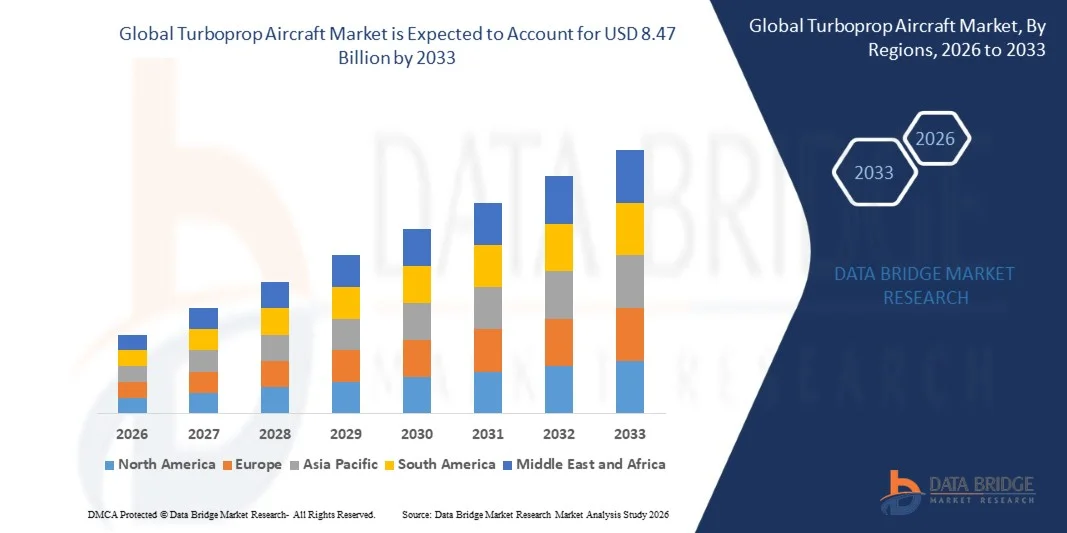
- As per Data Bridge Market Research analysis, the turboprop aircraft market was valued at USD 3.92 billion in 2025 and is projected to reach USD 8.47 billion by 2033, growing at a CAGR of 5.20% from 2026 to 2033.
- The market is experiencing consistent growth driven by rising demand for regional connectivity in underserved and short-runway markets, increasing replacement demand for ageing turboprop fleets, and expanding interest in hybrid-electric and sustainable aviation fuel-compatible propulsion technologies.
- The increasing focus on fuel-efficient regional air travel, combined with growing government and defense demand for special mission and utility turboprop platforms, is compelling airlines, corporate operators, and government agencies to invest in next-generation turboprop aircraft. Hybrid-electric and SAF-compatible propulsion systems are increasingly complementing conventional turboprop engines in many markets, offering improved fuel efficiency, reduced emissions, and lower operating costs on short- to medium-haul regional routes.
Market Size & Forecast
- Global Market Value (2025): USD 3.92 Billion
- Expected Market Value (2033): USD 8.47 Billion
- Forecast CAGR (2026–2033): 5.20%
- Leading Region in 2025: North America
- Fastest Growing Region: Asia-Pacific
What are the Major Takeaways of the Turboprop Aircraft Market?
- North America dominated the global turboprop aircraft market in 2025, supported by the region's extensive regional airline networks, strong presence of leading turboprop OEMs, and well-established corporate and government aviation infrastructure.
- Asia-Pacific is expected to be the fastest-growing region from 2026 to 2033, fueled by expanding regional connectivity programs, rising demand for short-runway and utility aircraft, and growing government investment in special mission and defense turboprop platforms across China, India, and Southeast Asia.
- The passenger aircraft segment dominates the market by aircraft type, supported by sustained demand for regional airliners and commuter aircraft connecting underserved routes with limited runway infrastructure.
- The special mission aircraft segment is witnessing the fastest growth by aircraft type, driven by rising government and defense demand for maritime patrol, ISR, and border surveillance platforms.
- The twin engine segment leads the market by engine configuration, given its widespread adoption across regional airliner and cargo aircraft platforms requiring higher payload and redundancy.
- The hybrid-electric turboprop segment is witnessing the fastest growth by propulsion technology, driven by accelerating industry investment in electrified regional aircraft propulsion demonstrator programs.
Report Scope and Turboprop Aircraft Market Segmentation
|
Attributes |
Turboprop Aircraft Key Market Insights |
|
Segments Covered |
|
|
Countries Covered |
North America
Europe
Asia-Pacific
South America
Middle East and Africa
|
|
Key Market Players |
|
|
Market Opportunities |
|
|
Value Added Data Infosets |
In addition to insights on market value, growth rate, segmentation, geographic coverage, and major players, reports curated by Data Bridge Market Research also include in-depth expert analysis, geographically represented company-wise production and capacity, distributor and partner network layouts, detailed and updated price trend analysis, and deficit analysis of supply and demand. |
What is the Key Trend in the Turboprop Aircraft Market?
- Aircraft OEMs and propulsion developers are increasingly pursuing hybrid-electric propulsion demonstrator programs that retrofit legacy turboprop airframes with electric motors and battery systems to validate fuel efficiency improvements before full commercial launch.
- These demonstrator programs enable manufacturers to de-risk certification pathways and quantify performance benefits before committing to clean-sheet hybrid-electric aircraft designs.
- For instance, on July 21, 2026, Pratt & Whitney Canada, an RTX business, began ground testing of its flight-standard hybrid-electric propulsion system and propeller in Longueuil, Quebec, ahead of installation on a De Havilland Canada Dash 8-100 experimental aircraft, with first flight expected in 2027; the project combines a Pratt & Whitney Canada thermal engine with a 1-megawatt electric motor from Collins Aerospace and a battery system from H55, in collaboration with De Havilland Aircraft of Canada, GKN Aerospace, AeroTEC, Ricardo, and the National Research Council of Canada.
- As airlines and operators continue to prioritize fuel efficiency, emissions reduction, and regional connectivity, the development of hybrid-electric and SAF-compatible turboprop propulsion is expected to accelerate, reinforcing next-generation propulsion technology as a core enabler of the turboprop aircraft market's long-term growth.
What are the Key Drivers of the Turboprop Aircraft Market?
- The sustained demand for regional air connectivity in underserved and short-runway markets has significantly increased orders for new turboprop aircraft capable of operating efficiently on shorter routes with lower passenger volumes.
- For instance, in April 2025, Canadian hydroelectric utility Hydro-Quebec ordered three ATR 72-600 turboprops, with ATR citing the order as evidence of growing momentum for turboprop demand in the Canadian market.
- Aircraft OEMs are expanding their turboprop product lines to meet renewed regional airline and cargo operator demand following the retirement of several legacy regional aircraft programs.
- For instance, Deutsche Aircraft has continued development of its 40-seat D328eco turboprop, positioning the aircraft to help address the regional aircraft supply gap left after production of the Bombardier/MHI Dash 8 and CRJ regional jet programs ceased.
- With regional airlines, government agencies, and defense organizations increasingly relying on turboprop aircraft for fuel-efficient, short-runway-capable operations, turboprop aircraft will remain indispensable for both commercial and special mission aviation programs.
Which Factors are Challenging the Growth of the Turboprop Aircraft Market?
- Turboprop aircraft development requires significant investment in propulsion certification, particularly for hybrid-electric and alternative-fuel platforms that must meet stringent aviation safety and emissions standards.
- These development costs and lengthy certification timelines have led some manufacturers to delay or cancel next-generation turboprop programs, slowing the pace of fleet modernization.
- For instance, in 2025, ATR postponed the launch date of its proposed hybrid-electric ATR 72 EVO program until 2029, while Embraer cancelled its long-planned 70- to 90-seat turboprop project, reflecting the substantial technical and financial risk associated with developing next-generation turboprop platforms.
- The high capital investment and lengthy certification timelines associated with next-generation turboprop programs continue to restrict the pace of fleet renewal, particularly among smaller regional operators. This barrier slows market penetration in price-sensitive and emerging aviation markets, limiting the widespread deployment of next-generation turboprop technologies despite growing regional connectivity demand.
How is the Turboprop Aircraft Market Segmented?
The turboprop aircraft market is segmented on the basis of aircraft type, engine configuration, seating capacity, maximum take-off weight, range, propulsion technology, avionics, landing gear, operational capability, application, end user, airframe material, sales channel and distribution channel.
- By Aircraft Type
On the basis of aircraft type, the global turboprop aircraft market is segmented into passenger aircraft, cargo aircraft, business aircraft, special mission aircraft, and military aircraft. The passenger aircraft segment dominates the market, owing to sustained demand for regional airliners and commuter aircraft connecting underserved routes with limited runway infrastructure, making it the preferred choice for regional airlines and commuter operators worldwide.
The special mission aircraft segment is witnessing the fastest growth, driven by rising government and defense demand for maritime patrol, intelligence, surveillance and reconnaissance, and border surveillance platforms built on proven turboprop airframes.
- By Engine Configuration
On the basis of engine configuration, the global turboprop aircraft market is segmented into single engine and twin engine. The twin engine segment dominates the market, supported by widespread adoption across regional airliner and cargo aircraft platforms requiring higher payload capacity, redundancy, and operational reliability.
The single engine segment is witnessing the fastest growth, driven by rising demand for cost-efficient utility, training, and owner-flown turboprop aircraft in both commercial and general aviation applications.
- By Seating Capacity
On the basis of seating capacity, the global turboprop aircraft market is segmented into less than 10 seats, 10–19 seats, 20–39 seats, 40–59 seats, and 60–90 seats. The 40–59 seats segment dominates the market due to its widespread adoption by regional airlines seeking an optimal balance between operating economics and route capacity, increasing demand for aircraft matched to regional passenger volumes, and growing fleet renewal activity among established regional carriers. additionally, rising focus on fuel efficiency, cabin comfort, and route flexibility further supports the strong adoption of aircraft in this seating capacity segment.
The 60–90 seats segment is anticipated to witness the fastest growth, driven by this growth is fueled by the increasing reliance on larger turboprops to replace ageing regional jet capacity on trunk regional routes. regional airlines, leasing companies, and government agencies are adopting larger-capacity turboprops to conduct cost-effective, fuel-efficient regional operations. additionally, the integration of these aircraft into expanding regional connectivity programs is enhancing their relevance, further driving segment growth.
- By Maximum Take-Off Weight (MTOW)
On the basis of maximum take-off weight, the global turboprop aircraft market is segmented into less than 5 tons, 5–10 tons, 10–20 tons, and above 20 tons. The 10–20 tons segment dominates the market due to its widespread adoption across mainstream regional airliner platforms that balance payload capacity with runway performance requirements.
The above 20 tons segment is witnessing the fastest growth, driven by rising demand for larger-capacity regional and military transport turboprops capable of carrying higher passenger loads and cargo volumes over longer routes.
- By Range
On the basis of range, the global turboprop aircraft market is segmented into less than 500 km, 500–1,000 km, 1,001–2,000 km, and above 2,000 km. The 500–1,000 km segment dominates the market due to its critical role in serving short- to medium-haul regional routes that form the core of turboprop airline networks. the widespread presence of regional route networks operating within this range facilitates strong aircraft utilization and reinforces this segment's leading market position.
The above 2,000 km segment is witnessing the fastest growth, driven by this growth is primarily driven by the increasing deployment of longer-range turboprops on extended regional and cargo routes as operators seek to maximize aircraft utilization across broader route networks.
- By Propulsion Technology
On the basis of propulsion technology, the global turboprop aircraft market is segmented into conventional turboprop, hybrid-electric turboprop, sustainable aviation fuel (SAF)-compatible, hydrogen fuel cell ready, and hydrogen combustion ready. The conventional turboprop segment dominates the market due to its widespread adoption across the existing global turboprop fleet and its proven reliability, certification history, and established maintenance infrastructure.
The hybrid-electric turboprop segment is witnessing the fastest growth, driven by accelerating industry investment in electrified propulsion demonstrator programs aimed at improving fuel efficiency on short- to medium-haul regional missions.
- By Avionics
On the basis of avionics, the global turboprop aircraft market is segmented into analog cockpit, glass cockpit, integrated modular avionics, and digital flight deck. The glass cockpit segment dominates the market due to its widespread adoption across modern turboprop platforms offering improved situational awareness, reduced pilot workload, and enhanced safety compared to legacy analog cockpits.
The digital flight deck segment is witnessing the fastest growth, driven by rising demand for synthetic vision, enhanced vision, and head-up display systems that improve operational safety in challenging weather and short-runway environments.
- By Landing Gear
On the basis of landing gear, the global turboprop aircraft market is segmented into fixed landing gear, retractable landing gear, amphibious landing gear, and ski landing gear. The retractable landing gear segment dominates the market due to its widespread use across mainstream regional airliner platforms where aerodynamic efficiency and fuel savings are prioritized.
The amphibious landing gear segment is witnessing the fastest growth, driven by rising demand for firefighting, search and rescue, and utility missions requiring water and rough-field operational flexibility.
- By Operational Capability
On the basis of operational capability, the global turboprop aircraft market is segmented into conventional runway operations, short take-off and landing (STOL), rough field operations, amphibious operations, and high-altitude operations. The conventional runway operations segment dominates the market due to its widespread use across established regional airline route networks operating from paved, adequately sized runways.
The STOL segment is witnessing the fastest growth, driven by this growth is driven by the increasing deployment of turboprops on short-runway regional and utility routes in geographically challenging and underserved markets.
- By Application
On the basis of application, the global turboprop aircraft market is segmented into regional passenger transport, cargo logistics, corporate aviation, air taxi, charter services, pilot training, maritime patrol, ISR missions, border security, search & rescue, medical evacuation, firefighting support, aerial survey, environmental monitoring, and flight inspection. The regional passenger transport segment dominates the market, given the central role of turboprop aircraft in connecting underserved regional routes globally.
The ISR missions segment is witnessing the fastest growth, driven by rising government and defense investment in surveillance and reconnaissance platforms built on proven, cost-effective turboprop airframes.
- By End User
On the basis of end user, the global turboprop aircraft market is segmented into commercial airlines, cargo operators, corporate & business operators, aircraft leasing companies, government agencies, military organizations, and humanitarian organizations. The commercial airlines segment dominates the market, given their central role in operating scheduled regional passenger services across established route networks.
The government agencies segment is witnessing the fastest growth, driven by rising demand for special mission and utility turboprops supporting coast guard, customs, border protection, and disaster management operations.
- By Airframe Material
On the basis of airframe material, the global turboprop aircraft market is segmented into aluminum alloy, composite, and hybrid structure. The aluminum alloy segment dominates the market due to its widespread use across established turboprop airframe designs, proven durability, and cost-effective manufacturing and maintenance processes.
The composite segment is witnessing the fastest growth, driven by rising adoption of carbon fiber and glass fiber composite structures in next-generation turboprop designs seeking improved fuel efficiency through weight reduction.
- By Sales Channel
On the basis of sales channel, the global turboprop aircraft market is segmented into OEM direct sales, authorized aircraft dealers, aircraft leasing companies, government procurement, defense procurement, and aircraft brokers. The OEM direct sales segment dominates the market, supported by long-term relationships between turboprop manufacturers and regional airlines, corporate operators, and government agencies.
The aircraft leasing companies segment is witnessing the fastest growth, driven by rising preference among regional airlines for leased turboprop capacity to manage fleet flexibility and capital expenditure.
- By Distribution Channel
On the basis of distribution channel, the global turboprop aircraft market is segmented into direct sales, channel partner sales, project-based procurement, and online sales. The direct sales segment dominates the market, supported by long-term OEM supply relationships and government and military procurement arrangements that require qualified, traceable aircraft sourcing.
The channel partner sales segment is witnessing the fastest growth, driven by rising demand among regional and utility operators for authorized distributors and aircraft parts distributors offering technical support alongside aircraft and spares sourcing.
Which Region Holds the Largest Share of the Turboprop Aircraft Market?
- North America dominated the turboprop aircraft market, supported by the region's extensive regional airline networks, strong presence of leading turboprop OEMs, and well-established corporate and government aviation infrastructure across the U.S. and Canada.
- The region also benefits from sustained investment in hybrid-electric propulsion demonstrator programs, growing regional airline fleet renewal activity, and continued government and defense demand for special mission turboprop platforms. Rising investment in next-generation propulsion technology continues to strengthen North America's leadership position in the global market.
U.S. Turboprop Aircraft Market Insight
The U.S. turboprop aircraft market is experiencing steady growth, supported by the country's large regional airline network, expanding corporate and government aviation fleets, and increasing investment in hybrid-electric and SAF-compatible propulsion technology. Rising investments in special mission and defense turboprop platforms are contributing to market growth. Furthermore, growing government focus on regional connectivity and fleet modernization is reinforcing the U.S. position as a leading market for turboprop aircraft.
Canada Turboprop Aircraft Market Insight
The Canada turboprop aircraft market is expanding steadily due to the country's reliance on turboprop aircraft for regional and remote connectivity, growing investment in hybrid-electric propulsion demonstrator programs, and increasing collaboration between aircraft manufacturers and propulsion technology developers. Continuous advancements in hybrid-electric flight demonstrator projects and rising regional airline fleet renewal activity are further driving market growth in Canada.
Asia-Pacific Turboprop Aircraft Market Insight
The Asia-Pacific turboprop aircraft market is expected to witness the fastest growth globally, driven by expanding regional connectivity programs, rising demand for short-runway and utility aircraft, and growing government investment in special mission and defense turboprop platforms across China, India, and Southeast Asia. Growing awareness regarding fuel efficiency, rising adoption of next-generation turboprop technologies, and increasing demand for domestically operated regional aircraft are supporting regional market expansion. Additionally, the growing presence of regional airline networks and government aviation programs is accelerating turboprop demand across the region.
China Turboprop Aircraft Market Insight
The China turboprop aircraft market is witnessing consistent growth due to rising investments in domestic regional aviation infrastructure, expanding regional airline networks, and growing government focus on aerospace self-sufficiency. Aircraft manufacturers, regional airlines, and government agencies are increasingly investing in domestic turboprop platforms to reduce reliance on imported aircraft. Moreover, increasing integration of advanced avionics and the country's focus on efficient, resilient regional air connectivity are further contributing to market growth.
India Turboprop Aircraft Market Insight
The India turboprop aircraft market is expanding steadily due to the country's growing regional connectivity initiatives, rising demand for short-runway capable aircraft, and increasing government investment in regional airport infrastructure. Regional airlines, government agencies, and leasing companies are increasingly investing in turboprop aircraft to meet rising domestic connectivity demand. Continuous government support for regional aviation is further driving market growth in India.
Which are the Top Companies in the Turboprop Aircraft Market?
The turboprop aircraft industry is primarily led by well-established companies, including:
- ATR (ATR Aircraft, JV of Airbus & Leonardo) (France)
- Textron Aviation Inc. (Beechcraft & Cessna) (U.S.)
- Pilatus Aircraft Ltd. (Switzerland)
- De Havilland Aircraft of Canada Limited (Canada)
- Daher Aircraft (France)
- Leonardo S.p.A. (Italy)
- AVIC (Aviation Industry Corporation of China) (China)
- Lockheed Martin Corporation (U.S.)
- Antonov (Ukroboronprom) (Ukraine)
- Airbus Defence and Space (Netherlands)
- Pacific Aerospace Ltd. (New Zealand)
- Indonesian Aerospace (PTDI) (Indonesia)
- Piaggio Aerospace (Italy)
- Aircraft Industries, a.s. (Czech Republic)
- Air Tractor, Inc. (U.S.)
- Thrush Aircraft (U.S.)
- Epic Aircraft (U.S.)
- ShinMaywa Industries, Ltd. (Japan)
- Britten-Norman (U.K.)
- Deutsche Aircraft (Germany)
- Grob Aircraft SE (Germany)
- TAI (Turkish Aerospace Industries) (Turkey)
What are Latest Developments in the Turboprop Aircraft Market?
- On July 21, 2026, Pratt & Whitney Canada, an RTX business, began ground testing of its flight-standard hybrid-electric propulsion system and propeller in Longueuil, Quebec, ahead of installation on a De Havilland Canada Dash 8-100 experimental aircraft, with first flight expected in 2027, in collaboration with De Havilland Aircraft of Canada, GKN Aerospace, AeroTEC, Ricardo, and the National Research Council of Canada.
- In April 2025, Canadian hydroelectric utility Hydro-Quebec ordered three ATR 72-600 turboprops, with ATR citing the order as evidence of growing turboprop demand momentum in the Canadian market.
- In 2025, ATR postponed the launch date of its proposed hybrid-electric ATR 72 EVO program until 2029, while Embraer cancelled its long-planned 70- to 90-seat turboprop project, reshaping the competitive landscape for next-generation regional turboprop development.
- Deutsche Aircraft has continued development of its 40-seat D328eco turboprop, positioning the aircraft to help address the regional aircraft supply gap left after production of the Bombardier/MHI Dash 8 and CRJ regional jet programs ceased.
- Pilatus Aircraft continued deliveries of its PC-12 NGX, powered by the Pratt & Whitney Canada PT6E-67XP engine, which was selected for the platform to deliver improved efficiency and reduced pilot workload through its advanced engine control system.

- Interactive Data Analysis Dashboard
- Company Analysis Dashboard for high growth potential opportunities
- Research Analyst Access for customization & queries
- Competitor Analysis with Interactive dashboard
- Latest News, Updates & Trend analysis
- Harness the Power of Benchmark Analysis for Comprehensive Competitor Tracking
Data collection and base year analysis are done using data collection modules with large sample sizes. The stage includes obtaining market information or related data through various sources and strategies. It includes examining and planning all the data acquired from the past in advance. It likewise envelops the examination of information inconsistencies seen across different information sources. The market data is analysed and estimated using market statistical and coherent models. Also, market share analysis and key trend analysis are the major success factors in the market report. To know more, please request an analyst call or drop down your inquiry.
The key research methodology used by DBMR research team is data triangulation which involves data mining, analysis of the impact of data variables on the market and primary (industry expert) validation. Data models include Vendor Positioning Grid, Market Time Line Analysis, Market Overview and Guide, Company Positioning Grid, Patent Analysis, Pricing Analysis, Company Market Share Analysis, Standards of Measurement, Global versus Regional and Vendor Share Analysis. To know more about the research methodology, drop in an inquiry to speak to our industry experts.
Data Bridge Market Research is a leader in advanced formative research. We take pride in servicing our existing and new customers with data and analysis that match and suits their goal. The report can be customized to include price trend analysis of target brands understanding the market for additional countries (ask for the list of countries), clinical trial results data, literature review, refurbished market and product base analysis. Market analysis of target competitors can be analyzed from technology-based analysis to market portfolio strategies. We can add as many competitors that you require data about in the format and data style you are looking for. Our team of analysts can also provide you data in crude raw excel files pivot tables (Fact book) or can assist you in creating presentations from the data sets available in the report.












