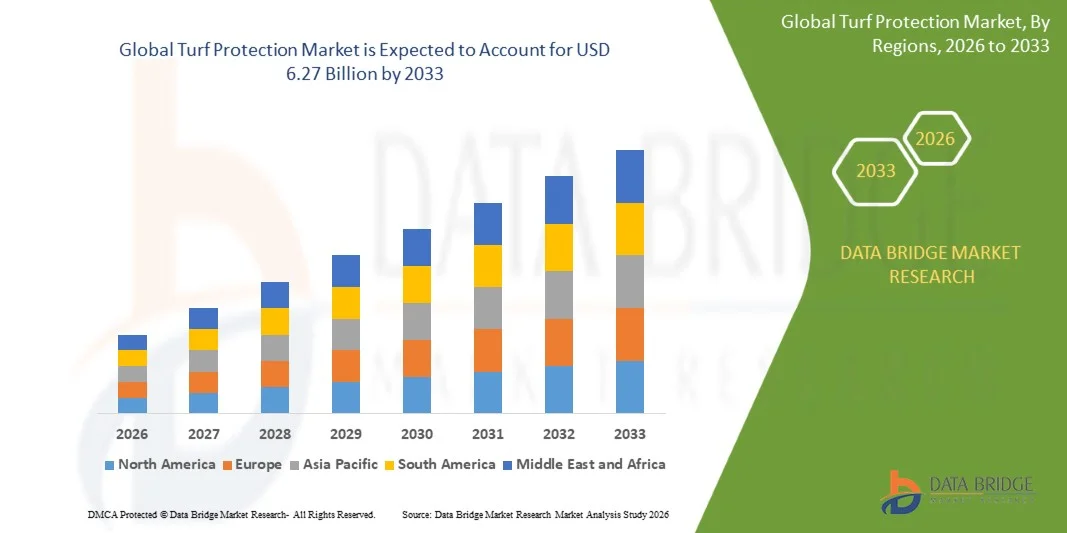
Turf Protection Market Size
- The global turf protection market size was valued at USD 4.91 billion in 2025 and is expected to reach USD 6.27 billion by 2033, at a CAGR of 3.1% during the forecast period
- The market growth is largely fueled by the increasing demand for well-maintained lawns, sports fields, and golf courses, coupled with technological advancements in turf protection solutions such as stress protection, pest control, and disease management. Enhanced formulations and integrated application methods are enabling turf managers to maintain healthy, resilient turf in both residential and commercial settings
- Furthermore, rising awareness of sustainable and environmentally friendly turf management practices is driving the adoption of biological, chemical, and mechanical solutions. These converging factors are accelerating the uptake of advanced turf protection products, thereby significantly boosting the industry’s growth
Turf Protection Market Analysis
- Turf protection products, including stress protection, pest control, and scarification solutions, are increasingly vital for maintaining the health, aesthetics, and functionality of turf in golf courses, sports fields, and urban landscaping. Their effectiveness in mitigating environmental stress, controlling pests, and preventing disease makes them essential components of modern turf management programs
- The escalating demand for turf protection is primarily fueled by rapid urbanization, expansion of sports and recreational infrastructure, and growing investment in high-quality turf maintenance. In addition, the rising preference for integrated turf management solutions that combine chemical, biological, and mechanical approaches is driving market adoption and supporting sustained industry growth
- North America dominated the turf protection market with a share of over 40% in 2025, due to a growing demand for well-maintained lawns, golf courses, and sports fields, as well as increasing awareness of turf health management practices
- Asia-Pacific is expected to be the fastest growing region in the turf protection market during the forecast period due to increasing urbanization, rising disposable incomes, and investments in sports and landscaping infrastructure in countries such as China, Japan, and India
- Chemical segment dominated the market with a market share of 45.6% in 2025, due to the effectiveness and rapid action of chemical treatments in managing stress, pests, and turf diseases. Turf managers often prefer chemical solutions for their proven efficacy and ease of application, which ensures quick recovery and enhanced turf performance. The segment sees sustained demand due to the availability of targeted formulations that address specific turf issues and integrate well with routine maintenance schedules. Chemical solutions also benefit from established regulatory frameworks and widespread adoption across commercial and recreational turf facilities
Report Scope and Turf Protection Market Segmentation
|
Attributes |
Turf Protection Key Market Insights |
|
Segments Covered |
|
|
Countries Covered |
North America
Europe
Asia-Pacific
Middle East and Africa
South America
|
|
Key Market Players |
|
|
Market Opportunities |
|
|
Value Added Data Infosets |
In addition to the insights on market scenarios such as market value, growth rate, segmentation, geographical coverage, and major players, the market reports curated by the Data Bridge Market Research also include import export analysis, production capacity overview, production consumption analysis, price trend analysis, climate change scenario, supply chain analysis, value chain analysis, raw material/consumables overview, vendor selection criteria, PESTLE Analysis, Porter Analysis, and regulatory framework. |
Turf Protection Market Trends
“Growing Adoption of Eco-Friendly Turf Protection”
- A significant trend in the turf protection market is the increasing adoption of eco-friendly and sustainable solutions for lawns, golf courses, sports fields, and commercial landscapes. This trend is driven by the rising awareness of environmental impact and the demand for products that reduce chemical usage while maintaining turf health. Such sustainable solutions are encouraging turf managers to integrate biological controls and advanced chemical formulations that minimize environmental harm
- For instance, Syngenta’s partnership with Koppert Biological Systems to develop biological turf protection products highlights the shift toward environmentally responsible solutions. These offerings strengthen turf resilience while supporting sustainable management practices
- The adoption of eco-friendly turf solutions is rising across recreational and commercial facilities, where stakeholders prioritize long-term turf durability and aesthetic quality. Products that combine stress protection, pest management, and disease prevention are becoming standard in integrated turf management programs
- Golf courses and sports facilities are increasingly incorporating sustainable turf protection to meet regulatory and consumer expectations. This is driving product innovation and creating demand for solutions that are both effective and environmentally compliant
- Residential landscaping is also experiencing growth in eco-friendly turf solutions as homeowners seek safe, high-performance products that protect turf without harming local ecosystems. The trend is fostering the development of user-friendly formulations suitable for varied applicationz
- Overall, the shift toward sustainable and biological turf protection is reinforcing the market’s evolution toward integrated, environmentally conscious practices that balance turf performance with ecological responsibility
Turf Protection Market Dynamics
Driver
“Rising Demand for Healthy and Resilient Turf”
- The growing focus on maintaining healthy, resilient turf in golf courses, sports fields, urban parks, and residential landscapes is a key driver for the turf protection market. Turf managers and facility operators are increasingly adopting advanced solutions that prevent stress damage, control pests, and reduce disease incidence
- For instance, products such as Adama’s TurfGuard Pro provide comprehensive turf disease management while promoting strong growth and durability, addressing the need for reliable and high-performing turf. The adoption of integrated chemical, biological, and mechanical approaches is enabling more effective turf maintenance strategies
- Rising urbanization and investment in recreational infrastructure are expanding the requirement for high-quality turf in public and private spaces. Maintaining visual appeal and functional performance under intensive use is driving consistent product demand
- Consumer and professional preference for sustainable and safe turf management practices is encouraging the development and adoption of multi-functional solutions. These solutions improve turf aesthetics and also support environmental compliance and operational efficiency
- The increasing awareness of climate and environmental stress impacts on turf is prompting the use of protective products that enhance resilience and longevity. The combined need for performance and sustainability continues to strengthen market growth
Restraint/Challenge
“High Cost and Regulatory Compliance”
- The turf protection market faces challenges due to the high costs associated with advanced chemical and biological products, as well as stringent regulatory requirements for use and environmental safety. These factors can limit adoption, particularly among small-scale turf managers and residential users
- For instance, the registration and compliance processes for herbicides and insecticides such as Envoke and Alucion 35 WG involve extensive testing and approval, increasing time-to-market and overall cost. Manufacturers must navigate complex regulations to ensure product safety and efficacy, which adds to operational expenses
- The reliance on specialized formulations and precision application methods also increases production costs and limits scalability. This is particularly evident in products combining multiple active ingredients for integrated turf management
- In addition, balancing performance with environmental compliance remains a challenge, as regulatory agencies impose strict limits on chemical usage and residues. Manufacturers must continuously innovate to meet regulatory standards without compromising efficacy or profitability
- These cost and compliance pressures collectively constrain market growth, requiring turf protection providers to optimize processes, develop cost-effective solutions, and educate users on proper application to maintain market momentum
Turf Protection Market Scope
The market is segmented on the basis of product, solution, and mode of application.
• By Product
On the basis of product, the turf protection market is segmented into stress protection, pest protection, and scarification. The stress protection segment dominated the market with the largest market revenue share in 2025, driven by the increasing need to maintain turf health under extreme weather conditions and environmental stressors. Turf managers and sports facility operators often prioritize stress protection products for their ability to enhance turf resilience, reduce wilting, and maintain aesthetic quality. The segment’s strong demand is further supported by innovations in stress-protective formulations that improve nutrient uptake and water retention. Stress protection products are widely compatible with various turf types and are often recommended as part of integrated turf management programs.
The pest protection segment is anticipated to witness the fastest growth rate from 2026 to 2033, fueled by rising incidences of turf-damaging insects and microbial infestations. For instance, companies such as Bayer are developing eco-friendly pest control solutions that target common turf pests while minimizing environmental impact. The increasing adoption of pest protection in golf courses, sports fields, and residential lawns contributes to its accelerated growth. Pest protection products also provide long-term benefits by reducing turf disease prevalence and improving overall turf quality. The segment benefits from continuous advancements in biological and chemical pest management solutions tailored for diverse turf environments.
• By Solution
On the basis of solution, the turf protection market is segmented into biological, chemical, and mechanical. The chemical segment dominated the market with the largest market revenue share of 45.6% in 2025, driven by the effectiveness and rapid action of chemical treatments in managing stress, pests, and turf diseases. Turf managers often prefer chemical solutions for their proven efficacy and ease of application, which ensures quick recovery and enhanced turf performance. The segment sees sustained demand due to the availability of targeted formulations that address specific turf issues and integrate well with routine maintenance schedules. Chemical solutions also benefit from established regulatory frameworks and widespread adoption across commercial and recreational turf facilities.
The biological segment is expected to witness the fastest CAGR from 2026 to 2033, driven by the growing focus on sustainable and eco-friendly turf management practices. For instance, Syngenta is investing in microbial-based solutions that promote natural turf resilience while reducing reliance on synthetic chemicals. Biological solutions are gaining popularity for their ability to improve soil health, enhance nutrient availability, and prevent turf stress naturally. Increased awareness among turf managers and environmentally conscious consumers contributes to the accelerated growth of biological solutions. The segment benefits from ongoing research in microbial strains and bio-stimulants that deliver consistent turf protection results.
• By Mode of Application
On the basis of mode of application, the turf protection market is segmented into seed, foliar, and soil. The foliar application segment dominated the market with the largest market revenue share in 2025, driven by its ability to deliver nutrients and protective agents directly to the turf canopy for rapid absorption. Turf managers often favor foliar sprays for quick corrective action against stress, pest, and disease-related issues, ensuring minimal damage to turf aesthetics. The segment sees strong adoption due to its compatibility with precision spraying equipment and smart turf management practices. Foliar application also allows for uniform coverage, reducing wastage and improving overall turf performance.
The soil application segment is anticipated to witness the fastest growth rate from 2026 to 2033, fueled by the increasing focus on root-zone health and long-term turf sustainability. For instance, companies such as Scotts Miracle-Gro are promoting soil-applied treatments that strengthen turf roots and enhance resistance to drought and pests. Soil applications are particularly effective for seedling establishment and enhancing nutrient uptake efficiency. The growing adoption of soil-applied bio-stimulants and fertilizers contributes to its accelerated growth in both sports and residential turf sectors. The segment benefits from technological advancements in controlled-release formulations and soil conditioning practices.
Turf Protection Market Regional Analysis
- North America dominated the turf protection market with the largest revenue share of over 40% in 2025, driven by a growing demand for well-maintained lawns, golf courses, and sports fields, as well as increasing awareness of turf health management practices
- Consumers in the region highly value advanced turf protection solutions that enhance stress resistance, pest management, and overall turf quality for recreational and commercial applications
- This widespread adoption is further supported by high investment in sports and landscaping infrastructure, technologically advanced turf management practices, and government initiatives promoting sustainable lawn care, establishing turf protection solutions as a preferred choice for both residential and commercial properties
U.S. Turf Protection Market Insight
The U.S. turf protection market captured the largest revenue share in 2025 within North America, fueled by increasing adoption of integrated turf management solutions and rising awareness of pest and stress-related turf issues. Consumers are prioritizing high-quality turf for sports fields, golf courses, and urban landscaping, encouraging the use of advanced stress protection and chemical solutions. The expanding trend of environmentally conscious turf management, coupled with demand for efficient foliar and soil applications, further propels market growth. Moreover, the adoption of professional turf maintenance services and the availability of innovative turf protection products are significantly contributing to market expansion.
Europe Turf Protection Market Insight
The Europe turf protection market is projected to expand at a substantial CAGR throughout the forecast period, primarily driven by strict regulations on turf management and increasing awareness of sustainable lawn care practices. Rising urbanization, coupled with growing investment in sports infrastructure and residential landscaping, is fostering adoption of turf protection solutions. European consumers and turf managers are drawn to products that improve turf durability, pest resistance, and visual appeal. The region is experiencing significant growth across golf courses, sports fields, and commercial landscapes, with turf protection products being incorporated into both new projects and renovation initiatives.
U.K. Turf Protection Market Insight
The U.K. turf protection market is anticipated to grow at a noteworthy CAGR during the forecast period, driven by increasing investment in sports and recreational infrastructure and a desire for visually appealing, healthy turf. Concerns regarding pest infestation and turf degradation are encouraging both homeowners and facility managers to adopt stress and pest protection solutions. The U.K.’s strong landscaping and horticulture sector, alongside growing e-commerce availability of turf protection products, is expected to continue supporting market growth.
Germany Turf Protection Market Insight
The Germany turf protection market is expected to expand at a considerable CAGR during the forecast period, fueled by rising awareness of sustainable turf care and demand for advanced chemical and biological solutions. Germany’s well-developed sports and recreational infrastructure, combined with its focus on environmental sustainability, promotes the adoption of turf protection products, particularly for commercial and public spaces. Integration of eco-friendly turf solutions with modern maintenance practices is increasingly prevalent, meeting consumer expectations for both performance and sustainability.
Asia-Pacific Turf Protection Market Insight
The Asia-Pacific turf protection market is poised to grow at the fastest CAGR during the forecast period of 2026 to 2033, driven by increasing urbanization, rising disposable incomes, and investments in sports and landscaping infrastructure in countries such as China, Japan, and India. The region’s growing focus on high-quality turf for sports fields, golf courses, and recreational areas, supported by government initiatives and turf care programs, is driving adoption. Furthermore, APAC emerging as a manufacturing hub for turf protection chemicals and biological solutions is increasing accessibility and affordability, expanding the consumer base for advanced turf protection products.
Japan Turf Protection Market Insight
The Japan turf protection market is gaining momentum due to high standards for sports fields, golf courses, and urban landscaping, coupled with a demand for stress- and pest-resistant turf. Japanese turf managers focus on solutions that integrate biological, chemical, and mechanical applications to maintain aesthetic and functional turf quality. The aging population and emphasis on low-maintenance turf solutions are also contributing to increased adoption of foliar and soil-applied treatments for residential and commercial areas.
China Turf Protection Market Insight
The China turf protection market accounted for the largest market revenue share in Asia-Pacific in 2025, driven by rapid urbanization, expanding sports infrastructure, and increased awareness of turf quality and maintenance. China represents a significant market for golf courses, stadiums, and residential landscaping, with a rising preference for integrated turf protection solutions. Government initiatives promoting green spaces, coupled with the availability of cost-effective chemical and biological turf protection products, are key factors propelling market growth in China.
Turf Protection Market Share
The turf protection industry is primarily led by well-established companies, including:
- Dow (U.S.)
- Syngenta AG (Switzerland)
- Idemitsu Kosan Co., Ltd. (Japan)
- The Andersons Inc. (U.S.)
- FMC Corporation (U.S.)
- Epicore (U.S.)
- BioNetworks Inc. (U.S.)
- CoreBiologic, LLC (U.S.)
- TeraGanix, Inc. (U.S.)
- Pure AG (U.S.)
- Backyard Organics, LLC (U.S.)
- Evans Turf Supplies Ltd. (U.K.)
- Nuturf Pty. Ltd. (Australia)
- Lallemand Inc. (Canada)
- CJB Industries, Inc. (U.S.)
- Oasis Turf & Tree (U.S.)
- Martenson Turf Products, Inc. (U.S.)
- AMVAC Chemical Corporation (U.S.)
- Howard Fertilizer & Chemical (U.S.)
- Vriesland Growers Cooperative, Inc. (U.S.)
- Sharda USA (U.S.)
- Growth Products Ltd. (U.S.)
- Eco Sustainable Solutions Ltd. (U.K.)
- Lucerne Biotech UK Ltd. (U.K.)
- Soil Technologies Corporation (U.S.)
Latest Developments in Global Turf Protection Market
- In January 2025, Syngenta announced a strategic partnership with Koppert Biological Systems to co-develop and commercialize integrated biological control solutions for turfgrass and ornamental disease management. This collaboration allows Syngenta to expand its portfolio into biological products, strengthening its position in sustainable turf protection. The initiative provides turf managers with advanced pest and disease control alternatives that reduce reliance on conventional chemicals, enhance environmental safety, and improve overall turf health, particularly in high-maintenance areas such as golf courses, sports fields, and premium landscaping projects
- In June 2025, Adama Agricultural Solutions launched TurfGuard Pro, a new turf disease management product specifically engineered for golf courses and commercial landscapes. TurfGuard Pro delivers robust control against major turf diseases while promoting healthy growth and resilience. Its introduction strengthens Adama’s market presence and provides turf professionals with a comprehensive solution to maintain aesthetic quality and durability. The product supports integrated turf management practices by combining preventive and curative effects, helping reduce operational costs and minimize turf damage from disease outbreaks
- In November 2024, BASF entered into a global collaboration with UPL to expand its turf and ornamental protection product lines across key international markets. This partnership enables both companies to leverage their distribution networks and research capabilities to deliver a broader range of effective turf protection solutions. The collaboration enhances product availability and accessibility for turf managers worldwide and facilitates innovation in sustainable turf management. It also allows golf course superintendents and commercial landscapers to adopt advanced solutions that improve turf resilience, reduce maintenance challenges, and ensure consistent turf quality under varying environmental conditions
- In May 2021, BASF launched Alucion 35 WG, a dual-active insecticide designed for golf courses. This non-restricted product provides effective control against surface-feeding insects such as ants, chinch bugs, cutworms, and bluegrass weevils. The launch strengthened BASF’s portfolio in turf protection and offered superintendents a reliable, easy-to-use solution that enhances turf health and minimizes pest-related damage, improving playability and aesthetic quality of turf areas
- In May 2021, AMVAC Chemical Corporation acquired the rights to sell Envoke herbicide in the U.S. from Syngenta, including end-use product trademarks and registration. This acquisition enabled AMVAC to expand its product portfolio for turf and agricultural applications in the U.S. market. By offering Envoke herbicide to American farmers and turf managers, AMVAC enhanced its market presence and provided a trusted solution for weed management, supporting better turf quality and maintenance efficiency across residential, commercial, and recreational landscapes

- Interactive Data Analysis Dashboard
- Company Analysis Dashboard for high growth potential opportunities
- Research Analyst Access for customization & queries
- Competitor Analysis with Interactive dashboard
- Latest News, Updates & Trend analysis
- Harness the Power of Benchmark Analysis for Comprehensive Competitor Tracking
Data collection and base year analysis are done using data collection modules with large sample sizes. The stage includes obtaining market information or related data through various sources and strategies. It includes examining and planning all the data acquired from the past in advance. It likewise envelops the examination of information inconsistencies seen across different information sources. The market data is analysed and estimated using market statistical and coherent models. Also, market share analysis and key trend analysis are the major success factors in the market report. To know more, please request an analyst call or drop down your inquiry.
The key research methodology used by DBMR research team is data triangulation which involves data mining, analysis of the impact of data variables on the market and primary (industry expert) validation. Data models include Vendor Positioning Grid, Market Time Line Analysis, Market Overview and Guide, Company Positioning Grid, Patent Analysis, Pricing Analysis, Company Market Share Analysis, Standards of Measurement, Global versus Regional and Vendor Share Analysis. To know more about the research methodology, drop in an inquiry to speak to our industry experts.
Data Bridge Market Research is a leader in advanced formative research. We take pride in servicing our existing and new customers with data and analysis that match and suits their goal. The report can be customized to include price trend analysis of target brands understanding the market for additional countries (ask for the list of countries), clinical trial results data, literature review, refurbished market and product base analysis. Market analysis of target competitors can be analyzed from technology-based analysis to market portfolio strategies. We can add as many competitors that you require data about in the format and data style you are looking for. Our team of analysts can also provide you data in crude raw excel files pivot tables (Fact book) or can assist you in creating presentations from the data sets available in the report.