


Two-Factor Authentication Market Size
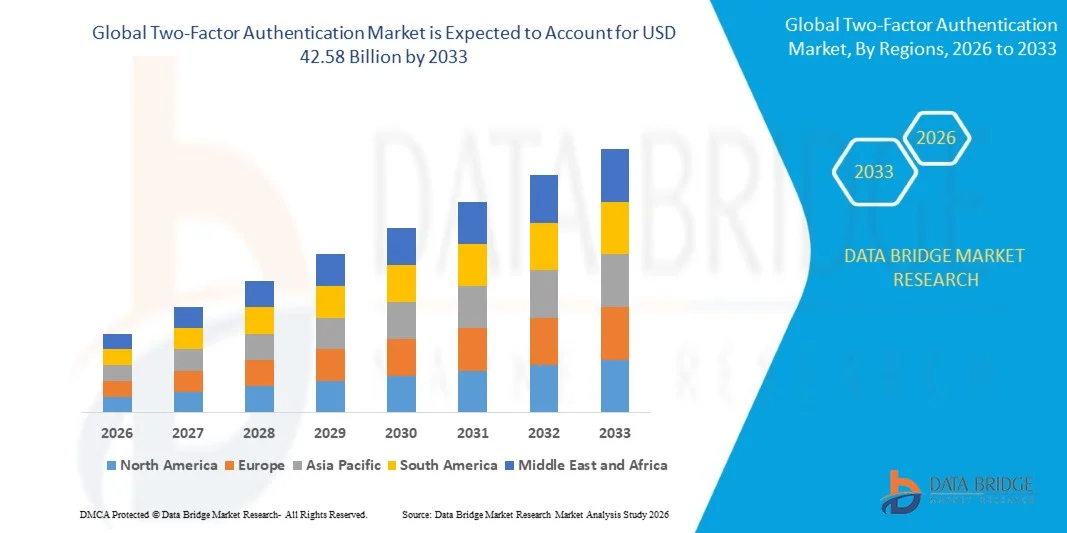
- The global two-factor authentication market size was valued at USD 10.99 billion in 2025and is expected to reach USD 42.58 billion by 2033, at a CAGR of 18.45% during the forecast period
- The market growth is largely fuelled by the rising incidence of cyber threats and data breaches, pushing organizations to adopt stronger identity verification systems
- Increasing regulatory compliance requirements and data protection mandates across industries are further accelerating the deployment of multi-layer authentication solutions
Two-Factor Authentication Market Analysis
- The market is experiencing strong adoption across banking, financial services, IT, and healthcare sectors due to growing concerns over unauthorized access and identity theft
- Continuous advancements in authentication technologies such as biometrics, OTP-based systems, and mobile authentication apps are enhancing security efficiency and user convenience
- North America dominated the global two-factor authentication market with the largest revenue share in 2025, driven by the rapid adoption of digital banking, cloud-based services, and advanced cybersecurity solutions across enterprises and government organizations
- Asia-Pacific region is expected to witness the highest growth rate in the global two-factor authentication market, driven by large-scale digital transformation initiatives, rising cyber fraud incidents, expanding IT infrastructure, and increasing adoption of secure authentication solutions across SMEs and large enterprises
- The OTP segment held the largest market revenue share in 2025 driven by its widespread adoption across online banking, e-commerce platforms, and enterprise login systems due to its simplicity and cost-effectiveness. OTP-based authentication is widely used because it provides quick verification through SMS, email, or app-based codes, making it highly accessible for both individual and enterprise users
Report Scope and Two-Factor Authentication Market Segmentation
|
Attributes |
Two-Factor Authentication Key Market Insights |
|
Segments Covered |
· By Type: One Time Password (OTP) and Public Key Infrastructure (PKI) · By Model: Smart Card with PIN, One Time Password with PIN, Biometric Technology with PIN, Smart Card with Biometric Technology, and Others · By Technology: OTP Authenticators, PKI Authenticators, Physical and Logical Access Control, Out-Of-Band Authenticators, and Mobile PKI Office Suite · By End-User: Banking and Finance, Government, Military and Defense, Commercial Security, Travel and Immigration, Healthcare, Consumer Electronics, and Aerospace |
|
Countries Covered |
North America · U.S. · Canada · Mexico Europe · Germany · France · U.K. · Netherlands · Switzerland · Belgium · Russia · Italy · Spain · Turkey · Rest of Europe Asia-Pacific · China · Japan · India · South Korea · Singapore · Malaysia · Australia · Thailand · Indonesia · Philippines · Rest of Asia-Pacific Middle East and Africa · Saudi Arabia · U.A.E. · South Africa · Egypt · Israel · Rest of Middle East and Africa South America · Brazil · Argentina · Rest of South America |
|
Key Market Players |
• Thales Group (France) |
|
Market Opportunities |
• Rising Adoption Of Biometric Authentication Solutions |
|
Value Added Data Infosets |
In addition to the insights on market scenarios such as market value, growth rate, segmentation, geographical coverage, and major players, the market reports curated by the Data Bridge Market Research also include in-depth expert analysis, geographically represented company-wise production and capacity, network layouts of distributors and partners, detailed and updated price trend analysis and deficit analysis of supply chain and demand. |
Two-Factor Authentication Market Trends
“Rising Adoption Of Advanced Digital Identity Verification Solutions”
- The growing focus on strengthening cybersecurity frameworks is significantly shaping the two-factor authentication market, as organizations increasingly prioritize multi-layered security mechanisms to protect sensitive data and digital identities. Two-factor authentication solutions are gaining traction due to their ability to reduce unauthorized access risks while enhancing login security across enterprise and consumer applications
- Increasing digitalization across banking, e-commerce, healthcare, and government services has accelerated the demand for secure authentication systems, as cyberattacks and data breaches continue to rise globally. Organizations are actively implementing authentication tools such as OTP, biometrics, and mobile-based verification to strengthen user authentication processes and improve trust in digital platforms
- Regulatory compliance requirements and data protection laws are influencing security investments, with enterprises emphasizing stronger identity verification protocols to meet industry standards. These factors are encouraging widespread adoption of authentication solutions while also driving continuous upgrades in cybersecurity infrastructure
- For instance, in 2024, Microsoft in the U.S. and Google in the U.S. expanded their authentication ecosystems by integrating advanced multi-factor authentication and passwordless login solutions across enterprise and consumer platforms. These enhancements were introduced to improve user security, reduce phishing risks, and strengthen digital ecosystem protection
- While demand for two-factor authentication is growing, sustained market expansion depends on seamless user experience design, cost-effective deployment, and integration with existing IT infrastructure. Vendors are also focusing on improving scalability and interoperability across devices and platforms
Two-Factor Authentication Market Dynamics
Driver
“Increasing Cybersecurity Threats And Regulatory Compliance Requirements”
- Rising incidents of cyber fraud, phishing attacks, and identity theft are a major driver for the two-factor authentication market. Organizations are increasingly adopting authentication systems to secure user access, reduce data breaches, and enhance overall cybersecurity resilience
- Expanding adoption of cloud computing, remote working models, and digital payment systems is influencing market growth. Two-factor authentication enhances security layers for online transactions and remote access environments, supporting secure digital transformation across industries
- Enterprises and government organizations are actively deploying authentication solutions through software integration, mobile applications, and biometric systems. These efforts are supported by growing awareness of cybersecurity risks and the need for stronger identity protection frameworks
- For instance, in 2023, Apple in the U.S. and Amazon in the U.S. strengthened their authentication systems by implementing enhanced multi-factor authentication across user accounts and enterprise services. This initiative improved account security, reduced unauthorized access risks, and strengthened customer trust in digital ecosystems
- Although cybersecurity awareness is increasing, wider adoption depends on user convenience, integration simplicity, and cost optimization. Continuous innovation in authentication technologies and improved user experience will be critical for long-term market growth
Restraint/Challenge
“User Resistance And Implementation Complexity In Authentication Systems”
- The complexity of deployment and user resistance to additional login steps remain key challenges for the two-factor authentication market. Many users perceive authentication processes as time-consuming, leading to lower adoption rates in certain consumer segments
- Integration challenges with legacy IT systems and inconsistent infrastructure across organizations also restrict seamless implementation. This is particularly evident in small and medium enterprises with limited cybersecurity budgets and technical expertise
- Dependence on mobile devices and network connectivity can also create operational limitations, especially in regions with weak digital infrastructure. In addition, risks such as SIM swapping and authentication bypass techniques continue to pose security concerns
- For instance, in 2024, several financial service providers in Southeast Asia reported reduced user adoption of authentication systems due to login friction and connectivity issues in mobile-based verification methods. These challenges also increased support costs and impacted customer experience in digital banking services
- Overcoming these challenges will require simplified authentication workflows, improved user interface design, and stronger integration capabilities. Increased awareness campaigns and investment in adaptive authentication technologies will be essential for expanding global adoption of two-factor authentication solutions
Two-Factor Authentication Market Scope
The market is segmented on the basis of type, model, technology, and end-user.
- By Type
On the basis of type, the global two-factor authentication market is segmented into One Time Password (OTP) and Public Key Infrastructure (PKI). The OTP segment held the largest market revenue share in 2025 driven by its widespread adoption across online banking, e-commerce platforms, and enterprise login systems due to its simplicity and cost-effectiveness. OTP-based authentication is widely used because it provides quick verification through SMS, email, or app-based codes, making it highly accessible for both individual and enterprise users.
The PKI segment is expected to witness the fastest growth rate from 2026 to 2033, driven by its strong encryption capabilities and higher level of security for sensitive data transactions. PKI-based systems are increasingly adopted in government, defense, and large enterprises where secure digital identity verification and certificate-based authentication are critical for preventing cyber threats.
- By Model
On the basis of model, the market is segmented into Smart Card with PIN, One Time Password with PIN, Biometric Technology with PIN, Smart Card with Biometric Technology, and Others. The One Time Password with PIN segment held the largest market share in 2025 due to its strong balance between usability and enhanced security, making it widely implemented in banking and enterprise applications. This model adds an extra layer of protection by combining dynamic OTP verification with user-defined PIN authentication.
The Biometric Technology with PIN segment is expected to witness the fastest growth rate from 2026 to 2033, driven by increasing demand for advanced authentication methods such as fingerprint and facial recognition. This combination enhances identity verification accuracy and is increasingly deployed in high-security environments such as financial institutions and government systems.
- By Technology
On the basis of technology, the market is segmented into OTP Authenticators, PKI Authenticators, Physical and Logical Access Control, Out-Of-Band Authenticators, and Mobile PKI Office Suite. The OTP Authenticators segment held the largest market revenue share in 2025 driven by their widespread integration into mobile applications, online banking systems, and enterprise security platforms. OTP authenticators are preferred due to their ease of deployment and compatibility with multiple digital platforms.
The Out-Of-Band Authenticators segment is expected to witness the fastest growth rate from 2026 to 2033, driven by rising concerns over phishing attacks and credential theft. This technology enhances security by verifying identity through a separate communication channel, making it increasingly popular for secure financial transactions and enterprise access control.
- By End-User
On the basis of end-user, the market is segmented into Banking and Finance, Government, Military and Defense, Commercial Security, Travel and Immigration, Healthcare, Consumer Electronics, and Aerospace. The Banking and Finance segment held the largest market revenue share in 2025 driven by the increasing need for secure online transactions, fraud prevention, and regulatory compliance. Financial institutions widely deploy two-factor authentication solutions to protect customer accounts and digital banking platforms.
The Healthcare segment is expected to witness the fastest growth rate from 2026 to 2033, driven by the rising digitization of patient records and increasing cybersecurity threats targeting sensitive medical data. Two-factor authentication is increasingly adopted in healthcare systems to ensure secure access to electronic health records and hospital management platforms.
Two-Factor Authentication Market Regional Analysis
- North America dominated the global two-factor authentication market with the largest revenue share in 2025, driven by the rapid adoption of digital banking, cloud-based services, and advanced cybersecurity solutions across enterprises and government organizations
- Organizations in the region highly value strong identity verification systems, regulatory compliance requirements, and seamless integration of authentication solutions with enterprise security infrastructure
- This widespread adoption is further supported by high digital penetration, strong presence of cybersecurity vendors, and increasing incidents of cyber fraud and data breaches, establishing two-factor authentication as a critical security layer across industries
U.S. Two-Factor Authentication Market Insight
The U.S. two-factor authentication market captured the largest revenue share in 2025 within North America, fueled by the extensive use of online banking, e-commerce platforms, and enterprise cloud applications. Businesses are increasingly prioritizing advanced authentication methods to prevent unauthorized access and identity theft. The growing shift toward remote work models, combined with rising demand for mobile-based authentication and biometric verification, further propels market growth. Moreover, strong integration of authentication systems with platforms such as enterprise software and cloud security ecosystems is significantly contributing to market expansion.
Europe Two-Factor Authentication Market Insight
The Europe two-factor authentication market is expected to witness the fastest growth rate from 2026 to 2033, primarily driven by stringent data protection regulations and increasing cybersecurity threats across digital platforms. The rising adoption of online financial services, e-governance systems, and cloud-based enterprise solutions is fostering demand for secure authentication technologies. European organizations are also focusing on compliance with regulatory frameworks, further accelerating the deployment of multi-layer authentication solutions across industries.
U.K. Two-Factor Authentication Market Insight
The U.K. two-factor authentication market is expected to witness the fastest growth rate from 2026 to 2033, driven by the increasing frequency of cyberattacks and the growing need for secure digital transactions. In addition, the expansion of online banking, fintech services, and e-commerce platforms is encouraging widespread adoption of authentication solutions. The country’s strong digital infrastructure and high awareness of cybersecurity risks are further supporting market growth across both public and private sectors.
Germany Two-Factor Authentication Market Insight
The Germany two-factor authentication market is expected to witness the fastest growth rate from 2026 to 2033, fueled by rising concerns over data privacy and the increasing adoption of secure digital identity solutions. Germany’s strong industrial and enterprise ecosystem promotes the integration of advanced authentication systems within corporate networks. The demand for secure access control in financial services, manufacturing, and government institutions is further driving the market, along with a strong focus on privacy-centric security frameworks.
Asia-Pacific Two-Factor Authentication Market Insight
The Asia-Pacific two-factor authentication market is expected to witness the fastest growth rate from 2026 to 2033, driven by rapid digital transformation, increasing smartphone penetration, and expanding online financial services in countries such as China, Japan, and India. The region’s growing adoption of cloud computing, e-commerce platforms, and mobile banking is significantly boosting demand for secure authentication solutions. In addition, government initiatives supporting digitalization and cybersecurity infrastructure development are accelerating market expansion across both enterprise and consumer applications.
Japan Two-Factor Authentication Market Insight
The Japan two-factor authentication market is expected to witness the fastest growth rate from 2026 to 2033 due to its advanced digital ecosystem, high cybersecurity awareness, and increasing adoption of IoT-based services. The country’s strong focus on secure digital identity verification is driving the use of biometric and OTP-based authentication systems. Furthermore, the integration of authentication solutions with smart devices, enterprise systems, and financial platforms is supporting market growth across residential, commercial, and institutional sectors.
China Two-Factor Authentication Market Insight
The China two-factor authentication market accounted for the largest market revenue share in Asia-Pacific in 2025, attributed to rapid digitalization, a large online consumer base, and extensive use of mobile payment systems. China is one of the largest markets for digital services, where secure authentication is increasingly deployed across banking, e-commerce, and government platforms. The expansion of smart city initiatives, strong domestic cybersecurity firms, and growing emphasis on data protection are key factors propelling the market in China.
Two-Factor Authentication Market Share
The Two-Factor Authentication industry is primarily led by well-established companies, including:
• Thales Group (France)
• Fujitsu (Japan)
• Suprema (South Korea)
• OneSpan (U.S.)
• NEC Corporation (Japan)
• Broadcom (U.S.)
• RSA Security LLC (U.S.)
• IBM (U.S.)
• HID Global Corporation (U.S.)
• Google LLC (U.S.)
• Dell Inc. (U.S.)
• Amazon Web Services, Inc. (U.S.)
• Entrust Corporation (Canada)
• ASSA ABLOY (Sweden)
• Crossmatch (U.S.)
• Censornet (U.K.)
• IDEMIA (France)
• ZKTeco Co., Ltd. (China)
• Watchdata Co., Ltd. (China)
• SecurEnvoy Ltd. (U.K.)
• 3M (U.S.)
• Yubico (U.S.)
• SecurStar (Germany)
• SecureAuth Corporation (U.S.)
Latest Developments in Global Two-Factor Authentication Market
- In October 2025, Okta (U.S.), through a strategic partnership with a cybersecurity firm, enhanced its 2FA ecosystem by integrating advanced threat detection into its identity management platform. This development focuses on combining identity verification with real-time behavioral analytics to detect anomalies during login attempts. It is expected to significantly reduce account takeover risks and strengthen enterprise identity security frameworks. The collaboration also enables faster incident response and adaptive authentication policies for enterprise clients. Overall, this move is likely to increase Okta’s competitiveness in the identity and access management market and support broader adoption across regulated industries such as banking and healthcare
- In September 2025, Google (U.S.) introduced an upgraded 2FA system incorporating biometric authentication, aimed at improving both security strength and user convenience. The new system integrates fingerprint and facial recognition technologies across its ecosystem to reduce dependency on passwords and OTP-based verification. This advancement enhances protection against phishing and credential theft while streamlining user login experiences across devices. It also aligns with growing demand for passwordless authentication solutions in consumer and enterprise applications. As a result, Google is expected to strengthen its ecosystem lock-in and accelerate adoption of biometric-based security standards in the global authentication market
- In August 2025, Microsoft (U.S.) launched an enhanced Azure Active Directory feature integrating AI-driven 2FA capabilities to predict and prevent potential security threats. This innovation uses machine learning algorithms to analyze user behavior patterns and detect suspicious login activities in real time. The feature enhances adaptive authentication by adjusting security requirements based on risk levels, thereby improving overall cloud security posture. It also reduces friction for legitimate users while strengthening defenses against cyberattacks such as credential stuffing and account hijacking. This development is expected to reinforce Microsoft’s leadership in cloud security and accelerate the shift toward AI-powered identity protection solutions globally

- Interactive Data Analysis Dashboard
- Company Analysis Dashboard for high growth potential opportunities
- Research Analyst Access for customization & queries
- Competitor Analysis with Interactive dashboard
- Latest News, Updates & Trend analysis
- Harness the Power of Benchmark Analysis for Comprehensive Competitor Tracking
Global Two Factor Authentication Market, Supply Chain Analysis and Ecosystem Framework
To support market growth and help clients navigate the impact of geopolitical shifts, DBMR has integrated in-depth supply chain analysis into its Global Two Factor Authentication Market research reports. This addition empowers clients to respond effectively to global changes affecting their industries. The supply chain analysis section includes detailed insights such as Global Two Factor Authentication Market consumption and production by country, price trend analysis, the impact of tariffs and geopolitical developments, and import and export trends by country and HSN code. It also highlights major suppliers with data on production capacity and company profiles, as well as key importers and exporters. In addition to research, DBMR offers specialized supply chain consulting services backed by over a decade of experience, providing solutions like supplier discovery, supplier risk assessment, price trend analysis, impact evaluation of inflation and trade route changes, and comprehensive market trend analysis.
Data collection and base year analysis are done using data collection modules with large sample sizes. The stage includes obtaining market information or related data through various sources and strategies. It includes examining and planning all the data acquired from the past in advance. It likewise envelops the examination of information inconsistencies seen across different information sources. The market data is analysed and estimated using market statistical and coherent models. Also, market share analysis and key trend analysis are the major success factors in the market report. To know more, please request an analyst call or drop down your inquiry.
The key research methodology used by DBMR research team is data triangulation which involves data mining, analysis of the impact of data variables on the market and primary (industry expert) validation. Data models include Vendor Positioning Grid, Market Time Line Analysis, Market Overview and Guide, Company Positioning Grid, Patent Analysis, Pricing Analysis, Company Market Share Analysis, Standards of Measurement, Global versus Regional and Vendor Share Analysis. To know more about the research methodology, drop in an inquiry to speak to our industry experts.
Data Bridge Market Research is a leader in advanced formative research. We take pride in servicing our existing and new customers with data and analysis that match and suits their goal. The report can be customized to include price trend analysis of target brands understanding the market for additional countries (ask for the list of countries), clinical trial results data, literature review, refurbished market and product base analysis. Market analysis of target competitors can be analyzed from technology-based analysis to market portfolio strategies. We can add as many competitors that you require data about in the format and data style you are looking for. Our team of analysts can also provide you data in crude raw excel files pivot tables (Fact book) or can assist you in creating presentations from the data sets available in the report.













