


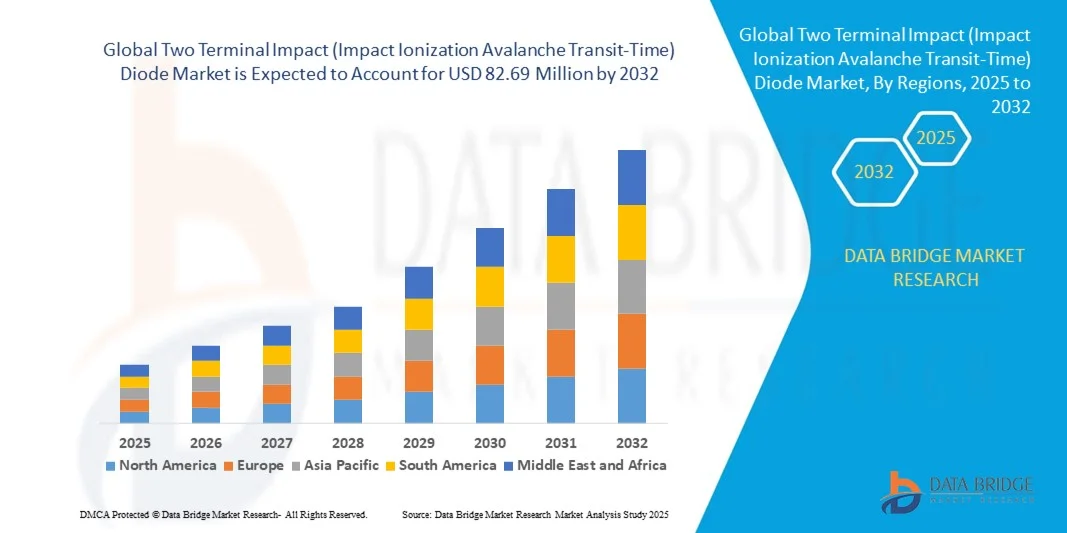
What is the Global Two Terminal Impact (Impact Ionization Avalanche Transit-Time) Diode Market Size and Growth Rate?
- The global two terminal impact (Impact Ionization Avalanche Transit-Time) diode market size was valued at USD 58.15 Million in 2024 and is expected to reach USD 82.69 Million by 2032, at a CAGR of 4.50% during the forecast period
- The growing demand of the product as it offer high operating range, availability of product which is compact in size, rising usages of the diodes as they are reliable while operate at high temperature along with economical nature of the impact diode, generally they have long life and fixed frequency as well as power stability are some of the major as well as important factors which will such asly to accelerate the growth of the two terminal impact (Impact Ionization Avalanche Transit-Time) diode market
What are the Major Takeaways of Two Terminal Impact (Impact Ionization Avalanche Transit-Time) Diode Market?
- Rising demand of the product for microwave oscillation, microwave generator, and amplification applications which will further contribute by generating immense opportunities that will lead to the growth of the Two Terminal Impact (Impact Ionization Avalanche Transit-Time) diode markets in the projected timeframe mentioned above
- Rate of generation of electron-hole pair in the avalanche region causes the generation of high noise along with product offers low tuning range which will such asly to act as market restraints factor for the growth of the two-terminal impact (impact ionization avalanche transit-time) diode in the above-mentioned projected timeframe
- North America dominated the global Two Terminal Impact (Impact Ionization Avalanche Transit-Time) diode market with the largest revenue share of 41.2% in 2024, driven by the increasing demand for advanced microwave and radar communication systems
- The Asia-Pacific market is forecasted to grow at the fastest CAGR of 10.26% from 2025 to 2032, propelled by rapid industrialization, expanding communication networks, and strong government support for semiconductor manufacturing in China, Japan, and India
- The Microwave Oscillator segment dominated the market with the largest revenue share of 37.6% in 2024, primarily due to its extensive use in radar systems, communication links, and high-frequency signal generation
Report Scope and Two Terminal Impact (Impact Ionization Avalanche Transit-Time) Diode Market Segmentation
|
Attributes |
Two Terminal Impact (Impact Ionization Avalanche Transit-Time) Diode Key Market Insights |
|
Segments Covered |
|
|
Countries Covered |
North America
Europe
Asia-Pacific
Middle East and Africa
South America
|
|
Key Market Players |
|
|
Market Opportunities |
|
|
Value Added Data Infosets |
In addition to the insights on market scenarios such as market value, growth rate, segmentation, geographical coverage, and major players, the market reports curated by the Data Bridge Market Research also include in-depth expert analysis, pricing analysis, brand share analysis, consumer survey, demography analysis, supply chain analysis, value chain analysis, raw material/consumables overview, vendor selection criteria, PESTLE Analysis, Porter Analysis, and regulatory framework. |
What is the Key Trend in the Two Terminal Impact (Impact Ionization Avalanche Transit-Time) Diode Market?
Technological Advancements and Miniaturization Driving Device Efficiency
- A prominent trend shaping the global two terminal impact (Impact Ionization Avalanche Transit-Time) diode market is the increasing focus on miniaturization and enhanced power efficiency in high-frequency applications such as radar, satellite communication, and 5G infrastructure
- Manufacturers are investing in developing compact diodes capable of operating at higher frequencies with improved efficiency and lower noise levels, addressing the growing demand from aerospace and defense sectors
- For instance, companies such as Infineon Technologies AG and MACOM Technology Solutions
- are advancing product designs through GaN (Gallium Nitride) and SiC (Silicon Carbide) materials, offering superior thermal stability and high breakdown voltage
- The integration of these advanced materials enhances overall performance, enabling faster signal transmission and greater power handling capabilities
- Furthermore, the use of AI-assisted design tools is improving precision and customization in diode manufacturing, allowing companies to optimize performance across various frequency bands
- This shift toward smaller, smarter, and more efficient devices is setting new standards in RF and microwave technologies, ensuring that two terminal impact diodes remain vital components in modern communication and defense systems
What are the Key Drivers of Two Terminal Impact (Impact Ionization Avalanche Transit-Time) Diode Market?
- The surge in demand for high-frequency and high-power semiconductor devices across aerospace, defense, and telecommunication sectors is a major driver of the Two Terminal Impact Diode market
- The widespread adoption of 5G networks, radar systems, and satellite communications has created substantial opportunities for diodes capable of handling ultra-fast signal transmission with minimal distortion
- For instance, in April 2024, ROHM Co., Ltd. announced the expansion of its RF component line to cater to next-generation radar and wireless communication systems
- Moreover, the growing use of advanced materials such as GaAs and GaN in diode manufacturing is enhancing efficiency, reliability, and thermal management, further stimulating market growth
- Defense modernization initiatives in countries such as the U.S., China, and India are also driving investments in high-frequency radar systems, significantly boosting diode demand.
- As industries continue to prioritize compactness, performance, and energy efficiency, the Two Terminal Impact Diode market is witnessing robust global adoption across multiple end-use applications
Which Factor is Challenging the Growth of the Two Terminal Impact (Impact Ionization Avalanche Transit-Time) Diode Market?
- The high manufacturing complexity and cost associated with advanced semiconductor materials such as GaN and SiC pose a significant challenge to the two terminal impact diode market
- Producing diodes with precise doping levels and maintaining performance consistency at ultra-high frequencies require specialized fabrication equipment and technical expertise, increasing production expenses
- In addition, thermal management issues in high-power applications can limit diode efficiency and lifespan, creating reliability concerns among end-users
- The limited availability of high-quality raw materials and the need for stringent quality control further constrain large-scale production
- Moreover, the presence of alternative technologies, including Schottky and PIN diodes, offering cost-effective solutions for certain RF applications, adds competitive pressure to the market
- Addressing these challenges through material innovation, cost optimization, and enhanced fabrication processes will be critical for sustaining long-term market growth and competitiveness in the Two Terminal Impact Diode industry
How is the Two Terminal Impact (Impact Ionization Avalanche Transit-Time) Diode Market Segmented?
The two-terminal impact (Impact Ionization Avalanche Transit-Time) market is segmented on the basis of application, end use, and base material.
- By Application
On the basis of application, the market is segmented into Microwave Oscillator, Microwave Generators, Modulated Output Oscillator, Receiver Local Oscillator, Negative Resistance Amplifications, Intrusion Alarm Networks, Police Radar, Low Power Microwave Transmitter, FM Telecom Transmitter, and CW Doppler Radar Transmitter. The Microwave Oscillator segment dominated the market with the largest revenue share of 37.6% in 2024, primarily due to its extensive use in radar systems, communication links, and high-frequency signal generation. Its efficiency in generating stable oscillations makes it crucial in defense and telecommunication applications.
Meanwhile, the CW Doppler Radar Transmitter segment is anticipated to register the fastest CAGR from 2025 to 2032, fueled by the rising deployment of motion detection and speed monitoring systems in defense, aerospace, and traffic management. Growing demand for compact, energy-efficient radar transmitters is expected to further drive growth across this segment.
- By End Use
On the basis of end use, the Two Terminal Impact (Impact Ionization Avalanche Transit-Time) Diode market is segmented into Electronic Devices, Semiconductor, Single Drift Devices, and Double Drift Devices. The Semiconductor segment held the largest market revenue share of 41.8% in 2024, attributed to the high utilization of avalanche diodes in semiconductor-based components such as amplifiers and oscillators. Their ability to operate at high frequencies with enhanced stability supports widespread use across defense and communication systems.
The Double Drift Devices segment is projected to witness the fastest growth rate between 2025 and 2032, driven by advancements in high-frequency device architectures. Double drift designs offer improved efficiency and higher power output, making them increasingly valuable in next-generation radar and communication infrastructure. The growing focus on miniaturization and performance enhancement across electronics further strengthens this segment’s outlook.
- By Base Material
On the basis of base material, the market is segmented into Silicon, Silicon Carbide (SiC), Gallium Arsenide (GaAs), and Indium Phosphide (InP). The Silicon segment dominated the market with a market share of 46.3% in 2024, driven by its widespread availability, cost-effectiveness, and suitability for low to medium power applications. Silicon-based diodes are extensively used in microwave and communication circuits due to their stable performance and easy integration with existing technologies.
However, the Gallium Arsenide (GaAs) segment is expected to grow at the fastest CAGR from 2025 to 2032, owing to its superior electron mobility, thermal resistance, and performance at high frequencies. GaAs-based diodes are becoming the preferred choice for advanced radar and satellite communication systems, where efficiency and precision are critical. Increasing R&D activities to improve GaAs fabrication technologies will such asly accelerate segment expansion in the coming years.
Which Region Holds the Largest Share of the Two Terminal Impact (Impact Ionization Avalanche Transit-Time) Diode Market?
- North America dominated the global two terminal impact (Impact Ionization Avalanche Transit-Time) diode diode market with the largest revenue share of 41.2% in 2024, driven by the increasing demand for advanced microwave and radar communication systems. The strong presence of defense and aerospace sectors, coupled with ongoing investments in 5G infrastructure, continues to propel the adoption of these diodes across the region
- Consumers and industries in North America highly value high-frequency performance, low phase noise, and signal stability, making these diodes vital for radar transmitters, amplifiers, and satellite communication
- In addition, the region’s emphasis on technological innovation, R&D activities, and partnerships between semiconductor firms and defense contractors further supports market dominance. The availability of major industry players and advanced fabrication facilities ensures consistent innovation, solidifying North America’s leadership position in the Two Terminal Impact (Impact Ionization Avalanche Transit-Time) Diode Diode market
U.S. Two Terminal Impact (Impact Ionization Avalanche Transit-Time) Diode Diode Market Insight
The U.S. market captured the largest share of 72% within North America in 2024, fueled by high investments in defense radar systems, electronic warfare, and telecommunication equipment. The demand for compact and high-efficiency microwave sources in radar and satellite communication has accelerated the deployment of IMPATT diodes. In addition, the ongoing expansion of 5G networks and next-generation wireless communication systems continues to drive innovation in high-power, high-frequency diode technologies. Government-backed projects in aerospace and the defense sector also strengthen domestic demand. Major players such as MACOM, Cree, and Microsemi contribute to regional dominance through innovation and collaboration. The focus on improving thermal efficiency, reliability, and cost-effectiveness ensures sustained market expansion in the U.S. IMPATT diode sector.
Europe Two Terminal Impact (Impact Ionization Avalanche Transit-Time) Diode Diode Market Insight
The Europe market is anticipated to expand at a steady CAGR during 2025–2032, driven by the rising adoption of microwave technologies across industrial automation, defense, and automotive radar systems. The region’s stringent defense modernization programs and investment in satellite communications significantly contribute to the market’s growth. European manufacturers emphasize the production of energy-efficient, compact, and durable diodes for high-frequency applications. In addition, the integration of IMPATT diodes into autonomous driving radar systems and smart city surveillance technologies is gaining traction. The increasing collaboration between defense contractors and semiconductor firms in Germany, France, and the U.K. reinforces the region’s technological position. Europe’s balanced focus on innovation, sustainability, and defense technology ensures long-term growth for the IMPATT diode market.
U.K. Two Terminal Impact (Impact Ionization Avalanche Transit-Time) Diode Diode Market Insight
The U.K. IMPATT diode market is projected to register a healthy CAGR during the forecast period, driven by rising investments in defense communication, automotive radar, and aerospace systems. The country's strong R&D infrastructure and government initiatives in radar technology advancements support growing demand. Moreover, the U.K.’s push toward smart defense systems and autonomous vehicle technology increases reliance on high-performance diodes. Partnerships between domestic research institutions and international semiconductor firms are fostering innovation and local production capabilities. With a focus on enhancing frequency stability and performance reliability, the U.K. market is poised for sustained expansion, aligning with its national security and industrial digitization objectives.
Germany Two Terminal Impact (Impact Ionization Avalanche Transit-Time) Diode Diode Market Insight
The Germany market is expected to experience strong growth from 2025 to 2032, supported by the country’s advanced semiconductor manufacturing ecosystem and emphasis on high-frequency electronics. Demand is being driven by industrial radar systems, telecommunication equipment, and automotive safety technologies. Germany’s robust industrial base and innovation-driven culture promote the integration of IMPATT diodes into smart mobility and communication systems. The government’s ongoing initiatives to enhance defense capabilities and digital infrastructure have further accelerated product adoption. In addition, local companies are focusing on sustainable and energy-efficient designs to reduce operational costs. Germany’s commitment to innovation and precision technology positions it as a key European hub for IMPATT diode development.
Which Region is the Fastest Growing Region in the Two Terminal Impact (Impact Ionization Avalanche Transit-Time) Diode Diode Market?
The Asia-Pacific market is forecasted to grow at the fastest CAGR of 10.26% from 2025 to 2032, propelled by rapid industrialization, expanding communication networks, and strong government support for semiconductor manufacturing in China, Japan, and India. The region’s growing emphasis on 5G deployment, radar technology, and satellite communication is driving widespread adoption of IMPATT diodes. Increased investments in defense and aerospace infrastructure, along with cost-effective manufacturing, make APAC a global hotspot for diode production. Furthermore, local companies are improving fabrication efficiency and exploring GaAs and SiC-based diode technologies for enhanced performance. As Asia-Pacific emerges as both a production and consumption hub, its role in shaping the future of the Two Terminal Impact (Impact Ionization Avalanche Transit-Time) Diode Diode market is becoming increasingly dominant.
Japan Two Terminal Impact (Impact Ionization Avalanche Transit-Time) Diode Diode Market Insight
The Japan market is expanding steadily, supported by the country’s advanced electronics ecosystem and emphasis on high-frequency applications. The integration of IMPATT diodes into satellite communication, automotive radar, and defense electronics is fueling market growth. Japanese manufacturers prioritize miniaturization and improved energy efficiency, aligning with the nation’s technological precision standards. Furthermore, Japan’s growing demand for IoT and 5G-based communication systems is accelerating the use of IMPATT diodes for stable and high-speed signal transmission. Collaborative research initiatives between academia and semiconductor firms continue to enhance product performance, making Japan a leader in precision diode technology.
China Two Terminal Impact (Impact Ionization Avalanche Transit-Time) Diode Diode Market Insight
The China market held the largest share in Asia-Pacific in 2024, driven by expanding manufacturing capabilities and massive demand from telecommunication and defense sectors. China’s rapid urbanization, strong semiconductor supply chain, and government-backed 5G expansion programs are key growth enablers. Local companies are increasingly focusing on GaAs- and InP-based diodes to meet the needs of high-frequency, high-power applications. Moreover, the push toward smart city development and radar surveillance systems continues to create strong opportunities. As China strengthens its position as a global semiconductor hub, it remains central to the growth and innovation of the Two Terminal Impact (Impact Ionization Avalanche Transit-Time) Diode Diode market.
Which are the Top Companies in Two Terminal Impact (Impact Ionization Avalanche Transit-Time) Diode Market?
The two terminal impact (Impact Ionization Avalanche Transit-Time) diode industry is primarily led by well-established companies, including:
- TeraSense Group (U.S.)
- ROHM Co., Ltd. (Japan)
- Microsemi (now part of Microchip Technology Inc.) (U.S.)
- Vishay Intertechnology, Inc. (U.S.)
- Infineon Technologies AG (Germany)
- MACOM Technology Solutions, Inc. (U.S.)
- Cree (U.S.)
- NXP Semiconductors (Netherlands)

- Interactive Data Analysis Dashboard
- Company Analysis Dashboard for high growth potential opportunities
- Research Analyst Access for customization & queries
- Competitor Analysis with Interactive dashboard
- Latest News, Updates & Trend analysis
- Harness the Power of Benchmark Analysis for Comprehensive Competitor Tracking
Global Two Terminal Impact Impact Ionization Avalanche Transit Time Diode Market, Supply Chain Analysis and Ecosystem Framework
To support market growth and help clients navigate the impact of geopolitical shifts, DBMR has integrated in-depth supply chain analysis into its Global Two Terminal Impact Impact Ionization Avalanche Transit Time Diode Market research reports. This addition empowers clients to respond effectively to global changes affecting their industries. The supply chain analysis section includes detailed insights such as Global Two Terminal Impact Impact Ionization Avalanche Transit Time Diode Market consumption and production by country, price trend analysis, the impact of tariffs and geopolitical developments, and import and export trends by country and HSN code. It also highlights major suppliers with data on production capacity and company profiles, as well as key importers and exporters. In addition to research, DBMR offers specialized supply chain consulting services backed by over a decade of experience, providing solutions like supplier discovery, supplier risk assessment, price trend analysis, impact evaluation of inflation and trade route changes, and comprehensive market trend analysis.
Data collection and base year analysis are done using data collection modules with large sample sizes. The stage includes obtaining market information or related data through various sources and strategies. It includes examining and planning all the data acquired from the past in advance. It likewise envelops the examination of information inconsistencies seen across different information sources. The market data is analysed and estimated using market statistical and coherent models. Also, market share analysis and key trend analysis are the major success factors in the market report. To know more, please request an analyst call or drop down your inquiry.
The key research methodology used by DBMR research team is data triangulation which involves data mining, analysis of the impact of data variables on the market and primary (industry expert) validation. Data models include Vendor Positioning Grid, Market Time Line Analysis, Market Overview and Guide, Company Positioning Grid, Patent Analysis, Pricing Analysis, Company Market Share Analysis, Standards of Measurement, Global versus Regional and Vendor Share Analysis. To know more about the research methodology, drop in an inquiry to speak to our industry experts.
Data Bridge Market Research is a leader in advanced formative research. We take pride in servicing our existing and new customers with data and analysis that match and suits their goal. The report can be customized to include price trend analysis of target brands understanding the market for additional countries (ask for the list of countries), clinical trial results data, literature review, refurbished market and product base analysis. Market analysis of target competitors can be analyzed from technology-based analysis to market portfolio strategies. We can add as many competitors that you require data about in the format and data style you are looking for. Our team of analysts can also provide you data in crude raw excel files pivot tables (Fact book) or can assist you in creating presentations from the data sets available in the report.













