


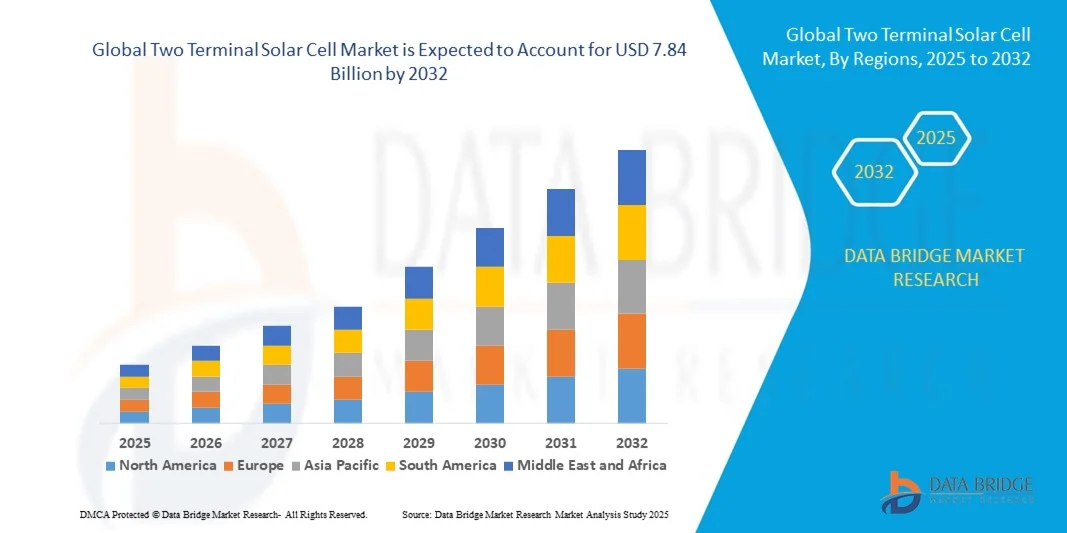
What is the Global Two Terminal Solar Cell Market Size and Growth Rate?
- The global two terminal solar cell market size was valued at USD 3.55 billion in 2024 and is expected to reach USD 7.84 billion by 2032, at a CAGR of 10.40% during the forecast period
- The growing demand of the clean fuel electricity, prevalence of favourable government initiatives, adoption of strict government norms towards emission, rising number of solar PV installations, growing number of technological innovations are some of the major as well as important factors which will likely to accelerate the growth of the two terminal solar cell market
What are the Major Takeaways of Two Terminal Solar Cell Market?
- Rising demand of environment friendly energy source along with growing number of research and development activities which will further contribute by generating immense opportunities that will led to the growth of the two terminal solar cell market
- Lack of awareness among the people regarding the benefits of the product in developing economies along with low performance efficiency which will likely to act as market restraints factor for the growth of the two terminal solar cell in the above mentioned forecasted period
- Europe dominated the two terminal solar cell market with the largest revenue share of 43.32% in 2024, driven by stringent energy regulations, rapid adoption of renewable energy technologies, and widespread deployment of residential and commercial solar systems
- The Asia-Pacific market is poised to grow at the fastest CAGR of 10.69% during 2025–2032, driven by rapid urbanization, rising disposable incomes, and increased awareness of renewable energy adoption in countries such as China, Japan, and India
- The Crystalline Silicon Cells segment dominated the market with a revenue share of 52.3% in 2024, owing to its high efficiency, durability, and proven performance in residential, commercial, and utility-scale installations
Report Scope and Two Terminal Solar Cell Market Segmentation
|
Attributes |
Two Terminal Solar Cell Key Market Insights |
|
Segments Covered |
|
|
Countries Covered |
North America
Europe
Asia-Pacific
Middle East and Africa
South America
|
|
Key Market Players |
|
|
Market Opportunities |
|
|
Value Added Data Infosets |
In addition to the insights on market scenarios such as market value, growth rate, segmentation, geographical coverage, and major players, the market reports curated by the Data Bridge Market Research also include in-depth expert analysis, pricing analysis, brand share analysis, consumer survey, demography analysis, supply chain analysis, value chain analysis, raw material/consumables overview, vendor selection criteria, PESTLE Analysis, Porter Analysis, and regulatory framework. |
What is the Key Trend in the Two Terminal Solar Cell Market?
Integration of Advanced Technologies for Efficiency and Performance
- A major trend shaping the global two terminal solar cell market is the growing integration of advanced technologies such as bifacial modules, AI-powered energy management, and smart inverters. These innovations are enhancing overall energy conversion efficiency, monitoring capabilities, and operational performance
- For instance, manufacturers are increasingly incorporating bifacial technology, allowing solar cells to capture sunlight from both front and back surfaces, significantly boosting energy yield. Similarly, AI-based predictive maintenance tools optimize performance and reduce downtime
- Integration with IoT-enabled systems enables real-time performance tracking, fault detection, and predictive energy output, providing end-users with data-driven insights to maximize efficiency and reduce operational costs
- This trend is further supported by the adoption of advanced materials such as PERC (Passivated Emitter Rear Contact) and heterojunction cells, improving module efficiency and lifespan
- Companies such as Jinko Solar and Trina Solar are actively developing next-generation Two Terminal Solar Cells with smart monitoring and enhanced energy output features to meet growing energy demands
- The market is witnessing increasing demand for technologically advanced, high-efficiency solar cells across residential, commercial, and utility-scale applications due to their performance, reliability, and sustainability benefits
What are the Key Drivers of Two Terminal Solar Cell Market?
- The rising global focus on renewable energy adoption and government incentives for solar energy deployment is a primary driver of the two terminal solar cell market
- For instance, in 2024, Jinko Solar (China) expanded its high-efficiency PERC module production to meet growing residential and commercial solar demand, driving market growth
- Increasing energy costs and environmental concerns are prompting businesses and homeowners to invest in solar systems, creating steady demand for two terminal solar cells
- Technological advancements in module efficiency, durability, and ease of installation are enhancing the appeal of two terminal solar cells, supporting adoption in new regions and sectors
- The global push toward carbon neutrality, coupled with initiatives for large-scale solar farms and distributed energy systems, is significantly fueling market expansion
- In addition, the decreasing cost of solar modules and improved financing options for solar projects are making two terminal solar cells more accessible, accelerating adoption across residential, commercial, and utility-scale sectors
Which Factor is Challenging the Growth of the Two Terminal Solar Cell Market?
- High initial capital investment and manufacturing complexity remain major challenges affecting market expansion. Producing high-efficiency Two Terminal Solar Cells requires advanced equipment and quality control, contributing to higher upfront costs
- For instance, fluctuations in polysilicon prices and global supply chain disruptions in 2024 impacted production costs for major players such as First Solar (U.S.) and Canadian Solar (Canada)
- Technical challenges related to cell efficiency, degradation, and long-term reliability can affect project feasibility and investor confidence
- In addition, limited awareness of high-performance modules in developing regions and the availability of lower-cost conventional solar panels can slow adoption
- Overcoming these challenges through government subsidies, innovative financing models, technological advancements, and local manufacturing expansion will be critical to sustaining long-term market growth
How is the Two Terminal Solar Cell Market Segmented?
The market is segmented on the basis of technology, product, grid, and application.
- By Technology
On the basis of technology, the two terminal solar cell market is segmented into Crystalline Silicon Cells, Thin Film Cells, and Ultra-Thin Film Cells. The Crystalline Silicon Cells segment dominated the market with a revenue share of 52.3% in 2024, owing to its high efficiency, durability, and proven performance in residential, commercial, and utility-scale installations. Crystalline silicon modules, including monocrystalline and polycrystalline variants, offer superior power output and long operational life, making them the preferred choice for large-scale adoption globally.
The Ultra-Thin Film Cells segment is expected to witness the fastest CAGR from 2025 to 2032, driven by growing demand for lightweight, flexible, and aesthetically adaptable solar panels suitable for rooftops, portable devices, and unconventional surfaces. Technological advancements in material efficiency, energy yield, and integration into smart systems are fueling the adoption of thin and ultra-thin cells. Overall, innovation in high-efficiency and lightweight solar technologies is shaping the market trajectory.
- By Product
On the basis of product, the two terminal solar cell market is segmented into Polycrystalline, Monocrystalline, Cadmium Telluride (CDTE), Amorphous Silicon (A-Si), and Copper Indium Gallium Diselenide (CIGS). The Monocrystalline segment dominated the market in 2024, capturing a revenue share of 48.7%, due to its superior efficiency, long-term reliability, and suitability for space-constrained installations such as rooftops and residential solar systems. Monocrystalline modules are widely preferred for high-performance solar applications where maximum power output is critical.
The CIGS segment is projected to witness the fastest CAGR from 2025 to 2032, propelled by the growing adoption of flexible, lightweight solar panels in innovative applications such as building-integrated photovoltaics and portable solar solutions. Continuous research on efficiency improvement, cost reduction, and durability is enabling the expansion of CIGS and other thin-film technologies. These product innovations are facilitating market growth across residential, commercial, and utility-scale installations.
- By Grid
On the basis of grid type, the two terminal solar cell market is segmented into On-Grid and Off-Grid. The On-Grid segment dominated the market in 2024 with a revenue share of 57.4%, driven by widespread adoption in urban residential and commercial projects where grid connectivity ensures consistent energy supply and net metering benefits. On-grid systems integrate seamlessly with local utilities, enabling energy export and cost savings.
The Off-Grid segment is expected to witness the fastest CAGR from 2025 to 2032, fueled by rising electrification in remote and rural areas, coupled with government initiatives promoting decentralized renewable energy solutions. Off-grid solar cells are increasingly used in standalone applications such as telecom towers, rural households, and small-scale commercial units. Growing demand for energy independence, renewable energy access, and mini-grid solutions is boosting the adoption of off-grid solar systems globally.
- By Application
On the basis of application, the two terminal solar cell market is segmented into Residential, Commercial, and Utility. The Residential segment dominated the market in 2024 with a revenue share of 46.1%, due to increasing rooftop solar installations, rising energy costs, and government incentives for residential solar adoption. Homeowners are attracted to Two Terminal Solar Cells for energy savings, sustainability, and integration with smart home systems.
The Utility segment is projected to witness the fastest CAGR from 2025 to 2032, driven by large-scale solar farm projects, increasing demand for renewable electricity, and global decarbonization goals. Investment in utility-scale solar projects by governments and private developers is accelerating adoption. Overall, growth across residential, commercial, and utility sectors is shaping a diverse and rapidly expanding Two Terminal Solar Cell market.
Which Region Holds the Largest Share of the Two Terminal Solar Cell Market?
- Europe dominated the two terminal solar cell market with the largest revenue share of 43.32% in 2024, driven by stringent energy regulations, rapid adoption of renewable energy technologies, and widespread deployment of residential and commercial solar systems
- Consumers and businesses in the region highly value high-efficiency panels, grid stability, and integration with energy management systems
- This strong adoption is further supported by government incentives, subsidies for solar installations, and ambitious carbon reduction targets, establishing Two Terminal Solar Cells as a preferred solution across residential, commercial, and utility applications
Germany Two Terminal Solar Cell Market Insight
The Germany market captured the largest revenue share of 35% within Europe in 2024, fueled by the country’s leadership in renewable energy adoption, advanced grid infrastructure, and technological innovation. The increasing demand for sustainable energy solutions, coupled with government incentives for rooftop and utility-scale solar, is driving market expansion. Germany’s emphasis on energy efficiency and smart energy management further reinforces adoption in both residential and commercial sectors.
U.K. Two Terminal Solar Cell Market Insight
The U.K. market is anticipated to grow at a notable CAGR, supported by policies encouraging solar deployment, integration with smart grids, and growing consumer preference for clean energy. Residential solar systems and commercial projects are driving adoption, alongside investments in research and manufacturing of advanced solar panels.
France Two Terminal Solar Cell Market Insight
France is witnessing steady growth due to increasing installation of rooftop solar systems, favorable regulatory frameworks, and incentives for renewable energy integration in urban and suburban areas. Both commercial and residential sectors are contributing to expansion, with companies focusing on high-efficiency panels to maximize energy yield.
Which Region is the Fastest Growing Region in the Two Terminal Solar Cell Market?
The Asia-Pacific market is poised to grow at the fastest CAGR of 10.69% during 2025–2032, driven by rapid urbanization, rising disposable incomes, and increased awareness of renewable energy adoption in countries such as China, Japan, and India. Growing government support for solar initiatives, along with the region’s emergence as a manufacturing hub for solar components, is making Two Terminal Solar Cells more affordable and accessible to a wider population.
China Two Terminal Solar Cell Market Insight
China accounted for the largest revenue share in APAC in 2024, due to massive investment in renewable energy, expansion of solar infrastructure, and strong domestic manufacturing capabilities. Both residential and commercial sectors are witnessing robust adoption, fueled by smart city initiatives and renewable energy targets.
Japan Two Terminal Solar Cell Market Insight
Japan is gaining momentum due to its advanced technology adoption, high energy efficiency standards, and demand for residential solar solutions. The growing trend of smart energy management in urban areas is further boosting market penetration.
India Two Terminal Solar Cell Market Insight
India’s market is expanding rapidly with government policies promoting off-grid and on-grid solar solutions, coupled with declining solar panel costs. Residential, commercial, and industrial solar installations are rising, driven by the need for energy security and sustainable power solutions.
Which are the Top Companies in Two Terminal Solar Cell Market?
The two terminal solar cell industry is primarily led by well-established companies, including:
- Mitsubishi Electric Corporation (Japan)
- Jinko Solar (China)
- Trina Solar (China)
- Canadian Solar (Canada)
- First Solar (U.S.)
- Moser Baer Solar Limited (India)
- Yingli (China)
- SunPower Corporation (U.S.)
- SunEdison Inc (U.S.)
- Tata Power Solar Systems Ltd. (India)
- GreenBrilliance (U.S.)
- SHARP CORPORATION (Japan)
- ALPS (Japan)
- Solaris Technology Industry, Inc. (U.S.)
- Itek Energy (U.S.)

- Interactive Data Analysis Dashboard
- Company Analysis Dashboard for high growth potential opportunities
- Research Analyst Access for customization & queries
- Competitor Analysis with Interactive dashboard
- Latest News, Updates & Trend analysis
- Harness the Power of Benchmark Analysis for Comprehensive Competitor Tracking
Global Two Terminal Solar Cell Market, Supply Chain Analysis and Ecosystem Framework
To support market growth and help clients navigate the impact of geopolitical shifts, DBMR has integrated in-depth supply chain analysis into its Global Two Terminal Solar Cell Market research reports. This addition empowers clients to respond effectively to global changes affecting their industries. The supply chain analysis section includes detailed insights such as Global Two Terminal Solar Cell Market consumption and production by country, price trend analysis, the impact of tariffs and geopolitical developments, and import and export trends by country and HSN code. It also highlights major suppliers with data on production capacity and company profiles, as well as key importers and exporters. In addition to research, DBMR offers specialized supply chain consulting services backed by over a decade of experience, providing solutions like supplier discovery, supplier risk assessment, price trend analysis, impact evaluation of inflation and trade route changes, and comprehensive market trend analysis.
Data collection and base year analysis are done using data collection modules with large sample sizes. The stage includes obtaining market information or related data through various sources and strategies. It includes examining and planning all the data acquired from the past in advance. It likewise envelops the examination of information inconsistencies seen across different information sources. The market data is analysed and estimated using market statistical and coherent models. Also, market share analysis and key trend analysis are the major success factors in the market report. To know more, please request an analyst call or drop down your inquiry.
The key research methodology used by DBMR research team is data triangulation which involves data mining, analysis of the impact of data variables on the market and primary (industry expert) validation. Data models include Vendor Positioning Grid, Market Time Line Analysis, Market Overview and Guide, Company Positioning Grid, Patent Analysis, Pricing Analysis, Company Market Share Analysis, Standards of Measurement, Global versus Regional and Vendor Share Analysis. To know more about the research methodology, drop in an inquiry to speak to our industry experts.
Data Bridge Market Research is a leader in advanced formative research. We take pride in servicing our existing and new customers with data and analysis that match and suits their goal. The report can be customized to include price trend analysis of target brands understanding the market for additional countries (ask for the list of countries), clinical trial results data, literature review, refurbished market and product base analysis. Market analysis of target competitors can be analyzed from technology-based analysis to market portfolio strategies. We can add as many competitors that you require data about in the format and data style you are looking for. Our team of analysts can also provide you data in crude raw excel files pivot tables (Fact book) or can assist you in creating presentations from the data sets available in the report.













