


Two Terminal Tunnel Diode Market Size
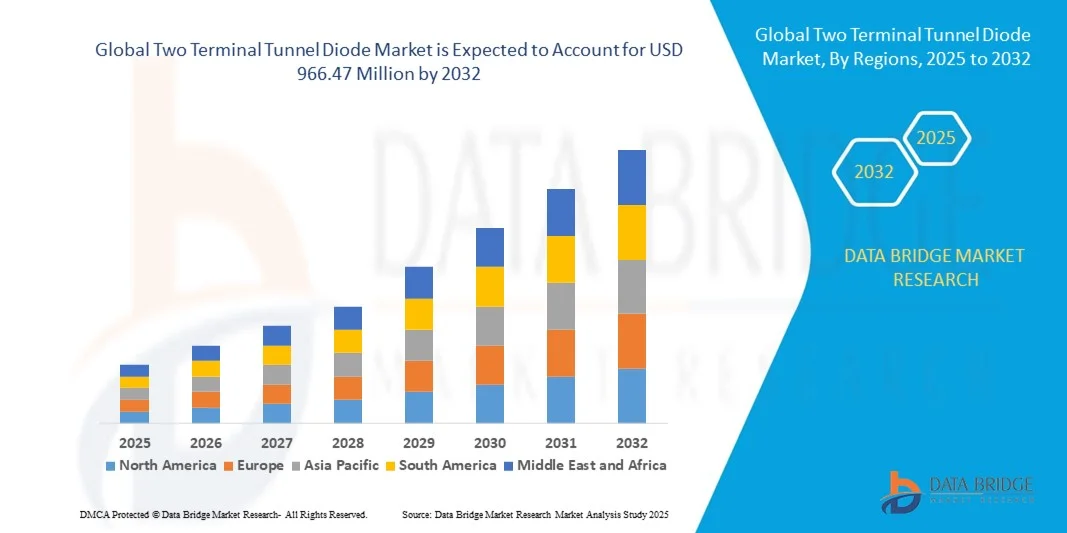
- The global two terminal tunnel diode market size was valued at USD 625 million in 2024 and is expected to reach USD 966.47 million by 2032, at a CAGR of 5.60% during the forecast period
- The market growth is largely fueled by the increasing adoption of high-frequency and low-noise electronic components across telecommunications, aerospace, defense, and industrial applications, driving demand for reliable tunnel diode solutions
- Furthermore, rising investments in advanced semiconductor technologies, coupled with the need for compact, energy-efficient, and high-performance components in next-generation electronic systems, are accelerating the uptake of tunnel diodes, thereby significantly boosting the market’s growth
Two Terminal Tunnel Diode Market Analysis
- Two terminal tunnel diodes are semiconductor devices characterized by their ability to operate at extremely high speeds with low noise, making them ideal for applications in microwave, RF, and high-frequency circuits. These devices are widely used in oscillators, amplifiers, detectors, and switching applications across commercial, defense, and industrial sectors
- The escalating demand for tunnel diodes is primarily driven by advancements in communication networks, increasing deployment in defense and aerospace electronics, and the growing requirement for miniaturized and energy-efficient components in modern electronic systems
- North America dominated the two terminal tunnel diode market in 2024, due to strong adoption of high-frequency electronic components and advanced communication systems
- Asia-Pacific is expected to be the fastest growing region in the two terminal tunnel diode market during the forecast period due to rapid industrialization, urbanization, and technological advancements in countries such as China, Japan, and India
- Surface mount segment dominated the market with a market share of 48.3% in 2024, due to its compact design, ease of integration into modern electronic circuits, and suitability for high-density PCBs. Manufacturers and designers prefer surface mount tunnel diodes for their ability to reduce assembly time and overall device footprint while maintaining reliable performance. The segment also benefits from growing adoption in miniaturized electronics, consumer devices, and high-frequency applications due to its proven thermal stability and compatibility with automated assembly processes
Report Scope and Two Terminal Tunnel Diode Market Segmentation
|
Attributes |
Two Terminal Tunnel Diode Key Market Insights |
|
Segments Covered |
|
|
Countries Covered |
North America
Europe
Asia-Pacific
Middle East and Africa
South America
|
|
Key Market Players |
|
|
Market Opportunities |
|
|
Value Added Data Infosets |
In addition to the insights on market scenarios such as market value, growth rate, segmentation, geographical coverage, and major players, the market reports curated by the Data Bridge Market Research also include in-depth expert analysis, geographically represented company-wise production and capacity, network layouts of distributors and partners, detailed and updated price trend analysis and deficit analysis of supply chain and demand. |
Two Terminal Tunnel Diode Market Trends
Adoption of Tunnel Diodes in 5G and High-Frequency Systems
- The two terminal tunnel diode market is witnessing notable growth due to increasing adoption in 5G networks and high-frequency electronic systems requiring fast switching and ultra-low voltage operation. Tunnel diodes’ unique quantum tunneling characteristics enable exceptional speed, making them suitable for modern communication, radar, and satellite systems as industries push the boundaries of data transmission and frequency utilization
- For instance, companies such as Micron Technologies and Semiconwell have developed tunnel diode solutions optimized for high-frequency oscillators and ultra-fast switching circuits used in aerospace communication and 5G base stations. Similarly, Hitachi and Kyocera are leveraging tunnel diode technology for advanced RF amplification and low-noise microwave applications in defense and space electronics
- The critical role of tunnel diodes in millimeter-wave and sub-terahertz systems is increasing as telecom operators roll out 5G infrastructure that demands components capable of maintaining high stability and performance under extreme signal loads. Their ability to operate effectively at very high frequencies makes them essential for next-generation bandwidth-intensive systems
- In addition, tunnel diodes are being integrated into cutting-edge instrumentation, high-speed logic circuits, and pulse generation systems, supporting advancements in scientific research and industrial automation. The technology’s unique negative resistance property provides design flexibility for engineers building compact circuits with reduced power requirements
- Growing interest in space-based internet services and defense radar modernization is further driving tunnel diode adoption, as these applications require components with consistent performance in harsh environments. Miniaturization combined with ultra-high frequency capabilities is reinforcing their position in the global semiconductor landscape
- As communication networks, radar systems, and advanced scientific devices continue to evolve, tunnel diodes’ high-frequency performance advantages will secure their importance in next-generation electronic architectures. The trend reflects ongoing demand for semiconductor components capable of pushing speed and stability limits in cutting-edge electronics
Two Terminal Tunnel Diode Market Dynamics
Driver
Demand for Compact, Low-Noise, High-Speed Components
- The rising need for miniature, low-noise, and high-speed semiconductor components is a primary driver of the tunnel diode market. These devices are highly valued in applications where small form factor, fast signal response, and minimal interference are essential for achieving operational efficiency and precision
- For instance, Semiconwell and Micron Technologies produce ultra-low capacitance tunnel diodes for integration into microwave and millimeter-wave circuits used in mobile communication systems, aerospace electronics, and high-speed data transfer modules. Their ability to deliver rapid switching with minimal signal distortion makes them ideal for specialized communications and instrumentation applications
- Tunnel diodes provide reliable high-speed functionality while maintaining a compact structure, which is critical for portable electronics, wearable devices, and miniaturized communication equipment. This physical efficiency supports greater integration flexibility in modern circuit designs
- In addition, their low noise performance at high frequencies improves signal clarity in sensitive environments such as radar detection, satellite navigation, and medical imaging. Reduced signal distortion enhances overall data accuracy and equipment responsiveness
- With the advance of miniaturized and energy-efficient systems across telecommunication, aerospace, and scientific industries, tunnel diodes meet diverse design needs by combining speed, stability, and noise minimization in small-scale packages. This capability ensures their continued relevance in evolving high-precision electronics markets
Restraint/Challenge
High Manufacturing Costs and Complexity
- The production of tunnel diodes involves intricate fabrication processes and high precision manufacturing, leading to elevated costs and posing a challenge for broader market adoption. Maintaining the thin junction layers and precise doping levels essential for quantum tunneling operation requires advanced semiconductor manufacturing infrastructure and expertise
- For instance, producers such as Kyocera and Hitachi face cost pressures when fabricating tunnel diodes for specialized high-frequency applications due to the need for ultra-clean environments, controlled deposition methods, and rigorous testing protocols ensuring consistent performance. These requirements significantly increase production expenses compared to conventional diodes
- Material quality, precision alignment, and advanced lithographic techniques all contribute to complex manufacturing steps that raise barriers to entry for smaller semiconductor companies. The need for highly skilled labor and specialized equipment adds further capital investment challenges
- In addition, limited economies of scale hinder cost reduction as tunnel diodes are primarily used in niche high-frequency applications rather than mass consumer electronics. This restricts price competitiveness against alternative semiconductor solutions in mainstream markets
- While process innovation, automation, and expanding application scope may gradually lower production costs, the manufacturing complexity and high capital investment requirements remain persistent obstacles. Achieving broader market penetration will depend on cost-efficient fabrication strategies and increased demand across diverse industries to justify large-scale production
Two Terminal Tunnel Diode Market Scope
The market is segmented on the basis of packaging type and end-use industry.
- By Packaging Type
On the basis of packaging type, the Two Terminal Tunnel Diode market is segmented into surface mount, module with connectors, and others. The surface mount segment dominated the market with the largest revenue share of 48.3% in 2024, driven by its compact design, ease of integration into modern electronic circuits, and suitability for high-density PCBs. Manufacturers and designers prefer surface mount tunnel diodes for their ability to reduce assembly time and overall device footprint while maintaining reliable performance. The segment also benefits from growing adoption in miniaturized electronics, consumer devices, and high-frequency applications due to its proven thermal stability and compatibility with automated assembly processes.
The module with connectors segment is expected to witness the fastest growth rate from 2025 to 2032, fueled by rising demand in specialized industrial and defense applications where robust connectivity and ease of replacement are critical. These modules provide enhanced protection against environmental factors, support high-power handling, and allow for flexible integration into complex systems. Their modular nature enables rapid deployment in telecommunications infrastructure, aerospace systems, and advanced electronic equipment, making them increasingly attractive for industries prioritizing reliability and maintainability.
- By End-Use Industry
On the basis of end-use industry, the Two Terminal Tunnel Diode market is segmented into aerospace & defense, telecommunication, oil & gas, and others. The telecommunication segment dominated the market in 2024, driven by the growing demand for high-speed communication networks and the critical role of tunnel diodes in high-frequency, low-noise, and microwave applications. Telecom companies rely on tunnel diodes for signal amplification, switching, and oscillation in modern communication systems, boosting the adoption of these devices in both wired and wireless infrastructures. The increasing rollout of 5G and upcoming 6G networks, along with expanding broadband connectivity, further contributes to the segment’s leading market share.
The aerospace & defense segment is expected to register the fastest growth rate from 2025 to 2032, supported by the rising need for high-performance, radiation-resistant, and reliable components in defense electronics, satellites, radar systems, and avionics. Tunnel diodes in aerospace applications provide low-noise amplification and high-frequency stability under extreme conditions, meeting stringent performance requirements. Continuous investment in defense modernization programs and the expansion of space exploration initiatives globally are anticipated to drive accelerated adoption of tunnel diodes in this sector.
Two Terminal Tunnel Diode Market Regional Analysis
- North America dominated the two terminal tunnel diode market with the largest revenue share in 2024, driven by strong adoption of high-frequency electronic components and advanced communication systems
- Companies in the region are increasingly integrating tunnel diodes into telecommunication, defense, and aerospace equipment due to their reliability in high-speed and low-noise applications
- This adoption is further supported by a technologically advanced ecosystem, high R&D investment, and demand for compact, high-performance components, establishing the region as a key market for tunnel diode manufacturers
U.S. Two Terminal Tunnel Diode Market Insight
The U.S. market captured the largest revenue share within North America in 2024, fueled by rapid technological advancements in telecommunications and defense sectors. The growing focus on high-frequency, low-noise, and microwave applications has accelerated the integration of tunnel diodes in both commercial and military systems. Moreover, increasing investments in 5G infrastructure, satellite communication, and avionics are driving demand, with manufacturers emphasizing miniaturization, energy efficiency, and high reliability to meet domestic market requirements.
Europe Two Terminal Tunnel Diode Market Insight
The Europe Two Terminal Tunnel Diode market is projected to expand at a substantial CAGR throughout the forecast period, primarily driven by increasing demand in telecommunications, defense, and industrial automation applications. European countries are focusing on high-performance, low-noise components to support advanced electronic systems. Rising investments in smart manufacturing, research initiatives, and the push for energy-efficient solutions are further encouraging adoption. The region is witnessing growth in both new installations and system upgrades, with Germany and the U.K. being key contributors.
U.K. Two Terminal Tunnel Diode Market Insight
The U.K. market is anticipated to grow at a noteworthy CAGR during the forecast period, driven by the growing deployment of advanced communication networks and defense electronics. Increasing adoption of tunnel diodes in industrial automation and high-frequency applications, along with government support for R&D in electronics, is fueling market expansion. The country’s robust infrastructure, combined with strong defense and telecom sectors, is expected to continue supporting demand.
Germany Two Terminal Tunnel Diode Market Insight
The Germany market is expected to expand at a considerable CAGR during the forecast period, fueled by increasing awareness of advanced semiconductor components and the need for high-frequency, low-noise devices in aerospace, defense, and industrial applications. Germany’s emphasis on innovation, technological advancement, and sustainable manufacturing practices promotes the adoption of tunnel diodes, especially in critical systems requiring high reliability and precision.
Asia-Pacific Two Terminal Tunnel Diode Market Insight
The Asia-Pacific market is poised to grow at the fastest CAGR during the forecast period of 2025 to 2032, driven by rapid industrialization, urbanization, and technological advancements in countries such as China, Japan, and India. The region’s growing electronics manufacturing base, coupled with increasing demand for high-speed communication and defense applications, is propelling adoption. In addition, government initiatives supporting digitalization and high-tech infrastructure projects are expanding the market across telecommunication, aerospace, and industrial sectors.
Japan Two Terminal Tunnel Diode Market Insight
The Japan market is gaining momentum due to the country’s high-tech electronics ecosystem and demand for precision components in defense, telecommunications, and industrial automation. Tunnel diodes are increasingly used in high-frequency, low-noise, and microwave circuits. The integration of these diodes into smart, connected systems is further supporting growth, with manufacturers focusing on reliability, compactness, and efficiency.
China Two Terminal Tunnel Diode Market Insight
The China market accounted for the largest market revenue share in Asia-Pacific in 2024, driven by rapid industrial growth, expansion of telecommunication networks, and rising demand for advanced electronic components. Tunnel diodes are widely adopted in telecom, defense, and industrial applications. The country’s growing semiconductor manufacturing capabilities, availability of affordable components, and strong domestic electronics ecosystem are key factors accelerating market growth.
Two Terminal Tunnel Diode Market Share
The two terminal tunnel diode industry is primarily led by well-established companies, including:
- Advanced Microwave, Inc. (U.S.)
- Planar Monolithics Industries, Inc. (U.S.)
- Eclipse MDI (U.S.)
- Atlantic Microwave Ltd (U.K.)
- Krytar, Inc. (U.S.)
- M Pulse Microwave Inc (U.S.)
- Deskew Technologies, LLC (U.S.)
- Tony Chapman Electronics Ltd. (U.K.)
- Cobham Limited (U.K.)
- S. R. Scientific Works (India)
- OMMIC (France)

- Interactive Data Analysis Dashboard
- Company Analysis Dashboard for high growth potential opportunities
- Research Analyst Access for customization & queries
- Competitor Analysis with Interactive dashboard
- Latest News, Updates & Trend analysis
- Harness the Power of Benchmark Analysis for Comprehensive Competitor Tracking
Global Two Terminal Tunnel Diode Market, Supply Chain Analysis and Ecosystem Framework
To support market growth and help clients navigate the impact of geopolitical shifts, DBMR has integrated in-depth supply chain analysis into its Global Two Terminal Tunnel Diode Market research reports. This addition empowers clients to respond effectively to global changes affecting their industries. The supply chain analysis section includes detailed insights such as Global Two Terminal Tunnel Diode Market consumption and production by country, price trend analysis, the impact of tariffs and geopolitical developments, and import and export trends by country and HSN code. It also highlights major suppliers with data on production capacity and company profiles, as well as key importers and exporters. In addition to research, DBMR offers specialized supply chain consulting services backed by over a decade of experience, providing solutions like supplier discovery, supplier risk assessment, price trend analysis, impact evaluation of inflation and trade route changes, and comprehensive market trend analysis.
Data collection and base year analysis are done using data collection modules with large sample sizes. The stage includes obtaining market information or related data through various sources and strategies. It includes examining and planning all the data acquired from the past in advance. It likewise envelops the examination of information inconsistencies seen across different information sources. The market data is analysed and estimated using market statistical and coherent models. Also, market share analysis and key trend analysis are the major success factors in the market report. To know more, please request an analyst call or drop down your inquiry.
The key research methodology used by DBMR research team is data triangulation which involves data mining, analysis of the impact of data variables on the market and primary (industry expert) validation. Data models include Vendor Positioning Grid, Market Time Line Analysis, Market Overview and Guide, Company Positioning Grid, Patent Analysis, Pricing Analysis, Company Market Share Analysis, Standards of Measurement, Global versus Regional and Vendor Share Analysis. To know more about the research methodology, drop in an inquiry to speak to our industry experts.
Data Bridge Market Research is a leader in advanced formative research. We take pride in servicing our existing and new customers with data and analysis that match and suits their goal. The report can be customized to include price trend analysis of target brands understanding the market for additional countries (ask for the list of countries), clinical trial results data, literature review, refurbished market and product base analysis. Market analysis of target competitors can be analyzed from technology-based analysis to market portfolio strategies. We can add as many competitors that you require data about in the format and data style you are looking for. Our team of analysts can also provide you data in crude raw excel files pivot tables (Fact book) or can assist you in creating presentations from the data sets available in the report.













