


Udder Health Market Analysis
The global udder health market is experiencing steady growth, driven by increasing awareness of milk quality, animal health, and the economic impact of udder-related diseases like mastitis. Mastitis remains the most prevalent and economically detrimental disease affecting dairy cattle. This has led to higher adoption of diagnostic tools and preventive measures, such as teat disinfectants and antibiotics. Growing global demand for milk and other dairy products has driven investments in udder health management to ensure quality and productivity.
Udder Health Market Size
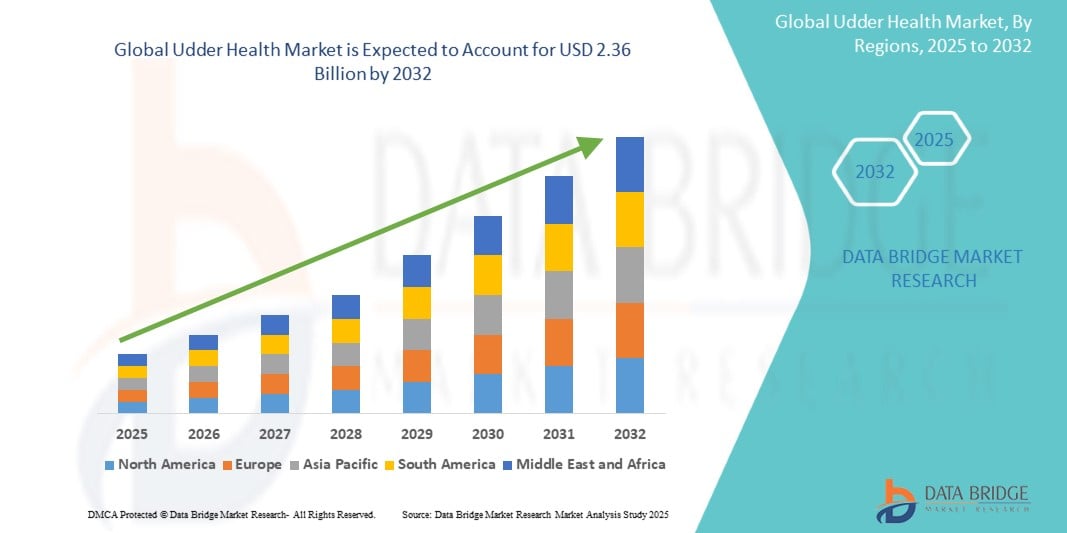
Global udder health market size was valued at USD 1.63 billion in 2024 and is projected to reach USD 2.36 billion by 2032, with a CAGR of 4.9% during the forecast period of 2025 to 2032. In addition to the insights on market scenarios such as market value, growth rate, segmentation, geographical coverage, and major players, the market reports curated by the Data Bridge Market Research also include depth expert analysis, patient epidemiology, pipeline analysis, pricing analysis, and regulatory framework.
Udder Health Market Trends
“Adoption Of Precision Dairy Farming Technologies”
The adoption of precision dairy farming technologies is transforming the udder health market by enabling more effective and proactive management of cow health. Advanced tools such as automated milking systems, sensor-based monitoring devices, and predictive analytics provide farmers with real-time insights into individual cow health. Automated milking systems, for instance, measure milk yield and somatic cell counts, which can indicate mastitis or other udder health issues. Similarly, sensors and wearable devices monitor parameters like milk conductivity, temperature, and cow activity, allowing early detection of potential health problems. Predictive analytics, powered by machine learning, further enhances this process by forecasting health risks based on environmental and physiological data, enabling timely and targeted interventions.
These technologies help reduce the incidence and severity of udder diseases like mastitis, minimize the reliance on broad-spectrum antibiotics, and improve overall herd productivity. This has increased the demand for advanced udder health solutions such as vaccines, diagnostic tools, and targeted treatments. While the high initial investment poses challenges, the long-term benefits of improved milk quality, cost efficiency, and enhanced animal welfare are driving widespread adoption, particularly in developed markets. Emerging economies are also beginning to embrace these innovations, positioning precision technologies as a cornerstone of sustainable dairy farming practices globally.
Report Scope and Udder Health Market Segmentation
|
Attributes |
Udder Health Key Market Insights |
|
Segments Covered |
|
|
Countries Covered |
U.S., Canada, Mexico, Germany, France, U.K., Netherlands, Switzerland, Belgium, Russia, Italy, Spain, Turkey, Rest of Europe, China, Japan, India, South Korea, Singapore, Malaysia, Australia, Thailand, Indonesia, Philippines, Rest of Asia-Pacific, Saudi Arabia, U.A.E., South Africa, Egypt, Israel, Rest of Middle East and Africa, Brazil, Argentina, Rest of South America |
|
Key Market Players |
Merck & Co., Inc. (US), Zoetis Inc. (US), Boehringer Ingelheim GmbH (Germany), Elanco Animal Health Incorporated (US), Ceva Santé Animale (France), Vetoquinol S.A. (France), Virbac S.A. (France), Ecolab Inc. (US), GEA Group Aktiengesellschaft (Germany), DeLaval International AB (Sweden), BouMatic LLC (US), Orffa International Holding B.V. (Netherlands), Lely International N.V. (Netherlands), AHV International B.V. (Netherlands), Albert Kerbl GmbH (Germany), G. Shepherd Animal Health Limited (UK), Ambig Equipment Limited (England), Draminski S.A. (Poland), Zenex Animal Health India Private Limited (India), Blackmango Herb (India), Nicosia Biolabs International Private Limited (India), Ring Biotechnology Co., Ltd. (China), Koru Diagnostics Ltd. (New Zealand), Mastaplex Limited (New Zealand), AR Brown Co., Ltd. (Japan) |
|
Market Opportunities |
|
|
Value Added Data Infosets |
In addition to the insights on market scenarios such as market value, growth rate, segmentation, geographical coverage, and major players, the market reports curated by the Data Bridge Market Research also include depth expert analysis, patient epidemiology, pipeline analysis, pricing analysis, and regulatory framework. |
Udder Health Market Definition
Udder health refers to the overall well-being of a cow's mammary gland, which is critical for dairy production. It encompasses the detection, prevention, and treatment of udder diseases such as mastitis, which is an inflammation of the udder tissue caused by bacterial infection. Good udder health ensures optimal milk quality and yield, as well as the welfare of the cow. Advanced management practices like regular monitoring, proper milking techniques, and the use of udder health monitoring technologies help in early detection of problems, timely treatment, and prevention strategies to minimize the incidence of diseases. These practices are crucial for maintaining herd health and maximizing dairy farm productivity.
Udder Health Market Dynamics
Drivers
- Increasing Prevalence of Mastitis
Mastitis is a major health issue in dairy animals, leading to reduced milk yield, lower quality, and economic losses. This has driven the demand for effective udder health solutions, including advanced diagnostic kits (somatic cell counters, PCR testing) and preventive measures like teat disinfectants and vaccines. For instance, products that detect and manage mastitis are being widely adopted in both developed and developing dairy industries. For instance, according to the American Pet Products Association (APPA), the overall prevalence of mastitis at the cow level was 39.67% (210/532) of which clinical (CM) and subclinical (SCM) were 16.70% and, 22.70%, respectively. The prevalence of CM and SCM were increasing as the age of cows increased. The prevalence of CM and SCM was higher in parity of 1–3 calving than in others. Hence, the rise in prevalence of mastitis drives the demand of pharmaceuticals and devices for effective udder health.
- Growing Global Demand for Dairy Products
The global demand for dairy products, such as milk, cheese, yogurt, and butter, is increasing due to population growth, urbanization, and evolving dietary preferences, particularly in emerging markets where dairy consumption is rising as incomes grow. This heightened demand has placed significant pressure on dairy farmers to boost production while maintaining high-quality standards. To achieve this, there is a growing emphasis on improving animal health and productivity, with a particular focus on udder health, as it directly impacts milk yield and quality. Farmers are investing in a range of udder health management tools, including hygiene products to prevent infections, nutritional supplements to boost immunity, and advanced disease monitoring systems for early detection and intervention. These innovations reduce the risk of diseases like mastitis, which can significantly impact productivity, and improve overall herd welfare.
Additionally, technologies like precision dairy farming systems are being adopted to monitor udder health parameters in real time, further enhancing efficiency and meeting the global surge in dairy demand. This trend reflects the interconnectedness of animal health, sustainable farming practices, and the evolving needs of the global dairy market.
Opportunities
- Integration of Digital Technologies in Udder Health Management
The adoption of digital tools such as IoT sensors, wearable devices, and automated monitoring systems presents a significant opportunity for the udder health market. These technologies enable real-time monitoring of udder conditions, early detection of mastitis, and precise administration of treatments. For example, smart dairy systems that track milk quality and animal health help farmers improve efficiency and reduce losses. For instance, IoT devices like HealthPatch MD and similar biosensors provide continuous monitoring, allowing farmers and veterinarians to detect early signs of mastitis or other udder-related issues, reducing disease prevalence and improving milk yield. The adoption of digital technologies in udder health management represents a paradigm shift towards data-driven, efficient, and sustainable dairy farming practices. By enabling early interventions and better disease management, these tools significantly enhance animal welfare and productivity. As the demand for high-quality dairy products grows globally, the integration of such advanced solutions will remain pivotal for the future of the udder health market.
- Development of Alternative Therapies
The development of alternative therapies for udder health is gaining traction as concerns over antibiotic resistance grow and consumer preferences shift toward organic and sustainable dairy products. Traditional antibiotics, while effective, contribute to the risk of antimicrobial resistance and often leave residues in milk, posing challenges for both public health and compliance with stricter regulatory standards. This has created a strong demand for natural, eco-friendly solutions that support udder health while meeting consumer expectations for clean-label dairy products. Herbal remedies, probiotics, and organic formulations are emerging as promising alternatives. Herbal therapies often leverage the antimicrobial and anti-inflammatory properties of natural compounds like neem, turmeric, and aloe vera to manage infections such as mastitis. Probiotic-based treatments, which use beneficial microorganisms to enhance the cow’s immune response and compete with pathogenic bacteria, offer a sustainable method to prevent and treat udder infections. Additionally, organic solutions, including essential oils and plant-based balms, provide gentle yet effective care, aligning with the principles of organic farming.
These therapies not only reduce dependency on antibiotics but also improve overall animal immunity and welfare, promoting better productivity and higher-quality milk. As the focus on sustainable farming intensifies, the adoption of alternative udder health solutions is expected to grow, further driving innovation in this market segment.
Restraints/Challenges
- High Cost of Advanced Udder Health Solutions
The high cost of advanced udder health solutions presents a significant barrier to their widespread adoption, especially among small-scale farmers who dominate the dairy sector globally. Advanced diagnostic tools, such as biosensors and IoT-enabled monitoring systems, as well as preventive solutions like vaccines and automated milking equipment, require substantial financial investment. These technologies, while effective in improving udder health and productivity, often involve high upfront costs and ongoing maintenance expenses. This makes them less accessible for small and medium-sized dairy farms, which typically operate on tight budgets and limited resources.
Moreover, in developing regions, inadequate infrastructure further compounds the issue. Challenges such as unreliable electricity, limited internet connectivity, and insufficient access to veterinary services reduce the feasibility of implementing digital monitoring systems or other high-tech solutions. These constraints hinder the adoption of advanced udder health measures, leaving many farmers reliant on traditional methods that may not be as effective or sustainable. While governments and organizations are working to address these challenges through subsidies and training programs, significant disparities in access to advanced udder health technologies persist. Bridging this gap requires collaborative efforts to reduce costs, improve infrastructure, and develop affordable, scalable solutions tailored to the needs of small-scale farmers, particularly in emerging markets.
- Antibiotic Resistance and Usage Concerns
The overuse of antibiotics in treating mastitis and other udder-related conditions has led to growing concerns over antibiotic resistance. This not only limits treatment options but also impacts consumer preferences, as there is increasing demand for antibiotic-free dairy products. Regulatory pressure to reduce antibiotic use further complicates the development of effective treatment protocols.
For instance, strict regulations in Nordic countries that limit antibiotic use in dairy farming. These regulations focus on reducing resistance by requiring bacteriological diagnostics before treatment decisions are made. Farmers and veterinarians are mandated to collect milk samples and conduct tests to identify pathogens, often delaying treatment and increasing costs. This structured approach highlights the complexities of balancing effective treatment and antibiotic stewardship.
Addressing the challenges of antibiotic resistance requires a multifaceted approach. Investments in alternative therapies, such as probiotics, vaccines, and natural remedies, combined with stricter antibiotic usage policies, can help achieve a balance between effective treatment and sustainable dairy farming. This shift will be crucial for maintaining consumer trust and meeting the rising demand for safe, high-quality dairy products.
Udder Health Market Scope
The market is segmented on the basis of product, veterinary care settings, and animal type. The growth amongst these segments will help you analyze meagre growth segments in the industries and provide the users with a valuable market overview and market insights to help them make strategic decisions for identifying core market Veterinary Care Settings.
Product
- Devices
- Pharmaceuticals
- Supplements
Veterinary Care Settings
- Dairy Farms
- Veterinary Hospitals & Clinics
Animal Type
- Dairy Cattle
- Sheep
- Others
Disease Type
- Clinical Mastitis
- Others
Udder Health Market Regional Analysis
The market is analysed and market size insights and trends are provided by country, product, veterinary care settings, and animal type as referenced above.
The countries covered in the market are U.S., Canada, Mexico, Germany, France, U.K., Netherlands, Switzerland, Belgium, Russia, Italy, Spain, Turkey, rest of Europe, China, Japan, India, South Korea, Singapore, Malaysia, Australia, Thailand, Indonesia, Philippines, rest of Asia-Pacific, Saudi Arabia, U.A.E., South Africa, Egypt, Israel, rest of Middle East and Africa, Brazil, Argentina, and rest of South America.
North America leads the global udder health market due to its advanced dairy farming practices, high awareness about animal health, and the presence of key players such as Zoetis Inc. and Merck Animal Health. The U.S. and Canada have large dairy industries where udder health is a priority to maintain milk quality and productivity. The established infrastructure, widespread veterinary services, and high adoption of advanced technologies such as diagnostic tools and automated systems contribute to the region's dominance.
Asia-Pacific is the fastest-growing region in the global udder health market. Countries like India and China are seeing significant growth in dairy consumption, driven by population growth and changing dietary preferences. Increased investments in dairy farming practices, alongside improving awareness of udder health and quality milk production, are fueling demand. Additionally, there is a rising adoption of technologies and veterinary services, especially in countries like India, where milk production is integral to the agricultural economy.
The country section of the report also provides individual market impacting factors and changes in regulation in the market domestically that impacts the current and future trends of the market. Data points like down-stream and upstream value chain analysis, technical trends and porter's five forces analysis, case studies are some of the pointers used to forecast the market scenario for individual countries. Also, the presence and availability of global brands and their challenges faced due to large or scarce competition from local and domestic brands, impact of domestic tariffs and trade routes are considered while providing forecast analysis of the country data.
Udder Health Market Share
The market competitive landscape provides details by competitor. Details included are company overview, company financials, revenue generated, market potential, investment in research and development, new market initiatives, global presence, production sites and facilities, production capacities, company strengths and weaknesses, product launch, product width and breadth, Veterinary Care Settings dominance. The above data points provided are only related to the companies' focus related to market.
Udder Health Market Leaders Operating in the Market Are:
- Merck & Co., Inc. (US)
- Zoetis Inc. (US)
- Boehringer Ingelheim GmbH (Germany)
- Elanco Animal Health Incorporated (US)
- Ceva Santé Animale (France)
- Vetoquinol S.A. (France)
- Virbac S.A. (France)
- Ecolab Inc. (US)
- GEA Group Aktiengesellschaft (Germany)
- DeLaval International AB (Sweden)
- BouMatic LLC (US)
- Orffa International Holding B.V. (Netherlands)
- Lely International N.V. (Netherlands)
- AHV International B.V. (Netherlands)
- Albert Kerbl GmbH (Germany)
- G. Shepherd Animal Health Limited (UK)
- Ambig Equipment Limited (England)
- Draminski S.A. (Poland)
- Zenex Animal Health India Private Limited (India)
- Blackmango Herb (India)
- Nicosia Biolabs International Private Limited (India)
- Ring Biotechnology Co., Ltd. (China)
- Koru Diagnostics Ltd. (New Zealand)
- Mastaplex Limited (New Zealand)
- AR Brown Co., Ltd. (Japan)
Latest Developments in Udder Health Market
- In August 2023, Zoetis Inc. introduced Vetscan Mastigram+, a rapid diagnostic tool designed for detecting mastitis pathogens in dairy cows. This technology helps farmers quickly identify infections, reducing the impact on milk production and improving overall udder health management
- In February 2022, Orffa entered into a distribution agreement with Eigenmann & Veronelli, a leading provider of specialty chemicals and food ingredients in Italy. This partnership enabled Orffa to enhance the promotion of its ESSENTIALS product line throughout Italy
- In February 2020, Ecolab Inc. launched Eco-Flex Teat Dip, a cutting-edge solution designed to address key challenges in udder health management. This innovative product focuses on affordability and effectiveness, making it accessible for dairy farmers while providing robust protection against infections. Teat dips like Eco-Flex are integral to udder health as they help maintain teat hygiene, reduce the risk of mastitis, and ensure higher milk quality. Eco-Flex Teat Dip is notable for its unique formulation that offers a balance between cost-efficiency and performance
- In April 2023, Boehringer Ingelheim GmbH, a leading player in the veterinary healthcare sector, recently expanded its mastitis care portfolio with the introduction of advanced intramammary products. These new offerings are specifically designed to enhance the efficacy of treatments for mastitis, a prevalent and costly condition affecting the udder health of dairy cows. By focusing on early-stage infections, these products aim to intervene before the condition escalates, reducing the severity and long-term impact on milk production and overall animal health
- In March 2023, DeLaval launched the DelPro Farm Management System 5.5, a cutting-edge platform that integrates digital technology to revolutionize udder health monitoring and overall dairy farm management. This system combines advanced data analytics, Internet of Things (IoT) devices, and real-time monitoring capabilities to provide farmers with actionable insights into cow health, milk quality, and operational efficiency. One of the key features of DelPro 5.5 is its ability to track individual cow data, such as milk yield, somatic cell count, and udder health indicators, through sensors and automated milking equipment

- Interactive Data Analysis Dashboard
- Company Analysis Dashboard for high growth potential opportunities
- Research Analyst Access for customization & queries
- Competitor Analysis with Interactive dashboard
- Latest News, Updates & Trend analysis
- Harness the Power of Benchmark Analysis for Comprehensive Competitor Tracking
Table of Content
1. INTRODUCTION
1.1 OBJECTIVES OF THE STUDY
1.2 MARKET DEFINITION
1.3 OVERVIEW OF GLOBAL UDDER HEALTH MARKET
1.4 CURRENCY AND PRICING
1.5 LIMITATION
1.6 MARKETS COVERED
2. MARKET SEGMENTATION
2.1 KEY TAKEAWAYS
2.2 ARRIVING AT THE GLOBAL UDDER HEALTH MARKET SIZE
2.2.1 VENDOR POSITIONING GRID
2.2.2 TECHNOLOGY LIFE LINE CURVE
2.2.3 TRIPOD DATA VALIDATION MODEL
2.2.4 MARKET GUIDE
2.2.5 MULTIVARIATE MODELLING
2.2.6 TOP TO BOTTOM ANALYSIS
2.2.7 CHALLENGE MATRIX
2.2.8 APPLICATION COVERAGE GRID
2.2.9 STANDARDS OF MEASUREMENT
2.2.10 VENDOR SHARE ANALYSIS
2.2.11 EPIDEMIOLOGY
2.2.12 DATA POINTS FROM KEY PRIMARY INTERVIEWS
2.2.13 DATA POINTS FROM KEY SECONDARY DATABASES
2.3 GLOBAL UDDER HEALTH MARKET : RESEARCH SNAPSHOT
2.4 ASSUMPTIONS
3. EXECUTIVE SUMMARY
4. PREMIUM INSIGHTS
4.1 PESTEL ANALYSIS
4.2 PORTER’S FIVE FORCES MODEL
4.3 COMPETITIVE INTELLIGENCE
5. INDUSTRY INSIGHTS
5.1 PATENT ANALYSIS
5.1.1 PATENT LANDSCAPE
5.1.2 USPTO NUMBER
5.1.3 PATENT EXPIRY
5.1.4 EPIO NUMBER
5.1.5 PATENT STRENGTH AND QUALITY
5.1.6 PATENT CLAIMS
5.1.7 PATENT CITATIONS
5.1.8 PATENT LITIGATION AND LICENSING
5.1.9 FILE OF PATENT
5.1.10 PATENT RECEIVED CONTRIES
5.1.11 TECHNOLOGY BACKGROUND
5.2 DRUG TREATMENT RATE BY MATURED MARKETS
5.3 DEMOGRAPHIC TRENDS: IMPACTS ON ALL INCIDENCE RATES
5.4 PATIENT FLOW DIAGRAM
5.5 KEY PRICING STRATEGIES
5.6 KEY PATIENT ENROLLMENT STRATEGIES
5.7 INTERVIEWS WITH SPECIALIST
5.8 OTHER KOL SNAPSHOTS
6. EPIDEMIOLOGY
6.1 INCIDENCE OF ALL BY GENDER
6.2 TREATMENT RATE
6.3 MORTALITY RATE
6.4 DRUG ADHERENCE AND THERAPY SWITCH MODEL
6.5 PATIENT TREATMENT SUCCESS RATES
7. MERGERS AND ACQUISITION
7.1 LICENSING
7.2 COMMERCIALIZATION AGREEMENTS
8. REGULATORY FRAMEWORK
8.1 REGULATORY APPROVAL PROCESS
8.2 GEOGRAPHIES’ EASE OF REGULATORY APPROVAL
8.3 REGULATORY APPROVAL PATHWAYS
8.4 LICENSING AND REGISTRATION
8.5 POST-MARKETING SURVEILLANCE
8.6 GOOD MANUFACTURING PRACTICES (GMPS) GUIDELINES
9. PIPELINE ANALYSIS
9.1 CLINICAL TRIALS AND PHASE ANALYSIS
9.2 DRUG THERAPY PIPELINE
9.3 PHASE III CANDIDATES
9.4 PHASE II CANDIDATES
9.5 PHASE I CANDIDATES
9.6 OTHERS (PRE-CLINICAL AND RESEARCH)
10. MARKETED DRUG ANALYSIS
10.1 DRUG
10.1.1 BRAND NAME
10.1.2 GENERICS NAME
10.2 THERAPEUTIC INDIACTION
10.3 PHARACOLOGICAL CLASS OD THE DRUG
10.4 DRUG PRIMARY INDICATION
10.5 MARKET STATUS
10.6 MEDICATION TYPE
10.7 DRUG DOSAGES FORM
10.8 DOSAGES AVAILABILITY
10.9 PACKAGING TYPE
10.10 DRUG ROUTE OF ADMINISTRATION
10.11 DOSING FREQUENCY
10.12 DRUG INSIGHT
10.13 AN OVERVIEW OF THE DRUG DEVELOPMENT ACTIVITIES SUCH AS REGULATORY MILSTONE, SAFETY DATA AND EFFICACY DATA, MARKET EXCLUSIVITY DATA.
10.13.1 FORECAST MARKET OUTLOOK
10.13.2 CROSS COMPETITION
10.13.3 THERAPEUTIC PORTFOLIO
10.13.4 CURRENT DEVELOPMENT SCENARIO
11. MARKET ACCESS
11.1 10-YEAR MARKET FORECAST
11.2 CLINICAL TRIAL RECENT UPDATES
11.3 ANNUAL NEW FDA APPROVED DRUGS
11.4 DRUGS MANUFACTURER AND DEALS
11.5 MAJOR DRUG UPTAKE
11.6 CURRENT TREATMENT PRACTICES
11.7 IMPACT OF UPCOMING THERAPY
12. R & D ANALYSIS
12.1 COMPARATIVE ANALYSIS
12.2 DRUG DEVELOPMENTAL LANDSCAPE
12.3 IN-DEPTH INSIGHTS ON REGULATORY MILESTONES
12.4 THERAPEUTIC ASSESSMENT
12.5 ASSET-BASED COLLABORATIONS AND PARTNERSHIPS
13. MARKET OVERVIEW
13.1 DRIVERS
13.2 RESTRAINTS
13.3 OPPORTUNITIES
13.4 CHALLENGES
14. GLOBAL UDDER HEALTH MARKET , BY PRODUCT
14.1 OVERVIEW
14.2 DEVICES
14.2.1 MILK MANAGEMENT SYSTEM
14.2.2 MILK SAMPLING EQUIPMENT
14.2.3 MILK QUALITY ANALYZER
14.3 PHARMACEUTICALS
14.3.1 BY DRUG TYPE
14.3.1.1. ANTIBIOTIC
14.3.1.1.1. CEPRAVIN DC
14.3.1.1.2. COBACTAN RANGE
14.3.1.1.3. MASTIPLAN LC
14.3.1.2. VACCINES(OXYTOCIN)
14.3.1.3. ANTI-INFLAMMATORY
14.3.1.3.1. FLUNIXIN MEGLUMINE
14.3.1.3.2. KETOPROFEN
14.3.1.3.3. CHLORHEXIDINE
14.3.1.3.4. CLOXACILLIN
14.3.1.4. INTRAMAMMERY INFUSION
14.3.2 BY DRUG FORM
14.3.2.1. BRANDED
14.3.2.2. GENERIC
14.3.3 BY ROUTE OF ADMINISTRATION
14.3.3.1. INJECTABLE
14.3.3.2. ORAL
14.3.3.3. TOPICAL
14.3.4 BY MODE OF PRESCRIPTION
14.3.4.1. PRESCRIPTION
14.3.4.2. OVER-THE-COUNTER
14.3.5 OTHER
14.4 SUPPLEMENTS
14.4.1 NUTRITIONAL SUPPLEMENTS
14.4.1.1. MINERAL
14.4.1.1.1. CALCIUM
14.4.1.1.2. MAGNESIUM
14.4.1.1.3. PHOSPHORUS
14.4.1.1.4. SODIUM AND POTASSIUM
14.4.1.2. VITAMIN
14.4.1.3. FATTY ACIDS & OMEGA-3S
14.4.2 PROBIOTICS & PREBIOTICS
14.4.3 IMMUNE SYSTEM BOOSTERS
14.4.3.1. BETA-GLUCANS
14.4.3.2. YEAST-BASED SUPPLEMENTS
14.4.4 HERBAL & BOTANICAL
14.4.5 ANTI-INFLAMMATORY
14.4.5.1. CURCUMIN
14.4.5.2. OMEGA-3 FATTY ACIDS
15. GLOBAL UDDER HEALTH MARKET , BY ANIMAL TYPE
15.1 OVERVIEW
15.2 DAIRY CATTLE
15.3 SHEEP
15.4 GOATS
15.5 SHEEP
15.6 BUFFALOES
15.7 YAKS
15.8 CAMELS
15.9 OTHERS
16. GLOBAL UDDER HEALTH MARKET, BY END USER
16.1 OVERVIEW
16.2 DAIRY FARMERS
16.3 VETERINARIANS AND ANIMAL CARE PROVIDERS
16.4 RESEARCH INSTITUTIONS
16.5 HOMECARE
16.6 OTHERS
17. GLOBAL UDDER HEALTH MARKET , BY DISTRIBUTION CHANNEL
17.1 OVERVIEW
17.2 DIRECT TENDER
17.3 RETAIL SALES
17.3.1 OFFLINE
17.3.2 ONLINE
17.4 OTHERS
18. GLOBAL UDDER HEALTH MARKET , COMPANY LANDSCAPE
18.1 COMPANY SHARE ANALYSIS: GLOBAL
18.2 COMPANY SHARE ANALYSIS: NORTH AMERICA
18.3 COMPANY SHARE ANALYSIS: EUROPE
18.4 COMPANY SHARE ANALYSIS: ASIA-PACIFIC
18.5 MERGERS & ACQUISITIONS
18.6 NEW PRODUCT DEVELOPMENT & APPROVALS
18.7 EXPANSIONS
18.8 REGULATORY CHANGES
18.9 PARTNERSHIP AND OTHER STRATEGIC DEVELOPMENTS
19. GLOBAL UDDER HEALTH MARKET , BY GEOGRAPHY
19.1 GLOBAL UDDER HEALTH MARKET (ALL SEGMENTATION PROVIDED ABOVE IS REPRESENTED IN THIS CHAPTER BY COUNTRY)
19.1.1 NORTH AMERICA
19.1.1.1. U.S.
19.1.1.1.1. U.S. UDDER HEALTH TREATMENT MARKET, BY PRODUCT
19.1.1.1.2. U.S. UDDER HEALTH TREATMENT MARKET, BY ANIMAL TYPE
19.1.1.1.3. U.S. UDDER HEALTH TREATMENT MARKET, BY END USER
19.1.1.1.4. U.S. UDDER HEALTH TREATMENT MARKET, BY DISTRIBUTION CHANNEL
19.1.2 CANADA
19.1.3 MEXICO
19.2 EUROPE
19.2.1 GERMANY
19.2.2 FRANCE
19.2.3 U.K.
19.2.4 ITALY
19.2.5 SPAIN
19.2.6 RUSSIA
19.2.7 TURKEY
19.2.8 NETHERLANDS
19.2.9 SWITZERLAND
19.2.10 AUSTRIA
19.2.11 IRELAND
19.2.12 NORWAY
19.2.13 POLAND
19.2.14 REST OF EUROPE
19.3 ASIA-PACIFIC
19.3.1 JAPAN
19.3.2 CHINA
19.3.3 TAIWAN
19.3.4 SOUTH KOREA
19.3.5 INDIA
19.3.6 AUSTRALIA
19.3.7 SINGAPORE
19.3.8 THAILAND
19.3.9 MALAYSIA
19.3.10 INDONESIA
19.3.11 PHILIPPINES
19.3.12 VIETNAM
19.3.13 REST OF ASIA-PACIFIC
19.4 SOUTH AMERICA
19.4.1 BRAZIL
19.4.2 ARGENTINA
19.4.3 CHILE
19.4.4 PERU
19.4.5 REST OF SOUTH AMERICA
19.5 MIDDLE EAST AND AFRICA
19.5.1 SOUTH AFRICA
19.5.2 SAUDI ARABIA
19.5.3 UAE
19.5.4 EGYPT
19.5.5 KUWAIT
19.5.6 ISRAEL
19.5.7 REST OF MIDDLE EAST AND AFRICA
19.6 KEY PRIMARY INSIGHTS: BY MAJOR COUNTRIES
20. GLOBAL UDDER HEALTH MARKET , SWOT AND DBMR ANALYSIS
21. GLOBAL UDDER HEALTH MARKET , COMPANY PROFILE
21.1 MERCK & CO., INC.
21.1.1 COMPANY OVERVIEW
21.1.2 REVENUE ANALYSIS
21.1.3 GEOGRAPHIC PRESENCE
21.1.4 PRODUCT PORTFOLIO
21.1.5 RECENT DEVELOPMENTS
21.2 ZOETIS INC.
21.3 BOEHRINGER INGELHEIM GMBH
21.4 ELANCO ANIMAL HEALTH INCORPORATED
21.5 CEVA SANTÉ ANIMALE
21.6 VETOQUINOL SA
21.7 FRVIRBAC SA
21.8 ECOLAB INC.
21.9 GEA GROUP AKTIENGESELLSCHAFT
21.10 DELAVAL INTERNATIONAL AB
21.11 BOUMATIC LLC
21.12 ORFFA INTERNATIONAL HOLDING BV
21.13 LELY INTERNATIONAL NV
21.14 AHV INTERNATIONAL BV
21.15 ALBERT KERBL GMBH
21.16 G. SHEPHERD ANIMAL HEALTH LIMITED
21.17 AMBIG EQUIPMENT LIMITED
21.18 DRAMINSKI SA
21.19 ZENEX ANIMAL HEALTH INDIA PRIVATE LIMITED
21.20 BLACKMANGO HERB
21.21 NICOSIA BIOLABS INTERNATIONAL PRIVATE LIMITED
21.22 RING BIOTECHNOLOGY CO., LTD.
21.23 KORU DIAGNOSTICS LTD.
21.24 MASTAPLEX LIMITED
21.25 AR BROWN CO., LTD.
21.25.1 COMPANY OVERVIEW
21.25.2 REVENUE ANALYSIS
21.25.3 GEOGRAPHIC PRESENCE
21.25.4 PRODUCT PORTFOLIO
21.25.5 RECENT DEVELOPMENTS
NOTE: THE COMPANIES PROFILED IS NOT EXHAUSTIVE LIST AND IS AS PER OUR PREVIOUS CLIENT REQUIREMENT. WE PROFILE MORE THAN 100 COMPANIES IN OUR STUDY AND HENCE THE LIST OF COMPANIES CAN BE MODIFIED OR REPLACED ON REQUEST
22. RELATED REPORTS
23. CONCLUSION
24. QUESTIONNAIRE
25. ABOUT DATA BRIDGE MARKET RESEARCH

Data collection and base year analysis are done using data collection modules with large sample sizes. The stage includes obtaining market information or related data through various sources and strategies. It includes examining and planning all the data acquired from the past in advance. It likewise envelops the examination of information inconsistencies seen across different information sources. The market data is analysed and estimated using market statistical and coherent models. Also, market share analysis and key trend analysis are the major success factors in the market report. To know more, please request an analyst call or drop down your inquiry.
The key research methodology used by DBMR research team is data triangulation which involves data mining, analysis of the impact of data variables on the market and primary (industry expert) validation. Data models include Vendor Positioning Grid, Market Time Line Analysis, Market Overview and Guide, Company Positioning Grid, Patent Analysis, Pricing Analysis, Company Market Share Analysis, Standards of Measurement, Global versus Regional and Vendor Share Analysis. To know more about the research methodology, drop in an inquiry to speak to our industry experts.
Data Bridge Market Research is a leader in advanced formative research. We take pride in servicing our existing and new customers with data and analysis that match and suits their goal. The report can be customized to include price trend analysis of target brands understanding the market for additional countries (ask for the list of countries), clinical trial results data, literature review, refurbished market and product base analysis. Market analysis of target competitors can be analyzed from technology-based analysis to market portfolio strategies. We can add as many competitors that you require data about in the format and data style you are looking for. Our team of analysts can also provide you data in crude raw excel files pivot tables (Fact book) or can assist you in creating presentations from the data sets available in the report.













