


Ultra-Long-Acting Hormonal Drug Market Size
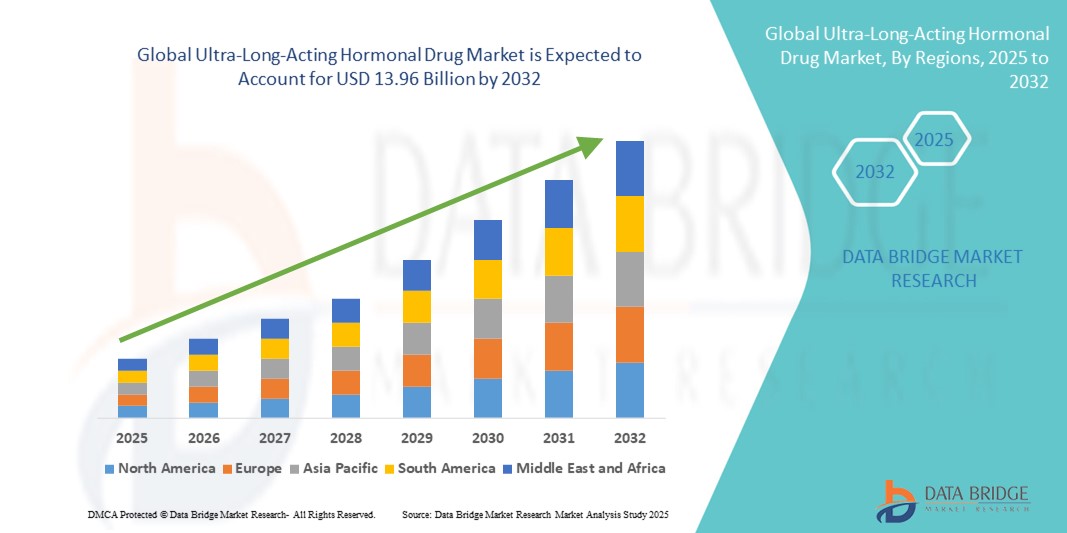
- The global ultra-long-acting hormonal drug market size was valued at USD 5.40 billion in 2024 and is expected to reach USD 13.96 billion by 2032, at a CAGR of 12.60% during the forecast period
- The market growth is largely fueled by the growing demand for long-term contraceptive solutions and hormone-related therapies that require reduced dosing frequency, leading to increased preference for ultra-long-acting hormonal drugs across both developed and emerging regions
- Furthermore, rising consumer demand for convenient, effective, and compliance-friendly therapeutic options is establishing ultra-long-acting hormonal drugs as a preferred alternative in reproductive health, menopausal therapy, and hormone replacement treatment. These converging factors are accelerating the uptake of Ultra-Long-Acting Hormonal Drug solutions, thereby significantly boosting the industry's growth
Ultra-Long-Acting Hormonal Drug Market Analysis
- Ultra-long-acting hormonal drugs, offering sustained release of hormones over extended periods, are increasingly vital components in modern therapeutic regimens for managing chronic endocrine, reproductive, and metabolic disorders across both male and female populations due to their enhanced compliance, reduced dosing frequency, and improved therapeutic efficacy
- The escalating demand for ultra-long-acting hormonal drugs is primarily fueled by the increasing prevalence of hormone-related disorders such as hypogonadism, menopause, growth hormone deficiency, and endometriosis, along with patient preference for less frequent dosing and improved quality of life
- North America dominated the ultra-long-acting hormonal drug market with the largest revenue share of 38.9% in 2024, characterized by advanced healthcare infrastructure, early adoption of long-acting therapies, favorable reimbursement policies, and a strong presence of key pharmaceutical companies. The U.S. is experiencing substantial growth in ultra-long-acting hormonal drug prescriptions, especially in hormone replacement therapies and contraceptives, driven by innovations in depot injections and implantable delivery systems
- Asia-Pacific is expected to be the fastest growing region in the ultra-long-acting hormonal drug market during the forecast period, due to increasing awareness of hormonal health, expanding healthcare access, rising disposable incomes, and growing demand for long-acting contraceptive and endocrine treatments in countries such as China, India, and Japan
- The reproductive health segment dominated the ultra-long-acting hormonal drug market with a revenue share of 46.1% in 2024, propelled by high demand for fertility support and contraceptive products
Report Scope and Ultra-Long-Acting Hormonal Drug Market Segmentation
|
Attributes |
Ultra-Long-Acting Hormonal Drug Key Market Insights |
|
Segments Covered |
|
|
Countries Covered |
North America
Europe
Asia-Pacific
Middle East and Africa
South America
|
|
Key Market Players |
|
|
Market Opportunities |
|
|
Value Added Data Infosets |
In addition to the insights on market scenarios such as market value, growth rate, segmentation, geographical coverage, and major players, the market reports curated by the Data Bridge Market Research also include in-depth expert analysis, pricing analysis, brand share analysis, consumer survey, demography analysis, supply chain analysis, value chain analysis, raw material/consumables overview, vendor selection criteria, PESTLE Analysis, Porter Analysis, and regulatory framework. |
Ultra-Long-Acting Hormonal Drug Market Trends
Growing Preference for Long-Acting Therapeutic Options
- A significant and accelerating trend in the global ultra-long-acting hormonal drug market is the increasing demand for long-acting injectable and implantable hormone therapies due to their ability to maintain stable hormone levels over extended periods and reduce dosing frequency
- For instance, ultra-long-acting formulations of testosterone, estrogen, and progestin are gaining momentum in hormone replacement therapies, offering improved patient compliance and minimized fluctuations in hormone concentration
- Innovations in drug delivery technologies, such as depot formulations, biodegradable implants, and microsphere carriers, are allowing pharmaceutical companies to develop hormonal drugs with dosing intervals that range from weeks to several months. These innovations are particularly important in chronic hormone-related conditions like menopause, endometriosis, prostate cancer, and hypogonadism
- Moreover, the growing prevalence of reproductive health disorders and the increasing global focus on family planning and contraception are driving the adoption of long-acting contraceptive options such as injectables and hormonal implants. These are especially popular in both high-income and low- and middle-income countries due to their effectiveness, cost-efficiency, and ease of use
- Pharmaceutical giants are investing heavily in clinical trials and R&D for newer hormone therapies that offer extended half-life, targeted delivery, and fewer side effects, thus reshaping treatment paradigms for endocrine and reproductive health
- As healthcare providers and patients increasingly recognize the value of consistent hormone therapy with fewer administrations, the demand for ultra-long-acting hormonal drugs is expected to grow rapidly across hospitals, clinics, and specialty endocrinology practices worldwide
- In addition, the rise in aging populations, especially in North America, Europe, and parts of Asia-Pacific, is increasing the incidence of hormonal imbalances and chronic diseases, further supporting the market demand for sustained hormone treatments
Ultra-Long-Acting Hormonal Drug Market Dynamics
Driver
Growing Need Due to Rising Demand for Long-Term Hormonal Therapies and Patient Compliance
- The increasing prevalence of chronic hormone-related disorders such as prostate cancer, endometriosis, menopause symptoms, and hormone-deficiency conditions is significantly driving the demand for ultra-long-acting hormonal drugs. These formulations offer patients a more manageable treatment regimen with fewer administrations
- For instance, in April 2024, Tolmar Pharmaceuticals announced the continued rollout of ELIGARD, a leuprolide acetate injection for advanced prostate cancer that provides 1-, 3-, 4-, and 6-month delivery options. Such ultra-long-acting formulations are contributing to higher patient adherence and therapeutic outcomes—key factors boosting the Ultra-Long-Acting Hormonal Drug industry growth in the forecast period
- As healthcare systems emphasize value-based care, these extended-release therapies help reduce hospital visits, ensure steady hormone levels, and improve patient quality of life—especially in aging populations where polypharmacy and forgetfulness pose challenges
- Furthermore, the growing demand for contraceptives in both developed and emerging markets is supporting the adoption of long-acting reversible contraceptives (LARCs) like hormonal implants and injectables, which are increasingly being recommended by clinicians due to their superior efficacy and user independence
- The convenience of fewer doses per year, minimized side effects due to stable drug release, and compatibility with automated refill and adherence-monitoring tools are key factors propelling the uptake of ultra-long-acting hormonal drugs in both inpatient and outpatient care settings
- The trend towards depot technologies, microspheres, and implantable hormone delivery systems is expanding access to new therapeutic areas and patient groups. In addition, increased awareness and government support for family planning and chronic condition management are contributing to broader market growth
Restraint/Challenge
High Development Costs and Limited Patient Awareness in Low-Income Regions
- The high R&D costs associated with developing ultra-long-acting hormonal drugs—especially those utilizing advanced polymer-based delivery systems or biodegradable implants—pose a major barrier to entry for smaller companies and limit price flexibility for consumers
- For instance, formulations involving sustained-release hormone carriers require extensive clinical trials for safety and efficacy, particularly in chronic and reproductive health indications. This leads to longer time-to-market, contributing to the high cost of the final product
- In addition, limited awareness and misconceptions surrounding long-acting hormonal therapies in many low- and middle-income countries hinder widespread adoption. Cultural reluctance, fear of long-term side effects, and preference for traditional short-term medications slow down market penetration
- Addressing these concerns through education campaigns, physician training, and policy support is crucial. Furthermore, pricing strategies and partnerships with public health organizations can help bring ultra-long-acting hormonal drugs to underserved populations
- Overcoming these challenges by investing in cost-effective delivery technologies, improving healthcare infrastructure, and promoting insurance coverage or reimbursement schemes will be vital for sustained market growth in the coming years
Ultra-Long-Acting Hormonal Drug Market Scope
The market is segmented on the basis of drug type, hormone type, route of administration, and application.
- By Drug Type
On the basis of drug type, the ultra-long-acting hormonal drug market is segmented into contraceptives, hormone replacement therapy (hrt), fertility treatments, growth hormone therapies, and others. The contraceptives segment dominated the market with the largest revenue share of 41.8% in 2024, driven by rising preference for long-acting reversible contraceptives (LARCs), including injectable and implantable birth control.
The hormone replacement therapy (HRT) segment is anticipated to register the fastest growth rate of 23.2% from 2025 to 2032, supported by increasing menopausal population and growing awareness of age-related hormonal imbalances.
- By Hormone Type
On the basis of hormone type, the ultra-long-acting hormonal drug market is segmented into estrogen-based, progesterone-based, testosterone-based, growth hormone-based, and others. The estrogen-based segment held the largest revenue share of 38.5% in 2024, driven by extensive application in both contraceptives and HRT for women.
The testosterone-based segment is expected to grow at the fastest CAGR of 21.4% during the forecast period, owing to increasing cases of male hypogonadism and demand for gender hormone therapy.
- By Route of Administration
On the basis of route of administration, the ultra-long-acting hormonal drug market is segmented into intramuscular, subcutaneous, transdermal, implantable, and oral. The intramuscular segment dominated with the highest market share of 40.2% in 2024, due to widespread use in contraceptives and testosterone injections.
The implantable segment is projected to grow at the fastest CAGR of 22.5% from 2025 to 2032, as a result of its long-term efficacy and patient compliance benefits.
- By Application
On the basis of application, the ultra-long-acting hormonal drug market is segmented into reproductive health, menopause management, growth disorders, gender hormone therapy, and others. The reproductive health segment accounted for the largest revenue share of 46.1% in 2024, propelled by high demand for fertility support and contraceptive products.
The gender hormone therapy segment is expected to expand at the fastest CAGR of 24.6% during the forecast period, driven by increasing inclusivity in healthcare and better access to hormone therapy for transgender and non-binary individuals.
Ultra-Long-Acting Hormonal Drug Market Regional Analysis
- North America dominated the ultra-long-acting hormonal drug market with the largest revenue share of 38.9% in 2024, driven by the rising prevalence of chronic hormonal disorders, increasing healthcare spending, and strong adoption of long-acting drug delivery technologies across the region
- Patients and providers in the region highly value the convenience of less frequent dosing schedules, improved compliance, and reduced side effects associated with ultra-long-acting formulations
- This growth is further supported by favorable reimbursement policies, a technologically advanced pharmaceutical sector, and rising awareness around women’s and men’s hormonal health, positioning North America as a leader in the global market
U.S. Ultra-Long-Acting Hormonal Drug Market Insight
The U.S. ultra-long-acting hormonal drug market captured the largest revenue share of 66% in 2024 within North America, fueled by increasing demand for advanced contraceptive solutions, hormone replacement therapies (HRT), and long-term treatments for endocrine disorders. Widespread use of injectable contraceptives and implants, a strong pipeline of hormonal drugs, and ongoing clinical research are major growth drivers. In addition, rising patient preference for minimally invasive, longer-duration treatments is shaping a robust market outlook in the U.S.
Europe Ultra-Long-Acting Hormonal Drug Market Insight
The Europe ultra-long-acting hormonal drug market is projected to expand at a substantial CAGR throughout the forecast period, driven by the rising aging population, increasing prevalence of menopausal and andropausal hormonal imbalances, and improved access to advanced therapeutics. Europe’s emphasis on personalized medicine and pharmaceutical R&D investments is fostering innovation in long-acting drug formulations. The adoption of extended-release hormonal therapies is accelerating in countries like Germany, France, and the U.K., especially across gynecology and oncology applications.
U.K. Ultra-Long-Acting Hormonal Drug Market Insight
The U.K. ultra-long-acting hormonal drug market is expected to grow at a noteworthy CAGR, owing to strong government support for reproductive health, rising awareness campaigns about hormone-related conditions, and patient interest in long-term therapies. Increasing partnerships between biotech firms and academic institutions are expected to boost development and clinical adoption of novel long-acting hormonal drugs, particularly in female health.
Germany Ultra-Long-Acting Hormonal Drug Market Insight
The Germany ultra-long-acting hormonal drug market is set to expand at a considerable CAGR over the forecast period, supported by its advanced pharmaceutical manufacturing capabilities, growing geriatric population, and high demand for hormone therapies addressing endocrine and oncological disorders. Germany’s focus on innovation and sustainability in drug delivery is enhancing the availability of long-acting formulations and implantable hormonal solutions.
Asia-Pacific Ultra-Long-Acting Hormonal Drug Market Insight
The Asia-Pacific ultra-long-acting hormonal drug market is poised to grow at the fastest CAGR from 2025 to 2032, led by increasing awareness about hormonal disorders, a growing middle class, and rapid expansion of healthcare infrastructure in emerging economies such as India, China, and Southeast Asia. Rising healthcare expenditures and initiatives promoting family planning and women's health are contributing significantly to market expansion. Moreover, local manufacturing and lower production costs are making ultra-long-acting drugs more accessible to larger populations.
Japan Ultra-Long-Acting Hormonal Drug Market Insight
The Japan ultra-long-acting hormonal drug market is witnessing strong momentum due to its aging population, increased focus on hormonal aging therapies, and integration of innovative drug delivery systems in its healthcare ecosystem. The Japanese population’s openness to technologically advanced and long-acting therapeutics supports the steady growth of this segment, particularly in prostate cancer and menopause treatments.
China Ultra-Long-Acting Hormonal Drug Market Insight
The China ultra-long-acting hormonal drug market accounted for the largest revenue share in Asia-Pacific in 2024, owing to government-driven healthcare reforms, a rapidly urbanizing population, and the growing prevalence of hormonal conditions such as PCOS, menopause, and low testosterone levels. Local pharmaceutical companies are rapidly advancing in the field of slow-release and implantable hormonal drugs, which, combined with increased investment in biotech, are positioning China as a central player in this market.
Ultra-Long-Acting Hormonal Drug Market Share
The Ultra-Long-Acting Hormonal Drug industry is primarily led by well-established companies, including:
- Pfizer Inc. (U.S.)
- AbbVie Inc. (U.S.)
- Sanofi (France)
- Novo Nordisk (Denmark)
- Lilly (U.S.)
- Ferring Pharmaceuticals (Switzerland)
- AstraZeneca (U.K.)
- Bayer AG (Germany)
- Organon & Co. (U.S.)
- Ipsen (France)
- Endo International plc (Ireland)
- Teva Pharmaceutical Industries Ltd. (Israel)
- Sun Pharmaceutical Industries Ltd. (India)
- Zydus Lifesciences Ltd. (India)
- Gedeon Richter Plc (Hungary)
- Myovant Sciences (U.S.)
- Sprout Pharmaceuticals (U.S.)
- ANI Pharmaceuticals, Inc. (U.S.)
- Cipla Ltd. (India)
- Endoceutics, Inc. (Canada)
Latest Developments in Global Ultra-Long-Acting Hormonal Drug Market
- In June 2025, biotech firm Metsera reported promising Phase I data for its ultra‑long‑acting amylin injectable MET‑233i, showing an average body‑weight reduction of ~8.4% at day 36 in overweight or obese participants. This monthly injectable demonstrated a ~19‑day half‑life—supporting monthly dosing—with generally mild side effects and no serious toxicities observed. This breakthrough underscores the rising potential of amylin analog therapies as part of next‑gen obesity treatment portfolios
- In April 2025, pharma giant Bayer announced that it plans to launch two new drugs later this year—acoramidis (Beyonttra) for heart failure and elinzanetant for menopause‑related hot flashes—each expected to cross USD 1 billion in peak annual sales, signaling strong commercial momentum in hormonal therapies
- In March 2025, scientists revealed a novel injectable contraceptive platform under development which self‑assembles in the body and provides long‑lasting progesterone release for at least 97 days. While currently at animal proof‑of‑concept stage, the platform holds promise for settings lacking surgical infrastructure and could be adapted for other chronic hormonal therapies in the future

- Interactive Data Analysis Dashboard
- Company Analysis Dashboard for high growth potential opportunities
- Research Analyst Access for customization & queries
- Competitor Analysis with Interactive dashboard
- Latest News, Updates & Trend analysis
- Harness the Power of Benchmark Analysis for Comprehensive Competitor Tracking
Data collection and base year analysis are done using data collection modules with large sample sizes. The stage includes obtaining market information or related data through various sources and strategies. It includes examining and planning all the data acquired from the past in advance. It likewise envelops the examination of information inconsistencies seen across different information sources. The market data is analysed and estimated using market statistical and coherent models. Also, market share analysis and key trend analysis are the major success factors in the market report. To know more, please request an analyst call or drop down your inquiry.
The key research methodology used by DBMR research team is data triangulation which involves data mining, analysis of the impact of data variables on the market and primary (industry expert) validation. Data models include Vendor Positioning Grid, Market Time Line Analysis, Market Overview and Guide, Company Positioning Grid, Patent Analysis, Pricing Analysis, Company Market Share Analysis, Standards of Measurement, Global versus Regional and Vendor Share Analysis. To know more about the research methodology, drop in an inquiry to speak to our industry experts.
Data Bridge Market Research is a leader in advanced formative research. We take pride in servicing our existing and new customers with data and analysis that match and suits their goal. The report can be customized to include price trend analysis of target brands understanding the market for additional countries (ask for the list of countries), clinical trial results data, literature review, refurbished market and product base analysis. Market analysis of target competitors can be analyzed from technology-based analysis to market portfolio strategies. We can add as many competitors that you require data about in the format and data style you are looking for. Our team of analysts can also provide you data in crude raw excel files pivot tables (Fact book) or can assist you in creating presentations from the data sets available in the report.












