


What is the Ultra-low Alpha Metal Market Size and Growth Rate?
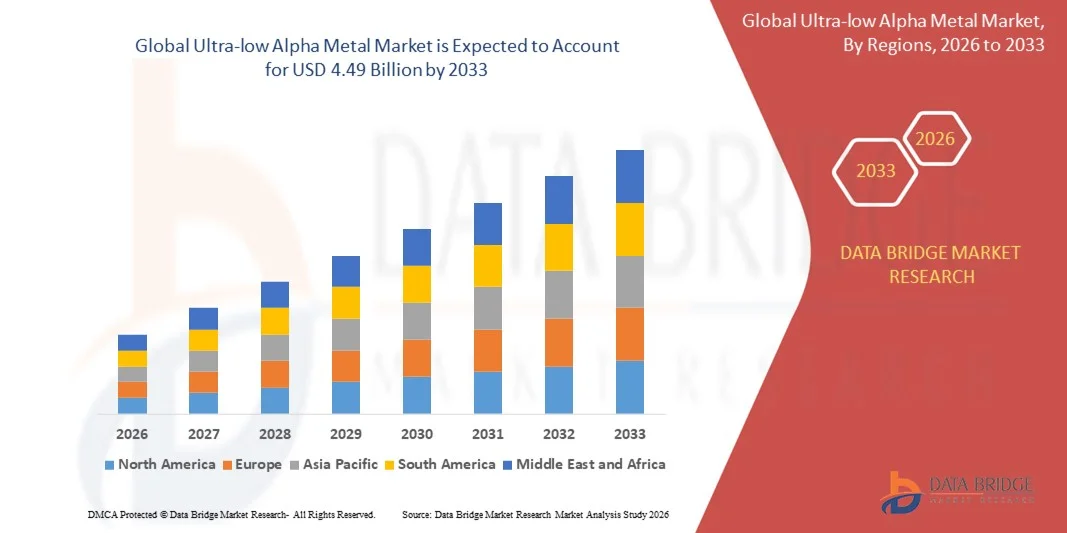
- As per Data Bridge Market Research analysis, the global ultra-low alpha metal market size was valued at USD 1.94 billion in 2025 and is expected to reach USD 4.49 billion by 2033, at a CAGR of 11.05% during the forecast period
- The market growth is largely fuelled by the increasing demand for high-purity metals in semiconductor, aerospace, and nuclear industries, where minimal alpha particle emission is critical to ensure performance and reliability
- Rising adoption of ultra-low alpha metals in advanced electronics, clean energy applications, and precision instrumentation is further driving market expansion, supported by ongoing technological innovations and stricter quality standards
Market Size & Forecast
- Global Market Value (2025): USD 1.94 billion
- Expected Market Value (2033): USD 4.49 billion
- Forecast CAGR (2026-2033): 11.05%
What are the Major Takeaways of Ultra-low Alpha Metal Market?
- The market is witnessing a surge in demand from semiconductor fabrication facilities, where ultra-low alpha metals are essential to minimize soft errors and enhance device reliability
- Increasing applications in nuclear energy, aerospace components, and precision instruments are contributing to the steady adoption of these metals globally, as industries seek materials with exceptional purity and stability
- North America dominated the ultra-low alpha metal market with the largest revenue share in 2025, driven by a growing demand for high-purity metals in semiconductor, aerospace, and nuclear applications, as well as increased investment in advanced electronics manufacturing
- Asia-Pacific region is expected to witness the highest growth rate in the global ultra-low alpha metal market, driven by rising demand from emerging electronics and semiconductor markets, expanding industrial base, and supportive government initiatives promoting technological advancement
- The Ultra-low Alpha Tin segment held the largest market revenue share in 2025, driven by its critical applications in semiconductor and electronics manufacturing. Ultra-low Alpha Tin provides exceptional purity, stability, and minimal radioactive contamination, making it highly suitable for wafer handling, coating, and packaging processes
Report Scope and Ultra-low Alpha Metal Market Segmentation
|
Attributes |
Ultra-low Alpha Metal Key Market Insights |
|
Segments Covered |
|
|
Countries Covered |
North America
Europe
Asia-Pacific
Middle East and Africa
South America
|
|
Key Market Players |
|
|
Market Opportunities |
|
|
Value Added Data Infosets |
In addition to the insights on market scenarios such as market value, growth rate, segmentation, geographical coverage, and major players, the market reports curated by the Data Bridge Market Research also include import export analysis, production capacity overview, production consumption analysis, price trend analysis, climate change scenario, supply chain analysis, value chain analysis, raw material/consumables overview, vendor selection criteria, PESTLE Analysis, Porter Analysis, and regulatory framework. |
What is the Key Trend in the Ultra-low Alpha Metal Market?
Rising Demand for Ultra-Low Alpha Metals in Semiconductor and Electronics Applications
- The growing adoption of ultra-low alpha metals is transforming the electronics and semiconductor landscape by providing materials with extremely low radioactive contamination. These metals reduce soft errors in sensitive devices such as memory chips, processors, and high-precision instrumentation, improving product reliability and lifespan. The increasing reliance on high-performance electronics in sectors such as data centers, aerospace, and medical devices further fuels adoption, making ultra-low alpha metals essential for critical applications
- The high demand for ultra-low alpha metals in advanced microelectronics and cleanroom environments is accelerating the use of high-purity metal sheets, foils, and coatings. These materials are particularly critical in semiconductor fabrication, nuclear instrumentation, and aerospace electronics, ensuring optimal performance and safety. Manufacturers are increasingly prioritizing ultra-low alpha metals to minimize defects and maximize throughput, particularly in wafer-level processing and high-density packaging
- The affordability, high purity, and consistency of modern ultra-low alpha metals are making them attractive for both industrial and research applications. Manufacturers benefit from reduced defects, improved yield, and compliance with strict industry standards. In addition, the metals’ thermal stability and mechanical robustness make them suitable for next-generation semiconductor devices and high-reliability components in aerospace and defense
- For instance, in 2023, several semiconductor manufacturers in North America and Europe reported improved chip reliability and reduced soft error rates after integrating ultra-low alpha metal components into wafer handling and packaging processes. This integration also enabled the development of smaller, faster, and more power-efficient devices, supporting the trend toward miniaturization and higher computational performance
- While adoption of ultra-low alpha metals continues to rise, market growth depends on continued R&D, quality control, and scalability. Companies must focus on material innovation, precise production processes, and localized supply chains to fully capitalize on growing demand. Ongoing collaboration between metal producers and end-users is also critical to address emerging industry requirements and ensure seamless integration into advanced electronic systems
Ultra-low Alpha Metal Market Dynamics
Driver
Increasing Adoption in Semiconductor, Aerospace, and Nuclear Applications
- Rising demand for highly reliable and contamination-free materials in semiconductors, aerospace, and nuclear instrumentation is driving the adoption of ultra-low alpha metals. These metals help prevent errors and improve the performance of critical electronic systems. Growing technological complexity in AI, IoT, and space exploration applications is further increasing reliance on ultra-low alpha metals for precision and longevity
- Industries are prioritizing ultra-low alpha metals to comply with stringent regulatory standards and ensure long-term product reliability. The increasing emphasis on advanced electronics in defense, aerospace, and space applications supports wider adoption. Enhanced quality assurance and rigorous testing protocols are encouraging companies to standardize ultra-low alpha metals in high-reliability production lines
- Technological advancements in purification, coating, and metal fabrication processes are enabling manufacturers to produce ultra-low alpha metals with higher uniformity and lower defect rates. This fuels market expansion across high-tech sectors. Integration of these metals in next-generation semiconductor devices and advanced packaging solutions further supports innovation in electronics and instrumentation
- For instance, in 2022, several aerospace component manufacturers in Europe and the U.S. integrated ultra-low alpha metal alloys into satellite systems and avionics, enhancing performance and operational safety. The materials also contributed to longer mission durations and reduced maintenance needs, underscoring their value in high-stakes aerospace applications
- While industry demand is a key market driver, continuous innovation, material standardization, and cost optimization are essential to sustain growth and meet the evolving needs of high-precision applications. Collaboration with research institutions, adherence to environmental standards, and adoption of scalable manufacturing methods are critical to fully leveraging market potential
Restraint/Challenge
High Production Costs and Complex Manufacturing Processes
- The high cost of producing ultra-low alpha metals, including purification, alloying, and precision manufacturing, limits adoption among smaller manufacturers and emerging markets. Cost remains a significant barrier for widespread deployment. The requirement for specialized equipment and cleanroom-grade facilities further adds to operational expenditures and production complexity
- In many regions, limited access to advanced production facilities and skilled personnel hinders the consistent fabrication of ultra-low alpha metals. This reduces availability and delays supply to critical industries. In addition, stringent quality control measures and process validation requirements increase production timelines and resource demands
- Supply chain constraints, including the scarcity of high-purity raw materials and specialized equipment, further restrict the availability of ultra-low alpha metals in certain regions. Delays in production can impact semiconductor, aerospace, and nuclear projects. Geopolitical factors and trade restrictions on raw materials can also exacerbate supply uncertainties, creating additional challenges for manufacturers
- For instance, in 2023, several semiconductor fabs in Asia reported challenges in sourcing ultra-low alpha metal foils due to high costs and limited supplier networks, affecting production timelines. Manufacturers had to implement buffer stocks and dual sourcing strategies, highlighting the importance of supply chain resilience in this sector
- While manufacturing technologies continue to evolve, addressing cost, accessibility, and supply chain complexities remains crucial. Market stakeholders must focus on efficient production methods, strategic sourcing, and global distribution networks to unlock long-term growth potential. Investment in automation, process optimization, and workforce training will also be key to overcoming existing barriers and sustaining market expansion
How is the Ultra-low Alpha Metal Market Segmented?
The market is segmented on the basis of product and end-user industry.
- By Product
On the basis of product, the ultra-low alpha metal market is segmented into Ultra-low Alpha Tin, Ultra-low Alpha Tin Alloys, Ultra-low Alpha Lead Alloys, and Ultra-low Alpha Lead-free Alloys. The Ultra-low Alpha Tin segment held the largest market revenue share in 2025, driven by its critical applications in semiconductor and electronics manufacturing. Ultra-low Alpha Tin provides exceptional purity, stability, and minimal radioactive contamination, making it highly suitable for wafer handling, coating, and packaging processes.
The Ultra-low Alpha Lead-free Alloys segment is expected to witness the fastest growth rate from 2026 to 2033, driven by the rising demand for environmentally friendly and RoHS-compliant materials in high-precision electronics and aerospace applications. Lead-free alloys offer comparable performance to traditional lead-based metals while meeting strict regulatory standards, enhancing adoption across semiconductor fabrication, medical instrumentation, and telecommunication sectors.
- By End-user Industry
On the basis of end-user industry, the market is segmented into Aviation, Automotive, Electronics, Medical, Telecommunication, and Others. The Electronics segment held the largest revenue share in 2025, owing to the extensive use of ultra-low alpha metals in semiconductors, memory chips, processors, and advanced instrumentation. These metals help reduce soft errors, improve device reliability, and ensure long-term operational performance.
The Aviation segment is expected to witness the fastest growth rate from 2026 to 2033, fueled by the increasing integration of ultra-low alpha metals in aerospace components, avionics, and satellite systems. High reliability, contamination-free properties, and compliance with stringent safety standards make these metals essential for aerospace applications, supporting market expansion in both commercial and defense aviation sectors.
Which Region Holds the Largest Share of the Ultra-low Alpha Metal Market?
- North America dominated the ultra-low alpha metal market with the largest revenue share in 2025, driven by a growing demand for high-purity metals in semiconductor, aerospace, and nuclear applications, as well as increased investment in advanced electronics manufacturing
- Industries in the region highly value the low-radioactivity properties, high reliability, and superior performance offered by ultra-low alpha metals for precision instrumentation and sensitive electronic devices
- This widespread adoption is further supported by strong R&D infrastructure, well-established manufacturing facilities, and the presence of key end-user industries, establishing ultra-low alpha metals as critical materials for both industrial and research applications
U.S. Ultra-Low Alpha Metal Market Insight
The U.S. ultra-low alpha metal market captured the largest revenue share in 2025 within North America, fueled by the expanding semiconductor and aerospace sectors. Companies are increasingly prioritizing the use of ultra-low alpha metals to reduce soft errors in high-precision devices and comply with stringent industry standards. The growing trend of miniaturized electronics, advanced chip packaging, and high-reliability aerospace systems further propels market growth. Moreover, strong government support for high-tech manufacturing and space exploration initiatives is significantly contributing to the adoption of ultra-low alpha metals in the U.S.
Europe Ultra-Low Alpha Metal Market Insight
The Europe ultra-low alpha metal market is expected to witness the fastest growth rate from 2026 to 2033, primarily driven by increasing demand for contamination-free materials in aerospace, nuclear, and electronics applications. The region’s emphasis on precision engineering, quality standards, and innovation fosters adoption. European industries are also drawn to the reliability, long-term stability, and regulatory compliance offered by ultra-low alpha metals. The market is experiencing notable growth across electronics, medical, and telecommunication applications, with metals being incorporated into both new systems and high-reliability replacements.
U.K. Ultra-Low Alpha Metal Market Insight
The U.K. ultra-low alpha metal market is expected to witness the fastest growth rate from 2026 to 2033, driven by the expansion of semiconductor, aerospace, and research applications. Increasing focus on advanced electronics, low-error instrumentation, and high-precision manufacturing encourages adoption. The U.K.’s strong research and development ecosystem, alongside its robust industrial infrastructure, continues to stimulate market growth.
Germany Ultra-Low Alpha Metal Market Insight
The Germany ultra-low alpha metal market is expected to witness the fastest growth rate from 2026 to 2033, fueled by high adoption in aerospace, nuclear, and industrial electronics. Germany’s well-established infrastructure, precision engineering expertise, and emphasis on quality and safety promote market expansion. The integration of ultra-low alpha metals into high-reliability systems and research applications is also becoming increasingly prevalent, with industries focusing on defect-free and low-contamination materials to meet stringent standards.
Asia-Pacific Ultra-Low Alpha Metal Market Insight
The Asia-Pacific ultra-low alpha metal market is expected to witness the fastest growth rate from 2026 to 2033, driven by rapid industrialization, rising semiconductor manufacturing, and technological advancements in countries such as China, Japan, South Korea, and India. The region’s growing electronics, aerospace, and nuclear sectors, supported by government initiatives for advanced manufacturing, are driving demand. Furthermore, APAC is emerging as a key production hub for ultra-low alpha metal materials, enhancing affordability and accessibility for a wider industrial base.
Japan Ultra-Low Alpha Metal Market Insight
The Japan ultra-low alpha metal market is expected to witness the fastest growth rate from 2026 to 2033 due to the country’s high-tech manufacturing culture, increasing electronics production, and aerospace development. Japanese industries prioritize low-radioactivity metals for high-precision applications, and integration with advanced semiconductor and instrumentation systems is fueling growth. Moreover, the aging workforce and focus on automated, high-reliability production further encourage the adoption of ultra-low alpha metals in both industrial and research sectors.
China Ultra-Low Alpha Metal Market Insight
The China ultra-low alpha metal market accounted for the largest revenue share in Asia-Pacific in 2025, attributed to the country’s expanding semiconductor, electronics, and aerospace industries. China stands as one of the largest markets for high-purity materials, and ultra-low alpha metals are increasingly used in precision instruments, chip packaging, and space applications. The push towards advanced manufacturing, smart electronics, and high-reliability systems, alongside strong domestic manufacturers, are key factors propelling market growth in China.
Which are the Top Companies in Ultra-low Alpha Metal Market?
The Ultra-low Alpha Metal industry is primarily led by well-established companies, including:
• Tech Resources Limited (U.K.)
• Honeywell International Inc. (U.S.)
• Indium Corporation (U.S.)
• Pure Technologies Ltd (U.K.)
• Mitsubishi Chemical Holdings Corporation (Japan)
• MacDermid Alpha Electronics Solutions (U.S.)
• DUKSAN Holdings (South Korea)
• JMC Advanced Materials (U.S.)
• Materion Corporation (U.S.)
• Heraeus Group (Germany)
What are Latest Developments in Global Ultra-low Alpha Metal Market?
- In August 2025, Kurt J. Lesker Company (U.S.) launched a new line of ultra-low alpha metal products aimed at the semiconductor industry. This development strengthens the company’s product portfolio and addresses the rising demand for high-purity materials in semiconductor manufacturing. By offering specialized products, the company is positioned to capture a larger market share, enhance operational efficiency for clients, and reinforce its reputation for innovation in precision materials, positively impacting market competitiveness and growth
- In September 2025, Mitsubishi Materials Corporation (Japan) formed a strategic partnership with a leading technology firm to develop sustainable production methods for ultra-low alpha metals. This initiative focuses on reducing waste and energy consumption while integrating advanced technologies into manufacturing. The collaboration highlights the company’s commitment to eco-friendly solutions, potentially setting new industry standards and improving its competitive positioning in the environmentally conscious ultra-low alpha metal market
- In July 2025, Ametek, Inc. (U.S.) expanded its manufacturing capacity by investing in a state-of-the-art facility dedicated to ultra-low alpha metal production. This development enhances production efficiency and meets the increasing demand for high-quality materials. Incorporating advanced automation technologies, the facility is expected to reduce lead times, improve product consistency, and support market growth by ensuring reliable supply for semiconductor, aerospace, and high-tech applications

- Interactive Data Analysis Dashboard
- Company Analysis Dashboard for high growth potential opportunities
- Research Analyst Access for customization & queries
- Competitor Analysis with Interactive dashboard
- Latest News, Updates & Trend analysis
- Harness the Power of Benchmark Analysis for Comprehensive Competitor Tracking
Global Ultra Low Alpha Metal Market, Supply Chain Analysis and Ecosystem Framework
To support market growth and help clients navigate the impact of geopolitical shifts, DBMR has integrated in-depth supply chain analysis into its Global Ultra Low Alpha Metal Market research reports. This addition empowers clients to respond effectively to global changes affecting their industries. The supply chain analysis section includes detailed insights such as Global Ultra Low Alpha Metal Market consumption and production by country, price trend analysis, the impact of tariffs and geopolitical developments, and import and export trends by country and HSN code. It also highlights major suppliers with data on production capacity and company profiles, as well as key importers and exporters. In addition to research, DBMR offers specialized supply chain consulting services backed by over a decade of experience, providing solutions like supplier discovery, supplier risk assessment, price trend analysis, impact evaluation of inflation and trade route changes, and comprehensive market trend analysis.
Data collection and base year analysis are done using data collection modules with large sample sizes. The stage includes obtaining market information or related data through various sources and strategies. It includes examining and planning all the data acquired from the past in advance. It likewise envelops the examination of information inconsistencies seen across different information sources. The market data is analysed and estimated using market statistical and coherent models. Also, market share analysis and key trend analysis are the major success factors in the market report. To know more, please request an analyst call or drop down your inquiry.
The key research methodology used by DBMR research team is data triangulation which involves data mining, analysis of the impact of data variables on the market and primary (industry expert) validation. Data models include Vendor Positioning Grid, Market Time Line Analysis, Market Overview and Guide, Company Positioning Grid, Patent Analysis, Pricing Analysis, Company Market Share Analysis, Standards of Measurement, Global versus Regional and Vendor Share Analysis. To know more about the research methodology, drop in an inquiry to speak to our industry experts.
Data Bridge Market Research is a leader in advanced formative research. We take pride in servicing our existing and new customers with data and analysis that match and suits their goal. The report can be customized to include price trend analysis of target brands understanding the market for additional countries (ask for the list of countries), clinical trial results data, literature review, refurbished market and product base analysis. Market analysis of target competitors can be analyzed from technology-based analysis to market portfolio strategies. We can add as many competitors that you require data about in the format and data style you are looking for. Our team of analysts can also provide you data in crude raw excel files pivot tables (Fact book) or can assist you in creating presentations from the data sets available in the report.













