


Ultramicrotome Market Size
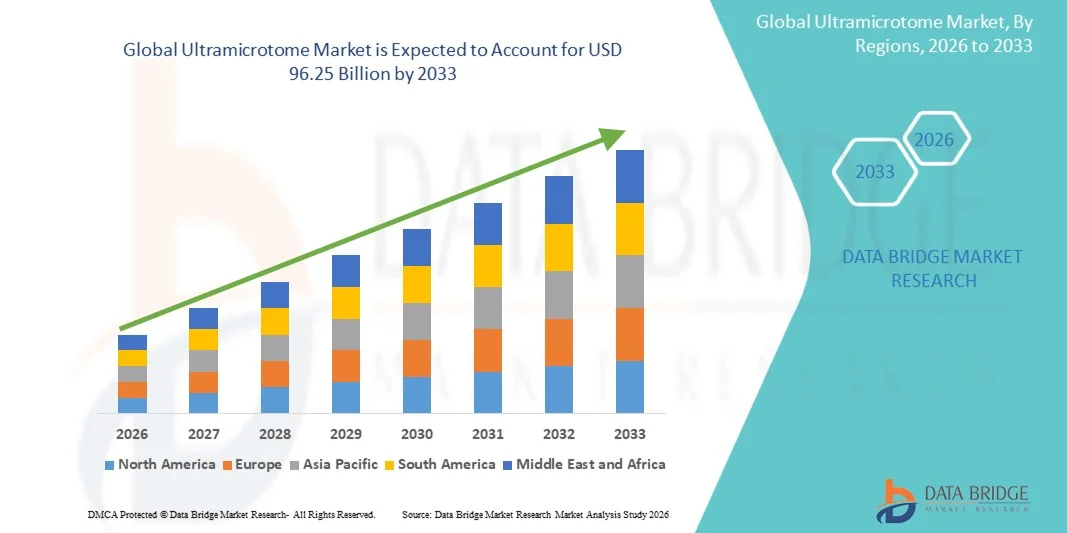
- The global ultramicrotome market size was valued at USD 59.04 billion in 2025and is expected to reach USD 96.25 billion by 2033, at a CAGR of 6.30% during the forecast period
- The market growth is primarily driven by the increasing demand for advanced sample preparation techniques in electron microscopy and material science research, alongside the expanding applications of ultrathin sectioning in life sciences and nanotechnology studies
- Additionally, rising investments in biomedical research, growing focus on precision diagnostics, and continuous technological advancements in automated and cryo-ultramicrotome systems are supporting broader adoption across academic institutes, pharmaceutical companies, and research laboratories. These combined factors are contributing significantly to the expansion of the global ultramicrotome industry
Ultramicrotome Market Analysis
- Ultramicrotomes, precision instruments designed to cut ultrathin sections of biological and material samples for microscopic examination, are increasingly essential in pathology, biomedical research, and electron microscopy applications due to their capability to deliver highly accurate and reproducible sample preparation for advanced imaging and analysis
- The increasing demand for ultramicrotomes is primarily driven by the growing adoption of electron microscopy techniques, rising investments in pharmaceutical and biotechnology research, and expanding utilization of advanced diagnostic and medical research technologies across healthcare and academic sectors
- North America dominated the ultramicrotome market with the largest revenue share of 38.6% in 2025, supported by strong healthcare infrastructure, extensive medical and life science research activities, and high adoption of advanced laboratory instruments, with the U.S. witnessing substantial growth in disease diagnosis and electron microscopy-based research applications
- Asia-Pacific is expected to be the fastest growing region in the ultramicrotome market during the forecast period due to increasing investments in healthcare research facilities, expanding pharmaceutical and biotechnology industries, and rising demand for advanced diagnostic technologies in emerging economies
- Fully Automated segment dominated the ultramicrotome market with a market share of 57.4% in 2025, driven by increasing preference for precision-based sample sectioning, improved operational efficiency, and reduced manual handling in hospitals, research centers, and pharmaceutical laboratories
Report Scope and Ultramicrotome Market Segmentation
|
Attributes |
Ultramicrotome Key Market Insights |
|
Segments Covered |
|
|
Countries Covered |
North America · U.S. · Canada · Mexico Europe · Germany · France · U.K. · Netherlands · Switzerland · Belgium · Russia · Italy · Spain · Turkey · Rest of Europe Asia-Pacific · China · Japan · India · South Korea · Singapore · Malaysia · Australia · Thailand · Indonesia · Philippines · Rest of Asia-Pacific Middle East and Africa · Saudi Arabia · U.A.E. · South Africa · Egypt · Israel · Rest of Middle East and Africa South America · Brazil · Argentina · Rest of South America |
|
Key Market Players |
|
|
Market Opportunities |
· Growing integration of cryosectioning and electron microscopy techniques · Rising investments in semiconductor nanotechnology and material science research |
|
Value Added Data Infosets |
In addition to the insights on market scenarios such as market value, growth rate, segmentation, geographical coverage, and major players, the market reports curated by the Data Bridge Market Research also include in-depth expert analysis, patient epidemiology, pipeline analysis, pricing analysis, and regulatory framework |
Ultramicrotome Market Trends
“Rising Adoption of Automated and Cryo-Ultramicrotomy Technologies”
- A significant and accelerating trend in the global ultramicrotome market is the increasing integration of automation and cryo-ultramicrotomy technologies in electron microscopy and biomedical research applications. This combination of advanced technologies is significantly improving precision, reproducibility, and efficiency in ultrathin sample preparation processes
- For instance, Leica Microsystems offers automated ultramicrotome systems integrated with cryo-capabilities for biological and material science applications, enabling researchers to prepare ultrathin frozen sections with enhanced structural preservation. Similarly, RMC Boeckeler provides advanced cryo-ultramicrotomes designed for high-resolution electron microscopy studies
- Automation integration in ultramicrotomes enables features such as programmable sectioning parameters, vibration reduction mechanisms, and digital thickness control to enhance cutting precision and operational consistency. For instance, some ultramicrotome systems utilize automated feed and trimming technologies to improve section quality and minimize sample damage during preparation. Furthermore, cryo-ultramicrotomy capabilities allow researchers to preserve delicate biological structures for advanced imaging and molecular analysis
- The seamless integration of ultramicrotomes with electron microscopy workflows and laboratory imaging platforms facilitates centralized sample preparation and analytical efficiency across research environments. Through a unified workflow, researchers can manage sample sectioning alongside imaging, staining, and analytical procedures, creating a more streamlined and productive laboratory experience
- This trend towards more precise, automated, and application-specific ultramicrotomy systems is fundamentally reshaping expectations for sample preparation technologies. Consequently, companies such as DiATOME are developing advanced diamond knife solutions and precision ultramicrotomy accessories to support high-resolution biological and nanotechnology research applications
- The demand for ultramicrotome systems that offer automation, cryo-sectioning compatibility, and enhanced precision control is growing rapidly across pharmaceutical, biotechnology, and research sectors, as institutions increasingly prioritize efficiency and accuracy in microscopic analysis
- Furthermore, advancements in digital monitoring systems and software-assisted sectioning controls are enabling laboratories to improve workflow reproducibility and reduce operational errors, contributing to greater adoption of technologically advanced ultramicrotome platforms worldwide
Ultramicrotome Market Dynamics
Driver
“Growing Need Due to Expanding Biomedical and Nanotechnology Research Activities”
- The increasing prevalence of biomedical research activities and expanding applications of nanotechnology and electron microscopy are significant drivers for the heightened demand for ultramicrotome systems
- For instance, in March 2025, Leica Microsystems announced advancements in automated ultramicrotomy solutions designed to improve precision sample preparation for life science and material research applications. Such strategies by key companies are expected to drive the ultramicrotome industry growth in the forecast period
- As research institutions and healthcare organizations continue to focus on advanced disease diagnosis and molecular-level investigations, ultramicrotomes provide critical capabilities for preparing ultrathin sections required for high-resolution imaging and analytical studies
- Furthermore, the growing adoption of electron microscopy technologies and increasing investments in pharmaceutical and biotechnology research are making ultramicrotomes an essential component of modern laboratory infrastructure, offering seamless compatibility with advanced imaging systems and analytical workflows
- The capability to produce consistent ultrathin sections for cellular analysis, neuroscience research, semiconductor studies, and pathological investigations are key factors propelling the adoption of ultramicrotome systems in both academic and industrial sectors. The trend towards automation in laboratory workflows and the increasing availability of technologically advanced ultramicrotome solutions further contribute to market growth
- Increasing government funding for life science research and expansion of advanced laboratory facilities across emerging economies are further accelerating the demand for ultramicrotome technologies in academic and clinical research applications
- Additionally, rising utilization of ultramicrotomes in pharmaceutical drug discovery and vaccine development processes is supporting market growth, as researchers increasingly depend on high-resolution microscopic analysis for molecular and cellular investigations
Restraint/Challenge
“High Equipment Costs and Technical Complexity Hurdle”
- Concerns surrounding the high acquisition and maintenance costs of advanced ultramicrotome systems pose a significant challenge to broader market penetration. As ultramicrotomes require precision engineering, specialized components, and skilled operation, they often involve substantial investment and operational complexity for laboratories and research institutions
- For instance, high-end cryo-ultramicrotome systems integrated with electron microscopy technologies can represent a considerable financial burden for small research facilities and academic laboratories with limited budgets
- Addressing these cost and technical challenges through improved instrument accessibility, operator training programs, and workflow simplification is crucial for expanding adoption. Companies such as Leica Microsystems and RMC Boeckeler emphasize user-friendly interfaces, automated controls, and technical support services in their product offerings to improve usability and efficiency. Additionally, the requirement for highly trained personnel to operate ultramicrotomes and prepare defect-free ultrathin sections can create barriers for institutions lacking specialized expertise. While technological advancements have improved automation capabilities, precision sample preparation still requires extensive technical knowledge and experience
- While automation and digital control technologies are gradually improving operational efficiency, the perceived complexity and high cost associated with ultramicrotome systems can still hinder widespread adoption, particularly in developing regions and smaller laboratories
- Overcoming these challenges through cost-effective instrument development, enhanced training initiatives, and technological innovations focused on workflow simplification will be vital for sustained market growth
- Limited availability of skilled professionals experienced in ultrathin sectioning techniques and electron microscopy sample preparation can further restrict efficient utilization of advanced ultramicrotome systems across research laboratories
- Furthermore, frequent maintenance requirements and the high replacement cost of precision accessories such as diamond knives and cryogenic components can increase long-term operational expenses for laboratories and research facilities
Ultramicrotome Market Scope
The market is segmented on the basis of technology, end user, technique, and application.
- By Technology
On the basis of technology, the ultramicrotome market is segmented into fully automated, semi-automated, and manual. The fully automated segment dominated the market with the largest market revenue share of 57.4% in 2025, driven by the increasing demand for precision-based ultrathin sectioning and workflow automation in advanced laboratories. Fully automated ultramicrotomes provide enhanced consistency, programmable controls, and reduced operator dependency, making them highly suitable for pharmaceutical, biotechnology, and electron microscopy applications. Research institutions and healthcare laboratories increasingly prefer automated systems due to their ability to improve productivity and minimize sample preparation errors. The integration of digital thickness adjustment, vibration control, and advanced trimming functions further supports the widespread adoption of fully automated ultramicrotomes. In addition, growing investments in life science research and high-resolution imaging technologies continue to strengthen the dominance of this segment across developed healthcare and research markets.
The semi-automated segment is anticipated to witness the fastest growth rate from 2026 to 2033, fueled by rising demand for cost-effective and flexible sample preparation systems in emerging laboratories and academic institutions. Semi-automated ultramicrotomes offer a balance between operational efficiency and affordability, making them increasingly attractive for medium-scale research facilities and diagnostic centers. These systems provide improved precision compared to manual instruments while allowing greater user control during sample sectioning procedures. The growing expansion of biomedical research activities and electron microscopy applications in developing economies is further accelerating adoption of semi-automated systems. Additionally, continuous technological advancements aimed at improving usability and reducing operational complexity are supporting segment growth. The increasing focus on upgrading laboratory infrastructure in emerging markets is also expected to contribute significantly to the expansion of the semi-automated segment.
- By End User
On the basis of end user, the ultramicrotome market is segmented into hospitals, pharmaceutical and biotechnology companies, ambulatory surgical centers, research centers, and other. The research centers segment dominated the market with the largest market revenue share in 2025, driven by extensive utilization of ultramicrotomes in life science, material science, and nanotechnology research applications. Research institutes frequently require ultrathin section preparation for electron microscopy studies and advanced molecular investigations, increasing demand for high-precision ultramicrotome systems. The availability of government funding for scientific research and growing investments in advanced imaging infrastructure further support segment dominance. In addition, collaborations between academic institutions and biotechnology companies are increasing the adoption of automated ultramicrotome solutions in research environments. The continuous expansion of neuroscience, pathology, and semiconductor research activities also contributes significantly to the strong market position of research centers.
The pharmaceutical and biotechnology companies segment is expected to witness the fastest growth rate from 2026 to 2033, fueled by increasing investments in drug discovery, vaccine development, and advanced cellular analysis. Pharmaceutical and biotechnology organizations increasingly utilize ultramicrotomes for molecular-level investigations, tissue analysis, and electron microscopy-based research procedures. The growing focus on precision medicine and biologics development is driving demand for advanced sample preparation technologies capable of delivering highly accurate ultrathin sections. Furthermore, the rising adoption of electron microscopy in pharmaceutical quality control and biomaterial research is supporting segment expansion. Continuous advancements in laboratory automation and imaging workflows are further encouraging pharmaceutical companies to adopt technologically advanced ultramicrotome systems. The increasing number of biotechnology startups and research collaborations worldwide is also expected to strengthen growth opportunities within this segment.
- By Technique
On the basis of technique, the ultramicrotome market is segmented into traditional histology technique, cryosectioning technique, electron microscopy technique, and botanical microtomy technique. The electron microscopy technique segment dominated the market with the largest market revenue share in 2025, driven by growing utilization of high-resolution imaging technologies in biomedical, nanotechnology, and semiconductor research applications. Electron microscopy techniques require highly precise ultrathin sample preparation, making ultramicrotomes essential tools in advanced analytical laboratories. Increasing investments in neuroscience, pathology, and molecular biology research are further supporting the adoption of electron microscopy-based sectioning procedures. The growing demand for detailed cellular and structural analysis across pharmaceutical and biotechnology industries is also contributing to segment dominance. In addition, technological advancements in transmission electron microscopy and scanning electron microscopy systems continue to strengthen the importance of electron microscopy techniques in modern research workflows. The expansion of nanotechnology and material science applications is further accelerating demand for this segment globally.
The cryosectioning technique segment is anticipated to witness the fastest growth rate from 2026 to 2033, fueled by increasing demand for rapid tissue analysis and preservation of biological structures during microscopic examination. Cryosectioning techniques are widely utilized in pathology, cancer diagnostics, and neuroscience research due to their ability to maintain cellular integrity and molecular composition during sample preparation. The growing prevalence of chronic diseases and rising focus on precision diagnostics are increasing adoption of cryosectioning technologies across healthcare and research institutions. Furthermore, advancements in cryo-ultramicrotomy systems are improving section quality, operational efficiency, and reproducibility in laboratory workflows. Pharmaceutical and biotechnology companies are also increasingly adopting cryosectioning methods for drug development and biomolecular studies. The expanding application scope of cryogenic imaging and molecular pathology is expected to contribute significantly to the rapid growth of this segment.
- By Application
On the basis of application, the ultramicrotome market is segmented into disease diagnosis and medical research. The medical research segment dominated the market with the largest market revenue share in 2025, driven by increasing utilization of ultramicrotomes in life science studies, nanotechnology investigations, and advanced molecular research applications. Medical researchers extensively rely on ultrathin section preparation for electron microscopy imaging and detailed structural analysis of tissues and biomaterials. Growing investments in biomedical innovation and expanding research activities related to neuroscience, oncology, and infectious diseases are further supporting segment growth. In addition, the increasing collaboration between research organizations and pharmaceutical companies is driving the demand for high-precision laboratory instruments. Technological advancements in imaging systems and automated ultramicrotomy workflows also contribute to the dominance of the medical research segment. The expansion of academic research programs and government-supported scientific initiatives worldwide continues to strengthen the adoption of ultramicrotome systems in medical research applications.
The disease diagnosis segment is expected to witness the fastest growth rate from 2026 to 2033, fueled by rising demand for accurate pathological analysis and advanced diagnostic imaging technologies. Ultramicrotomes are increasingly utilized in diagnostic laboratories for preparing ultrathin tissue sections required in cancer diagnostics, neurological disease investigations, and cellular pathology studies. The growing prevalence of chronic diseases and increasing emphasis on early disease detection are supporting the adoption of precision diagnostic technologies globally. Furthermore, advancements in cryosectioning and electron microscopy techniques are improving the efficiency and reliability of disease diagnosis workflows. Healthcare providers are also increasingly investing in advanced laboratory infrastructure to enhance diagnostic accuracy and patient outcomes. The expanding integration of molecular pathology and personalized medicine approaches is expected to further accelerate growth within the disease diagnosis segment.
Ultramicrotome Market Regional Analysis
- North America dominated the ultramicrotome market with the largest revenue share of 38.6% in 2025, supported by strong healthcare infrastructure, extensive medical and life science research activities, and high adoption of advanced laboratory instruments
- Research institutions and laboratories in the region highly value the precision, automation capabilities, and advanced sectioning performance offered by ultramicrotome systems for high-resolution imaging and analytical applications
- This widespread adoption is further supported by strong healthcare infrastructure, substantial research funding, and the growing presence of pharmaceutical and biotechnology companies, establishing ultramicrotomes as essential instruments for medical research, disease diagnosis, and nanotechnology applications across academic and industrial settings
U.S. Ultramicrotome Market Insight
The U.S. ultramicrotome market captured the largest revenue share of 79% in 2025 within North America, fueled by the strong presence of advanced biomedical research facilities and the expanding adoption of electron microscopy technologies. Research organizations and healthcare institutions are increasingly prioritizing precision sample preparation systems for disease diagnosis and molecular-level investigations. The growing focus on neuroscience, cancer research, and nanotechnology applications, combined with robust investments in laboratory automation and imaging technologies, further propels the ultramicrotome industry. Moreover, the increasing integration of advanced microscopy workflows and automated sectioning systems is significantly contributing to the market’s expansion.
Europe Ultramicrotome Market Insight
The Europe ultramicrotome market is projected to expand at a substantial CAGR throughout the forecast period, primarily driven by increasing investments in life science research and the escalating demand for high-resolution imaging technologies across healthcare and academic sectors. The growth of pharmaceutical and biotechnology research activities, coupled with the rising adoption of advanced laboratory instruments, is fostering the utilization of ultramicrotomes. European research institutions are also drawn to the precision, automation, and reproducibility these systems offer. The region is experiencing significant growth across medical research, pathology, and material science applications, with ultramicrotomes increasingly incorporated into advanced microscopy and diagnostic laboratories.
U.K. Ultramicrotome Market Insight
The U.K. ultramicrotome market is anticipated to grow at a noteworthy CAGR during the forecast period, driven by the increasing focus on biomedical innovation and demand for advanced disease diagnostic technologies. Additionally, expanding neuroscience and pathology research activities are encouraging healthcare organizations and research laboratories to adopt precision ultrathin sectioning systems. The U.K.’s strong academic research network, alongside its growing pharmaceutical and biotechnology sectors, is expected to continue to stimulate market growth.
Germany Ultramicrotome Market Insight
The Germany ultramicrotome market is expected to expand at a considerable CAGR during the forecast period, fueled by increasing emphasis on scientific innovation and the demand for technologically advanced laboratory equipment. Germany’s highly developed healthcare and industrial research infrastructure, combined with its strong focus on material science and nanotechnology applications, promotes the adoption of ultramicrotome systems, particularly in research institutes and pharmaceutical laboratories. The integration of automated ultramicrotomy technologies with advanced electron microscopy systems is also becoming increasingly prevalent, aligning with the country’s focus on precision and research efficiency.
Asia-Pacific Ultramicrotome Market Insight
The Asia-Pacific ultramicrotome market is poised to grow at the fastest CAGR of 22.8% during the forecast period of 2026 to 2033, driven by increasing investments in healthcare research infrastructure, rising biotechnology activities, and rapid technological advancements in countries such as China, Japan, and India. The region’s growing focus on medical research, supported by government initiatives promoting scientific innovation and laboratory modernization, is driving the adoption of ultramicrotome systems. Furthermore, as Asia-Pacific emerges as a major hub for pharmaceutical manufacturing and nanotechnology research, the accessibility and utilization of advanced ultramicrotome technologies are expanding across academic and industrial laboratories.
Japan Ultramicrotome Market Insight
The Japan ultramicrotome market is gaining momentum due to the country’s advanced technological capabilities, strong research culture, and increasing demand for precision analytical instruments. The Japanese market places significant emphasis on biomedical research and material science innovation, and the adoption of ultramicrotomes is driven by the increasing use of electron microscopy and cryosectioning techniques. The integration of ultramicrotome systems with advanced imaging platforms and laboratory automation technologies is fueling growth. Moreover, Japan’s expanding investments in regenerative medicine and molecular pathology research are likely to spur demand for high-precision sample preparation systems across research and healthcare sectors.
India Ultramicrotome Market Insight
The India ultramicrotome market accounted for the largest market revenue share in Asia Pacific in 2025, attributed to the country’s expanding healthcare research sector, increasing pharmaceutical manufacturing activities, and rapid adoption of advanced laboratory technologies. India stands as one of the emerging markets for biomedical and pathology research, and ultramicrotome systems are becoming increasingly utilized in hospitals, research centers, and biotechnology laboratories. The push towards healthcare modernization and the growing availability of advanced microscopy infrastructure, alongside expanding domestic research capabilities, are key factors propelling the market in India
Ultramicrotome Market Share
The Ultramicrotome industry is primarily led by well-established companies, including:
- Leica Microsystems (Germany)
- RMC Boeckeler (U.S.)
- Thermo Fisher Scientific Inc. (U.S.)
- JEOL Ltd. (Japan)
- Hitachi High-Tech Corporation (Japan)
- Electron Microscopy Sciences (U.S.)
- Ted Pella, Inc. (U.S.)
- Sakura Finetek USA, Inc. (U.S.)
- SLEE medical GmbH (Germany)
- MEDITE Medical GmbH (Germany)
- Bright Instruments Ltd (U.K.)
- MICROS Produktions- u. HandelsgmbH. (Austria)
- Diapath S.p.A. (Italy)
- DiATOME Ltd. (Switzerland)
- Histo-Line Laboratories Srl (Italy)
- AMOS SCIENTIFIC PTY LTD (Australia)
- SM Scientific Instruments Pvt. Ltd. (India)
- Alltion (Wuzhou) Co., Ltd. (China)
- Yamato Kohki Industrial Co., Ltd. (Japan)
- Precisionary Instruments, LLC (U.S.)
What are the Recent Developments in Global Ultramicrotome Market?
- In March 2025, Leica Microsystems expanded the application capabilities of its UC Enuity ultramicrotome platform by introducing advanced workflows supporting high-pressure freezing protocols and ultrastructural 3D electron microscopy research. The company emphasized enhanced automation, fluorescence-guided trimming, and cryo-sectioning precision to improve sample preparation reliability for biomedical and nanotechnology investigations. This advancement reflects the growing industry focus on integrated ultramicrotomy and cryogenic imaging solutions
- In January 2025, Oak Ridge National Laboratory highlighted the utilization of the Leica EM UC7 Cryogenic Ultramicrotome for ultrathin sectioning of cryo-immobilized biological and polymer samples in transmission electron microscopy studies. The system supports sectioning at extremely low temperatures and enables preparation of delicate materials for high-resolution imaging applications. This development demonstrates the increasing adoption of cryogenic ultramicrotomy technologies across advanced material science and biomedical research laboratories
- In March 2024, Leica Microsystems announced the launch of its next-generation UC Enuity ultramicrotome system, designed to improve automation, precision, and reproducibility in electron microscopy sample preparation. The new platform incorporates automated setup functions, modular upgrade capabilities, and enhanced cryo-sectioning performance to support advanced biomedical and material science research applications. This development highlights the company’s focus on improving workflow efficiency and accessibility for laboratories utilizing ultrathin sectioning technologies
- In June 2023, ZEISS Microscopy introduced ZEISS Volutome, an integrated in-chamber ultramicrotome system developed for serial block-face imaging applications in field emission scanning electron microscopes (FE-SEM). The system was designed to enable highly automated 3D imaging of biological structures with improved image acquisition and sectioning accuracy. This launch strengthened ZEISS’s position in advanced electron microscopy and volume imaging technologies for life science research
- In June 2023, ZEISS Microscopy announced that its Volutome serial block-face imaging solution would integrate automated cutting, image acquisition, and image preprocessing functionalities into a unified workflow for 3D ultrastructural analysis. The system was specifically developed to support long-duration unattended imaging with enhanced stability and data processing capabilities for life science applications. This innovation underscores the increasing demand for automated ultramicrotomy systems supporting high-throughput electron microscopy research

- Interactive Data Analysis Dashboard
- Company Analysis Dashboard for high growth potential opportunities
- Research Analyst Access for customization & queries
- Competitor Analysis with Interactive dashboard
- Latest News, Updates & Trend analysis
- Harness the Power of Benchmark Analysis for Comprehensive Competitor Tracking
Data collection and base year analysis are done using data collection modules with large sample sizes. The stage includes obtaining market information or related data through various sources and strategies. It includes examining and planning all the data acquired from the past in advance. It likewise envelops the examination of information inconsistencies seen across different information sources. The market data is analysed and estimated using market statistical and coherent models. Also, market share analysis and key trend analysis are the major success factors in the market report. To know more, please request an analyst call or drop down your inquiry.
The key research methodology used by DBMR research team is data triangulation which involves data mining, analysis of the impact of data variables on the market and primary (industry expert) validation. Data models include Vendor Positioning Grid, Market Time Line Analysis, Market Overview and Guide, Company Positioning Grid, Patent Analysis, Pricing Analysis, Company Market Share Analysis, Standards of Measurement, Global versus Regional and Vendor Share Analysis. To know more about the research methodology, drop in an inquiry to speak to our industry experts.
Data Bridge Market Research is a leader in advanced formative research. We take pride in servicing our existing and new customers with data and analysis that match and suits their goal. The report can be customized to include price trend analysis of target brands understanding the market for additional countries (ask for the list of countries), clinical trial results data, literature review, refurbished market and product base analysis. Market analysis of target competitors can be analyzed from technology-based analysis to market portfolio strategies. We can add as many competitors that you require data about in the format and data style you are looking for. Our team of analysts can also provide you data in crude raw excel files pivot tables (Fact book) or can assist you in creating presentations from the data sets available in the report.













