


Global Ultrasound Probe Disinfection Market
Market Size in USD Million
CAGR :
% 
 USD
763.79 Million
USD
2,591.68 Million
2025
2033
USD
763.79 Million
USD
2,591.68 Million
2025
2033
 Forecast Period Forecast Period |
2026 –2033 |
 Market Size (Base Year) Market Size (Base Year) |
USD 763.79 Million |
 Market Size (Forecast Year) Market Size (Forecast Year) |
USD 2,591.68 Million |
 CAGR CAGR |
% |
| Major Markets Players |
|
Ultrasound Probe Disinfection Market Size
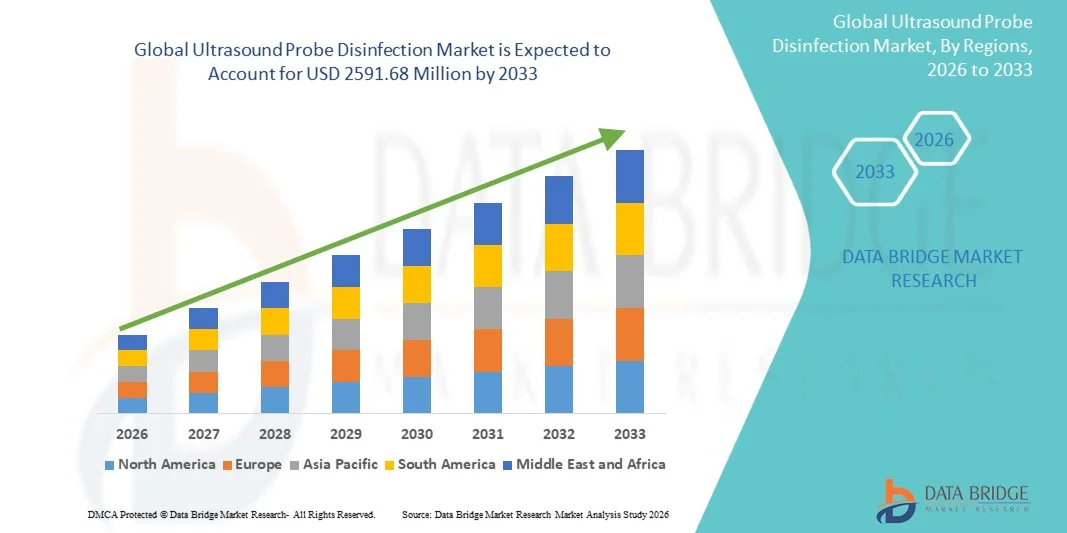
- The global ultrasound probe disinfection market size was valued at USD 763.79 Million in 2025and is expected to reach USD 2591.68 Million by 2033, at a CAGR of 16.50% during the forecast period
- The market growth is largely fueled by the increasing focus on infection prevention and control in healthcare settings, along with stringent regulatory guidelines for medical device reprocessing, leading to greater adoption of advanced ultrasound probe disinfection solutions
- Furthermore, rising demand for patient safety, growing use of ultrasound procedures across diagnostic and therapeutic applications, and the need for efficient, user-friendly, and automated disinfection systems are establishing ultrasound probe disinfection solutions as essential components of modern healthcare. These converging factors are accelerating the uptake of ultrasound probe disinfection solutions, thereby significantly boosting the industry's growth
Ultrasound Probe Disinfection Market Analysis
- Ultrasound probe disinfection solutions, including high-level disinfection systems, automated reprocessors, and consumables, are increasingly vital components of modern healthcare settings due to their critical role in preventing cross-contamination and ensuring patient safety during diagnostic and interventional procedures
- The escalating demand for ultrasound probe disinfection solutions is primarily fueled by stringent infection control regulations, increasing use of ultrasound imaging across specialties, and growing awareness regarding hospital-acquired infections (HAIs)
- North America dominated the ultrasound probe disinfection market with the largest revenue share of 37.9% in 2025, characterized by advanced healthcare infrastructure, strict regulatory compliance, and high adoption of automated disinfection technologies, with the U.S. experiencing substantial growth driven by continuous technological advancements and strong presence of key market players
- Asia-Pacific is expected to be the fastest growing region in the Ultrasound Probe Disinfection market during the forecast period due to expanding healthcare infrastructure, increasing diagnostic imaging procedures, and rising awareness about infection prevention practices
- The high-level disinfection (HLD) segment held the largest market revenue share of 52.3% in 2025, driven by its critical role in eliminating bacteria, viruses, fungi, and spores from semi-critical ultrasound probes
Report Scope and Ultrasound Probe Disinfection Market Segmentation
|
Attributes |
Ultrasound Probe Disinfection Key Market Insights |
|
Segments Covered |
|
|
Countries Covered |
North America · U.S. · Canada · Mexico Europe · Germany · France · U.K. · Netherlands · Switzerland · Belgium · Russia · Italy · Spain · Turkey · Rest of Europe Asia-Pacific · China · Japan · India · South Korea · Singapore · Malaysia · Australia · Thailand · Indonesia · Philippines · Rest of Asia-Pacific Middle East and Africa · Saudi Arabia · U.A.E. · South Africa · Egypt · Israel · Rest of Middle East and Africa South America · Brazil · Argentina · Rest of South America |
|
Key Market Players |
· Nanosonics Ltd. (Australia) · CIVCO Medical Solutions (U.S.) · Advanced Sterilization Products (ASP) (U.S.) · Ecolab Inc. (U.S.) · Steris plc (Ireland) · Getinge AB (Sweden) · Tristel plc (U.K.) · Metrex Research, LLC (U.S.) · Parker Laboratories, Inc. (U.S.) · Virox Technologies Inc. (Canada) · Schülke & Mayr GmbH (Germany) · 3M Company (U.S.) · Cantel Medical Corp. (U.S.) · CS Medical LLC (U.S.) · Germitec (France) · Soluscope (France) · Matachana Group (Spain) · Wassenburg Medical B.V. (Netherlands) · Bio-Cide International, Inc. (U.S.) · ReNu Medical, Inc. (U.S.) |
|
Market Opportunities |
· Increasing Emphasis on Infection Control and Regulatory Compliance · Increasing Emphasis on Infection Control and Regulatory Compliance |
|
Value Added Data Infosets |
In addition to the insights on market scenarios such as market value, growth rate, segmentation, geographical coverage, and major players, the market reports curated by the Data Bridge Market Research also include in-depth expert analysis, patient epidemiology, pipeline analysis, pricing analysis, and regulatory framework. |
Ultrasound Probe Disinfection Market Trends
“Increasing Emphasis on Infection Control and High-Level Disinfection Technologies”
- A significant and accelerating trend in the global Ultrasound Probe Disinfection market is the growing emphasis on infection prevention and the adoption of advanced high-level disinfection (HLD) technologies in healthcare settings. This is driven by rising concerns regarding hospital-acquired infections (HAIs) and the need for stringent hygiene protocols
- For instance, automated disinfection systems such as those developed by Nanosonics Limited (trophon system) are widely used in hospitals for high-level disinfection of ultrasound probes, ensuring consistent and effective decontamination while reducing manual errors
- The shift from manual cleaning methods to automated and standardized disinfection solutions is improving operational efficiency and compliance with regulatory guidelines
- Furthermore, increasing regulatory scrutiny and guidelines from healthcare authorities are encouraging the adoption of validated and traceable disinfection processes
- The integration of tracking systems and digital documentation is also enhancing accountability and ensuring adherence to infection control standards
- This trend toward safer, more efficient, and technologically advanced disinfection methods is significantly shaping the growth of the ultrasound probe disinfection market
Ultrasound Probe Disinfection Market Dynamics
Driver
“Rising Incidence of Hospital-Acquired Infections and Increasing Use of Ultrasound Procedures”
- The increasing prevalence of hospital-acquired infections (HAIs), coupled with the growing number of diagnostic and interventional ultrasound procedures, is a major driver for the ultrasound probe disinfection market
- For instance, studies have shown that improperly disinfected probes can transmit pathogens such as bacteria and viruses, prompting healthcare facilities to adopt advanced disinfection systems to minimize infection risks and ensure patient safety
- As ultrasound imaging is widely used across departments such as radiology, cardiology, and obstetrics, the frequency of probe usage has significantly increased, necessitating effective and rapid disinfection solutions
- In addition, growing awareness among healthcare professionals regarding cross-contamination risks is encouraging the adoption of high-level disinfection practices
- The expansion of healthcare infrastructure, particularly in emerging economies, is also contributing to increased demand for reliable disinfection systems
- Moreover, advancements in ultrasound technology and the rising preference for minimally invasive diagnostic procedures are further boosting market growth
Restraint/Challenge
“High Cost of Advanced Disinfection Systems and Compliance Challenges”
- One of the primary challenges in the ultrasound probe disinfection market is the high cost associated with advanced automated disinfection systems and consumables, which can limit adoption, especially in smaller healthcare facilities
- For instance, high-level disinfection units and their proprietary disinfectants often require significant upfront investment and ongoing maintenance costs, making them less accessible for budget-constrained clinics
- In addition, strict regulatory requirements and compliance standards can create operational complexities for healthcare providers, requiring continuous monitoring, documentation, and staff training
- Variability in adherence to disinfection protocols across healthcare settings also poses a challenge, potentially impacting the effectiveness of infection control measures
- Furthermore, concerns related to the compatibility of disinfectants with sensitive ultrasound probes can limit the choice of cleaning solutions
- Addressing these challenges through cost-effective solutions, streamlined compliance processes, and enhanced training programs will be essential for sustained market growth
Ultrasound Probe Disinfection Market Scope
The market is segmented on the basis of products & services, level of disinfection, type of probe, end user, and distribution channel.
- By Products & Services
On the basis of products & services, the Ultrasound Probe Disinfection Market is segmented into instruments, consumables, and services. The consumables segment dominated the largest market revenue share of 48.6% in 2025, driven by the recurring need for disinfectants, wipes, enzymatic cleaners, and high-level disinfection solutions used after every ultrasound procedure. Hospitals and diagnostic centers rely heavily on consumables due to strict infection prevention protocols and regulatory compliance requirements, especially for semi-critical probes. The increasing volume of ultrasound imaging procedures globally further accelerates the consumption rate, making this segment highly revenue-generating. In addition, rising awareness about healthcare-associated infections (HAIs) and cross-contamination risks has strengthened demand for high-quality, effective disinfectant products. The consumables segment also benefits from continuous product innovations, including eco-friendly and rapid-acting disinfectants, enhancing workflow efficiency. Growing outpatient and point-of-care ultrasound usage further boosts demand for portable disinfection consumables. Emerging markets are also contributing significantly due to expanding healthcare infrastructure and improved sterilization practices. The segment’s dominance is reinforced by its essential, repeat-purchase nature, ensuring steady revenue streams.
The instruments segment is anticipated to witness the fastest growth rate with a CAGR of 18.9% from 2026 to 2033, fueled by increasing adoption of automated and high-level disinfection systems. Advanced disinfection instruments offer standardized, time-efficient, and user-independent cleaning processes, reducing human error and improving compliance. Healthcare facilities are increasingly investing in automated reprocessing systems to enhance operational efficiency and meet stringent regulatory guidelines. Technological advancements such as UV-C disinfection, hydrogen peroxide systems, and integrated digital tracking are further driving adoption. The rise in minimally invasive procedures and growing ultrasound usage in emergency and critical care settings are also supporting demand. In addition, hospitals are prioritizing workflow optimization, which encourages investment in automated instruments over manual methods. Increasing focus on patient safety and accreditation standards is accelerating adoption across developed regions. Furthermore, integration with hospital IT systems for tracking and audit purposes adds value to these systems. As healthcare systems modernize globally, the instruments segment is expected to expand rapidly.
- By Level of Disinfection
On the basis of level of disinfection, the market is segmented into low-level disinfection, intermediate-level disinfection, and high-level disinfection. The high-level disinfection (HLD) segment held the largest market revenue share of 52.3% in 2025, driven by its critical role in eliminating bacteria, viruses, fungi, and spores from semi-critical ultrasound probes. HLD is mandatory for probes used in endocavitary and invasive procedures, making it a regulatory requirement in most healthcare settings. The increasing use of transvaginal, transrectal, and transesophageal ultrasound procedures significantly contributes to segment dominance. Hospitals and diagnostic imaging centers prioritize HLD due to stringent infection control protocols and rising medico-legal concerns. The growing burden of infectious diseases and emphasis on patient safety further reinforce the adoption of high-level disinfection methods. In addition, regulatory bodies worldwide are mandating strict sterilization standards, driving demand for HLD solutions. Technological advancements in automated HLD systems also support segment growth. The increasing volume of diagnostic imaging procedures further accelerates demand. As healthcare systems focus on quality care, HLD remains indispensable.
The intermediate-level disinfection segment is expected to witness the fastest CAGR of 17.4% from 2026 to 2033, driven by its growing use in routine diagnostic applications where full sterilization is not always required. This level of disinfection is gaining popularity due to its balance between effectiveness and cost-efficiency. Healthcare facilities increasingly adopt intermediate-level solutions for non-invasive procedures, reducing operational costs while maintaining safety standards. Rising demand for point-of-care ultrasound and portable devices further boosts this segment. In addition, improvements in disinfectant formulations are enhancing efficacy and reducing turnaround time. Expanding outpatient care services and diagnostic centers are also contributing to growth. The segment benefits from ease of use and faster processing compared to high-level methods. Increasing awareness about infection prevention in smaller healthcare settings supports adoption. As cost optimization becomes a priority, intermediate-level disinfection is expected to grow rapidly.
- By Type of Probe
On the basis of type of probe, the market is segmented into critical devices, semicritical devices, and noncritical devices. The semicritical devices segment dominated the largest market revenue share of 46.8% in 2025, as these probes come into contact with mucous membranes and require high-level disinfection. Transvaginal and transrectal probes fall under this category and are widely used in gynecology, urology, and gastroenterology. The increasing prevalence of chronic diseases and rising demand for diagnostic imaging significantly contribute to segment dominance. Strict regulatory guidelines for reprocessing semicritical devices further drive demand. Hospitals prioritize these probes for accurate internal imaging, increasing their usage frequency. In addition, advancements in probe technology are expanding their applications across specialties. Growing awareness about cross-contamination risks also supports the adoption of stringent disinfection protocols. The segment continues to benefit from rising healthcare expenditure globally. The expanding aging population further drives diagnostic procedures.
The critical devices segment is projected to grow at the fastest CAGR of 16.8% from 2026 to 2033, driven by increasing use in invasive and surgical procedures. These probes require sterilization rather than disinfection, making them highly regulated and technologically advanced. The growth is supported by rising minimally invasive surgeries and advancements in interventional imaging. Healthcare providers are investing in high-end probes with enhanced imaging capabilities, boosting demand. In addition, increasing surgical volumes globally contribute to segment expansion. Technological integration with real-time imaging systems further enhances adoption. Emerging economies are also witnessing increased use of advanced probes. Growing focus on precision medicine supports this trend. As surgical procedures rise, demand for critical probes will increase significantly.
- By End User
On the basis of end user, the market is segmented into hospitals & diagnostic imaging centers, ambulatory care centers, maternity centers, academic & research institutes, and others. The hospitals & diagnostic imaging centers segment accounted for the largest market revenue share of 55.1% in 2025, driven by high patient volumes and extensive use of ultrasound imaging across multiple departments. Hospitals require strict infection control protocols, leading to consistent demand for advanced disinfection solutions. The availability of skilled professionals and advanced infrastructure further supports segment dominance. Increasing diagnostic procedures and hospital admissions contribute significantly to growth. In addition, regulatory compliance requirements drive continuous adoption of disinfection systems. The rise in chronic diseases and aging populations increases imaging demand. Hospitals also invest heavily in automated disinfection technologies to improve efficiency. The segment benefits from strong reimbursement frameworks in developed regions.
The ambulatory care centers segment is expected to witness the fastest CAGR of 18.2% from 2026 to 2033, driven by the shift toward outpatient care and minimally invasive procedures. These centers are increasingly adopting portable ultrasound systems, boosting demand for compact disinfection solutions. Cost-effectiveness and shorter patient stays make ambulatory centers attractive, supporting growth. Rising healthcare decentralization further accelerates adoption. In addition, increasing investments in outpatient infrastructure contribute to expansion. Technological advancements in portable disinfection devices enhance usability. Growing awareness about infection control in outpatient settings supports demand. Emerging markets are also witnessing rapid expansion of ambulatory care services.
- By Distribution Channel
On the basis of distribution channel, the market is segmented into direct tender, third-party distributors, and others. The direct tender segment held the largest market revenue share of 49.7% in 2025, driven by bulk procurement by hospitals and healthcare institutions. Direct purchasing ensures cost efficiency, product authenticity, and long-term supplier relationships. Governments and large healthcare organizations prefer tender-based procurement for high-value equipment and consumables. This channel also allows better compliance with regulatory standards and quality assurance. Increasing public healthcare investments further support segment dominance. In addition, centralized procurement systems enhance operational efficiency. The segment benefits from large-scale contracts and consistent demand.
The third-party distributors segment is projected to grow at the fastest CAGR of 17.6% from 2026 to 2033, driven by expanding access in remote and emerging markets. Distributors play a crucial role in reaching smaller healthcare facilities and clinics. Increasing demand for quick product availability and after-sales support supports this segment. In addition, distributors help manufacturers expand their geographic presence. Growth in private healthcare facilities further boosts demand. Flexible supply chain networks enhance market penetration. Rising e-commerce integration also contributes to growth. As healthcare access expands globally, distributor networks will grow rapidly.
Ultrasound Probe Disinfection Market Regional Analysis
- North America dominated the ultrasound probe disinfection market with the largest revenue share of 37.9% in 2025, characterized by advanced healthcare infrastructure, strict regulatory compliance, and high adoption of automated disinfection technologies
- The region is witnessing strong demand for high-level disinfection systems due to increasing focus on infection prevention and control in healthcare settings
- In addition, the growing number of diagnostic imaging procedures and stringent guidelines from regulatory bodies are further supporting market growth, with the U.S. experiencing substantial expansion driven by continuous technological advancements and a strong presence of key market players
U.S. Ultrasound Probe Disinfection Market Insight
The U.S. ultrasound probe disinfection market captured the largest revenue share in 2025 within North America, fueled by the increasing volume of ultrasound procedures and heightened awareness regarding hospital-acquired infections. Healthcare providers are increasingly adopting automated and high-level disinfection systems to ensure patient safety and regulatory compliance. Furthermore, the presence of advanced healthcare facilities, strong reimbursement frameworks, and continuous innovation in disinfection technologies are contributing significantly to market growth.
Europe Ultrasound Probe Disinfection Market Insight
The Europe ultrasound probe disinfection market is projected to expand at a substantial CAGR throughout the forecast period, primarily driven by stringent infection control regulations and increasing emphasis on patient safety. The growing adoption of advanced disinfection systems across hospitals and diagnostic centers, along with rising awareness regarding cross-contamination risks, is supporting market expansion. In addition, the increasing number of ultrasound imaging procedures is further boosting demand in the region.
U.K. Ultrasound Probe Disinfection Market Insight
The U.K. ultrasound probe disinfection market is anticipated to grow at a noteworthy CAGR during the forecast period, driven by strong regulatory frameworks and increasing focus on infection prevention practices. The rising number of diagnostic imaging procedures and growing awareness among healthcare professionals regarding proper probe reprocessing are encouraging the adoption of advanced disinfection systems. In addition, improvements in healthcare infrastructure are contributing to sustained market growth.
Germany Ultrasound Probe Disinfection Market Insight
The Germany ultrasound probe disinfection market is expected to expand at a considerable CAGR during the forecast period, fueled by increasing healthcare expenditure and strong demand for technologically advanced disinfection solutions. Germany’s well-established healthcare system and emphasis on hygiene standards are promoting the adoption of automated and efficient disinfection technologies. Furthermore, the growing focus on patient safety and regulatory compliance is driving market growth.
Asia-Pacific Ultrasound Probe Disinfection Market Insight
The Asia-Pacific ultrasound probe disinfection market is poised to grow at the fastest CAGR during the forecast period of 2026 to 2033, driven by expanding healthcare infrastructure, increasing diagnostic imaging procedures, and rising awareness about infection prevention practices. The region is witnessing rapid growth in hospital and diagnostic center establishments, along with improved access to healthcare services. Government initiatives aimed at strengthening healthcare systems are further supporting market expansion.
Japan Ultrasound Probe Disinfection Market Insight
The Japan ultrasound probe disinfection market is gaining momentum due to the country’s advanced healthcare system and increasing focus on patient safety. The market is characterized by high adoption of innovative disinfection technologies and strong regulatory compliance. In addition, the growing aging population and rising demand for diagnostic imaging are contributing to market growth.
China Ultrasound Probe Disinfection Market Insight
The China ultrasound probe disinfection market accounted for the largest market revenue share in Asia Pacific in 2025, attributed to the country’s rapidly expanding healthcare infrastructure and increasing number of diagnostic procedures. Rising awareness regarding infection control and improving access to advanced disinfection technologies are driving market growth. Furthermore, government initiatives to enhance healthcare quality and the presence of domestic manufacturers are key factors propelling the market in China.
Ultrasound Probe Disinfection Market Share
The Ultrasound Probe Disinfection industry is primarily led by well-established companies, including:
- Nanosonics Ltd. (Australia)
- CIVCO Medical Solutions (U.S.)
- Advanced Sterilization Products (ASP) (U.S.)
- Ecolab Inc. (U.S.)
- Steris plc (Ireland)
- Getinge AB (Sweden)
- Tristel plc (U.K.)
- Metrex Research, LLC (U.S.)
- Parker Laboratories, Inc. (U.S.)
- Virox Technologies Inc. (Canada)
- Schülke & Mayr GmbH (Germany)
- 3M Company (U.S.)
- Cantel Medical Corp. (U.S.)
- CS Medical LLC (U.S.)
- Germitec (France)
- Soluscope (France)
- Matachana Group (Spain)
- Wassenburg Medical B.V. (Netherlands)
- Bio-Cide International, Inc. (U.S.)
- ReNu Medical, Inc. (U.S.)
Latest Developments in Global Ultrasound Probe Disinfection Market
- In March 2021, healthcare demand for automated ultrasound probe disinfection systems declined temporarily due to reduced elective procedures during the COVID-19 pandemic, impacting companies such as Nanosonics; however, the situation highlighted the critical importance of infection prevention technologies and high-level disinfection systems in maintaining patient safety in clinical environments
- In June 2023, global healthcare systems accelerated the adoption of high-level disinfection (HLD) technologies for ultrasound probes, driven by stricter infection control regulations and rising awareness of healthcare-associated infections, leading to increased deployment of automated and traceable disinfection systems in hospitals and diagnostic centers
- In February 2024, research studies highlighted the growing role of UV-C–based disinfection technologies for ultrasound probes, focusing on improving microbial inactivation efficiency and addressing limitations related to inconsistent surface exposure, thereby supporting innovation in non-chemical disinfection solutions
- In August 2025, Nanosonics announced the launch of its trophon3 system along with trophon2 Plus software upgrades, designed to deliver automated high-level disinfection of ultrasound probes with enhanced workflow efficiency, digital traceability, and improved compliance monitoring capabilities
- In August 2025, the trophon3 system introduced faster disinfection cycles, improved connectivity features, and integrated compliance tracking, enabling healthcare facilities to reduce cross-contamination risks and meet evolving regulatory standards for ultrasound probe reprocessing
- In August 2025, regulatory documentation updates from the U.S. Food and Drug Administration (FDA) reaffirmed the continued use and evolution of automated hydrogen peroxide–based ultrasound probe disinfection systems, supporting ongoing product innovation and compliance with infection control standards
- In September 2025, industry developments showed increasing integration of digital traceability, RFID tracking, and software-driven compliance systems into ultrasound probe disinfection workflows, helping healthcare providers enhance audit readiness and reduce manual errors in reprocessing procedures
- In October 2025, healthcare providers globally continued shifting toward automated, chemical-controlled, and fast-cycle disinfection technologies, including hydrogen peroxide mist systems and UV-C cabinets, to improve operational efficiency and ensure consistent high-level disinfection in high-volume imaging settings
SKU-
Get online access to the report on the World's First Market Intelligence Cloud

- Interactive Data Analysis Dashboard
- Company Analysis Dashboard for high growth potential opportunities
- Research Analyst Access for customization & queries
- Competitor Analysis with Interactive dashboard
- Latest News, Updates & Trend analysis
- Harness the Power of Benchmark Analysis for Comprehensive Competitor Tracking
Research Methodology
Data collection and base year analysis are done using data collection modules with large sample sizes. The stage includes obtaining market information or related data through various sources and strategies. It includes examining and planning all the data acquired from the past in advance. It likewise envelops the examination of information inconsistencies seen across different information sources. The market data is analysed and estimated using market statistical and coherent models. Also, market share analysis and key trend analysis are the major success factors in the market report. To know more, please request an analyst call or drop down your inquiry.
The key research methodology used by DBMR research team is data triangulation which involves data mining, analysis of the impact of data variables on the market and primary (industry expert) validation. Data models include Vendor Positioning Grid, Market Time Line Analysis, Market Overview and Guide, Company Positioning Grid, Patent Analysis, Pricing Analysis, Company Market Share Analysis, Standards of Measurement, Global versus Regional and Vendor Share Analysis. To know more about the research methodology, drop in an inquiry to speak to our industry experts.
Customization Available
Data Bridge Market Research is a leader in advanced formative research. We take pride in servicing our existing and new customers with data and analysis that match and suits their goal. The report can be customized to include price trend analysis of target brands understanding the market for additional countries (ask for the list of countries), clinical trial results data, literature review, refurbished market and product base analysis. Market analysis of target competitors can be analyzed from technology-based analysis to market portfolio strategies. We can add as many competitors that you require data about in the format and data style you are looking for. Our team of analysts can also provide you data in crude raw excel files pivot tables (Fact book) or can assist you in creating presentations from the data sets available in the report.












