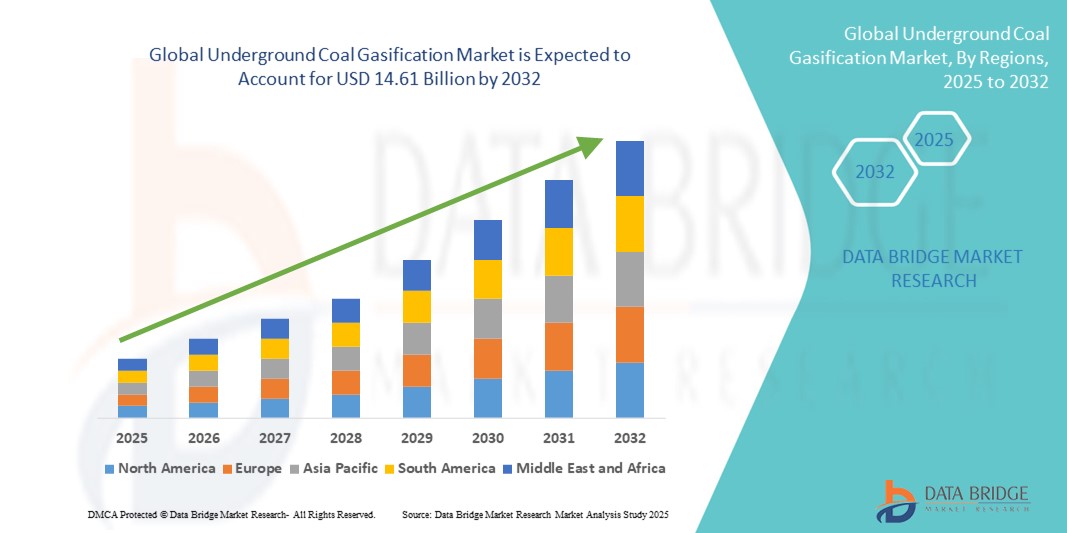
Underground Coal Gasification Market Size
- The global underground coal gasification market size was valued at USD 8.44 billion in 2024 and is expected to reach USD 14.61 billion by 2032, at a CAGR of 7.10% during the forecast period
- The market growth is primarily driven by the increasing demand for clean and efficient energy production and rising environmental awareness promoting cleaner energy alternatives
- Growing adoption of underground coal gasification (UCG) for power generation and chemical production, coupled with advancements in carbon capture and storage (CCS) technologies, is further propelling market demand across both developed and emerging economies
Underground Coal Gasification Market Analysis
- The underground coal gasification market is experiencing steady growth as industries seek cost-effective and environmentally friendly methods to access deep coal reserves without traditional mining
- Rising demand for hydrogen-rich syngas for applications such as chemical production, synthetic natural gas, and power generation is encouraging innovation in UCG technologies, particularly in fluidized bed and entrained flow gasifiers
- Asia-Pacific dominated the underground coal gasification market with the largest revenue share of 41.4% in 2024, driven by abundant coal reserves and growing energy needs in countries such as China and India
- North America is expected to be the fastest-growing region during the forecast period, propelled by advancements in UCG technologies, increasing investments in clean energy, and supportive regulatory frameworks in the U.S. and Canada
- The in-situ gasification segment dominated the largest market revenue share of 62.3% in 2024, driven by its cost-effectiveness and ability to access unmineable coal reserves without traditional mining operations. In-situ gasification involves converting coal into syngas directly within the underground seam, reducing surface disruption and eliminating the need for coal extraction and transportation
Report Scope and Underground Coal Gasification Market Segmentation
|
Attributes |
Underground Coal Gasification Key Market Insights |
|
Segments Covered |
|
|
Countries Covered |
North America
Europe
Asia-Pacific
Middle East and Africa
South America
|
|
Key Market Players |
|
|
Market Opportunities |
|
|
Value Added Data Infosets |
In addition to the insights on market scenarios such as market value, growth rate, segmentation, geographical coverage, and major players, the market reports curated by the Data Bridge Market Research also include import export analysis, production capacity overview, production consumption analysis, price trend analysis, climate change scenario, supply chain analysis, value chain analysis, raw material/consumables overview, vendor selection criteria, PESTLE Analysis, Porter Analysis, and regulatory framework. |
Underground Coal Gasification Market Trends
Increasing Integration of AI and Big Data Analytics
- The global underground coal gasification (UCG) market is experiencing a notable trend toward integrating Artificial Intelligence (AI) and Big Data analytics
- These technologies enable advanced data processing and analysis, providing deeper insights into gasification processes, operational efficiency, and environmental impact monitoring
- AI-powered UCG solutions facilitate proactive optimization, identifying potential operational inefficiencies or safety issues before they escalate, reducing downtime and operational costs
- For instance, companies are developing AI-driven platforms to monitor real-time gasification parameters, optimize syngas production, and predict maintenance needs for gasifiers based on environmental and geological data
- This trend enhances the efficiency and environmental compliance of UCG systems, making them more appealing to energy producers and industrial operators
- AI algorithms analyze extensive data sets, including gas composition, temperature variations, and geological conditions, to improve process control and minimize greenhouse gas emissions
Underground Coal Gasification Market Dynamics
Driver
Rising Demand for Clean Energy and Efficient Resource Utilization
- The increasing global demand for cleaner energy alternatives and efficient use of coal resources is a major driver for the UCG market
- UCG systems provide an alternative to traditional coal mining by converting coal into syngas in-situ, reducing surface disruption and enabling access to deep or uneconomical coal seams
- Government initiatives, particularly in Asia-Pacific countries such as China and India, are promoting UCG to leverage abundant coal reserves while addressing environmental concerns through carbon capture and storage (CCS) integration
- The advancement of IoT and 5G technologies is enhancing UCG applications, enabling real-time monitoring and data transmission for more efficient and safer gasification processes
- Energy companies are increasingly adopting UCG to produce syngas for power generation, chemical production, and synthetic fuels, aligning with global energy transition goals
Restraint/Challenge
High Implementation Costs and Environmental Concerns
- The significant initial investment required for UCG infrastructure, including drilling, gasifier setup, and monitoring systems, poses a barrier to adoption, particularly in emerging markets with limited capital
- Integrating UCG systems into existing energy or industrial frameworks can be complex and costly, requiring specialized expertise and equipment
- Environmental concerns, such as potential groundwater contamination and greenhouse gas emissions, remain a major challenge. UCG processes generate sensitive data and byproducts, raising concerns about environmental impact and compliance with stringent regulations
- The fragmented regulatory landscape across countries regarding environmental standards, emissions, and land use complicates operations for international UCG operators
- These factors can deter adoption and limit market expansion, particularly in regions with high environmental awareness or cost sensitivity
Underground Coal Gasification market Scope
The market is segmented on the basis of technology type, application, end-user industry, and gasifier.
- By Technology Type
On the basis of technology type, the global underground coal gasification (UCG) market is segmented into in-situ gasification and ex-situ gasification. The in-situ gasification segment dominated the largest market revenue share of 62.3% in 2024, driven by its cost-effectiveness and ability to access unmineable coal reserves without traditional mining operations. In-situ gasification involves converting coal into syngas directly within the underground seam, reducing surface disruption and eliminating the need for coal extraction and transportation. This technology’s lower capital requirements and reduced environmental footprint make it highly attractive for energy-producing regions with deep or low-quality coal deposits.
The ex-situ gasification segment is expected to register the fastest growth rate from 2025 to 2032, as advancements in surface-based gasification technologies improve efficiency and scalability. Ex-situ gasification allows for greater control over the gasification process and is preferred for applications requiring high-purity syngas, such as chemical production. The flexibility to process coal in controlled environments and integrate with advanced carbon capture and storage (CCS) systems is driving its adoption among industries seeking cleaner energy solutions.
- By Application
On the basis of application, the global underground coal gasification market is categorized into power generation, chemical production, synthetic natural gas (SNG), fuel production, and others. The power generation segment accounted for the highest revenue share in 2024, supported by the global demand for cleaner and more efficient electricity generation technologies. UCG enables the production of syngas for use in integrated gasification combined cycle (IGCC) systems, which offer higher efficiency and lower emissions compared to traditional coal-fired power plants. The ability to utilize unmineable coal reserves for large-scale power generation further drives this segment’s dominance.
The chemical production segment is anticipated to grow at the fastest CAGR from 2025 to 2032, propelled by the increasing demand for syngas as a feedstock for producing chemicals such as methanol, ammonia, and fertilizers. UCG’s ability to produce hydrogen-rich syngas supports its adoption in chemical manufacturing, particularly in regions with abundant coal reserves. The growing focus on sustainable chemical production and the integration of CCS technologies are key factors accelerating this segment’s growth.
- By End-User Industry
On the basis of end-user industry, the global underground coal gasification market is segmented into energy, chemical, metallurgical, environmental, and others. The energy segment held the largest revenue share in 2024, attributed to the rising global energy demand and the need for cost-effective, low-emission energy sources. UCG provides a viable alternative for countries with significant coal reserves, enabling energy security through domestic resources. The integration of UCG with IGCC and carbon capture technologies further enhances its appeal for large-scale energy production.
The chemical industry segment is projected to grow at the fastest rate from 2025 to 2032, driven by the increasing use of syngas in chemical manufacturing and the global push for cleaner production processes. UCG’s ability to produce high-purity hydrogen and carbon monoxide supports its adoption in the synthesis of chemicals, particularly in Asia-Pacific, where industrial growth is robust. The metallurgical and environmental segments are also gaining traction due to UCG’s potential in steel production and carbon capture applications.
- By Gasifier
On the basis of gasifier, the global underground coal gasification market is segmented into fixed bed, fluidized bed, and entrained flow. The fluidized bed segment accounted for the largest revenue share in 2024, driven by its high efficiency and ability to handle a variety of feedstocks, including low-quality coals. Fluidized bed gasifiers offer excellent mixing and heat transfer, resulting in higher reaction rates and cleaner syngas production, making them ideal for power generation and chemical applications.
The entrained flow segment is expected to grow at the fastest CAGR from 2025 to 2032, owing to its superior efficiency and flexibility in processing diverse coal types. Entrained flow gasifiers produce clean, tar-free syngas, which is critical for high-purity applications such as hydrogen production and chemical synthesis. The segment’s growth is further supported by technological advancements and increasing investments in clean energy solutions.
Underground Coal Gasification Market Regional Analysis
- Asia-Pacific dominated the underground coal gasification market with the largest revenue share of 41.4% in 2024, driven by abundant coal reserves and growing energy needs in countries such as China and India
- Consumers and industries prioritize UCG for its ability to access deep or unmineable coal seams, reducing mining costs and environmental impacts while producing syngas for various applications
- Growth is supported by advancements in gasification technologies, including in-situ and ex-situ methods, alongside rising adoption in energy, chemical, and synthetic fuel production sectors
Japan Underground Coal Gasification Market Insight
Japan’s underground coal gasification market is expected to witness notable growth due to strong consumer and industry preference for high-efficiency, low-emission energy solutions. The presence of advanced technological infrastructure and integration of UCG in power generation accelerate market penetration. Rising interest in synthetic natural gas and chemical production also contributes to growth.
China Underground Coal Gasification Market Insight
China holds the largest share of the Asia-Pacific underground coal gasification market, propelled by rapid industrialization, rising energy demands, and extensive coal reserves. The country’s focus on energy security and reduced environmental impact supports the adoption of advanced UCG technologies. Strong domestic research capabilities and government-backed projects enhance market accessibility.
U.S. Underground Coal Gasification Market Insight
The U.S. underground coal gasification market is expected to witness significant growth, fueled by strong research and development efforts and growing interest in cleaner energy alternatives. The trend towards utilizing unmineable coal reserves and advancements in carbon capture and storage (CCS) technologies further boost market expansion. Pilot projects and government support for sustainable energy solutions complement the adoption of UCG technologies.
Europe Underground Coal Gasification Market Insight
The Europe underground coal gasification market is expected to witness significant growth, supported by regulatory emphasis on reducing carbon emissions and enhancing energy security. Industries seek UCG technologies that provide cleaner syngas production while meeting stringent environmental standards. The growth is prominent in both power generation and chemical production applications, with countries such as Germany and Poland showing notable uptake due to energy diversification needs.
U.K. Underground Coal Gasification Market Insight
The U.K. market for underground coal gasification is expected to witness steady growth, driven by demand for sustainable energy solutions and reduced reliance on traditional fossil fuels. Increased interest in syngas for chemical production and power generation encourages adoption. Evolving environmental regulations and focus on carbon capture technologies influence project development, balancing efficiency with compliance.
Germany Underground Coal Gasification Market Insight
Germany is expected to witness significant growth in underground coal gasification, attributed to its advanced energy sector and high focus on environmental sustainability. German industries prefer technologically advanced UCG systems that reduce greenhouse gas emissions and enhance energy efficiency. The integration of UCG in power generation and chemical industries supports sustained market growth.
Underground Coal Gasification Market Share
The underground coal gasification industry is primarily led by well-established companies, including:
- Air Products and Chemicals, Inc. (U.S.)
- Sasol Limited (South Africa)
- Siemens (Germany)
- Air Liquide (France)
- BASF SE (Germany)
- BP p.l.c (U.K.)
- Linde plc (Germany)
- General Electric (U.S.)
- Haldor Topsoe (Denmark)
- Royal Dutch Shell (Netherlands)
- Eskom Holdings (South Africa)
- Adani Group (India)
What are the Recent Developments in Global Underground Coal Gasification Market?
- In October 2023, Shell and Chevron announced a partnership to develop a new Underground Coal Gasification (UCG) project in Australia, marking a significant step toward sustainable coal utilization. The initiative aims to convert deep coal seams into syngas through in-situ gasification, reducing the need for traditional mining and lowering CO₂ emissions. This collaboration reflects a broader industry push to balance energy security with environmental responsibility, leveraging advanced technologies to unlock cleaner energy from coal while supporting Australia’s transition to a low-carbon future
- In June 2023, India’s Ministry of Coal launched its first-ever pilot project for Underground Coal Gasification (UCG) at the Kasta coal block in Jamtara district, Jharkhand. This initiative is a collaboration between Eastern Coalfields Limited (ECL), Central Mine Planning and Design Institute (CMPDI) Ranchi, and Ergo Exergy Technologies Inc. (EETI) from Canada. The project aims to convert deep coal seams into valuable gases such as methane and hydrogen through in-situ gasification, reducing environmental impact and unlocking previously inaccessible coal reserves. It marks a major step toward advanced coal utilization and energy innovation in India
- In March 2023, India’s Ministry of Coal approved incentive scheme to promote coal and lignite gasification projects through Viability Gap Funding (VGF). The scheme supports both public sector undertakings (PSUs) and private companies, aiming to accelerate the adoption of clean coal technologies and maximize the use of difficult-to-mine coal reserves. It is structured into three categories, covering large-scale, small-scale, and demonstration projects, with the goal of achieving 100 million tonnes of coal gasification by 2030, reducing import dependency and enhancing energy security
- In February 2023, the Ministry of Coal, Government of India, directed Coal India Limited (CIL) to form two joint ventures with BHEL and GAIL to undertake coal gasification projects. This strategic move aligns with India’s Coal Gasification Mission, which targets 100 million tonnes of coal gasification by 2030. The joint ventures aim to commercialize home-grown gasification technologies, reduce reliance on imported fuels, and unlock value from high-ash and difficult-to-mine coal reserves. The initiative supports cleaner energy production and promotes self-reliance in critical industrial sectors
- In January 2023, research spanning 2023–2024 identified transformative advancements in Underground Coal Gasification (UCG), notably the development of an integrated UCG–Coalbed Methane (CBM)–Carbon Capture, Utilization, and Storage (CCUS) process. This integrated approach is seen as a critical pathway for the industrialization of UCG, enabling cleaner energy production from coal while addressing environmental concerns. The synergy between UCG, CBM extraction, and CCUS enhances efficiency, supports carbon neutrality, and promotes real-time monitoring and safety innovations, including groundwater protection and emission reduction strategies

- Interactive Data Analysis Dashboard
- Company Analysis Dashboard for high growth potential opportunities
- Research Analyst Access for customization & queries
- Competitor Analysis with Interactive dashboard
- Latest News, Updates & Trend analysis
- Harness the Power of Benchmark Analysis for Comprehensive Competitor Tracking
Data collection and base year analysis are done using data collection modules with large sample sizes. The stage includes obtaining market information or related data through various sources and strategies. It includes examining and planning all the data acquired from the past in advance. It likewise envelops the examination of information inconsistencies seen across different information sources. The market data is analysed and estimated using market statistical and coherent models. Also, market share analysis and key trend analysis are the major success factors in the market report. To know more, please request an analyst call or drop down your inquiry.
The key research methodology used by DBMR research team is data triangulation which involves data mining, analysis of the impact of data variables on the market and primary (industry expert) validation. Data models include Vendor Positioning Grid, Market Time Line Analysis, Market Overview and Guide, Company Positioning Grid, Patent Analysis, Pricing Analysis, Company Market Share Analysis, Standards of Measurement, Global versus Regional and Vendor Share Analysis. To know more about the research methodology, drop in an inquiry to speak to our industry experts.
Data Bridge Market Research is a leader in advanced formative research. We take pride in servicing our existing and new customers with data and analysis that match and suits their goal. The report can be customized to include price trend analysis of target brands understanding the market for additional countries (ask for the list of countries), clinical trial results data, literature review, refurbished market and product base analysis. Market analysis of target competitors can be analyzed from technology-based analysis to market portfolio strategies. We can add as many competitors that you require data about in the format and data style you are looking for. Our team of analysts can also provide you data in crude raw excel files pivot tables (Fact book) or can assist you in creating presentations from the data sets available in the report.