What is the Underwater Concrete Market Size and Growth Rate?
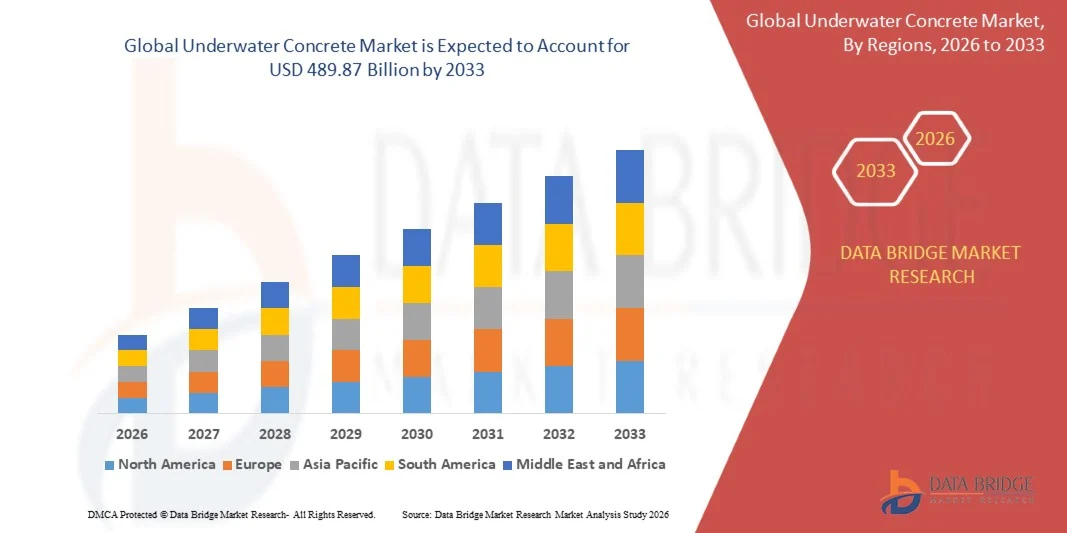
- As per Data Bridge Market Research analysis, the underwater concrete market was valued at USD 272.63 billion in 2025 and is projected to reach USD 489.87 billion by 2033, growing at a CAGR of 7.60% from 2026 to 2033.
- The market is experiencing consistent growth driven by rising investment in bridges, ports, dams, and coastal protection, increasing rehabilitation of aging submerged infrastructure, and expanding offshore energy foundations that require concrete to be placed in water without losing cement or fines.
- The increasing adoption of anti-washout admixtures, self-consolidating mixes, and engineered placement methods, combined with growing emphasis on durability and environmental protection during marine construction, is supporting market adoption. Underwater concrete is being applied across port and harbor construction, bridge and pier foundations, hydropower structures, and construction chemicals and admixture systems, offering contractors a reliable method for casting structural concrete below the waterline.
Market Size & Forecast
- Global Market Value (2025): USD 272.63 Billion
- Expected Market Value (2033): USD 489.87 Billion
- Forecast CAGR (2026–2033): 7.60%
- Absolute Market Expansion (2025–2033): USD 217.23 Billion
- Growth Multiple (2025–2033): 1.80x
- Leading Region in 2025: Asia-Pacific
- Fastest Growing Region: Middle East and Africa
What are the Major Takeaways of the Underwater Concrete Market?
- Asia-Pacific dominated the underwater concrete market with the largest revenue share of 38.90% in 2025, supported by large-scale port, bridge, hydropower, and coastal infrastructure programs across China, India, Japan, and Southeast Asia.
- Middle East and Africa is expected to be the fastest-growing region at a CAGR of 9.10% from 2026 to 2033, fueled by coastal megaprojects, port expansion, desalination and energy infrastructure, and growing marine construction activity.
- The tremie mix concrete segment led the type category with a 39.80% share in 2025, driven by its long-established use in deep foundations, caissons, and pile cut-offs.
- Anti-washout concrete is the fastest-growing type, projected to register a CAGR of 9.80%, reflecting demand for non-dispersible mixes that reduce cement loss and environmental impact during placement.
- The tremie placement segment dominated the method category with a 46.30% revenue share in 2025, led by its suitability for large-volume placements in deep water.
- Bridge & pier foundations accounted for 33.90% of the market share in 2025, preferred by increasing construction and rehabilitation of river and sea crossings.
- The offshore wind & energy foundations segment is the fastest-growing application category, with a CAGR of 10.40%, driven by rising investment in offshore wind, subsea grouting, and coastal energy infrastructure.
Report Scope and Underwater Concrete Market Segmentation
|
Attributes |
Underwater Concrete Key Market Insights |
|
Segments Covered |
|
|
Countries Covered |
North America
Europe
Asia-Pacific
Middle East and Africa
South America
|
|
Key Market Players |
|
|
Market Opportunities |
|
|
Value Added Data Infosets |
In addition to the insights on market scenarios such as market value, growth rate, segmentation, geographical coverage, and major players, the market reports curated by the Data Bridge Market Research also include import export analysis, production capacity overview, production consumption analysis, price trend analysis, climate change scenario, supply chain analysis, value chain analysis, raw material/consumables overview, vendor selection criteria, PESTLE Analysis, Porter Analysis, and regulatory framework. |
What is the Key Trend in the Underwater Concrete Market?
- Underwater concrete is increasingly shifting from conventional tremie placement toward engineered anti-washout and self-consolidating mixes, supported by polymer and biopolymer admixtures, supplementary cementitious materials, and fiber reinforcement that improve cohesion and strength during placement in water.
- For instance, in March 2024, according to Buildings (MDPI), researchers comparing anionic and nonionic anti-washout admixtures found that anionic admixtures were more effective at improving workability and strength, with 28-day compressive strength reaching 37.00 MPa, an increase of 151.00% over concrete without admixtures and 131.00% over concrete with nonionic admixtures.
- Material innovation is expanding beyond cellulose-based admixtures, with researchers exploring natural biopolymers, nanosilica, and by-product materials to reduce washout while limiting cost and environmental impact.
- Environmental performance is becoming a central design criterion, as anti-washout systems reduce cement leaching and turbidity in surrounding water, helping contractors meet marine and inland-water permit requirements.
- For instance, in April 2024, according to Buildings (MDPI), researchers testing three biopolymers as anti-washout admixtures for underwater concreting reported that all three improved resistance to scouring, while two of them also enhanced compressive, tensile, and flexural strength, highlighting the potential of bio-based alternatives.
- As marine infrastructure ages and offshore energy construction expands, underwater concrete is expected to evolve toward higher-performance, lower-carbon, and more predictable placement systems supported by digital mix design and testing.
What are the Key Drivers of the Underwater Concrete Market?
- Large public investment in bridges, ports, hydropower, and coastal defense, together with the need to repair aging piers, jetties, and dams without lengthy dewatering, is significantly increasing demand for concrete that can be placed directly in water.
- For instance, in December 2025, according to the Vancouver Fraser Port Authority, a public notice for a proposed jetty pile repair described rehabilitating 17 concrete piles using permanent steel encasements, underwater concrete footings, and scour protection, adding about 230.00 m² of underwater footprint and roughly 240.00 m³ of material, with non-shrink underwater concrete or grout placed through tremie pipes.
- Contractors and asset owners are adopting anti-washout admixtures and specialized mixes to reduce material loss, avoid expensive dewatering, and protect surrounding water quality, improving cost and schedule certainty on marine projects.
- For instance, according to a Sika project case study on Folly Pier in Anstruther, Scotland, the Sika Underwater Concrete System was used to place a specially designed mix of 2,000.00 cubic metres, with concrete supplied by Breedon and placed by three divers, enabling repair of a listed harbor structure without altering its external appearance.
- With expanding offshore wind, desalination, and port projects, and growing availability of standardized admixtures and test methods, underwater concrete is becoming a more established and specifiable solution across developed and emerging markets.
What Factors Are Challenging the Growth of the Underwater Concrete Market?
- Underwater concrete requires careful mix design, specialized admixtures, trained crews, and often divers or marine equipment, increasing project cost and complexity compared with concrete placed in dry conditions.
- For instance, in July 2024, according to the LACCEI conference proceedings, researchers testing structural concrete placed underwater with MasterMatrix UW 450 at 260, 780, and 1,300.00 ml per 100 kg of cement recorded compressive strength reductions of 21.10%, 45.06%, and 45.90%, respectively, compared with standard dry-cast concrete, highlighting the strength trade-offs of underwater placement.
- These technical requirements can create challenges related to dosage control, viscosity management, compatibility with superplasticizers and supplementary cementitious materials, and maintaining uniform quality in deep, turbulent, or tidal conditions.
- Project delays caused by weather, currents, permitting, and environmental restrictions can also raise costs and limit the number of suitable working days for underwater placement.
- For instance, according to the Engineering and Technology Journal (Vol. 44, Issue 5), an experimental study of engineered cementitious composites for underwater concrete found that increasing anti-washout admixture improved underwater stability but that excessive viscosity adversely affected strength and ductility, with an optimum mix of 0.70% admixture and 1.75% fiber reaching about 99.60 MPa at 360 days.
- The combination of higher cost, sensitivity to mix design, and dependence on skilled marine labor can constrain adoption among small contractors and cost-sensitive projects, particularly where cofferdams or dewatering remain feasible.
How is the Underwater Concrete Market Segmented?
The underwater concrete market is segmented on the basis of type, placement method, application, and end user.
- By Type
On the basis of type, the underwater concrete market is segmented into tremie mix concrete, anti-washout concrete, preplaced aggregate concrete, and fiber-reinforced & others. The tremie mix concrete segment dominated the market with 39.80% share in 2025, supported by its long-established use in caissons, piles, pier footings, and deep foundations. Tremie mixes are widely specified in national standards and are familiar to contractors and inspectors. They can be produced by ready-mix suppliers using locally available materials and standard admixtures. Large-volume infrastructure projects continue to rely on tremie mixes for predictable, cost-effective placement.
The anti-washout concrete segment is projected to register the fastest growth at a CAGR of 9.80% from 2026 to 2033, driven by increasing demand for non-dispersible mixes that reduce cement loss and turbidity during placement. These mixes use cellulose, polymer, or biopolymer admixtures to create cohesive, self-leveling concrete that can be placed without dewatering. Their use is expanding in repair work, shallow-water construction, and environmentally sensitive sites. Advances in admixture chemistry and compatibility with supplementary cementitious materials are improving performance. Growing regulatory focus on water quality is further supporting adoption.
- By Placement Method
On the basis of placement method, the underwater concrete market is segmented into tremie, pumping, preplaced aggregate & grouting, and others. The tremie segment dominated the market with 46.30% share in 2025, supported by its suitability for large-volume placements in deep water and in confined formwork. The method keeps fresh concrete from direct contact with water by discharging it below the surface through a pipe. It is widely used for foundations of bridges, quay walls, and caissons. Established contractor expertise and well-documented procedures continue to support the dominance of tremie placement across major infrastructure projects.
The pumping segment is projected to register the fastest growth at a CAGR of 8.90% from 2026 to 2033, driven by increasing use of anti-washout and self-consolidating mixes that can be pumped accurately to the point of placement. Pumping offers faster placement rates, better control over location, and reduced labor compared with bucket methods. Barge-mounted and floating pump systems are expanding access to nearshore and offshore sites. Improvements in pump capacity, hose handling, and monitoring systems are improving reliability. Growing offshore and coastal projects are creating additional opportunities for pumped underwater concrete.
- By Application
On the basis of application, the underwater concrete market is segmented into bridge & pier foundations, dams & hydropower, ports, harbors & marine structures, offshore wind & energy foundations, and others. The bridge & pier foundations segment dominated the application category with 33.90% share in 2025, supported by continued construction of river and sea crossings and rehabilitation of existing piers. Underwater concrete is used for foundation seals, pile caps, scour protection, and pier repairs. Rising traffic loads and the age of existing bridge stock are increasing maintenance and strengthening requirements. Government infrastructure programs further support demand for reliable submerged placement solutions.
The offshore wind & energy foundations segment is projected to register the fastest growth at a CAGR of 10.40% from 2026 to 2033, driven by increasing investment in offshore wind farms, subsea grouting, and coastal energy infrastructure. Underwater grouts and concretes are used for foundations, scour protection, cable protection, and connection details. Larger turbine sizes and deeper sites are increasing the technical demands on submerged materials. Expansion of offshore energy projects in Europe, Asia-Pacific, and North America is creating long-term demand. Performance, durability, and environmental compliance remain important selection criteria.
- By End User
On the basis of end user, the underwater concrete market is segmented into government & public infrastructure, energy & utilities, marine & port operators, and private construction & others. The government & public infrastructure segment dominated the end-user category with 52.70% share in 2025, supported by large public spending on bridges, dams, flood defenses, and coastal works. Public agencies are the main clients for long-life structures where durability and environmental compliance are critical. Multi-year funding programs and rehabilitation backlogs sustain demand for underwater concreting. Standardized specifications and procurement frameworks also favor established materials and contractors.
The energy & utilities segment is projected to register the fastest growth at a CAGR of 9.20% from 2026 to 2033, driven by increasing investment in hydropower refurbishment, offshore wind, desalination intakes, and power-plant cooling structures. Utilities require durable submerged structures that can be built or repaired with minimal service interruption. Underwater concrete and grout enable work in intake tunnels, spillways, and marine foundations. Expansion of renewable energy and aging of existing hydropower assets are creating additional opportunities. Strong emphasis on reliability and environmental protection further supports adoption.
Which Region Holds the Largest Share of the Underwater Concrete Market?
- Asia-Pacific dominated the underwater concrete market with the largest revenue share of 38.90% in 2025, supported by large-scale port, bridge, hydropower, and coastal infrastructure programs across China, India, Japan, and Southeast Asia.
- The region also benefits from rapid urbanization, extensive coastlines and river systems, strong cement and admixture manufacturing capacity, and sustained government investment in transport and energy infrastructure. Increasing use of anti-washout admixtures in bridge, harbor, and dam projects continues to strengthen Asia-Pacific's position in the global market.
U.S. Underwater Concrete Market Insight
The U.S. underwater concrete market is witnessing steady growth due to rising investment in aging bridge, lock-and-dam, port, and coastal infrastructure. Federal and state agencies are funding rehabilitation of submerged structures, creating demand for anti-washout admixtures and tremie placement services. In addition, growing offshore wind development along the Atlantic coast, strong marine contracting expertise, and established specification standards are accelerating adoption of underwater concrete across public and commercial projects.
Asia-Pacific Underwater Concrete Market Insight
The Asia-Pacific underwater concrete market is expected to witness rapid growth, driven by large-scale port, bridge, and hydropower construction, expanding coastal infrastructure, and rising investment in offshore energy across countries such as China, India, and Japan. Strong domestic cement and admixture manufacturing, along with rapid urbanization and flood-protection programs, is supporting regional market expansion. In addition, increasing adoption of advanced anti-washout technologies is accelerating demand.
Japan Underwater Concrete Market Insight
The Japan underwater concrete market is witnessing consistent growth due to the country's extensive coastline, port facilities, and need for seismic-resilient marine structures. Contractors and public agencies have long experience with non-dispersible concrete and are increasingly adopting advanced admixtures for repair and reinforcement work. Moreover, strong demand for durability, quality control, and environmental protection in coastal construction is further contributing to market growth in Japan.
China Underwater Concrete Market Insight
The China underwater concrete market is growing rapidly, driven by large-scale bridge, port, hydropower, and sea-crossing projects and a strong domestic construction chemicals industry. Large state-backed infrastructure programs and expanding coastal development are significantly boosting demand for underwater placement solutions. In addition, growing research activity in anti-washout materials and increasing offshore energy construction are positioning China as a key growth market for underwater concrete across Asia-Pacific.
U.K. Underwater Concrete Market Insight
The U.K. underwater concrete market is experiencing steady growth, supported by the maintenance of aging harbors, piers, and flood defenses and the expansion of offshore wind. Marine contractors, ready-mix suppliers, and admixture companies are increasingly using specialized underwater concrete systems for repair and heritage structures. Furthermore, strict environmental regulation of marine works and growing offshore energy investment are supporting wider adoption of underwater concrete in the U.K.
Germany Underwater Concrete Market Insight
The Germany underwater concrete market is expanding steadily due to the country's extensive inland waterways, ports, and offshore wind activity in the North Sea and Baltic Sea. Civil engineering contractors and public authorities are increasingly using engineered underwater concrete and grout for lock, weir, and foundation work. Continuous advancements in construction chemicals, strong technical standards, and Germany's focus on durability and environmental protection are further driving market growth in the country.
Which are the Top Companies in Underwater Concrete Market?
The underwater concrete industry is primarily led by well-established companies, including:
- Sika AG (Switzerland)
- Mapei S.p.A. (Italy)
- The Euclid Chemical Company (U.S.)
- Fosroc International Limited (U.K.)
- Master Builders Solutions (Germany)
- Holcim Ltd (Switzerland)
- Heidelberg Materials AG (Germany)
- CEMEX, S.A.B. de C.V. (Mexico)
- CRH plc (Ireland)
- Compagnie de Saint-Gobain S.A. (France)
- UltraTech Cement Ltd. (India)
- Taiheiyo Cement Corporation (Japan)
- Anhui Conch Cement Company Limited (China)
- China National Building Material Company Limited (China)
- Votorantim Cimentos S.A. (Brazil)
- Dow Inc. (U.S.)
- Shin-Etsu Chemical Co., Ltd. (Japan)
- Kao Corporation (Japan)
- Normet Group Oy (Finland)
- Fritz-Pak Corporation (U.S.)
What are Latest Developments in Underwater Concrete Market?
- In 2026, Mapei AS published an Environmental Product Declaration (EPD Norge, NEPD-9092-9092-1) for Rescon T, its anti-washout admixture for underwater concrete and mortar, reporting a global warming potential of 1.66 kg CO2e per kg for modules A1–A3, supporting transparent environmental assessment of underwater concrete systems.
- In December 2025, the Vancouver Fraser Port Authority opened a public review of a jetty pile rehabilitation project involving 17 concrete piles, underwater concrete footings, and scour protection placed with barge-mounted equipment and divers, reflecting continued demand for submerged concrete repair.
- In 2021, Euclid Chemical introduced EUCON AWA-P20, a ready-to-use anti-washout admixture that modifies the rheology of self-consolidating concrete to prevent loss of cement and fines during underwater placement, meets ASTM C494 Type S and CRD-C661-06, and reduces the need for dewatering.
- Master Builders Solutions offers MasterMatrix UW 450, a patented liquid cellulose-based anti-washout admixture that meets U.S. Army Corps of Engineers CRD-C 661-06, and MasterMatrix UW 440, a powdered admixture compliant with BS 8443:2005 that can also be used at lower dosages in piling applications, as listed in the company's product literature.
- Sika's Underwater Concrete System, which combines Sika UCS powdered underwater stabilizer with a polycarboxylate superplasticizer, was used on the Folly Pier repair in Anstruther, Scotland, where a specially designed mix of 2,000.00 cubic metres was placed by divers without compaction.
- Interactive Data Analysis Dashboard
- Company Analysis Dashboard for high growth potential opportunities
- Research Analyst Access for customization & queries
- Competitor Analysis with Interactive dashboard
- Latest News, Updates & Trend analysis
- Harness the Power of Benchmark Analysis for Comprehensive Competitor Tracking
Global Underwater Concrete Market, Supply Chain Analysis and Ecosystem Framework
To support market growth and help clients navigate the impact of geopolitical shifts, DBMR has integrated in-depth supply chain analysis into its Global Underwater Concrete Market research reports. This addition empowers clients to respond effectively to global changes affecting their industries. The supply chain analysis section includes detailed insights such as Global Underwater Concrete Market consumption and production by country, price trend analysis, the impact of tariffs and geopolitical developments, and import and export trends by country and HSN code. It also highlights major suppliers with data on production capacity and company profiles, as well as key importers and exporters. In addition to research, DBMR offers specialized supply chain consulting services backed by over a decade of experience, providing solutions like supplier discovery, supplier risk assessment, price trend analysis, impact evaluation of inflation and trade route changes, and comprehensive market trend analysis.
Data collection and base year analysis are done using data collection modules with large sample sizes. The stage includes obtaining market information or related data through various sources and strategies. It includes examining and planning all the data acquired from the past in advance. It likewise envelops the examination of information inconsistencies seen across different information sources. The market data is analysed and estimated using market statistical and coherent models. Also, market share analysis and key trend analysis are the major success factors in the market report. To know more, please request an analyst call or drop down your inquiry.
The key research methodology used by DBMR research team is data triangulation which involves data mining, analysis of the impact of data variables on the market and primary (industry expert) validation. Data models include Vendor Positioning Grid, Market Time Line Analysis, Market Overview and Guide, Company Positioning Grid, Patent Analysis, Pricing Analysis, Company Market Share Analysis, Standards of Measurement, Global versus Regional and Vendor Share Analysis. To know more about the research methodology, drop in an inquiry to speak to our industry experts.
Data Bridge Market Research is a leader in advanced formative research. We take pride in servicing our existing and new customers with data and analysis that match and suits their goal. The report can be customized to include price trend analysis of target brands understanding the market for additional countries (ask for the list of countries), clinical trial results data, literature review, refurbished market and product base analysis. Market analysis of target competitors can be analyzed from technology-based analysis to market portfolio strategies. We can add as many competitors that you require data about in the format and data style you are looking for. Our team of analysts can also provide you data in crude raw excel files pivot tables (Fact book) or can assist you in creating presentations from the data sets available in the report.