


What is the Unified Threat Management Market Size and Overview?
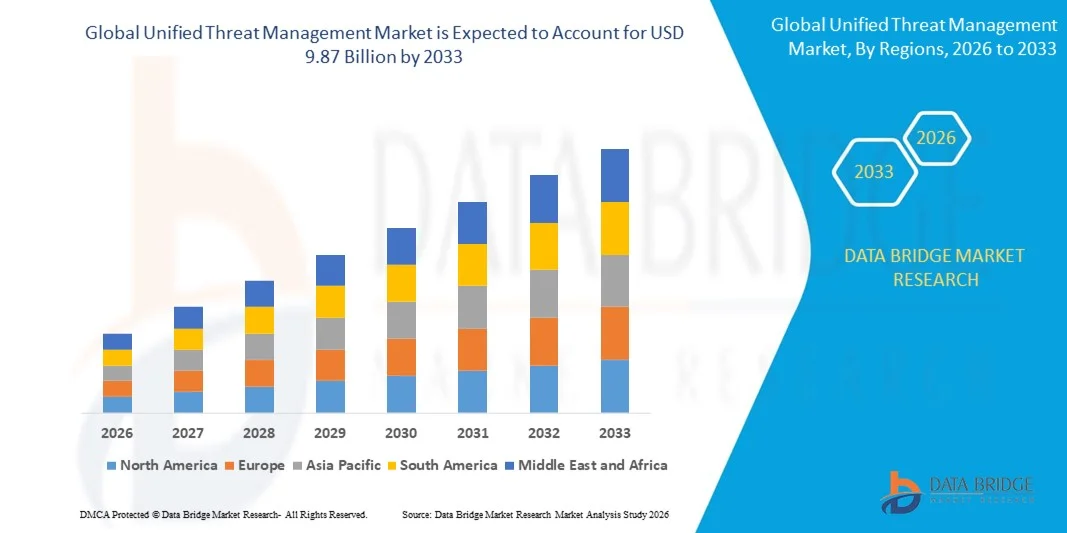
- As per Data Bridge Market Research Analysis The global unified threat management market size was valued at USD 6.05 billion in 2025 and is expected to reach USD 9.87 billion by 2033, at a CAGR of 6.30% during the forecast period
- The market growth is largely fueled by the rising need for consolidated cybersecurity frameworks as enterprises increasingly digitalize their operations across cloud, on-premises, and hybrid environments. The expansion of connected networks and growing exposure to cyberthreats are accelerating the adoption of unified platforms capable of managing multiple security functions through a single interface
- Furthermore, increasing enterprise demand for simplified, scalable, and integrated security solutions is establishing unified threat management as a preferred approach for protecting complex IT infrastructures. These converging factors are driving rapid adoption of unified threat management systems, thereby significantly strengthening the market’s overall growth trajectory
Market Size & Forecast
- Global Market Value (2025): USD 6.05 billion
- Expected Market Value (2033): USD 9.87 billion
- Forecast CAGR (2026–2033): 6.30%
Unified Threat Management Market Analysis
- Unified threat management solutions, offering integrated firewall, intrusion prevention, antivirus, web filtering, and threat intelligence capabilities, are becoming essential components of enterprise cybersecurity strategies across industries. Their ability to centralize security operations, enhance visibility, and reduce management complexity is making unified threat management systems critical for safeguarding modern digital networks
- The escalating demand for unified threat management platforms is primarily fueled by the surge in cyberattacks, rapid cloud adoption, and the increasing need for real-time, automated protection across distributed IT environments. Organizations are prioritizing unified solutions to optimize security performance while lowering operational burdens
- North America dominated the unified threat management market with a share of 41% in 2025, due to the rising incidence of cyberattacks and the increased adoption of consolidated security platforms across enterprises
- Asia-Pacific is expected to be the fastest growing region in the unified threat management market during the forecast period due to rising digital adoption, expanding enterprise networks, and increasing cloud deployments in countries such as China, Japan, and India
- Cloud segment dominated the market with a market share of 58.8% in 2025, due to rising adoption of scalable security platforms that support real-time threat monitoring across distributed networks. Organizations prefer cloud-based unified threat management because it reduces infrastructure costs and enables rapid updates against evolving cyber risks. Cloud models support seamless integration with remote work environments, strengthening visibility and control across multiple endpoints. The growing shift toward digital transformation further reinforces the dominance of cloud deployment as enterprises prioritize flexible and centrally managed security frameworks
Report Scope and Unified Threat Management Market Segmentation
Attributes |
Unified Threat Management Key Market Insights |
|
Segments Covered |
|
|
Countries Covered |
North America
Europe
Asia-Pacific
Middle East and Africa
South America
|
|
Key Market Players |
|
|
Market Opportunities |
|
|
Value Added Data Infosets |
In addition to the insights on market scenarios such as market value, growth rate, segmentation, geographical coverage, and major players, the market reports curated by the Data Bridge Market Research also include in-depth expert analysis, geographically represented company-wise production and capacity, network layouts of distributors and partners, detailed and updated price trend analysis and deficit analysis of supply chain and demand. |
What is the Key Trend in the Unified Threat Management Market?
Rising Integration of AI-Driven Threat Detection in Unified Threat Management
- A significant trend in the unified threat management market is the rising integration of AI-driven threat detection systems that enhance the accuracy and speed of identifying network anomalies across enterprise environments. This trend is strengthening the role of AI as a foundational layer within unified threat management frameworks that require continuous monitoring and adaptive security intelligence
- For instance, companies such as Fortinet deploy AI-embedded unified threat management appliances that analyze traffic patterns and identify emerging risks with greater precision. Such AI-supported functions improve detection reliability and support uninterrupted threat assessment in networks handling large volumes of sensitive data
- Enterprises are increasingly adopting AI-enabled unified threat management platforms as these solutions support real-time behavioral analysis and automated risk scoring. This is positioning AI-integrated unified threat management as a critical component for organizations that depend on proactive identification of advanced threats across distributed IT infrastructures
- The shift toward more complex digital ecosystems is driving greater reliance on machine learning algorithms within unified threat management systems to evaluate potential vulnerabilities at faster rates. This trend is supporting improved response measures and helping enterprises manage evolving cyber risks with stronger predictive capabilities
- Many industries are prioritizing AI-driven unified threat management tools to support scalable network protection, ensure contextual threat interpretation, and reinforce security posture across multi-cloud environments. This is strengthening the adoption of solutions that combine automation and intelligence in a unified structure
- The market is experiencing steady growth as AI-powered analytics enable more efficient handling of encrypted traffic, reduce false positives, and support continuous adaptation to new attack patterns. This rising use of AI is reinforcing the transition toward smarter, predictive, and more resilient unified threat management architectures across global organizations
Unified Threat Management Market Dynamics
Driver
Growing Demand for Centralized Security Management Solutions
- The growing need for centralized security management across enterprise networks is driving greater adoption of unified threat management platforms that consolidate multiple security functions into a single system. These platforms enable streamlined oversight and improve operational efficiency by reducing the complexity of handling separate security tools
- For instance, Cisco provides integrated unified threat management solutions that combine firewall, intrusion prevention, content filtering, and VPN capabilities within one unified interface. This centralized approach supports easier configuration, better visibility, and consistent security enforcement across broad IT environments
- Organizations are increasingly implementing unified threat management systems to manage rising cyber risks and simplify security orchestration across remote offices and cloud infrastructures. This driver is strengthening the demand for platforms that offer coordinated defense mechanisms and unified policy control
- The need to reduce administrative workloads and improve response speed to security incidents is encouraging enterprises to deploy consolidated unified threat management solutions. These systems support faster decision-making and reduce operational fragmentation by delivering all essential protection tools in one place
- The rising requirement for scalable and maintenance-friendly security models is reinforcing this driver as enterprises seek integrated solutions that provide stable performance under growing network loads. This sustained dependence on centralized management continues to influence market growth toward more unified architectures
Restraint/Challenge
High Complexity in Managing Multi-Layered Security Architectures
- The unified threat management market faces challenges due to the increasing complexity of managing multi-layered security architectures that integrate various protection controls within a single system. This creates operational difficulty for organizations that must ensure seamless coordination across all components
- For instance, Check Point offers comprehensive unified threat management architectures that require skilled configuration to align firewall rules, intrusion detection, and content control modules effectively. These intricate deployments demand specialized expertise and raise management burdens for enterprises
- Ensuring consistent performance across all integrated layers requires rigorous monitoring and frequent fine-tuning, which can extend operational timelines. These requirements heighten administrative pressure and increase the difficulty of maintaining reliability across complex deployments
- The challenge is further intensified by the need to synchronize diverse functions such as endpoint protection, web filtering, and network defense within the same platform. This adds intricacy to troubleshooting and affects the stability of security workflows
- The market continues to encounter constraints as enterprises struggle to optimize multi-layered structures while maintaining high performance and cost efficiency. This challenge reinforces the need for more intuitive, automation-driven unified threat management solutions that reduce operational strain and improve overall system manageability
How is the Unified Threat Management Market Segmented?
The market is segmented on the basis of deployment type, enterprise size, and industry.
- By Deployment
On the basis of deployment, the unified threat management market is segmented into cloud and on-premises. The cloud segment dominated the market with the largest share of 58.8% in 2025 due to rising adoption of scalable security platforms that support real-time threat monitoring across distributed networks. Organizations prefer cloud-based unified threat management because it reduces infrastructure costs and enables rapid updates against evolving cyber risks. Cloud models support seamless integration with remote work environments, strengthening visibility and control across multiple endpoints. The growing shift toward digital transformation further reinforces the dominance of cloud deployment as enterprises prioritize flexible and centrally managed security frameworks.
The on-premises segment is expected to witness the fastest growth from 2026 to 2033 supported by verticals with strict data governance requirements and high-sensitivity workloads. Businesses in regulated industries select on-premises unified threat management solutions in order to maintain full control over data, infrastructure, and internal security policies. These deployments ensure reduced exposure to external networks and provide customized configurations for mission-critical systems. The demand for localized infrastructure remains strong among organizations prioritizing compliance, latency control, and internal threat prevention measures.
- By Enterprise Size
On the basis of enterprise size, the unified threat management market is segmented into large enterprises and small and medium enterprises. Large enterprises dominated the market in 2025 driven by extensive adoption of integrated security systems to manage increasing volumes of cyber threats. Complex network environments across multiple branches require consolidated security platforms that improve operational efficiency. Large enterprises invest heavily in unified threat management solutions to unify firewall, intrusion prevention, content filtering, and antivirus within a single interface, ensuring improved governance and streamlined management. High cybersecurity budgets and rising digital workloads also support the segment’s leadership.
The small and medium enterprise segment is anticipated to witness the fastest growth from 2026 to 2033 as these businesses invest in cost-efficient all-in-one threat management systems. SMEs increasingly prefer unified threat management platforms in order to simplify security operations and overcome resource limitations through centralized dashboards. Cloud-enabled unified threat management offerings provide SMEs with enterprise-grade protection while reducing the need for specialized internal security teams. Growing exposure to cyberattacks and expanding digital footprints encourage SMEs to deploy adaptable solutions that support secure business expansion.
- By Industry
On the basis of industry, the unified threat management market is segmented into banking, financial services and insurance (BFSI), government and utilities, healthcare, retail, manufacturing, telecom and IT, education, and others. The BFSI segment dominated the market in 2025 driven by the sector’s requirement for continuous threat surveillance and strong data protection mechanisms. Financial institutions rely on unified threat management solutions to safeguard transaction data, prevent fraud, and secure high-value digital channels. Rising digital banking adoption strengthens the sector’s dependence on unified platforms that ensure regulatory compliance and real-time risk mitigation. The industry’s prioritization of secure communication channels further reinforces its leading position.
The healthcare segment is expected to witness the fastest growth rate from 2026 to 2033 due to escalating cyberattacks on medical networks and patient record systems. Healthcare providers adopt unified threat management systems in order to strengthen endpoint protection across clinical devices and connected medical infrastructure. The growing digitization of patient information requires integrated security controls that safeguard critical data from ransomware and unauthorized access. Increased telehealth usage and interconnected hospital networks further accelerate the demand for centralized and scalable unified threat management solutions within healthcare environments.
Unified Threat Management Market Regional Analysis
- North America dominated the unified threat management market with the largest revenue share of 41% in 2025, driven by the rising incidence of cyberattacks and the increased adoption of consolidated security platforms across enterprises
- Organizations in the region highly value the efficiency, centralized monitoring, and integrated protection offered by unified threat management solutions across complex network environments
- This strong demand is further supported by high digital penetration, a mature IT ecosystem, and the growing preference for unified cybersecurity frameworks that enhance visibility and reduce management complexities. The rapid adoption of cloud services, remote work environments, and advanced threat intelligence continues to reinforce the region’s leading position in the unified threat management landscape
U.S. Unified Threat Management Market Insight
The U.S. unified threat management market captured the largest revenue share within North America in 2025, fueled by the rapid expansion of connected systems and the increasing need for multi-layered threat protection. Enterprises are prioritizing unified threat management platforms to strengthen data security, maintain compliance, and prevent sophisticated cyberattacks targeting critical infrastructure and digital services. The growing deployment of cloud-based applications, combined with strong demand for consolidated firewall, intrusion prevention, and web filtering solutions, is further accelerating adoption. Moreover, the rise of hybrid work models and the widespread integration of digital communication tools continue to drive investments in unified cybersecurity solutions across U.S. enterprises.
Europe Unified Threat Management Market Insight
The Europe unified threat management market is projected to expand at a substantial CAGR throughout the forecast period, driven by stringent cybersecurity regulations and the growing focus on safeguarding critical data across industries. The rise in digital transformation initiatives, together with the adoption of connected systems, is strengthening the need for integrated security frameworks. European enterprises place strong emphasis on risk mitigation, compliance alignment, and secure communication networks, supporting the increasing installation of unified threat management systems. The region is witnessing notable demand across corporate, public-sector, and industrial infrastructures, where unified solutions are being integrated into both new deployments and modernization projects.
U.K. Unified Threat Management Market Insight
The U.K. unified threat management market is anticipated to grow at a noteworthy CAGR during the forecast period, driven by rising cybersecurity threats and the need for centralized protection across enterprise networks. Concerns regarding data breaches and fraud are encouraging organizations to adopt comprehensive unified threat management platforms that provide real-time threat analysis and simplified control. The U.K.’s strong digital economy, expanding cloud ecosystem, and widespread adoption of connected business applications are further propelling market expansion. Growing regulatory compliance requirements continue to strengthen the reliance on unified cybersecurity frameworks across both private and public sectors.
Germany Unified Threat Management Market Insight
The Germany unified threat management market is expected to expand at a considerable CAGR during the forecast period, supported by increasing awareness of cyber risks and a rising preference for advanced, reliable security infrastructures. Germany’s emphasis on industrial digitalization, particularly within manufacturing and automation environments, drives strong demand for integrated unified threat management solutions. The country’s well-established IT ecosystem and commitment to secure, privacy-oriented technologies promote the installation of unified security systems in business and government settings. Growing alignment with EU cybersecurity regulations further accelerates the deployment of multi-layered protection across critical sectors.
Asia-Pacific Unified Threat Management Market Insight
The Asia-Pacific unified threat management market is poised to grow at the fastest CAGR during the forecast period of 2026 to 2033, driven by rising digital adoption, expanding enterprise networks, and increasing cloud deployments in countries such as China, Japan, and India. The region’s strong shift toward smart infrastructure and digital business operations is accelerating the need for consolidated cybersecurity platforms. Growing investments in IT modernization, along with government-led digitalization programs, are reinforcing the demand for unified threat management solutions across enterprises of varying sizes. The availability of cost-effective offerings and rapid adoption of connected technologies are broadening unified threat management penetration across multiple industries throughout the region.
Japan Unified Threat Management Market Insight
The Japan unified threat management market is gaining momentum due to the country’s advanced technological landscape, rapid digitization, and strong emphasis on network security. Japanese enterprises prioritize unified threat management systems that deliver high accuracy, reliability, and seamless integration across IoT-enabled environments. The increasing number of connected commercial buildings, smart infrastructure projects, and cloud-based business applications is fueling market growth. Japan’s aging workforce is also driving a shift toward automated and simplified security management platforms that ensure secure access and operational continuity across various sectors.
China Unified Threat Management Market Insight
The China unified threat management market accounted for the largest revenue share in Asia-Pacific in 2025, supported by a rapidly expanding digital economy and widespread adoption of intelligent network systems. China’s fast-growing enterprise ecosystem, combined with strong government initiatives promoting cybersecurity enhancement, is accelerating the deployment of unified threat management solutions. The rise of smart cities, industrial automation, and connected commercial environments further strengthens demand for integrated protection. The presence of robust domestic technology manufacturers and increased accessibility of advanced security platforms continue to propel market growth across the country.
Unified Threat Management Market Share
The unified threat management industry is primarily led by well-established companies, including:
- Barracuda Networks, Inc. (U.S.)
- Check Point Software Technologies Ltd. (Israel)
- Cisco (U.S.)
- Dell Inc. (U.S.)
- Fortinet, Inc. (U.S.)
- Hewlett-Packard Development Company, L.P. (U.S.)
- IBM Corporation (U.S.)
- Juniper Networks, Inc. (U.S.)
- Sophos Ltd. (U.K.)
- WatchGuard Technologies, Inc. (U.S.)
- Huawei Technologies Co., Ltd. (China)
- Untangle (U.S.)
- Clavister (Sweden)
- Comodo Security Solutions, Inc. (U.S.)
- Hillstone Networks (China)
- Panda Security, S.L.U. (Spain)
- Trustwave Holdings, Inc. (U.S.)
- McAfee, LLC (U.S.)
- Trend Micro Incorporated (Japan)
- DigiCert, Inc. (U.S.)
- Infineon Technologies AG (Germany)
Latest Developments in Global Unified Threat Management Market
- In August 2024, Fortinet, Inc. completed the acquisition of Lacework, an integrated cloud security company, significantly strengthening its capabilities in AI-driven cloud and workload protection. This development enhances Fortinet’s unified threat management portfolio by combining Lacework’s behavioral analytics with Fortinet’s extensive security fabric. The integration is expected to accelerate enterprise adoption of consolidated, automated cloud security platforms, reinforcing Fortinet’s competitive position in the rapidly evolving unified threat management landscape
- In May 2024, Sophos Ltd. entered a distribution agreement with Infinigate to expand its reach in the U.K. market, enabling broader access to Sophos’ unified threat management offerings. This collaboration allows Sophos to leverage Infinigate’s strong channel network to penetrate new customer segments and strengthen partner-driven growth. The enhanced market presence is expected to support rising demand for integrated cybersecurity solutions among mid-sized and large enterprises across the U.K.
- In April 2024, Check Point Software Technologies expanded its unified threat management portfolio with new advanced threat prevention capabilities designed to defend against ransomware, zero-day exploits, and AI-enabled attacks. This upgrade introduces deeper automation, real-time threat intelligence, and stronger integration across network and cloud environments. The enhancement positions Check Point as a more robust competitor in the unified threat management space and fuels market demand for unified platforms offering superior predictive security
- In February 2024, Cisco Systems introduced upgraded AI-powered monitoring and security orchestration functionalities across its unified threat management ecosystem. These improvements offer enhanced visibility, automated response, and better protection across hybrid, multi-cloud, and distributed IT environments. Cisco’s expansion of intelligence-led capabilities increases the attractiveness of its unified threat management solutions, supporting enterprise shifts toward centralized security management frameworks
- In January 2024, WatchGuard Technologies launched upgraded Firebox unified threat management appliances featuring higher processing power, advanced intrusion prevention, and deeper endpoint integration. These enhancements address the growing need for scalable, high-performance security systems across mid-sized businesses. The updated Firebox line strengthens WatchGuard’s role in the unified threat management market by offering optimized protection designed for expanding networks and modernized IT infrastructures

- Interactive Data Analysis Dashboard
- Company Analysis Dashboard for high growth potential opportunities
- Research Analyst Access for customization & queries
- Competitor Analysis with Interactive dashboard
- Latest News, Updates & Trend analysis
- Harness the Power of Benchmark Analysis for Comprehensive Competitor Tracking
Global Unified Threat Management Market, Supply Chain Analysis and Ecosystem Framework
To support market growth and help clients navigate the impact of geopolitical shifts, DBMR has integrated in-depth supply chain analysis into its Global Unified Threat Management Market research reports. This addition empowers clients to respond effectively to global changes affecting their industries. The supply chain analysis section includes detailed insights such as Global Unified Threat Management Market consumption and production by country, price trend analysis, the impact of tariffs and geopolitical developments, and import and export trends by country and HSN code. It also highlights major suppliers with data on production capacity and company profiles, as well as key importers and exporters. In addition to research, DBMR offers specialized supply chain consulting services backed by over a decade of experience, providing solutions like supplier discovery, supplier risk assessment, price trend analysis, impact evaluation of inflation and trade route changes, and comprehensive market trend analysis.
Data collection and base year analysis are done using data collection modules with large sample sizes. The stage includes obtaining market information or related data through various sources and strategies. It includes examining and planning all the data acquired from the past in advance. It likewise envelops the examination of information inconsistencies seen across different information sources. The market data is analysed and estimated using market statistical and coherent models. Also, market share analysis and key trend analysis are the major success factors in the market report. To know more, please request an analyst call or drop down your inquiry.
The key research methodology used by DBMR research team is data triangulation which involves data mining, analysis of the impact of data variables on the market and primary (industry expert) validation. Data models include Vendor Positioning Grid, Market Time Line Analysis, Market Overview and Guide, Company Positioning Grid, Patent Analysis, Pricing Analysis, Company Market Share Analysis, Standards of Measurement, Global versus Regional and Vendor Share Analysis. To know more about the research methodology, drop in an inquiry to speak to our industry experts.
Data Bridge Market Research is a leader in advanced formative research. We take pride in servicing our existing and new customers with data and analysis that match and suits their goal. The report can be customized to include price trend analysis of target brands understanding the market for additional countries (ask for the list of countries), clinical trial results data, literature review, refurbished market and product base analysis. Market analysis of target competitors can be analyzed from technology-based analysis to market portfolio strategies. We can add as many competitors that you require data about in the format and data style you are looking for. Our team of analysts can also provide you data in crude raw excel files pivot tables (Fact book) or can assist you in creating presentations from the data sets available in the report.













