


Unijunction Transistor Market Size
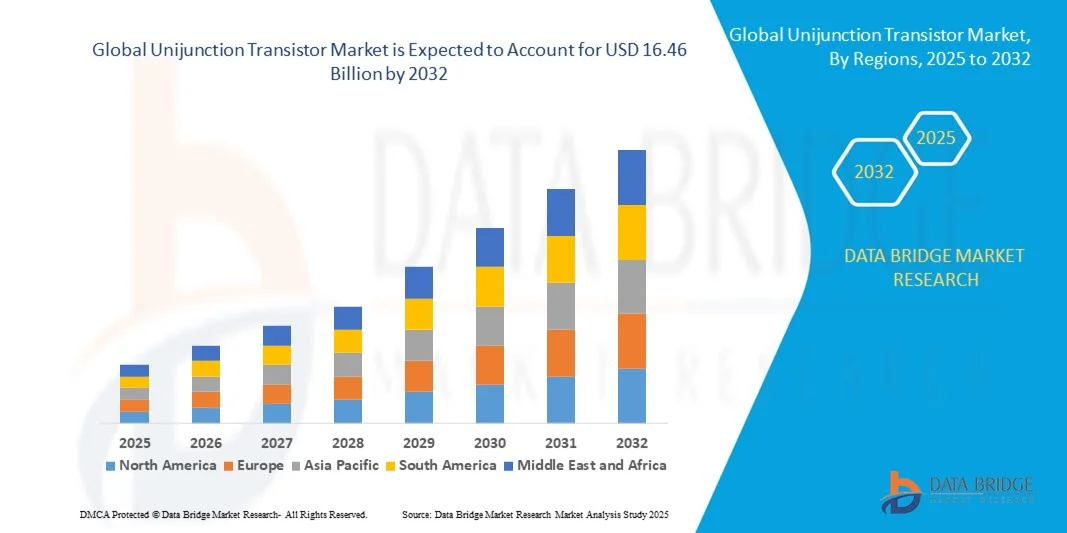
- The global unijunction transistor market size was valued at USD 13.41 billion in 2024 and is expected to reach USD 16.46 billion by 2032, at a CAGR of 2.60% during the forecast period
- The market growth is largely fueled by the increasing demand for reliable and cost-effective electronic switching and triggering components across industrial automation, consumer electronics, and power control applications. The rising focus on energy-efficient circuit designs and the expanding use of timing and pulse generation systems in various electronic devices are driving widespread adoption of unijunction transistors
- Furthermore, continuous advancements in semiconductor manufacturing technologies and the integration of UJTs in low-power and compact electronic devices are accelerating market expansion. These factors, combined with the growing penetration of automation in industrial and automotive sectors, are strengthening the market’s overall growth trajectory
Unijunction Transistor Market Analysis
- Unijunction transistors (UJTs) are three-terminal semiconductor devices used primarily for triggering, oscillation, and pulse generation in timing and control circuits. Their simplicity, low cost, and efficiency make them a key component in industrial, consumer, and educational electronics applications
- The escalating demand for UJTs is driven by their increasing use in automation systems, signal processing circuits, and power control devices. The market is further supported by rapid industrialization, rising electronics production in Asia-Pacific, and ongoing efforts by semiconductor manufacturers to improve performance and reliability of these devices
- Asia-Pacific dominated the unijunction transistor market in 2024, due to expanding semiconductor manufacturing, growing adoption of industrial automation, and increasing demand for electronic components across automotive and consumer sectors
- North America is expected to be the fastest growing region in the unijunction transistor market during the forecast period due to high demand for electronic components in industrial, aerospace, and consumer applications
- Industrial segment dominated the market with a market share of 39.1% in 2024, due to the widespread use of UJTs in timing, triggering, and pulse generation circuits in industrial automation and control systems. Industries often rely on UJTs for their simplicity, reliability, and cost-effectiveness in switching and oscillator applications. The segment also benefits from the growing adoption of automated machinery and robotics, which require precise and repeatable electronic control components, making UJTs a preferred choice for engineers
Report Scope and Unijunction Transistor Market Segmentation
|
Attributes |
Unijunction Transistor Key Market Insights |
|
Segments Covered |
|
|
Countries Covered |
North America
Europe
Asia-Pacific
Middle East and Africa
South America
|
|
Key Market Players |
|
|
Market Opportunities |
|
|
Value Added Data Infosets |
In addition to the insights on market scenarios such as market value, growth rate, segmentation, geographical coverage, and major players, the market reports curated by the Data Bridge Market Research also include in-depth expert analysis, geographically represented company-wise production and capacity, network layouts of distributors and partners, detailed and updated price trend analysis and deficit analysis of supply chain and demand. |
Unijunction Transistor Market Trends
Increased Use of UJTs in Consumer Electronics
- The unijunction transistor (UJT) market is witnessing stable growth due to its continued use in consumer electronics requiring efficient triggering and timing circuits. Despite being a mature technology, UJTs retain demand for applications that benefit from simplicity and cost-effectiveness, such as lamp dimmers, oscillators, timers, and controlled rectifiers used in household and small appliance electronics
- For instance, NTE Electronics and Central Semiconductor manufacture unijunction transistors that are widely used in electronic controllers for fans, lighting systems, and power tools requiring stable pulse triggering performance. Similarly, American Microsemiconductor offers compact UJTs for DIY electronics and industrial modules where predictable firing sequences and low power dissipation are essential
- The growth of low-cost consumer systems, especially in developing economies, continues to drive UJT integration into circuits where modern digital control systems may be unnecessary or cost-prohibitive. Their ability to perform consistent triggering in relaxation oscillator and phase control circuits makes them reliable components for mass-market electronic designs
- In addition, the rising trend in educational and prototyping applications is contributing to UJT utilization. Engineering institutions and electronics hobbyists favor UJTs for basic timing circuit demonstrations and low-complexity project development due to their simplicity and predictable characteristics
- As consumer electronics evolve toward intelligent yet affordable designs, legacy components such as UJTs maintain their niche presence for specific low-power analog control tasks. Their enduring relevance in small-scale electronic systems underscores their stability, reliability, and suitability for cost-sensitive markets emphasizing function over complexity
Unijunction Transistor Market Dynamics
Driver
Demand for Reliable and Simple Switching Devices
- The ongoing demand for reliable and easy-to-implement switching devices continues to support growth in the unijunction transistor market. UJTs remain valuable for designers seeking simple semiconductor components capable of consistent pulse generation, delay timing, and triggering control in low-power applications
- For instance, Microsemi and Central Semiconductor provide unijunction transistors optimized for low-voltage switching functions in timing and triggering modules where circuit simplicity and long operational life are critical. Their balanced performance and low component count support streamlined circuit configurations ideal for basic consumer electronics and control systems
- The inherent design advantages of UJTs, such as stable negative resistance regions and minimal external circuitry requirements, make them appealing for engineers aiming to reduce design complexity. These features enable cost-effective production of small appliances and analog control circuits across a broad range of market segments
- In addition, the device’s ability to function effectively in relaxation oscillator circuits and waveform generation ensures strong adoption in instrumentation and educational applications. Its predictable firing voltage and temperature stability offer consistent performance even under variable operating conditions
- As industries and educational sectors continue to appreciate robust, easy-to-integrate electronic components, UJTs will retain a niche but steady role in foundational circuit designs. Their simplicity, reliability, and versatility sustain continued utilization wherever compact triggering solutions are required
Restraint/Challenge
Replacement by Modern Transistor Alternatives
- The unijunction transistor market faces a major challenge from the rapid replacement of legacy components by modern semiconductor technologies offering superior control, integration, and miniaturization. Devices such as programmable unijunction transistors (PUTs), thyristors, and silicon-controlled rectifiers (SCRs) have largely substituted UJTs in newer designs
- For instance, ON Semiconductor and STMicroelectronics have focused on advanced switching transistors that integrate multiple control functions, delivering greater efficiency and precision for power electronics and automation applications. These modern alternatives offer improved thermal stability, compact packaging, and digital compatibility that outpace traditional UJT performance
- In addition, the declining production of UJTs due to limited industrial demand has led to supply inconsistencies and higher per-unit costs, making them less attractive to large-scale manufacturers. This supply constraint further accelerates the shift toward advanced integrated transistor technologies
- Educational and prototyping markets remain among the few segments retaining UJT use, but mainstream consumer electronics production has widely transitioned to microcontroller-based control circuits that provide superior programmability and speed. This replacement trend restricts potential market expansion for UJTs
- While legacy applications and learning environments continue to sustain minimal demand, long-term market prospects are hindered by technological obsolescence. Overcoming this challenge will require focusing on niche applications and low-cost production strategies where UJTs can remain economically and functionally viable
Unijunction Transistor Market Scope
The market is segmented on the basis of application and specifications.
- By Application
On the basis of application, the UJT market is segmented into Aerospace & Defense, Industrial, Telecommunications, and Consumer Electronics. The Industrial segment dominated the largest market revenue share of 39.1% in 2024, driven by the widespread use of UJTs in timing, triggering, and pulse generation circuits in industrial automation and control systems. Industries often rely on UJTs for their simplicity, reliability, and cost-effectiveness in switching and oscillator applications. The segment also benefits from the growing adoption of automated machinery and robotics, which require precise and repeatable electronic control components, making UJTs a preferred choice for engineers.
The Consumer Electronics segment is anticipated to witness the fastest growth rate from 2025 to 2032, fueled by increasing incorporation of UJTs in compact electronic devices, home appliances, and power control circuits. UJTs are valued in this segment for their ability to provide efficient triggering and timing functions with minimal external circuitry. Rising consumer demand for smarter, energy-efficient electronics further propels their adoption, alongside advancements in miniaturization and integration within modern electronic products.
- By Specifications
On the basis of specifications, the UJT market is segmented into Standoff Ratio, RMS Power Dissipation, RMS Emitter Current, Peak Pulse Emitter Current, Interbase Voltage, Emitter Reverse Voltage, and Operating and Storage Junction Temperatures. The RMS Power Dissipation segment held the largest market revenue share in 2024, driven by its critical role in determining the transistor’s ability to handle continuous power without overheating. High-power dissipation UJTs are essential for industrial and heavy-duty applications where reliability under sustained load is crucial. Engineers and designers often prioritize this specification to ensure stable performance and longer device lifespan in demanding environments.
The Standoff Ratio segment is expected to witness the fastest CAGR from 2025 to 2032, fueled by its importance in defining the intrinsic switching characteristics of UJTs. UJTs with optimized standoff ratios provide precise control in oscillator and timing circuits, which is increasingly required in advanced electronics and automation systems. Growing demand for high-performance triggering devices and improved efficiency in electronic circuits drives the rapid adoption of UJTs with superior standoff ratio specifications.
Unijunction Transistor Market Regional Analysis
- Asia-Pacific dominated the unijunction transistor market with the largest revenue share in 2024, driven by expanding semiconductor manufacturing, growing adoption of industrial automation, and increasing demand for electronic components across automotive and consumer sectors
- The region’s robust electronics production base, cost-effective manufacturing, and government support for domestic semiconductor initiatives are propelling market expansion
- Rapid urbanization, rising consumer electronics penetration, and advancements in power electronics applications are further enhancing the use of unijunction transistors across developing economies
China Unijunction Transistor Market Insight
China held the largest share in the Asia-Pacific unijunction transistor market in 2024, owing to its leadership in semiconductor fabrication, large-scale electronics manufacturing, and strong industrial automation adoption. The presence of major component suppliers, continuous investments in chip design capabilities, and government-backed semiconductor development programs are accelerating market growth. Demand is also supported by the expansion of power control and switching applications across industrial and consumer sectors.
India Unijunction Transistor Market Insight
India is witnessing the fastest growth in the Asia-Pacific region, fueled by increasing electronics production, expanding industrial automation, and government initiatives such as “Make in India” promoting domestic semiconductor assembly. Rising adoption of low-cost control and timing devices in automotive and consumer electronics is driving market penetration. In addition, investments in R&D centers and a growing focus on electronics manufacturing services (EMS) are strengthening India’s position in the UJT market.
Europe Unijunction Transistor Market Insight
The Europe unijunction transistor market is expanding steadily, supported by growing demand for energy-efficient electronic components, advancements in industrial automation, and robust investment in power electronics. The region’s focus on sustainable manufacturing and high-performance electronic systems is driving adoption in aerospace, automotive, and industrial applications. Moreover, the presence of established semiconductor companies and innovation-focused design hubs contributes to consistent market growth.
Germany Unijunction Transistor Market Insight
Germany’s unijunction transistor market is driven by its dominance in industrial automation, strong engineering capabilities, and a leading position in advanced manufacturing technologies. The country’s emphasis on energy-efficient systems, precision electronics, and integration of automation components in smart factories supports high demand for UJTs. Continuous R&D efforts and collaboration between technology firms and research institutions further enhance market expansion.
U.K. Unijunction Transistor Market Insight
The U.K. market is supported by a well-developed electronics industry, increasing focus on semiconductor innovation, and growing adoption of advanced power control systems. Post-Brexit policy emphasis on strengthening local chip manufacturing and R&D capabilities is encouraging market development. The rise of electric vehicles, smart devices, and automation solutions continues to drive demand for reliable and efficient transistor technologies.
North America Unijunction Transistor Market Insight
North America is projected to grow at the fastest CAGR from 2025 to 2032, driven by high demand for electronic components in industrial, aerospace, and consumer applications. Growing investment in semiconductor research, rising adoption of automation technologies, and strong presence of OEMs are fueling market expansion. The increasing focus on miniaturization and high-performance circuit design further boosts the regional demand for unijunction transistors.
U.S. Unijunction Transistor Market Insight
The U.S. accounted for the largest share in the North America market in 2024, supported by its robust semiconductor ecosystem, advanced R&D infrastructure, and early adoption of next-generation electronics. Strong demand from aerospace, defense, and industrial automation sectors continues to drive growth. Government incentives promoting domestic chip manufacturing and the presence of key technology leaders further reinforce the country’s leading position in the UJT market.
Unijunction Transistor Market Share
The unijunction transistor industry is primarily led by well-established companies, including:
- STMicroelectronics (Switzerland)
- Infineon Technologies AG (Germany)
- Texas Instruments Incorporated (U.S.)
- Focus Microwaves Inc. (Canada)
- Advanced Linear Devices, Inc. (U.S.)
- UBS-Axcera (U.S.)
- Semiconductor Components Industries, LLC (U.S.)
- Central Semiconductor Corp. (U.S.)
- MULTICOMP PRO (U.K.)
- American Microsemiconductor, Inc. (U.S.)
- General Transistor Corp. (U.S.)
- Bore Transistor (U.S.)

- Interactive Data Analysis Dashboard
- Company Analysis Dashboard for high growth potential opportunities
- Research Analyst Access for customization & queries
- Competitor Analysis with Interactive dashboard
- Latest News, Updates & Trend analysis
- Harness the Power of Benchmark Analysis for Comprehensive Competitor Tracking
Global Unijunction Transistor Market, Supply Chain Analysis and Ecosystem Framework
To support market growth and help clients navigate the impact of geopolitical shifts, DBMR has integrated in-depth supply chain analysis into its Global Unijunction Transistor Market research reports. This addition empowers clients to respond effectively to global changes affecting their industries. The supply chain analysis section includes detailed insights such as Global Unijunction Transistor Market consumption and production by country, price trend analysis, the impact of tariffs and geopolitical developments, and import and export trends by country and HSN code. It also highlights major suppliers with data on production capacity and company profiles, as well as key importers and exporters. In addition to research, DBMR offers specialized supply chain consulting services backed by over a decade of experience, providing solutions like supplier discovery, supplier risk assessment, price trend analysis, impact evaluation of inflation and trade route changes, and comprehensive market trend analysis.
Data collection and base year analysis are done using data collection modules with large sample sizes. The stage includes obtaining market information or related data through various sources and strategies. It includes examining and planning all the data acquired from the past in advance. It likewise envelops the examination of information inconsistencies seen across different information sources. The market data is analysed and estimated using market statistical and coherent models. Also, market share analysis and key trend analysis are the major success factors in the market report. To know more, please request an analyst call or drop down your inquiry.
The key research methodology used by DBMR research team is data triangulation which involves data mining, analysis of the impact of data variables on the market and primary (industry expert) validation. Data models include Vendor Positioning Grid, Market Time Line Analysis, Market Overview and Guide, Company Positioning Grid, Patent Analysis, Pricing Analysis, Company Market Share Analysis, Standards of Measurement, Global versus Regional and Vendor Share Analysis. To know more about the research methodology, drop in an inquiry to speak to our industry experts.
Data Bridge Market Research is a leader in advanced formative research. We take pride in servicing our existing and new customers with data and analysis that match and suits their goal. The report can be customized to include price trend analysis of target brands understanding the market for additional countries (ask for the list of countries), clinical trial results data, literature review, refurbished market and product base analysis. Market analysis of target competitors can be analyzed from technology-based analysis to market portfolio strategies. We can add as many competitors that you require data about in the format and data style you are looking for. Our team of analysts can also provide you data in crude raw excel files pivot tables (Fact book) or can assist you in creating presentations from the data sets available in the report.













