


What is the Global Unmanned Composite Size and Growth Rate?
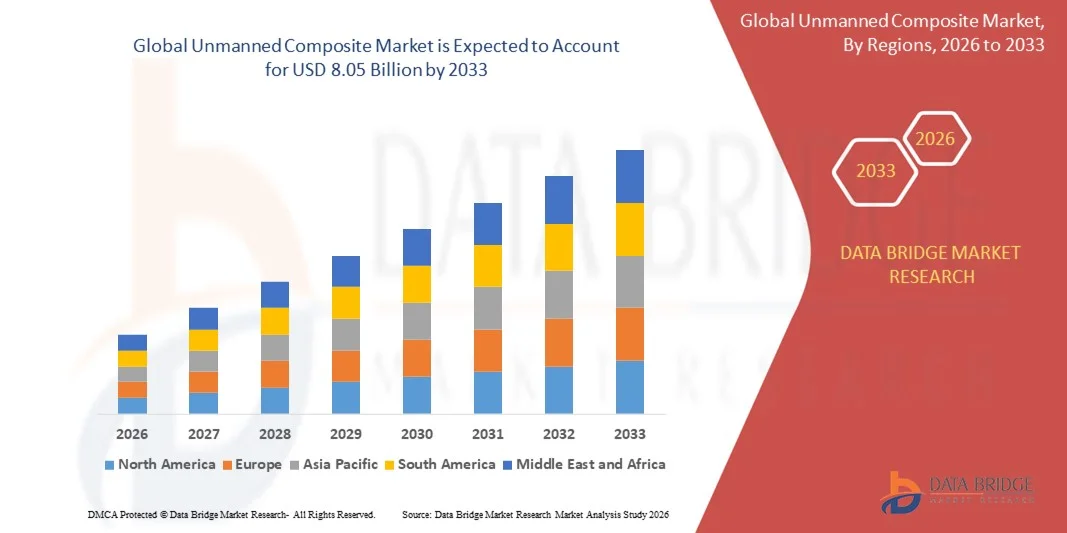
- As per Data Bridge Market Research Analysis the global Unmanned Composite Market size was valued at USD 2.63 billion in 2025 and is projected to reach USD 8.05 billion by 2033, growing at a CAGR of 15.00% during the forecast period.
- The market expansion is primarily driven by increasing demand for lightweight, high-strength materials in aerospace, automotive, and defense applications, coupled with ongoing advancements in composite manufacturing technologies.
- Additionally, the push for fuel-efficient, durable, and cost-effective solutions across multiple industries is propelling the adoption of unmanned composite materials. These factors collectively are fueling market growth and establishing unmanned composites as a critical component in modern engineering and manufacturing.
Market Size & Forecast
- Global Market Value (2025): USD 2.63 billion
- Expected Market Value (2033): USD 8.05 billion
- Forecast CAGR (2026–2033): 15.00%
What are the Major Takeaways of Global Unmanned Composite?
- Unmanned composites, comprising advanced lightweight materials used in aerospace, defense, and automotive applications, are becoming increasingly critical due to their high strength-to-weight ratio, corrosion resistance, and ability to enhance fuel efficiency and performance in unmanned systems.
- The rising demand for unmanned composites is primarily driven by the need for durable, lightweight materials in drones, autonomous vehicles, and aerospace components, alongside ongoing innovations in composite manufacturing techniques such as additive manufacturing and automated fiber placement.
- North America dominated the Global Unmanned Composite Market with the largest revenue share of 34.1% in 2025, supported by strong aerospace and defense sectors, early adoption of advanced materials, and a high concentration of key manufacturers investing in R&D for next-generation unmanned systems.
- Asia-Pacific is expected to be the fastest-growing region in the Global Unmanned Composite Market during the forecast period due to rapid industrialization, increasing defense budgets, and growing adoption of unmanned aerial vehicles (UAVs) and autonomous transport solutions.
- The CFRP segment dominated the market with a revenue share of 43.2% in 2025, owing to its exceptional strength-to-weight ratio, high stiffness, and widespread adoption in aerospace, defense, and automotive unmanned platforms.
 Report Scope and Global Unmanned Composite Market Segmentation
|
Attributes |
Unmanned Composite Key Market Insights |
|
Segments Covered |
|
|
Countries Covered |
North America
Europe
Asia-Pacific
Middle East and Africa
South America
|
|
Key Market Players |
|
|
Market Opportunities |
|
|
Value Added Data Infosets |
|
What is the Key Trend in the Global Unmanned Composite?
Advanced Performance Through AI-Enabled Design and Automation
- A significant and accelerating trend in the global Unmanned Composite Market is the integration of artificial intelligence (AI) and advanced automation technologies into the design, manufacturing, and testing of composite materials. This combination is enhancing performance, precision, and efficiency in producing lightweight, high-strength components for aerospace, defense, and automotive applications.
- For instance, AI-driven simulation tools can optimize fiber orientation and layup patterns in carbon fiber-reinforced polymers, reducing material waste while improving structural performance. Similarly, automated fiber placement (AFP) machines can produce complex composite geometries with minimal human intervention, ensuring consistent quality and faster production cycles.
- AI integration in unmanned composite manufacturing enables predictive maintenance of equipment, real-time quality monitoring, and optimization of material properties to meet specific performance criteria. For example, some aerospace-grade composites manufacturers utilize AI algorithms to detect microstructural defects during production and recommend process adjustments, thereby reducing scrap rates and enhancing reliability.
- The seamless integration of AI with robotic manufacturing platforms and digital twins facilitates centralized control over production processes, enabling manufacturers to simulate, test, and optimize composite parts virtually before actual fabrication. This approach ensures higher efficiency, reduced costs, and faster time-to-market for unmanned systems.
- This trend toward intelligent, automated, and highly optimized composite production is fundamentally transforming the expectations of aerospace, defense, and automotive industries. Consequently, companies such as Hexcel, Toray, and Gurit are increasingly developing AI-enabled composite solutions with predictive analytics, automated fabrication, and enhanced material performance for next-generation unmanned platforms.
- The demand for unmanned composites with AI-driven design and automated manufacturing capabilities is growing rapidly across aerospace, defense, and automotive sectors, as manufacturers increasingly prioritize performance, efficiency, and reliability in lightweight structural components.
Global Unmanned Composite Market Dynamics
Driver
Growing Demand Driven by Lightweight, High-Performance Requirements
- The increasing need for fuel-efficient, durable, and high-strength materials across aerospace, defense, and automotive industries is a major driver for the rising demand for unmanned composites.
- For instance, in 2025, Hexcel Corporation introduced advanced carbon fiber composites optimized for unmanned aerial vehicles (UAVs), enhancing payload capacity and flight efficiency. Initiatives such as these by key manufacturers are expected to significantly boost the unmanned composite market during the forecast period.
- As industries seek to reduce vehicle weight, improve energy efficiency, and meet stringent regulatory requirements, unmanned composites offer superior mechanical properties, corrosion resistance, and long-term durability, providing a clear advantage over traditional materials such as aluminum or steel.
- Furthermore, the increasing adoption of autonomous and unmanned systems, including drones, unmanned ground vehicles (UGVs), and marine vehicles, is creating a higher demand for composite materials that enable lightweight, high-performance structural components.
- The versatility of unmanned composites, combined with their ability to be tailored for specific applications, is driving adoption across both commercial and defense sectors. Continuous innovation in composite materials, such as hybrid composites and advanced polymers, further accelerates market growth.
Restraint/Challenge
High Production Costs and Manufacturing Complexity
- The relatively high cost of advanced unmanned composites and the complexity of manufacturing processes pose significant challenges to broader market adoption. Producing high-performance composites often requires specialized equipment, skilled labor, and stringent quality control measures, which can increase production expenses.
- For instance, automated fiber placement (AFP) and resin transfer molding (RTM) technologies, while improving precision and performance, are capital-intensive and may limit small-scale adoption.
- Addressing these challenges through process optimization, development of cost-effective raw materials, and innovations in automated manufacturing is critical for expanding market penetration. Companies such as Toray and Solvay are investing in scalable production techniques and automation to reduce costs and improve efficiency.
- While prices for unmanned composite materials are gradually decreasing, the premium associated with high-performance solutions can still limit adoption, particularly in price-sensitive regions or for applications with less critical performance requirements.
- Overcoming these challenges through technological innovation, improved manufacturing efficiency, and the development of more cost-effective composite solutions will be essential for sustaining long-term growth in the unmanned composite market.
How is the Global Unmanned Composite Segmented?
Unmanned composite market is segmented on the basis of type, platform and application.
- By Type
On the basis of type, the Global Unmanned Composite Market is segmented into Aramid Fiber Reinforced Polymer (AFRP), Boron Fiber Reinforced Polymer (BFRP), Carbon Fiber Reinforced Polymer (CFRP), and Glass Fiber Reinforced Polymer (GFRP). The CFRP segment dominated the market with a revenue share of 43.2% in 2025, owing to its exceptional strength-to-weight ratio, high stiffness, and widespread adoption in aerospace, defense, and automotive unmanned platforms. Carbon fiber composites are preferred for critical components such as UAV airframes, UGV chassis, and lightweight structural parts in passenger drones, as they significantly improve performance while reducing overall system weight.
The Aramid Fiber Reinforced Polymer segment is expected to witness the fastest CAGR of 21.5% from 2026 to 2033, driven by its superior impact resistance, energy absorption, and suitability for protective structures in military-grade unmanned vehicles. Rising demand for hybrid composite solutions combining CFRP and AFRP also contributes to this rapid growth.
- By Platform
On the basis of platform, the Global Unmanned Composite Market is segmented into Autonomous Unmanned Vehicles (AUV), Remotely Operated Vehicles (ROV), Unmanned Aerial Vehicles (UAV), Unmanned Ground Vehicles (UGV), Unmanned Space Vehicles (USV), Passenger Drones, and Autonomous Ships. The UAV segment dominated the market with a revenue share of 41.7% in 2025, driven by the booming adoption of drones for defense, logistics, surveillance, and commercial delivery applications. UAVs benefit from composites due to the need for lightweight airframes, high endurance, and fuel efficiency.
The UGV segment is expected to witness the fastest CAGR of 22.1% from 2026 to 2033, fueled by growing applications in military reconnaissance, industrial inspection, and autonomous logistics platforms. Increasing investments in AI-enabled ground vehicles and hybrid electric propulsion systems also accelerate the adoption of unmanned composites in UGVs.
- By Application
On the basis of application, the Global Unmanned Composite Market is segmented into exterior and interior components. The exterior segment dominated the market with a revenue share of 45.3% in 2025, as unmanned platforms such as UAVs, UGVs, and passenger drones rely heavily on lightweight, high-strength composite materials for airframes, chassis, and hulls to improve performance and endurance. Exterior components require superior structural integrity, weather resistance, and impact tolerance, making CFRP and AFRP the preferred materials.
The interior segment is expected to witness the fastest CAGR of 20.8% from 2026 to 2033, driven by the rising use of composites in interior panels, payload mounts, electronic housings, and vibration-damping structures. Growing demand for modular, customizable interiors in autonomous vehicles and space drones further accelerates the adoption of advanced composites in interior applications.
Which Region Holds the Largest Share of the Global Unmanned Composite?
- North America dominated the Global Unmanned Composite Market with the largest revenue share of 34.1% in 2025, driven by strong demand for lightweight, high-performance materials in aerospace, defense, and automotive unmanned platforms.
- The region benefits from well-established aerospace and defense industries, early adoption of advanced composite technologies, and a high concentration of key manufacturers investing in research and development for next-generation unmanned systems.
- This widespread adoption is further supported by robust government defense spending, high technological expertise, and growing deployment of autonomous vehicles, drones, and unmanned ground systems. The presence of major market players, coupled with continuous innovations in carbon fiber, aramid, and boron fiber composites, establishes North America as a leading hub for unmanned composite materials in both commercial and defense applications.
U.S. Unmanned Composite Market Insight
The U.S. unmanned composite market captured the largest revenue share of 81% in 2025 within North America, driven by strong demand for lightweight, high-performance materials in aerospace, defense, and autonomous vehicle applications. Manufacturers are increasingly adopting carbon fiber, aramid, and hybrid composites to improve fuel efficiency, structural strength, and durability in UAVs, UGVs, and passenger drones. The growing trend of unmanned systems for military, logistics, and industrial applications, combined with advanced R&D initiatives and robust infrastructure, further propels market growth. Additionally, government support for defense modernization and investments in autonomous technologies is accelerating the adoption of unmanned composites across both commercial and defense sectors.
Europe Unmanned Composite Market Insight
The Europe unmanned composite market is projected to expand at a substantial CAGR during the forecast period, primarily driven by stringent regulations for lightweight and fuel-efficient aerospace and automotive applications. The increasing adoption of UAVs, UGVs, and autonomous vessels in industrial, defense, and research sectors is fostering the demand for advanced composite materials. European manufacturers are also focusing on eco-friendly, high-performance composites, aligning with sustainability initiatives. The region is experiencing significant growth across aerospace, defense, and autonomous mobility applications, with unmanned composites being integrated into both new platforms and retrofitting projects.
U.K. Unmanned Composite Market Insight
The U.K. unmanned composite market is anticipated to grow at a noteworthy CAGR during the forecast period, fueled by rising investments in autonomous systems, drones, and defense applications. The trend toward lightweight, high-strength materials for UAVs, UGVs, and passenger drones, combined with increasing government focus on defense modernization and industrial automation, is driving adoption. The presence of research institutions and advanced manufacturing infrastructure further supports market growth, enabling innovation in carbon fiber and hybrid composite solutions for unmanned platforms.
Germany Unmanned Composite Market Insight
The Germany unmanned composite market is expected to expand at a considerable CAGR during the forecast period, driven by the country’s emphasis on high-performance, sustainable materials for aerospace, defense, and industrial unmanned applications. Germany’s advanced R&D capabilities, strong industrial base, and focus on energy-efficient solutions encourage the adoption of carbon fiber, aramid, and boron fiber composites. Integration of advanced composites in autonomous vehicles and UAV platforms is becoming increasingly prevalent, with a focus on durability, lightweight design, and performance optimization in alignment with local industry standards and regulations.
Asia-Pacific Unmanned Composite Market Insight
The Asia-Pacific unmanned composite market is poised to grow at the fastest CAGR of 24% during 2026–2033, driven by rapid industrialization, technological advancements, and increasing adoption of UAVs, UGVs, and autonomous vehicles in countries such as China, Japan, and India. Government initiatives promoting smart cities, autonomous logistics, and defense modernization are accelerating demand. The region’s growing manufacturing capabilities for composite materials, combined with increasing affordability and accessibility of high-performance unmanned systems, are expanding the market across commercial, industrial, and defense sectors.
Japan Unmanned Composite Market Insight
The Japan unmanned composite market is gaining momentum due to the country’s high-tech industrial ecosystem, advanced R&D capabilities, and growing demand for autonomous drones and unmanned vehicles. Lightweight, high-strength composites such as CFRP and AFRP are increasingly adopted to enhance performance and fuel efficiency. Additionally, Japan’s focus on smart manufacturing and automation, along with urban mobility initiatives and defense modernization, is driving growth in both commercial and military applications. The integration of composites into UAV airframes and UGV chassis is particularly notable, supporting high-performance unmanned platforms.
China Unmanned Composite Market Insight
The China unmanned composite market accounted for the largest revenue share in Asia-Pacific in 2025, driven by rapid urbanization, industrial automation, and increasing adoption of autonomous systems. The country is a major hub for UAV manufacturing, passenger drones, and UGV development, creating high demand for carbon fiber and hybrid composite materials. Government initiatives promoting smart cities, autonomous logistics, and defense modernization, coupled with a strong domestic manufacturing base for advanced composites, are key factors propelling market growth. Additionally, competitive pricing and growing technological expertise are expanding the adoption of unmanned composites across commercial, industrial, and defense sectors.
Which are the Top Companies in Global Unmanned Composite?
The Unmanned Composite industry is primarily led by well-established companies, including:
• Hexcel Corporation (U.S.)
• Toray Industries (Japan)
• Solvay S.A. (Belgium)
• Mitsubishi Chemical Holdings (Japan)
• Owens Corning (U.S.)
• SGL Carbon (Germany)
• Teijin Limited (Japan)
• Gurit Holding AG (Switzerland)
• Cytec Solvay Group (Belgium)
• Tencate Advanced Composites (Netherlands)
• Huntsman Corporation (U.S.)
• Plasan Carbon Composites (Israel)
• Dongguan Guanhua Advanced Materials (China)
• Sigmatex Ltd. (U.K.)
• Jushi Group Co., Ltd. (China)
• Toray Advanced Composites (U.S.)
• BASF SE (Germany)
• Renegade Materials Corporation (U.S.)
• Ashland Global Holdings (U.S.)
• Mitsubishi Rayon Co., Ltd. (Japan)
What are the Recent Developments in Global Unmanned Composite Market?
- In April 2024, Hexcel Corporation, a global leader in advanced composites, announced a strategic initiative in South Africa to supply lightweight carbon fiber and hybrid composite materials for aerospace and defense unmanned platforms. This initiative highlights Hexcel’s commitment to delivering high-performance materials tailored to the specific operational and environmental requirements of regional unmanned systems. By leveraging its global expertise in composites, Hexcel is strengthening its position in the rapidly growing global Unmanned Composite Market.
- In March 2024, Toray Industries, a Japan-based advanced materials company, launched its next-generation carbon fiber-reinforced polymer (CFRP) solutions for unmanned aerial vehicles (UAVs) and autonomous drones, designed to enhance structural efficiency and flight endurance. This development emphasizes Toray’s focus on innovation in lightweight, high-strength materials for commercial and defense unmanned platforms, ensuring superior performance and reliability.
- In March 2024, Solvay S.A. successfully supplied advanced thermoplastic composites for India’s Bengaluru Urban Drone Initiative, aimed at improving autonomous surveillance and urban logistics capabilities. This project underscores Solvay’s commitment to applying its material expertise to high-performance unmanned systems, contributing to safer, more efficient urban operations.
- In February 2024, Gurit Holding AG, a leading supplier of composite solutions for aerospace and industrial unmanned systems, announced a strategic partnership with Asia-Pacific drone manufacturers to provide tailored composite materials for UAVs and UGVs. This collaboration is designed to enhance durability, reduce weight, and improve performance across autonomous platforms, highlighting Gurit’s focus on innovation and operational efficiency.
- In January 2024, Mitsubishi Chemical Holdings unveiled its advanced boron fiber-reinforced polymer (BFRP) panels for unmanned ground vehicles (UGVs) at the International Composite Expo 2024. The BFRP panels offer high strength-to-weight performance and corrosion resistance, enabling improved durability and operational efficiency. This launch reinforces Mitsubishi Chemical’s commitment to integrating cutting-edge composite technologies into unmanned systems, supporting both commercial and defense applications.

- Interactive Data Analysis Dashboard
- Company Analysis Dashboard for high growth potential opportunities
- Research Analyst Access for customization & queries
- Competitor Analysis with Interactive dashboard
- Latest News, Updates & Trend analysis
- Harness the Power of Benchmark Analysis for Comprehensive Competitor Tracking
Global Unmanned Composite Market, Supply Chain Analysis and Ecosystem Framework
To support market growth and help clients navigate the impact of geopolitical shifts, DBMR has integrated in-depth supply chain analysis into its Global Unmanned Composite Market research reports. This addition empowers clients to respond effectively to global changes affecting their industries. The supply chain analysis section includes detailed insights such as Global Unmanned Composite Market consumption and production by country, price trend analysis, the impact of tariffs and geopolitical developments, and import and export trends by country and HSN code. It also highlights major suppliers with data on production capacity and company profiles, as well as key importers and exporters. In addition to research, DBMR offers specialized supply chain consulting services backed by over a decade of experience, providing solutions like supplier discovery, supplier risk assessment, price trend analysis, impact evaluation of inflation and trade route changes, and comprehensive market trend analysis.
Data collection and base year analysis are done using data collection modules with large sample sizes. The stage includes obtaining market information or related data through various sources and strategies. It includes examining and planning all the data acquired from the past in advance. It likewise envelops the examination of information inconsistencies seen across different information sources. The market data is analysed and estimated using market statistical and coherent models. Also, market share analysis and key trend analysis are the major success factors in the market report. To know more, please request an analyst call or drop down your inquiry.
The key research methodology used by DBMR research team is data triangulation which involves data mining, analysis of the impact of data variables on the market and primary (industry expert) validation. Data models include Vendor Positioning Grid, Market Time Line Analysis, Market Overview and Guide, Company Positioning Grid, Patent Analysis, Pricing Analysis, Company Market Share Analysis, Standards of Measurement, Global versus Regional and Vendor Share Analysis. To know more about the research methodology, drop in an inquiry to speak to our industry experts.
Data Bridge Market Research is a leader in advanced formative research. We take pride in servicing our existing and new customers with data and analysis that match and suits their goal. The report can be customized to include price trend analysis of target brands understanding the market for additional countries (ask for the list of countries), clinical trial results data, literature review, refurbished market and product base analysis. Market analysis of target competitors can be analyzed from technology-based analysis to market portfolio strategies. We can add as many competitors that you require data about in the format and data style you are looking for. Our team of analysts can also provide you data in crude raw excel files pivot tables (Fact book) or can assist you in creating presentations from the data sets available in the report.













