Upstream Electrification Market Overview
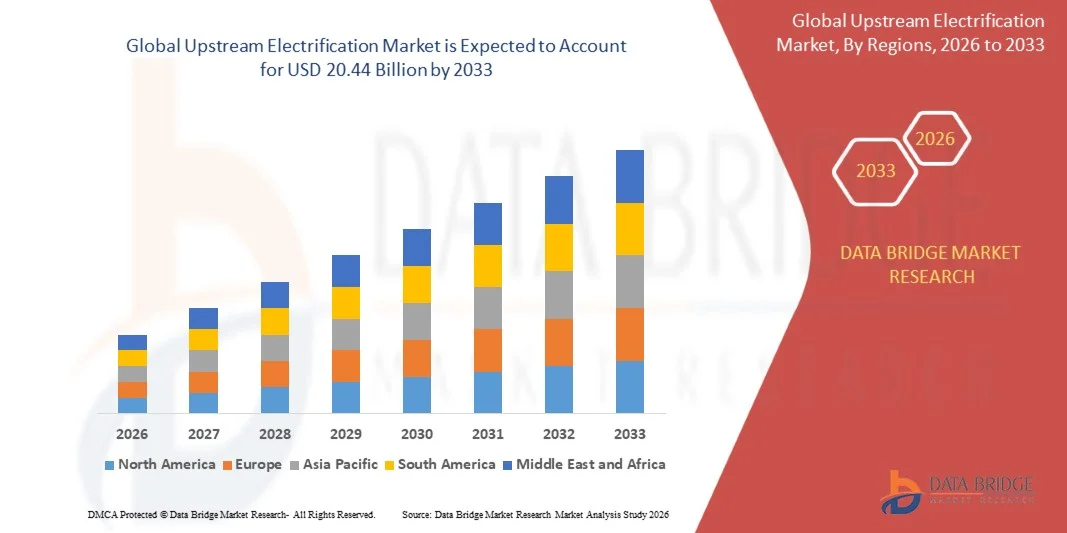
As per Data Bridge Market Research Analysis the Upstream Electrification Market was valued at USD 8.20 billion in 2025 and is projected to reach USD 20.44 billion by 2033, growing at a CAGR of 12.10% from 2026 to 2033. This robust expansion is underpinned by the increasing integration of renewable energy sources and electric power systems into oil and gas extraction, production, and processing activities . The transition from traditional fossil-fuel-powered machinery to electrically driven alternatives is not merely an environmental imperative but a strategic move to enhance reliability, reduce operational costs, and comply with stringent global emission regulations .
The industry is witnessing a fundamental shift where electrification is recognized as a core lever for reducing the carbon footprint of upstream operations while improving overall system performance and ultimate recovery from reservoirs .
Key Market Trends & Insights
- The Offshore Platform Electrification application segment is a dominant force in the market, driven by the need to replace diesel generators with cleaner, more efficient power sources in remote and challenging marine environments.
- Offshore Wind technology is the leading and fastest-growing segment, with the global push for zero-emission targets and large-scale offshore infrastructure development fueling its expansion. It is projected to be worth over USD 7 billion by 2034.
- North America accounted for a significant market share in 2025, leading the charge due to its robust infrastructure, technological advancements, and strong regulatory frameworks supporting energy sustainability.
- Asia-Pacific is expected to be the fastest-growing region, with countries like China and India driving demand through rapid industrialization, urbanization, and ambitious government policies for cleaner energy adoption.
- A major trend is the increasing integration of renewable energy sources like wind, solar, and hydropower with traditional oil and gas assets, reducing reliance on fossil fuels and enabling compliance with emissions targets.
- Technological advancements, particularly in energy storage (advanced batteries), electric motors, and smart grid/power management systems, are enhancing the feasibility, reliability, and cost-effectiveness of electrification projects.
Market Size & Forecast
- Global Market Value (2025): USD 8.20 Billion
- Expected Market Value (2033): USD 20.44 Billion
- Forecast CAGR (2026–2033): 12.10%
- Leading Region in 2025: North America
- Fastest Growing Region: Asia-Pacific
Report Scope and Upstream Electrification Market Segmentation
|
Attributes |
Upstream Electrification Key Market Insights |
|
Segments Covered |
|
|
Countries Covered |
North America · U.S. · Canada · Mexico Europe · Germany · France · U.K. · Netherlands · Switzerland · Belgium · Russia · Italy · Spain · Turkey · Rest of Europe Asia-Pacific · China · Japan · India · South Korea · Singapore · Malaysia · Australia · Thailand · Indonesia · Philippines · Rest of Asia-Pacific Middle East and Africa · Saudi Arabia · U.A.E. · South Africa · Egypt · Israel · Rest of Middle East and Africa South America · Brazil · Argentina · Rest of South America |
|
Key Market Players |
· ABB Ltd. (Switzerland) · Aker Solutions ASA (Norway) · SLB (U.S.) · Siemens Energy AG (Germany) · GE Vernova Inc. (U.S.) · Hitachi Energy Ltd. (Switzerland) · Schneider Electric SE (France) · Prysmian S.p.A. (Italy) · Nexans S.A. (France) · TechnipFMC plc (U.K.) · Baker Hughes Company (U.S.) · Worley Limited (Australia) · Equinor ASA (Norway) · Shell plc (U.K.) · BP p.l.c. (U.K.) |
|
Market Opportunities |
· Integration of AI and digital twin technologies for optimized energy management and predictive maintenance · Development of cost-effective hybrid power solutions combining renewable sources with energy storage. · Strategic partnerships between oil & gas companies and technology providers to develop standardized, scalable electrification modules . |
|
Value Added Data Infosets |
In addition to the insights on market scenarios such as market value, growth rate, segmentation, geographical coverage, and major players, the market reports curated by the Data Bridge Market Research also include in-depth expert analysis, geographically represented company-wise production and capacity, network layouts of distributors and partners, detailed and updated price trend analysis and deficit analysis of supply chain and demand. |
Upstream Electrification Market Trends
Trend: Growth in Renewable Energy Integration & Offshore Wind
A dominant trend is the accelerating integration of renewable energy sources, particularly offshore wind, into upstream oil and gas operations. The industry is moving beyond traditional power generation towards hybrid solutions that combine wind, solar, and hydropower with electric systems. This shift is exemplified by pioneering projects like the Hywind Tampen floating wind farm in Norway, which provides renewable power directly to offshore platforms, and Equinor's Johan Sverdrup field, connected to the onshore power grid . Companies are leveraging offshore wind not only to decarbonize their assets but also to stabilize energy costs and reduce the logistical burden of fuel supply in remote locations.
Upstream Electrification Market Dynamics
Key Market Driver: Decarbonization & Supportive Government Regulations
The primary driver of the upstream electrification market is the intensifying global focus on reducing greenhouse gas emissions and achieving net-zero targets . Stringent environmental regulations from governments and international bodies are compelling oil and gas companies to adopt cleaner technologies. Supportive government policies, such as tax credits (e.g., Canada's CCUS tax credit, US CarbonSAFE Initiative), direct investments in low-carbon infrastructure, and subsidies for renewable energy, are creating a strong economic incentive for electrification . Furthermore, investor pressure and corporate commitments to ESG (Environmental, Social, and Governance) principles are accelerating the adoption of electrification as a tangible strategy to reduce Scope 1 and 2 emissions from upstream operations.
In April 2024, Equinor announced the completion of the partial electrification of the Sleipner field centre and Gudrun platform on the Norwegian Continental Shelf. The project connects the facilities to power from shore, reducing annual carbon dioxide emissions by approximately 160,000 tonnes, while contributing to Norway's national decarbonization objectives and demonstrating the impact of supportive government climate policies on upstream electrification investments
Key Restraint/Challenge: High Initial Capital Investment & Infrastructure
A dominant trend is the accelerating integration of renewable energy sources, particularly offshore wind, into upstream oil and gas operations . The industry is moving beyond traditional power generation towards hybrid solutions that combine wind, solar, and hydropower with electric systems. This shift is exemplified by pioneering projects like the Hywind Tampen floating wind farm in Norway, which provides renewable power directly to offshore platforms, and Equinor's Johan Sverdrup field, connected to the onshore power grid. Companies are leveraging offshore wind not only to decarbonize their assets but also to stabilize energy costs and reduce the logistical burden of fuel supply in remote locations.
In February 2025, Reuters reported that BP announced it would review and prioritize capital spending across its energy portfolio, including lower-carbon investments, to improve financial returns amid rising project costs and market uncertainty. The announcement reflected the growing pressure on energy companies to carefully evaluate capital-intensive electrification and decarbonization projects before committing large-scale investments.
Key Market Opportunity: Technological Advancements in Energy Storage & Digitalization
A significant market opportunity lies in the continuous innovation of energy storage and digital technologies . Advanced battery systems and hybrid power solutions are becoming increasingly viable for providing stable, on-demand power to platforms, especially during intermittent renewable generation. Furthermore, the integration of AI, digital twins, and IoT with electrified systems enables real-time monitoring, predictive maintenance, and optimized energy management . This digitalization enhances operational efficiency, reduces downtime, and maximizes the value derived from reservoir management, creating a strong business case for investment in electrification beyond mere compliance.
In November 2024, ABB announced a collaboration with Lhyfe to develop advanced battery energy storage and power management solutions for offshore renewable and industrial applications. The partnership focuses on integrating battery storage, automation, and digital energy management technologies to improve power reliability and support low-carbon industrial operations, including future offshore energy infrastructure.
Upstream Electrification Market Scope
The upstream electrification market is segmented on the basis of technology, application, equipment, services, and region.
- By Technology
On the basis of Technology, the market is segmented into offshore wind, underground cables, solar, and other technologies. The Offshore Wind segment is the dominant and fastest-growing technology, driven by its scalability, high capacity factor, and suitability for powering remote offshore platforms. Its growth is supported by government initiatives like Feed-in Tariffs (FiT) and a global push for zero-emission targets .
The Solar segment is also gaining traction, particularly as a complementary power source for hybrid systems in regions with high solar irradiance.
- By Application
On the basis of application, the market is segmented into offshore platform electrification, LNG/FLNG facilities, refineries, and others. Offshore Platform Electrification holds the largest market share, as offshore assets are significant energy consumers where replacing diesel generators with electric power offers immediate emissions reduction and operational benefits.
The Refinery application segment is also poised for significant growth as onshore processing facilities seek to reduce their carbon footprint and integrate renewable power into their operations .
- By Equipment
On the basis of equipment market is segmented into segment electric motors, electric generators, electric pumps, electric compressors, and electric control systems. The Electric Motors and Electric Generators segments are crucial for converting electrical energy into mechanical work and vice versa, replacing traditional gas turbines and diesel engines.
Electric Control Systems are vital for managing and optimizing the performance of electrified assets, enabling automation and integration with smart grid technologies .
- By Services
On the basis of Services market is segmented into engineering & consulting, installation & commissioning, and maintenance & upgrades. The Maintenance & Upgrades segment is critical for ensuring long-term reliability and performance of complex electrified systems, representing a significant recurring revenue stream. Engineering & Consulting services are essential for planning and designing customized electrification solutions that meet the specific technical and regulatory requirements of each project .
Upstream Electrification Market Regional Analysis
North America dominated the Upstream Electrification Market in 2025, attributed to its mature oil and gas industry, robust infrastructure, and strong regulatory frameworks supporting energy transition . The U.S. market is driven by strategic initiatives to enhance energy security and production capacity, coupled with technological advancements and investments in sustainability projects . Canada, with its commitment to net-zero emissions, is also a key market, particularly focusing on decarbonizing its oil sands operations through CCS and electrification projects .
The Asia-Pacific region is the fastest-growing market, driven by rapid industrialization, urbanization, and increasing energy demand in countries like China and India . China is experiencing high growth due to its digital-first wellness behaviors and government push for clean energy, making it a pivotal market for electrification technologies . India's growth is fueled by expanding energy infrastructure and government support for sustainable energy solutions.
U.S. Upstream Electrification Market Insight
The U.S. market is characterized by a strong push for energy independence and sustainability . Favorable government policies, such as the CarbonSAFE Initiative, and strategic infrastructure investments (e.g., new pipelines) are bolstering the market . The focus is on upgrading and expanding electrification infrastructure to support domestic oil and gas production efficiently and with a lower environmental impact .
China Upstream Electrification Market Insight
China's market is expanding rapidly, fueled by its status as a major energy consumer and a global leader in renewable energy deployment . The government's strong policy support for energy efficiency and carbon reduction is driving the adoption of electrification technologies across the oil and gas value chain. The market is characterized by rapid innovation and the integration of advanced digital technologies .
Norway Upstream Electrification Market Insight
Norway serves as a global benchmark for upstream electrification, leveraging its abundant hydropower to drastically reduce emissions from its continental shelf . The country's early mover advantage and strategic goal to cut emissions by 70% by 2040 showcase the significant potential of electrification in even the most challenging offshore environments . Projects like Johan Sverdrup and Hywind Tampen demonstrate the technical and economic viability of powering platforms with renewable energy .
Upstream Electrification Market Share
The upstream electrification industry is primarily led by well-established companies, including:
- ABB Ltd. (Switzerland)
- Aker Solutions ASA (Norway)
- SLB (U.S.)
- Siemens Energy AG (Germany)
- GE Vernova Inc. (U.S.)
- Hitachi Energy Ltd. (Switzerland)
- Schneider Electric SE (France)
- Prysmian S.p.A. (Italy)
- Nexans S.A. (France)
- TechnipFMC plc (U.K.)
- Baker Hughes Company (U.S.)
- Worley Limited (Australia)
- Equinor ASA (Norway)
- Shell plc (U.K.)
- BP p.l.c. (U.K.)
Latest Developments in Upstream Electrification Market
- In December 2025, BP announced that construction activities for the Sangachal Terminal Electrification (STEL) project in Azerbaijan are progressing safely and on schedule. The project aims for full electrification by the end of 2028 and is expected to reduce operational emissions by approximately 50% through connection to the national grid and integration with the Shafag solar project .
- In October 2025, Larsen & Toubro (L&T) secured grid infrastructure orders valued between $282 million and $569 million in Saudi Arabia and the UAE. These projects involve constructing a 400 kV substation in the UAE and a 380 kV substation with transmission lines in Saudi Arabia as part of the Kingdom's National Renewable Energy Programme (NREP) .
- In July 2025, ABB was awarded a large contract by BP to lead the electrification of the Sangachal terminal in Azerbaijan. The project includes providing and integrating synchronous condensers to decommission existing gas turbines and connect the facility to the national grid .
- In July 2025, The ANOH Gas Development in Nigeria, a project by Seplat Energy and Renaissance Africa Energy, started commercial operations. This integrated gas-to-power solution supplies nearly 600 million cubic feet of gas per day for power generation, strengthening the link between upstream output and domestic power markets .
- In September 2024, Research from Rystad Energy indicated that converting upstream assets to run on electricity powered by renewables or otherwise-flared gas could cut more than 80% of associated emissions, with fully electrified assets on the Norwegian Continental Shelf showing an 86% drop in emissions per barrel .
- In October 2024, Shell Pipeline Company has made a strategic decision to construct the Rome pipeline, a new offshore infrastructure project. The pipeline will span 100 miles from the company’s Green Canyon block 19 hub platform to its Fourchon Junction facility in Louisiana. Through an agreement with BP America Production Company, the pipeline will exclusively transport crude oil from BP's Kaskida field. The project connects with Enbridge's Canyon oil pipeline, a 140-mile system with 24 and 26-inch sections, linking the Kaskida Floating Production Unit to the Green Canyon hub platform.

- Interactive Data Analysis Dashboard
- Company Analysis Dashboard for high growth potential opportunities
- Research Analyst Access for customization & queries
- Competitor Analysis with Interactive dashboard
- Latest News, Updates & Trend analysis
- Harness the Power of Benchmark Analysis for Comprehensive Competitor Tracking
Data collection and base year analysis are done using data collection modules with large sample sizes. The stage includes obtaining market information or related data through various sources and strategies. It includes examining and planning all the data acquired from the past in advance. It likewise envelops the examination of information inconsistencies seen across different information sources. The market data is analysed and estimated using market statistical and coherent models. Also, market share analysis and key trend analysis are the major success factors in the market report. To know more, please request an analyst call or drop down your inquiry.
The key research methodology used by DBMR research team is data triangulation which involves data mining, analysis of the impact of data variables on the market and primary (industry expert) validation. Data models include Vendor Positioning Grid, Market Time Line Analysis, Market Overview and Guide, Company Positioning Grid, Patent Analysis, Pricing Analysis, Company Market Share Analysis, Standards of Measurement, Global versus Regional and Vendor Share Analysis. To know more about the research methodology, drop in an inquiry to speak to our industry experts.
Data Bridge Market Research is a leader in advanced formative research. We take pride in servicing our existing and new customers with data and analysis that match and suits their goal. The report can be customized to include price trend analysis of target brands understanding the market for additional countries (ask for the list of countries), clinical trial results data, literature review, refurbished market and product base analysis. Market analysis of target competitors can be analyzed from technology-based analysis to market portfolio strategies. We can add as many competitors that you require data about in the format and data style you are looking for. Our team of analysts can also provide you data in crude raw excel files pivot tables (Fact book) or can assist you in creating presentations from the data sets available in the report.