


What is the Used Cooking Oil Market Size and Growth Rate?
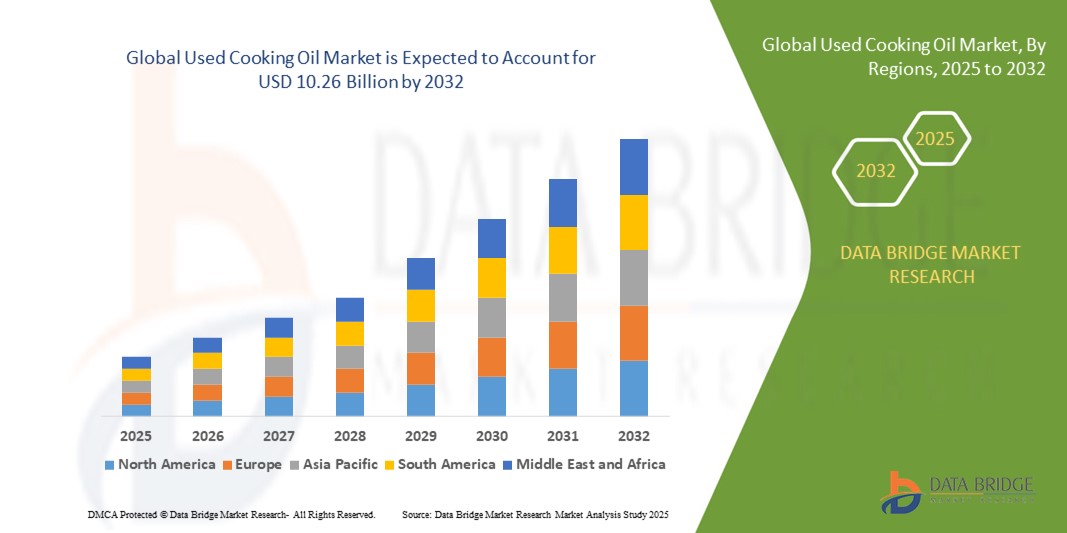
- As per Data Bridge Market Research Analysis the global used cooking oil market size was valued at USD 6.95 billion in 2024 and is expected to reach USD 10.26 billion by 2032, at a CAGR of 5.00% during the forecast period
- The market growth is largely fuelled by the rising demand for biodiesel production, growing emphasis on waste management and recycling, and increasing awareness about the environmental benefits of repurposing used cooking oil
- Expanding government initiatives and subsidies for renewable energy sources are further accelerating the collection and utilization of used cooking oil across commercial and industrial sectors
Market Size & Forecast
- Global Market Value (2024): USD 6.95 Billion
- Expected Market Value (2032): USD 10.26 Billion
- Forecast CAGR (2025–2032): 5.00%
Used Cooking Oil Market Analysis
- The market is witnessing steady growth due to increasing use of used cooking oil in biodiesel production, driven by global sustainability goals and renewable fuel policies
- Rising awareness about proper waste disposal and environmental protection is encouraging households and food service providers to recycle used cooking oil
- North America dominated the used cooking oil market in 2024 with the largest revenue share, driven by strong regulatory frameworks promoting renewable fuels and the widespread availability of waste oil from commercial foodservice operations
- Asia-Pacific region is expected to witness the highest growth rate in the global used cooking oil market, driven by rapid urbanization, rising consumption of edible oils, expanding foodservice industry, and government efforts to formalize UCO collection and promote biofuel adoption
- The HORECA segment dominated the market with the largest market revenue share in 2024, attributed to the high volume of waste oil generated in commercial foodservice establishments. This segment benefits from organized collection mechanisms and long-term contracts with biodiesel producers and recyclers, making it a key contributor to the formal UCO supply chain. The consistency and volume of oil generated in the HORECA sector make it a preferred source for industrial applications
Report Scope and Used Cooking Oil Market Segmentation
|
Attributes |
Used Cooking Oil Key Market Insights |
|
Segments Covered |
|
|
Countries Covered |
North America
Europe
Asia-Pacific
Middle East and Africa
South America
|
|
Key Market Players |
|
|
Market Opportunities |
• Expansion of Biodiesel Production Facilities in Emerging Economies |
|
Value Added Data Infosets |
In addition to the insights on market scenarios such as market value, growth rate, segmentation, geographical coverage, and major players, the market reports curated by the Data Bridge Market Research also include in-depth expert analysis, pricing analysis, brand share analysis, consumer survey, demography analysis, supply chain analysis, value chain analysis, raw material/consumables overview, vendor selection criteria, PESTLE Analysis, Porter Analysis, and regulatory framework. |
What is the Key Trend in the Used Cooking Oil Market?
Growing Adoption of Biodiesel Production Using Used Cooking Oil
- The increasing focus on sustainable fuel alternatives has led to a surge in the use of used cooking oil (UCO) for biodiesel production. As governments enforce stricter emission regulations and promote greener energy, UCO is emerging as a cost-effective and eco-friendly raw material, particularly in Europe and North America
- The commercial foodservice sector, including restaurants and quick-service chains, is increasingly entering into partnerships with biodiesel producers to monetize their waste oil. This closed-loop system is helping reduce environmental pollution while supporting circular economy initiatives
- Collection infrastructure and logistics around UCO have seen significant improvement, driven by public-private partnerships. Dedicated collection networks, especially in urban areas, are making it easier for stakeholders to recycle waste oil, further promoting biodiesel conversion
- For instance, in 2023, McDonald’s Netherlands partnered with a local biodiesel company to convert all its used cooking oil into renewable fuel, powering its delivery fleet and reducing overall carbon emissions
- Although biodiesel production is a key driver, consistent quality, standardized collection, and contamination control remain vital to ensuring scalability. Advancements in pre-treatment technologies and supportive policies are expected to further accelerate this trend
Used Cooking Oil Market Dynamics
Driver
Increased Government Regulations and Incentives Supporting Waste-to-Energy Transition
• Governments across various regions are implementing supportive policies to encourage the recycling and reuse of used cooking oil, particularly for biodiesel and other bio-based applications. These efforts aim to reduce landfill waste, curb illegal oil disposal, and meet national sustainability targets
• Many countries offer subsidies, tax credits, or mandates to promote the use of biodiesel derived from waste feedstocks. These measures are encouraging both producers and consumers to participate in the used oil recovery chain, ultimately boosting collection rates and market growth
• Regulatory agencies are also cracking down on improper disposal practices, imposing penalties and encouraging formalized collection services. This is pushing food establishments to ensure proper storage and handover of their used oil
• For instance, the U.K.’s Renewable Transport Fuel Obligation (RTFO) mandates a minimum percentage of renewable fuel usage in transport. This has significantly increased demand for UCO-based biodiesel in the region
• While regulations and incentives are driving the market, effective implementation and monitoring are necessary to prevent fraudulent practices, ensure supply chain traceability, and maintain environmental integrity
Restraint/Challenge
Lack of Collection Infrastructure and Quality Control in Emerging Economies
• The used cooking oil market faces significant hurdles in developing countries due to inadequate collection infrastructure, lack of awareness, and informal recycling practices. Many food vendors dispose of used oil improperly or sell it illegally for reuse, which poses serious public health concerns
• Absence of organized collection systems limits the availability of quality feedstock for industrial usage. Inconsistent pickup schedules and lack of storage equipment further discourage foodservice establishments from participating in recycling programs
• Poor quality control during collection often leads to contamination, which affects the suitability of UCO for biodiesel production and increases processing costs. This discourages biodiesel producers from sourcing UCO in bulk from unregulated markets
• For instance, in 2022, a survey in Southeast Asia revealed that over 60% of small-scale food vendors either reused or discarded used oil without formal collection, citing the absence of support infrastructure and awareness
• Addressing these challenges requires coordinated efforts between governments, recyclers, and food operators. Investment in localized collection systems, public education, and quality certification mechanisms will be critical to unlocking untapped supply potential and ensuring safe and sustainable UCO usage
Used Cooking Oil Market Scope
The market is segmented on the basis of source and application.
- By Source
On the basis of source, the used cooking oil market is segmented into food manufacturers, HORECA (hotels, restaurants, and catering), household, and others. The HORECA segment dominated the market with the largest market revenue share in 2024, attributed to the high volume of waste oil generated in commercial foodservice establishments. This segment benefits from organized collection mechanisms and long-term contracts with biodiesel producers and recyclers, making it a key contributor to the formal UCO supply chain. The consistency and volume of oil generated in the HORECA sector make it a preferred source for industrial applications.
The household segment is expected to witness the fastest growth rate from 2025 to 2032, driven by increasing consumer awareness about proper disposal and recycling of cooking oil. Government-led awareness campaigns and localized collection initiatives are encouraging more households to participate in used oil recycling, especially in urban regions. The development of easy-to-use collection systems and incentives for domestic contributors are further fueling growth in this segment.
- By Application
On the basis of application, the used cooking oil market is segmented into biodiesel, oleochemical products, animal feed, and others. The biodiesel segment held the largest market revenue share in 2024 due to rising demand for renewable energy sources and strong policy support for waste-derived biofuels. Used cooking oil is increasingly being recognized as a sustainable and cost-effective feedstock for biodiesel production, especially in Europe and North America where regulatory mandates and carbon offset goals are prominent.
The oleochemical products segment is expected to witness the fastest growth rate from 2025 to 2032, supported by its use in the production of soaps, lubricants, surfactants, and cosmetics. As manufacturers seek bio-based raw materials to replace petroleum-derived inputs, UCO is emerging as an attractive alternative. The segment is gaining momentum due to the growing trend toward green chemistry and sustainable personal care product formulations.
Used Cooking Oil Market Regional Analysis
- North America dominated the used cooking oil market in 2024 with the largest revenue share, driven by strong regulatory frameworks promoting renewable fuels and the widespread availability of waste oil from commercial foodservice operations
- High participation from quick-service restaurants, advanced collection infrastructure, and policy incentives such as the Renewable Fuel Standard (RFS) are key factors supporting market growth across the region
- The region’s mature biodiesel industry and focus on sustainable waste management further reinforce its leadership position
U.S. Used Cooking Oil Market Insight
The U.S. used cooking oil market accounted for the highest revenue share within North America in 2024, supported by an extensive network of restaurants, food processors, and institutional kitchens generating consistent volumes of UCO. Federal and state-level policies such as LCFS (Low Carbon Fuel Standard) and RFS (Renewable Fuel Standard) continue to drive demand for UCO-derived biodiesel. Strategic collaborations between recycling companies and foodservice chains, coupled with investments in refining technologies, are further enhancing the U.S. market landscape.
Asia-Pacific Used Cooking Oil Market Insight
Asia-Pacific is expected to witness the fastest growth rate from 2025 to 2032, propelled by increasing edible oil consumption, rapid urbanization, and a growing focus on sustainable fuel alternatives. Government-backed efforts in countries such as India and Indonesia to formalize UCO collection networks and combat illegal oil reuse are creating strong growth potential. The region's expanding biodiesel capacity and rising public awareness are also accelerating market adoption.
China Used Cooking Oil Market Insight
The China used cooking oil market held the largest market share in Asia-Pacific in 2024, fueled by the country’s large-scale foodservice industry and rapid urban growth. Regulatory enforcement against illegal reuse of waste oil and increased investment in biodiesel infrastructure have strengthened China’s formal UCO collection and processing capabilities. With strong domestic manufacturing support and growing interest in biofuels, China remains a critical contributor to regional and global UCO markets.
Japan Used Cooking Oil Market Insight
The Japan used cooking oil market is expected to witness the fastest growth rate from 2025 to 2032, supported by the country’s emphasis on sustainability and efficient waste management. Japan’s highly urbanized population and established recycling culture have led to increased participation in UCO collection, particularly from restaurants and institutional kitchens. In addition, initiatives promoting biodiesel use in public transportation and local industries are contributing to market growth, with a focus on high-quality, contaminant-free used oil feedstock.
Europe Used Cooking Oil Market Insight
Europe is expected to witness the fastest growth rate from 2025 to 2032, supported by robust recycling policies, stringent biofuel blending mandates, and advanced waste collection systems. Strong regulatory backing under programs such as RED II (Renewable Energy Directive) has made UCO a preferred feedstock for biodiesel production. The region benefits from a highly engaged HORECA sector, public awareness, and technological innovation in oil purification and conversion.
Germany Used Cooking Oil Market Insight
Germany is expected to witness the fastest growth rate from 2025 to 2032, driven by a combination of strict environmental standards, efficient waste segregation practices, and high biodiesel demand. The country’s integration of sustainability into industrial operations and household behavior has supported a well-structured UCO collection ecosystem. With ongoing innovation in refining technologies and strong industry participation, Germany remains a central hub for UCO processing and biofuel supply.
U.K. Used Cooking Oil Market Insight
The U.K. used cooking oil market is expected to witness the fastest growth rate from 2025 to 2032, underpinned by supportive government initiatives and rising awareness around circular economy practices. Collection programs targeting both commercial and household contributors have expanded significantly, while the use of UCO in biodiesel blends for transportation is gaining traction. The presence of a strong foodservice industry and growing investments in waste-to-energy solutions are expected to further fuel market expansion in the U.K.
Used Cooking Oil Market Share
The Used Cooking Oil industry is primarily led by well-established companies, including:
- KRATON CORPORATION (U.S.)
- PAG KIMYA SAN. TIC. LTD. STI. (Turkey)
- TCG GREENCHEM (U.S.)
- YKA Akay Ticaret ve Kimya Sanayi A.Ş. (Turkey)
- G.C. RUTTEMAN & Co. B.V. (Netherlands)
- MALPLAST INDUSTRIES LIMITED (Kenya)
- Finis-Eillert (Netherlands)
- Bettcher Industries, Inc. (U.S.)
- ANKO FOOD MACHINE CO. LTD. (Taiwan)
- Heat and Control, Inc. (U.S.)
- Baader Global SE (Germany)
- Dover Corporation (U.S.)
Latest Developments in Global Used Cooking Oil Market
- In February 2022, St1 Nordic Oy completed the acquisition of Brocklesby Ltd., a company specializing in recycling used cooking oil and fatty food waste. This strategic move enhances St1's capabilities in sustainable waste management and biofuel production, supporting their long-term renewable energy goals and strengthening their position in the circular economy space
- In November 2022, KNP Arises, under the leadership of Kirti and Sushil Vaishnav, undertook a large-scale biodiesel initiative by converting 3 million liters of waste cooking oil from Delhi-based restaurants. This project achieved an 80% reduction in carbon dioxide emissions compared to fossil fuels, highlighting the environmental benefits and potential for UCO-based biodiesel in urban sustainability efforts
- In November 2022, Neste acquired the used cooking oil collection and aggregation business of Crimson Renewable Energy Holdings, LLC. The acquisition aims to expand Neste’s renewable feedstock sourcing on the U.S. West Coast, particularly for biodiesel production, further reinforcing its global leadership in the renewable fuels market
- In December 2022, the Food Safety and Standards Authority of India (FSSAI) collected around 60,000 liters of used cooking oil from restaurants and hotels in Ernakulam as part of the RUCO (Repurpose Used Cooking Oil) initiative. The collected oil was sent for biodiesel conversion, promoting responsible waste disposal and contributing to India’s push for renewable energy adoption through community participation

- Interactive Data Analysis Dashboard
- Company Analysis Dashboard for high growth potential opportunities
- Research Analyst Access for customization & queries
- Competitor Analysis with Interactive dashboard
- Latest News, Updates & Trend analysis
- Harness the Power of Benchmark Analysis for Comprehensive Competitor Tracking
Global Used Cooking Oil Market, Supply Chain Analysis and Ecosystem Framework
To support market growth and help clients navigate the impact of geopolitical shifts, DBMR has integrated in-depth supply chain analysis into its Global Used Cooking Oil Market research reports. This addition empowers clients to respond effectively to global changes affecting their industries. The supply chain analysis section includes detailed insights such as Global Used Cooking Oil Market consumption and production by country, price trend analysis, the impact of tariffs and geopolitical developments, and import and export trends by country and HSN code. It also highlights major suppliers with data on production capacity and company profiles, as well as key importers and exporters. In addition to research, DBMR offers specialized supply chain consulting services backed by over a decade of experience, providing solutions like supplier discovery, supplier risk assessment, price trend analysis, impact evaluation of inflation and trade route changes, and comprehensive market trend analysis.
Data collection and base year analysis are done using data collection modules with large sample sizes. The stage includes obtaining market information or related data through various sources and strategies. It includes examining and planning all the data acquired from the past in advance. It likewise envelops the examination of information inconsistencies seen across different information sources. The market data is analysed and estimated using market statistical and coherent models. Also, market share analysis and key trend analysis are the major success factors in the market report. To know more, please request an analyst call or drop down your inquiry.
The key research methodology used by DBMR research team is data triangulation which involves data mining, analysis of the impact of data variables on the market and primary (industry expert) validation. Data models include Vendor Positioning Grid, Market Time Line Analysis, Market Overview and Guide, Company Positioning Grid, Patent Analysis, Pricing Analysis, Company Market Share Analysis, Standards of Measurement, Global versus Regional and Vendor Share Analysis. To know more about the research methodology, drop in an inquiry to speak to our industry experts.
Data Bridge Market Research is a leader in advanced formative research. We take pride in servicing our existing and new customers with data and analysis that match and suits their goal. The report can be customized to include price trend analysis of target brands understanding the market for additional countries (ask for the list of countries), clinical trial results data, literature review, refurbished market and product base analysis. Market analysis of target competitors can be analyzed from technology-based analysis to market portfolio strategies. We can add as many competitors that you require data about in the format and data style you are looking for. Our team of analysts can also provide you data in crude raw excel files pivot tables (Fact book) or can assist you in creating presentations from the data sets available in the report.













