


Uterine Fibroids Market Size
-
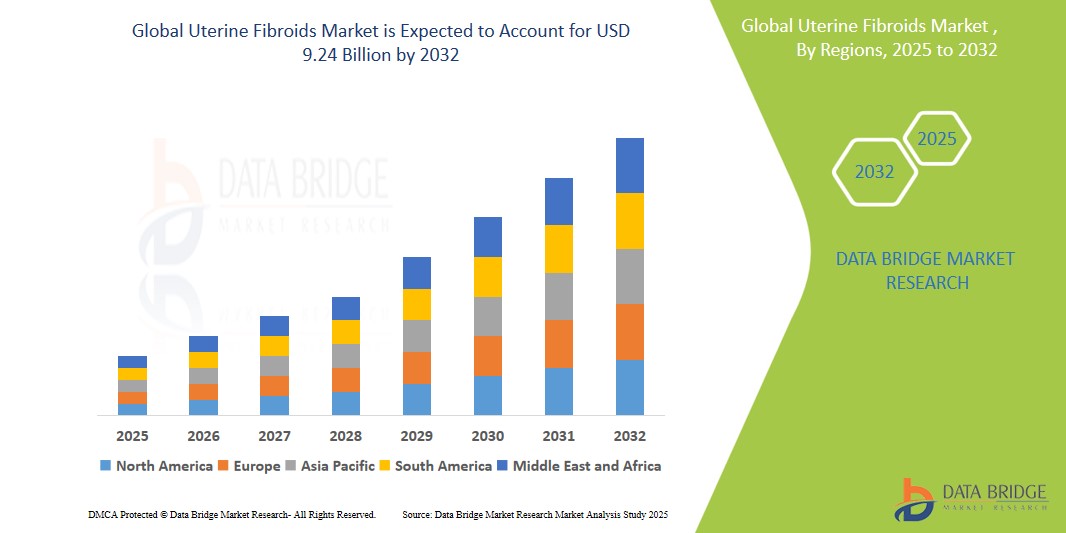
The Global Uterine Fibroids Market size was valued at USD 4.25 billion in 2024 and is expected to reach USD 9.24 billion by 2032, at a CAGR of 10.2% during the forecast period
-
This growth is driven by factors such as rising incidence of uterine fibroids, increased awareness about the condition, growing demand for non-invasive treatment options, and advancements in diagnostic technologies
Uterine Fibroids Market Analysis
-
Uterine fibroids are also known as leiomyoma or myomas, which can be characterized by the formation of abnormal non-cancerous tissue growth inside the wall of the uterus. A woman may develop one or many fibroids in uterus and these can vary in sizes depending upon the condition and level
-
The demand for uterine fibroid treatments is significantly driven by the rising prevalence of uterine fibroids, increasing awareness through women’s health initiatives, and technological advancements in minimally invasive treatment options such as MR-guided focused ultrasound and laparoscopic procedures
- North America is expected to dominate the Uterine Fibroids market with a share of 36.4%, due to its advanced healthcare infrastructure, widespread use of modern treatment techniques, and strong presence of key market players specializing in gynecological health.
- Asia-Pacific is expected to be the fastest growing region in the Uterine Fibroids market during the forecast period due to rapid improvements in healthcare infrastructure, increased awareness about reproductive health, and a higher number of treatment procedures being performed
- Subserosal Fibroids segment is expected to dominate the market with a market share of 34.5% due to its high prevalence and frequent need for clinical intervention. This type of fibroid is more likely to cause noticeable symptoms, leading to earlier diagnosis and treatment. Despite the emergence of newer non-invasive therapies, surgical management of subserosal fibroids remains widely adopted due to its established clinical outcomes, ease of procedural planning, and minimal requirement for specialized infrastructure. Its predictable growth pattern and accessibility during surgery continue to support its leading role in fibroid treatment.
Report Scope and Uterine Fibroids Market Segmentation
|
Attributes |
Uterine Fibroids Key Market Insights |
|
Segments Covered |
|
|
Countries Covered |
North America
Europe
Asia-Pacific
Middle East and Africa
South America
|
|
Key Market Players |
|
|
Market Opportunities |
|
|
Value Added Data Infosets |
In addition to the insights on market scenarios such as market value, growth rate, segmentation, geographical coverage, and major players, the market reports curated by the Data Bridge Market Research also include import export analysis, production capacity overview, production consumption analysis, price trend analysis, climate change scenario, supply chain analysis, value chain analysis, raw material/consumables overview, vendor selection criteria, PESTLE Analysis, Porter Analysis, and regulatory framework. |
Uterine Fibroids Market Trends
“Growing Shift Toward Non-Invasive and Uterus-Preserving Treatment Options”
- One prominent trend in the Uterine Fibroids market is the growing shift toward non-invasive and uterus-preserving treatment options
- This trend is driven by increasing patient demand for fertility preservation, shorter recovery periods, and reduced surgical risks compared to traditional hysterectomy
- For instance, in 2022, the U.S. FDA approved the Exablate 2100 system by Insightec for MR-guided focused ultrasound (MRgFUS), enabling non-invasive treatment of uterine fibroids with real-time imaging and no incisions
- This development is transforming fibroid management by offering effective, outpatient-based treatment options that preserve the uterus and improve quality of life for women
- The Uterine Fibroids market is expected to grow steadily, supported by rising adoption of non-surgical alternatives, technological advancements, and increasing awareness of reproductive health and minimally invasive solutions
Uterine Fibroids Market Dynamics
Driver
“Rising Prevalence of Uterine Fibroids Among Women of Reproductive Age”
- The rising prevalence of uterine fibroids among women of reproductive age is significantly driving the demand for effective and accessible treatment solutions
- As more women experience symptoms such as heavy menstrual bleeding, pelvic pain, and fertility issues, there is growing emphasis on early diagnosis and personalized treatment options
- With increased screening and awareness, clinicians are identifying fibroids at earlier stages, allowing for less invasive management and improved patient outcomes. This has led to greater demand for uterus-preserving procedures such as laparoscopic myomectomy and uterine artery embolization
- The burden of untreated fibroids often leads to reduced quality of life and long-term health complications, prompting women to seek treatment earlier and more proactively
- This shift is also encouraging healthcare providers and policymakers to prioritize fibroid care within broader women’s health initiatives
For instance,
- A 2021 report by the NIH highlighted that up to 80% of women develop uterine fibroids by age 50, with a disproportionate impact on Black women, who often experience earlier onset and more severe symptoms.
- This growing clinical need has led to expanded research funding and wider adoption of advanced treatment options across developed and developing markets
- The increasing prevalence of fibroids is expected to continue driving growth in the global market as healthcare systems respond with improved screening, innovative therapies, and greater patient education efforts
Opportunity
“Expanding Access to Treatment in Emerging Markets”
- The expanding access to treatment in emerging markets is creating significant growth opportunities for the Uterine Fibroids market
- Rising healthcare investments, increased awareness of women’s health, and the introduction of cost-effective, minimally invasive treatments are improving care access in regions such as Asia-Pacific, Latin America, and parts of Africa
- Government initiatives and international support programs are helping to expand diagnostic infrastructure, train specialists, and promote early intervention strategies, reducing the burden of untreated fibroids
- As affordability and healthcare accessibility improve, more women are seeking diagnosis and treatment, fueling demand for advanced therapies and driving market expansion in developing economies
For instance,
- In 2022, India’s National Health Mission expanded access to gynecological care by including non-invasive fibroid treatments like uterine artery embolization in public hospitals, significantly increasing patient access in rural and underserved areas
- These developments highlight the untapped potential of emerging markets, encouraging global manufacturers and healthcare providers to invest in region-specific solutions and partnerships
- With continued infrastructure growth and awareness efforts, emerging markets are expected to play a key role in the future expansion of the global uterine fibroids market
Restraint/Challenge
“High Cost of Advanced Treatment Procedures and Limited Reimbursement”
- The high cost of advanced uterine fibroid treatment procedures presents a major challenge for market growth, especially in low- and middle-income countries
- Minimally invasive techniques such as MR-guided focused ultrasound (MRgFUS), laparoscopic myomectomy, and uterine artery embolization involve significant costs for equipment, skilled personnel, and post-operative care
- These procedures often require advanced imaging systems and specialized infrastructure, making them less accessible in underfunded healthcare systems. High out-of-pocket costs can also deter patients from opting for such treatments
- Inadequate insurance coverage and limited reimbursement policies further restrict the adoption of these modern approaches, leading many facilities to continue using older, less effective treatment options
For instance,
- In several African and Southeast Asian countries, healthcare providers still rely heavily on hysterectomy due to the high upfront cost and limited availability of non-invasive alternatives like MRgFUS
- This economic barrier contributes to unequal access to quality care and slows the global adoption of innovative, patient-friendly fibroid treatments
- Without broader policy reforms and improved funding support, these cost-related restraints may continue to limit market growth, particularly in underserved regions
Uterine Fibroids Market Scope
The market is segmented on the basis of type, mechanism of action, drugs type, diagnosis, treatment, route of administration and end-user.
|
Segmentation |
Sub-Segmentation |
|
By Type |
|
|
By mechanism of Action |
|
|
By Drug Type |
|
|
By Diagnosis |
|
|
By Treatment |
|
|
By Route of Admininstration |
|
|
By End User |
|
In 2025, the Subserosal Fibroids is projected to dominate the market with a largest share in type segment
The Subserosal Fibroids segment is expected to dominate the Uterine Fibroids market with the largest share of 34.5% in 2025 due to its high clinical prevalence, ease of detection, and the relative simplicity of treatment procedures. These fibroids, which grow on the outer wall of the uterus, often lead to noticeable symptoms, prompting timely medical intervention. Despite the development of newer, non-invasive treatment technologies, surgical options such as laparoscopic myomectomy remain the preferred approach for managing subserosal fibroids. Their established clinical pathways, procedural familiarity among gynecologists, and cost-effectiveness continue to reinforce their dominant market position.
The GnRH Agonists is expected to account for the largest share during the forecast period in mechanisam of action segment
In 2025, the GnRH Agonists segment is expected to dominate the market due to its non-surgical nature, improved patient outcomes, and growing preference as a first-line pharmacological therapy. GnRH agonists help reduce fibroid size and associated symptoms by lowering estrogen levels, offering a valuable treatment option for women seeking temporary relief or preparing for surgery. Unlike invasive procedures, these medications offer greater flexibility, fewer complications, and can be administered in outpatient settings. The increasing demand for non-invasive, hormone-based therapies—supported by favorable clinical outcomes and expanding regulatory approvals—is driving the continued growth and adoption of this segment.
Uterine Fibroids Market Regional Analysis
“North America Holds the Largest Share in the Uterine Fibroids Market”
-
North America dominates the Uterine Fibroids market with a share of 36.4%, driven by its advanced healthcare infrastructure, widespread use of minimally invasive treatment techniques, and the strong presence of key market players in gynecological care
- The U.S. holds a significant share of 78.3% in the regional market due to high awareness among women, early diagnosis rates, and the growing adoption of pharmacological and non-invasive procedures such as uterine artery embolization and MRI-guided focused ultrasound
- The presence of leading companies like AbbVie, Hologic, and Medtronic, along with ongoing investments in women's health R&D, continues to fuel innovation and access to cutting-edge fibroid treatment solutions
- The rising number of uterine fibroid procedures, increasing patient preference for uterus-preserving treatments, and government initiatives promoting women's reproductive health contribute to market expansion. As demand for safer and more effective options grows, North America is expected to maintain its leading position in the global market
“Asia-Pacific is Projected to Register the Highest CAGR in the Uterine Fibroids Market”
-
The Asia-Pacific region is expected to witness the highest growth rate in the Uterine Fibroids market, driven by rapid improvements in healthcare infrastructure, rising awareness of women’s reproductive health, and increasing demand for effective treatment options
- Countries such as China, India, and Japan are emerging as key markets due to the growing prevalence of uterine fibroids, rising fertility concerns, and greater availability of advanced, minimally invasive treatment techniques
- Japan, with its well-established medical infrastructure, continues to lead in adopting innovative technologies such as MR-guided focused ultrasound and laparoscopic myomectomy, enhancing the precision and safety of fibroid treatment
- The region’s expanding healthcare access, increased investments in gynecological care, and growing focus on fertility-preserving therapies are expected to propel market growth, positioning Asia-Pacific as the fastest-growing region in the global uterine fibroids market
Uterine Fibroids Market Share
The market competitive landscape provides details by competitor. Details included are company overview, company financials, revenue generated, market potential, investment in research and development, new market initiatives, global presence, production sites and facilities, production capacities, company strengths and weaknesses, product launch, product width and breadth, application dominance. The above data points provided are only related to the companies' focus related to market.
The Major Market Leaders Operating in the Market Are:
- GlaxoSmithKline plc (United Kingdom
- F. Hoffmann-La Roche Ltd (Switzerland)
- Pfizer Inc (U.S.)
- ovartis AG (Switzerland)
- Bristol-Myers Squibb Company (U.S.)
- Sanofi (France)
- Teva Pharmaceutical Industries Ltd. (Israel)
- Amgen Inc (U.S.)
- Medtronic (Ireland)
- Endo International plc (Ireland)
- Mylan N.V (U.S. – now part of Viatris)
- Sun Pharmaceutical Industries Ltd (India)
- Hologic, Inc (U.S.)
- Smith & Nephew (United Kingdom)
- Merck & Co., Inc (U.S.)
- ALLERGAN (U.S. – acquired by AbbVie)
- Bayer AG (Germany)
- Koninklijke Philips N.V (Netherlands)
- IceCure Medical (Israel)
Latest Developments in Global Uterine Fibroids Market
- In November 2022, The TruClear system, a mechanically operated hysteroscopic tissue removal tool for the safe and efficient treatment of intrauterine abnormalities (IUA), was recently introduced by India Medtronic Private Limited. IUA is frequently used to diagnose conditions, including fibroids, polyps, adhesions, cancers, hyperplasia, and retained products of conception.
- In November 2023, to increase the commercialization of its sonata treatment, which targets uterine fibroids, Gynesonics announced an investment of $67 million.
- In June 2022, The Healthcare Products Regulatory Agency (MHRA) and UK Medicines have authorized the marketing of Yselty, an oral GnRH antagonist, to treat mild to severe signs and symptoms of uterine fibroids (UF) in adult women of reproductive years. ObsEva SA is a biopharmaceutical company developing and commercializing novel health therapies for women

- Interactive Data Analysis Dashboard
- Company Analysis Dashboard for high growth potential opportunities
- Research Analyst Access for customization & queries
- Competitor Analysis with Interactive dashboard
- Latest News, Updates & Trend analysis
- Harness the Power of Benchmark Analysis for Comprehensive Competitor Tracking
Table of Content
1 INTRODUCTION
1.1 OBJECTIVES OF THE STUDY
1.2 MARKET DEFINITION
1.3 OVERVIEW OF GLOBAL UTERINE FIBROIDS MARKET
1.4 CURRENCY AND PRICING
1.5 LIMITATION
1.6 MARKETS COVERED
2 MARKET SEGMENTATION
2.1 KEY TAKEAWAYS
2.2 ARRIVING AT THE GLOBAL UTERINE FIBROIDS MARKET SIZE
2.2.1 VENDOR POSITIONING GRID
2.2.2 TECHNOLOGY LIFE LINE CURVE
2.2.3 TRIPOD DATA VALIDATION MODEL
2.2.4 MARKET GUIDE
2.2.5 MULTIVARIATE MODELLING
2.2.6 TOP TO BOTTOM ANALYSIS
2.2.7 CHALLENGE MATRIX
2.2.8 APPLICATION COVERAGE GRID
2.2.9 STANDARDS OF MEASUREMENT
2.2.10 VENDOR SHARE ANALYSIS
2.2.11 DATA POINTS FROM KEY PRIMARY INTERVIEWS
2.2.12 DATA POINTS FROM KEY SECONDARY DATABASES
2.3 GLOBAL UTERINE FIBROIDS MARKET: RESEARCH SNAPSHOT
2.4 ASSUMPTIONS
3 MARKET OVERVIEW
3.1 DRIVERS
3.2 RESTRAINTS
3.3 OPPORTUNITIES
3.4 CHALLENGES
4 EXECUTIVE SUMMARY
5 EPIDEMIOLOGY
6 PREMIUM INSIGHTS
6.1 PESTEL ANALYSIS
6.2 PORTER’S 5 FORCES
6.3 KEY STRATEGIC INITIATIVES
6.4 PATENT ANALYSIS
6.5 GLOBAL UTERINE FIBROIDS MARKET ANALYSIS (QUALITATIVE AND QUANTITATIVE ANALYSIS)
7 INDUSTRY INSIGHTS
7.1 DEMOGRAPHIC TRENDS: IMPACTS ON ALL INCIDENCE RATES
7.2 KEY PRICING STRATEGIES
7.3 INTERVIEWS WITH DEVICE MANUFACTURERS
7.4 INTERVIEWS WITH DRUG MANUFACTURERS
7.5 OTHER KOL SNAPSHOTS
8 PIPELINE ANALYSIS
8.1 PHASE III CANDIDATES
8.2 PHASE II CANDIDATES
8.3 PHASE I CANDIDATES
8.4 OTHERS (PRE-CLINICAL AND RESEARCH)
9 REGULATORY FRAMWORK
10 GLOBAL UTERINE FIBROIDS MARKET, BY TYPE
10.1 OVERVIEW
10.2 SUBSEROSAL FIBROIDS
10.3 INTRAMURAL FIBROIDS
10.4 SUBMUCOSAL FIBROIDS
10.5 OTHERS
11 GLOBAL UTERINE FIBROIDS MARKET, BY DIAGNOSIS AND TREATMENT
11.1 OVERVIEW
11.2 DIAGNOSIS
11.2.1 ULTRASONOGRAPHY
11.2.2 MAGNETIC RESONANCE IMAGING (MRI)
11.2.3 COMPUTED TOMOGRAPHY
11.2.4 HYSTEROSCOPY
11.2.5 HYSTEROSALPINGOGRAPHY (HSG)
11.2.6 SONOHYSTEROGRAPHY
11.2.7 OTHERS
11.3 TREATMENT
11.3.1 MEDICATION
11.3.1.1. MEDICATION, BY TYPE
11.3.1.1.1. GNRH AGONISTS
11.3.1.1.1.1 BY TYPE
11.3.1.1.1.1.1. CETRORELIX
11.3.1.1.1.1.2. ELAGOLIX
11.3.1.1.1.1.3. LEUPRORELIN
11.3.1.1.1.1.4. OTHER
11.3.1.1.2. STEROIDS
11.3.1.1.3. CONTRACEPTIVES
11.3.1.1.3.1 BY TYPE
11.3.1.1.3.1.1. COMBINED ORAL CONTRACEPTIVES
11.3.1.1.3.1.2. PROGESTIN
I. MEDROXYPROGESTERONE ACETATE
II. NORETHINDRONE ACETATE
III. OTHERS
11.3.1.1.3.1.3. HORMONAL INTRAUTERINE DEVICES (IUDS)
11.3.1.1.4. NONSTEROIDAL ANTI-INFLAMMATORY DRUGS (NSAIDS)
11.3.1.1.4.1 BY TYPE
11.3.1.1.4.1.1. IBUPROFEN
11.3.1.1.4.1.2. NAPROXEN
11.3.1.1.4.1.3. MEFENAMIC ACID
11.3.1.1.4.1.4. OTHERS
11.3.1.1.5. VITAMINS
11.3.1.1.6. OTHERS
11.3.1.2. MEDICATION, BY PRESCRIPTION TYPE
11.3.1.2.1. PRESCRIPTION DRUGS
11.3.1.2.2. OTC DRUGS
11.3.1.3. MEDICATIONS, BY ROUTE OF ADMINISTRATION
11.3.1.3.1. ORAL MEDICATION
11.3.1.3.2. INEJCTABLE MEDICATIONS
11.3.1.3.3. TOPICAL MEDICATIONS
11.3.1.3.4. INTRAUTERINE DEVICES (IUDS)
11.3.2 SURGERY AND MEDICAL PROCEDURES
11.3.2.1. UTERINE FIBROID EMBOLIZATION
11.3.2.2. MAGNETIC RESONANCE GUIDED PROCEDURES
11.3.2.2.1. PERCUTANEOUS LASER ABLATION
11.3.2.2.2. TRANSCUTANEOUS FOCUSED ULTRASOUND
11.3.2.3. MYOLYSIS
11.3.2.4. ENDOMETRIAL ABLATION
11.3.2.5. HYSTERECTOMY
11.3.2.5.1. ABDOMINAL HYSTERECTOMY
11.3.2.5.2. VAGINAL HYSTERECTOMY
11.3.2.5.3. LAPAROSCOPIC HYSTERECTOMY
11.3.2.5.4. ROBOTIC-ASSISTED HYSTERECTOMY
11.3.2.5.5. OTHERS
11.3.2.6. MYOMECTOMY
11.3.2.6.1. MYOMECTOMY, BY TYPE
11.3.2.6.1.1 ABDOMINAL MYOMECTOMY
11.3.2.6.1.2 LAPAROSCOPIC MYOMECTOMY
11.3.2.6.1.3 HYSTEROSCOPIC MYOMECTOMY
11.3.2.6.1.4 OTHERS
12 GLOBAL UTERINE FIBROIDS MARKET, BY AGE GROUP
12.1 OVERVIEW
12.2 PREMENOPAUSAL WOMEN
12.3 POSTMENOPAUSAL WOMEN
13 GLOBAL UTERINE FIBROIDS MARKET, BY END USER
13.1 OVERVIEW
13.2 HOSPITALS
13.3 SPECIALTY CLINICS
13.4 AMBULATORY SURGICAL CENTERS
13.5 RESEARCH AND ACADEMIC INSTITUTES
13.6 HOMECARE SETTINGS
13.7 OTHERS
14 GLOBAL UTERINE FIBROIDS MARKET, BY DISTRIBUTION CHANNEL
14.1 OVERVIEW
14.2 DIRECT TENDERS
14.3 RETAIL SALES
14.3.1 HOSPITAL PHARMACY
14.3.2 RETAIL PHARMACY
14.3.3 ONLINE PHARMACY
14.4 OTHERS
15 GLOBAL UTERINE FIBROIDS MARKET, BY COUNTRY
Global UTERINE FIBROIDS Market (ALL SEGMENTATION PROVIDED ABOVE IS REPRESENTED IN THIS CHAPTER BY COUNTRY)
15.1 NORTH AMERICA
15.1.1 U.S.
15.1.2 CANADA
15.1.3 MEXICO
15.2 EUROPE
15.2.1 GERMANY
15.2.2 U.K.
15.2.3 ITALY
15.2.4 FRANCE
15.2.5 SPAIN
15.2.6 RUSSIA
15.2.7 SWITZERLAND
15.2.8 TURKEY
15.2.9 BELGIUM
15.2.10 NETHERLANDS
15.2.11 DENMARK
15.2.12 SWEDEN
15.2.13 POLAND
15.2.14 NORWAY
15.2.15 FINLAND
15.2.16 REST OF EUROPE
15.3 ASIA-PACIFIC
15.3.1 JAPAN
15.3.2 CHINA
15.3.3 SOUTH KOREA
15.3.4 INDIA
15.3.5 AUSTRALIA
15.3.6 SINGAPORE
15.3.7 THAILAND
15.3.8 MALAYSIA
15.3.9 INDONESIA
15.3.10 NEW ZEALAND
15.3.11 VIETNAM
15.3.12 TAIWAN
15.3.13 PHILIPPINES
15.3.14 REST OF ASIA-PACIFIC
15.4 SOUTH AMERICA
15.4.1 BRAZIL
15.4.2 ARGENTINA
15.4.3 REST OF SOUTH AMERICA
15.5 MIDDLE EAST AND AFRICA
15.5.1 SOUTH AFRICA
15.5.2 SAUDI ARABIA
15.5.3 UAE
15.5.4 EGYPT
15.5.5 ISRAEL
15.5.6 OMAN
15.5.7 QATAR
15.5.8 BAHRAIN
15.5.9 REST OF MIDDLE EAST AND AFRICA
15.6 KEY PRIMARY INSIGHTS: BY MAJOR COUNTRIES
16 GLOBAL UTERINE FIBROIDS MARKET, COMPANY LANDSCAPE
16.1 COMPANY SHARE ANALYSIS: GLOBAL
16.2 COMPANY SHARE ANALYSIS: NORTH AMERICA
16.3 COMPANY SHARE ANALYSIS: EUROPE
16.4 COMPANY SHARE ANALYSIS: ASIA-PACIFIC
16.5 MERGERS & ACQUISITIONS
16.6 NEW PRODUCT DEVELOPMENT & APPROVALS
16.7 EXPANSIONS
16.8 REGULATORY CHANGES
16.9 PARTNERSHIP AND OTHER STRATEGIC DEVELOPMENTS
17 GLOBAL UTERINE FIBROIDS MARKET, SWOT AND DBMR ANALYSIS
18 GLOBAL UTERINE FIBROIDS MARKET, COMPANY PROFILE
18.1 PFIZER
18.1.1 COMPANY OVERVIEW
18.1.2 REVENUE ANALYSIS
18.1.3 GEOGRAPHIC PRESENCE
18.1.4 PRODUCT PORTFOLIO
18.1.5 RECENT DEVELOPMENTS
18.2 ABBVIE
18.2.1 COMPANY OVERVIEW
18.2.2 REVENUE ANALYSIS
18.2.3 GEOGRAPHIC PRESENCE
18.2.4 PRODUCT PORTFOLIO
18.2.5 RECENT DEVELOPMENTS
18.3 FERRING B.V
18.3.1 COMPANY OVERVIEW
18.3.2 REVENUE ANALYSIS
18.3.3 GEOGRAPHIC PRESENCE
18.3.4 PRODUCT PORTFOLIO
18.3.5 RECENT DEVELOPMENTS
18.4 GLADFEM
18.4.1 COMPANY OVERVIEW
18.4.2 REVENUE ANALYSIS
18.4.3 GEOGRAPHIC PRESENCE
18.4.4 PRODUCT PORTFOLIO
18.4.5 RECENT DEVELOPMENTS
18.5 DEBIOPHARM
18.5.1 COMPANY OVERVIEW
18.5.2 REVENUE ANALYSIS
18.5.3 GEOGRAPHIC PRESENCE
18.5.4 PRODUCT PORTFOLIO
18.5.5 RECENT DEVELOPMENTS
18.6 BAYER AG
18.6.1 COMPANY OVERVIEW
18.6.2 REVENUE ANALYSIS
18.6.3 GEOGRAPHIC PRESENCE
18.6.4 PRODUCT PORTFOLIO
18.6.5 RECENT DEVELOPMENTS
18.7 NOVARTIS
18.7.1 COMPANY OVERVIEW
18.7.2 REVENUE ANALYSIS
18.7.3 GEOGRAPHIC PRESENCE
18.7.4 PRODUCT PORTFOLIO
18.7.5 RECENT DEVELOPMENTS
18.8 ASTRAZENECA
18.8.1 COMPANY OVERVIEW
18.8.2 REVENUE ANALYSIS
18.8.3 GEOGRAPHIC PRESENCE
18.8.4 PRODUCT PORTFOLIO
18.8.5 RECENT DEVELOPMENTS
18.9 HOLOGIC INC.
18.9.1 COMPANY OVERVIEW
18.9.2 REVENUE ANALYSIS
18.9.3 GEOGRAPHIC PRESENCE
18.9.4 PRODUCT PORTFOLIO
18.9.5 RECENT DEVELOPMENTS
18.1 A.R. LIFE SCIENCE
18.10.1 COMPANY OVERVIEW
18.10.2 REVENUE ANALYSIS
18.10.3 GEOGRAPHIC PRESENCE
18.10.4 PRODUCT PORTFOLIO
18.10.5 RECENT DEVELOPMENTS
18.11 WEEFSEL PHARMA
18.11.1 COMPANY OVERVIEW
18.11.2 REVENUE ANALYSIS
18.11.3 GEOGRAPHIC PRESENCE
18.11.4 PRODUCT PORTFOLIO
18.11.5 RECENT DEVELOPMENTS
18.12 DR. REDDY
18.12.1 COMPANY OVERVIEW
18.12.2 REVENUE ANALYSIS
18.12.3 GEOGRAPHIC PRESENCE
18.12.4 PRODUCT PORTFOLIO
18.12.5 RECENT DEVELOPMENTS
18.13 WELLONA PHARMA
18.13.1 COMPANY OVERVIEW
18.13.2 REVENUE ANALYSIS
18.13.3 GEOGRAPHIC PRESENCE
18.13.4 PRODUCT PORTFOLIO
18.13.5 RECENT DEVELOPMENTS
18.14 MERIL LIFE SCIENCES PVT LTD
18.14.1 COMPANY OVERVIEW
18.14.2 REVENUE ANALYSIS
18.14.3 GEOGRAPHIC PRESENCE
18.14.4 PRODUCT PORTFOLIO
18.14.5 RECENT DEVELOPMENTS
18.15 MERCK
18.15.1 COMPANY OVERVIEW
18.15.2 REVENUE ANALYSIS
18.15.3 GEOGRAPHIC PRESENCE
18.15.4 PRODUCT PORTFOLIO
18.15.5 RECENT DEVELOPMENTS
18.16 VERITY PHARMACEUTICALS, INC.
18.16.1 COMPANY OVERVIEW
18.16.2 REVENUE ANALYSIS
18.16.3 GEOGRAPHIC PRESENCE
18.16.4 PRODUCT PORTFOLIO
18.16.5 RECENT DEVELOPMENTS
18.17 TEVA PHARMACEUTICAL INDUSTRIES LTD.
18.17.1 COMPANY OVERVIEW
18.17.2 REVENUE ANALYSIS
18.17.3 GEOGRAPHIC PRESENCE
18.17.4 PRODUCT PORTFOLIO
18.17.5 RECENT DEVELOPMENTS
18.18 MYOVANT SCIENCES GMBH
18.18.1 COMPANY OVERVIEW
18.18.2 REVENUE ANALYSIS
18.18.3 GEOGRAPHIC PRESENCE
18.18.4 PRODUCT PORTFOLIO
18.18.5 RECENT DEVELOPMENTS
18.19 ALLERGAN, INC.
18.19.1 COMPANY OVERVIEW
18.19.2 REVENUE ANALYSIS
18.19.3 GEOGRAPHIC PRESENCE
18.19.4 PRODUCT PORTFOLIO
18.19.5 RECENT DEVELOPMENTS
18.2 MEDICINES360
18.20.1 COMPANY OVERVIEW
18.20.2 REVENUE ANALYSIS
18.20.3 GEOGRAPHIC PRESENCE
18.20.4 PRODUCT PORTFOLIO
18.20.5 RECENT DEVELOPMENTS
18.21 GEDEON RICHTER PLC.
18.21.1 COMPANY OVERVIEW
18.21.2 REVENUE ANALYSIS
18.21.3 GEOGRAPHIC PRESENCE
18.21.4 PRODUCT PORTFOLIO
18.21.5 RECENT DEVELOPMENTS
18.22 BOSTON SCIENTIFIC CORPORATION
18.22.1 COMPANY OVERVIEW
18.22.2 REVENUE ANALYSIS
18.22.3 GEOGRAPHIC PRESENCE
18.22.4 PRODUCT PORTFOLIO
18.22.5 RECENT DEVELOPMENTS
18.23 SUN PHARMACEUTICAL INDUSTRIES LTD.
18.23.1 COMPANY OVERVIEW
18.23.2 REVENUE ANALYSIS
18.23.3 GEOGRAPHIC PRESENCE
18.23.4 PRODUCT PORTFOLIO
18.23.5 RECENT DEVELOPMENTS
NOTE: THE COMPANIES PROFILED IS NOT EXHAUSTIVE LIST AND IS AS PER OUR PREVIOUS CLIENT REQUIREMENT. WE PROFILE MORE THAN 100 COMPANIES IN OUR STUDY AND HENCE THE LIST OF COMPANIES CAN BE MODIFIED OR REPLACED ON REQUEST RELATED REPORTS
19 CONCLUSION
20 QUESTIONNAIRE
21 ABOUT DATA BRIDGE MARKET RESEARCH

Data collection and base year analysis are done using data collection modules with large sample sizes. The stage includes obtaining market information or related data through various sources and strategies. It includes examining and planning all the data acquired from the past in advance. It likewise envelops the examination of information inconsistencies seen across different information sources. The market data is analysed and estimated using market statistical and coherent models. Also, market share analysis and key trend analysis are the major success factors in the market report. To know more, please request an analyst call or drop down your inquiry.
The key research methodology used by DBMR research team is data triangulation which involves data mining, analysis of the impact of data variables on the market and primary (industry expert) validation. Data models include Vendor Positioning Grid, Market Time Line Analysis, Market Overview and Guide, Company Positioning Grid, Patent Analysis, Pricing Analysis, Company Market Share Analysis, Standards of Measurement, Global versus Regional and Vendor Share Analysis. To know more about the research methodology, drop in an inquiry to speak to our industry experts.
Data Bridge Market Research is a leader in advanced formative research. We take pride in servicing our existing and new customers with data and analysis that match and suits their goal. The report can be customized to include price trend analysis of target brands understanding the market for additional countries (ask for the list of countries), clinical trial results data, literature review, refurbished market and product base analysis. Market analysis of target competitors can be analyzed from technology-based analysis to market portfolio strategies. We can add as many competitors that you require data about in the format and data style you are looking for. Our team of analysts can also provide you data in crude raw excel files pivot tables (Fact book) or can assist you in creating presentations from the data sets available in the report.












