


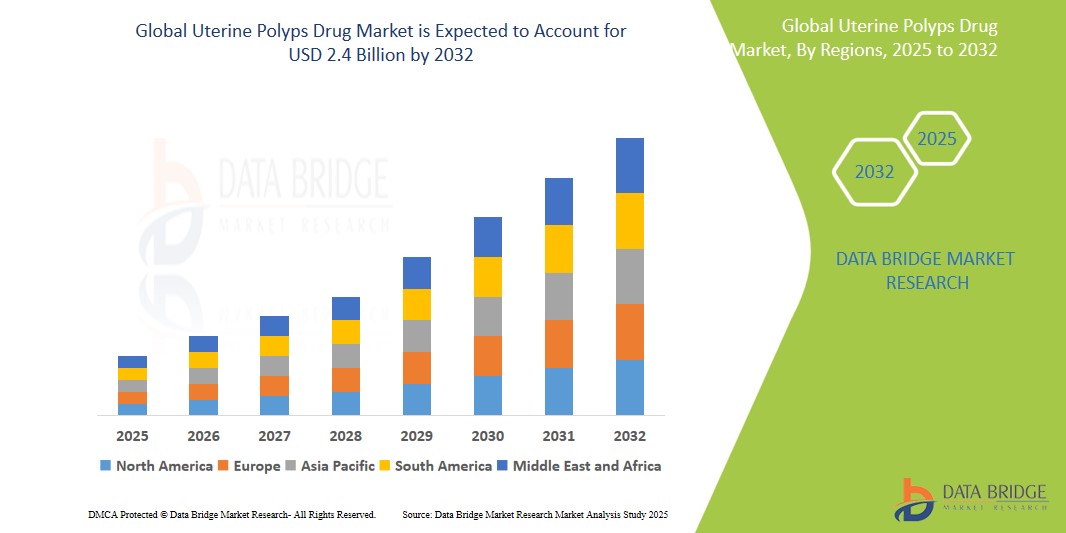
Uterine Polyps Drug Market Size
- The Global Uterine Polyps Drug Market size was valued at USD 1.2 billion in 2024 and is expected to reach USD 2.43 billion by 2032, at a CAGR of 9.2% during the forecast period
- This growth is driven by factors such as the rising prevalence of uterine disorders, increasing awareness of women’s reproductive health, and the growing demand for minimally invasive treatment options
Uterine Polyps Drug Market Analysis
- Uterine Polyps Drugs play a critical role in the medical management of endometrial polyps, particularly in symptomatic women and those seeking fertility treatments. These drugs include hormonal therapies like Levonorgestrel, Progesterone, and Gonadotropin-Releasing Hormone (GnRH) agonists, which help in reducing polyp size and preventing recurrence
- The demand for these drugs is increasing due to the growing burden of uterine abnormalities, lifestyle changes, delayed childbearing, and higher diagnostic rates through techniques like transvaginal ultrasound and hysteroscopy
- North America is expected to dominate the Uterine Polyps Drug Market owing to advanced diagnostic infrastructure, high healthcare spending, and strong awareness about women’s reproductive health
- Asia-Pacific is projected to be the fastest-growing region during the forecast period, driven by increasing patient awareness, rising access to gynecological care, and improvements in healthcare infrastructure across emerging economies
- The Medication segment is expected to dominate the market with 64.5% of the share, propelled by a preference for non-invasive management before considering surgical options such as polypectomy or hysteroscopic removal.
Report Scope and Uterine Polyps Drug Market Segmentation
|
Attributes |
Uterine Polyps Drug Key Market Insights |
|
Segments Covered |
|
|
Countries Covered |
North America
Europe
Asia-Pacific
Middle East and Africa
South America
|
|
Key Market Players |
|
|
Market Opportunities |
|
|
Value Added Data Infosets |
In addition to the insights on market scenarios such as market value, growth rate, segmentation, geographical coverage, and major players, the market reports curated by the Data Bridge Market Research also include import export analysis, production capacity overview, production consumption analysis, price trend analysis, climate change scenario, supply chain analysis, value chain analysis, raw material/consumables overview, vendor selection criteria, PESTLE Analysis, Porter Analysis, and regulatory framework. |
Uterine Polyps Drug Market Trends
“Shift Toward Non-Invasive Treatment & Hormonal Therapy Advancements”
- A key trend in the uterine polyps drug market is the growing preference for non-invasive treatment options, particularly hormonal therapies, as alternatives to surgical intervention
- Innovations in hormone-based drug formulations, such as Levonorgestrel-releasing intrauterine systems (LNG-IUS) and Gonadotropin-releasing hormone (GnRH) analogs, are offering effective symptom relief and polyp regression without the need for surgery
- For instance, recent advancements in targeted hormone therapies have improved patient compliance and reduced recurrence rates, which is especially beneficial for women seeking fertility preservation or avoiding surgery
- These developments are driving demand for pharmaceutical-based treatments, improving patient outcomes and expanding therapeutic options in gynecology
Uterine Polyps Drug Market Dynamics
Driver
“Rising Prevalence of Uterine Polyps & Delayed Childbearing Age”
- The global increase in uterine polyps cases, particularly among women aged 35–50, is driving demand for effective medical treatments
- Lifestyle changes, hormonal imbalances, obesity, and delayed childbearing contribute to higher risk factors associated with the development of endometrial polyps.Increasing awareness of menstrual health and fertility issues is leading to earlier diagnosis and proactive management of uterine polyps
- For instance, A 2023 report by the World Health Organization emphasized that over 10% of reproductive-aged women globally experience abnormal uterine bleeding, with a significant portion diagnosed with endometrial polyps requiring medical intervention.
- This growing patient pool contributes to higher prescription rates of uterine polyps drugs and adoption of hormonal therapies, supporting overall market growth
Opportunity
“Emergence of Personalized Hormone Therapy & Fertility Preservation Solutions”
- The demand for personalized medicine is creating opportunities for tailored hormonal therapies based on patient-specific hormonal profiles, reproductive goals, and risk factors
- Pharmaceutical companies are exploring novel drug delivery mechanisms, such as intrauterine drug-releasing systems and long-acting injectables, to improve treatment efficacy and minimize systemic side effects
- For instance, In 2024, clinical trials for a new low-dose, localized hormone therapy for uterine polyps showed promising results in reducing symptoms while maintaining fertility, especially among women under 40.
- This innovation caters to the increasing number of women seeking non-surgical and fertility-preserving alternatives, enhancing long-term patient outcomes and satisfaction
Restraint/Challenge
“Limited Awareness & Delayed Diagnosis in Low-Income Regions”
- Despite advancements in drug therapy, low awareness and underdiagnosis of uterine polyps in developing regions remain major challenges
- Many women in underserved areas lack access to regular gynecological care or diagnostic tools like transvaginal ultrasound or hysteroscopy, resulting in delayed treatment and complications
- For instance, According to a 2022 report by the Guttmacher Institute, over 45% of women in Sub-Saharan Africa and South Asia have unmet needs for reproductive health screenings, which significantly affects early detection and treatment of uterine conditions.
- These diagnostic barriers limit the uptake of uterine polyps drug therapies and reduce market penetration in emerging economies, despite the growing prevalence of the condition
Uterine Polyps Drug Market Scope
The market is segmented on the basis treatment, diagnosis, stages, drug type, route of administration and end user.
|
Segmentation |
Sub-Segmentation |
|
By Treatment |
|
|
By Diagnosis |
|
|
By Stages |
|
|
By Drugs Type |
|
|
By Route of Administration |
|
|
By End- User |
|
In 2025, the medication segment is projected to dominate the market with the largest share in the treatment segment
The medication segment is expected to dominate the Global Uterine Polyps Drug Market with the largest share of 64.5% in 2025, driven by the growing preference for non-invasive treatment options. Hormonal therapies such as Levonorgestrel, Progesterone, and Gonadotropin-Releasing Hormone (GnRH) agonists are increasingly being adopted due to their effectiveness in reducing polyp size, controlling symptoms, and preserving fertility. As awareness of uterine health rises and diagnostic rates improve, the demand for medication-based management continues to grow, supporting market expansion.
In 2025, the oral route of administration is expected to dominate the market with the largest share in the route of administration segment
The oral segment is projected to dominate the route of administration category in the Global Uterine Polyps Drug Market with the largest market share of 57.8% in 2025, owing to its convenience, patient compliance, and widespread use in hormonal therapies. Oral medications are preferred as first-line treatment in many cases, especially for patients seeking to avoid surgical intervention. As the number of diagnosed cases rises and pharmaceutical innovation advances, oral therapies are expected to remain the cornerstone of uterine polyp management globally.
Uterine Polyps Drug Market Regional Analysis
“North America Holds the Largest Share in the Uterine Polyps Drug Market”
- North America dominates the Global Uterine Polyps Drug Market, supported by a robust healthcare infrastructure, widespread access to gynecological care, and a strong presence of major pharmaceutical and medical device companie
- The U.S. holds a substantial share due to the high awareness of women’s reproductive health, increasing diagnosis rates of uterine polyps, and a strong inclination toward non-invasive medical management over surgery
- Well-structured reimbursement policies, ongoing research initiatives in hormonal therapy, and a proactive approach toward early screening and treatment contribute significantly to market strength in the region
- Furthermore, the increasing adoption of advanced diagnostic techniques such as transvaginal ultrasound and hysteroscopy, along with patient preferences for minimally invasive drug treatments, are accelerating the market’s expansion in North America
“Asia-Pacific is Projected to Register the Highest CAGR in the Uterine Polyps Drug Market”
- The Asia-Pacific region is expected to witness the fastest growth in the Global Uterine Polyps Drug Market, driven by improving healthcare access, rising awareness of reproductive disorders, and increasing government support for women’s health programs
- Countries like India, China, and South Korea are emerging as key growth hubs due to their large patient populations and rising rates of uterine conditions linked to hormonal imbalances and obesity
- Japan, with its advanced pharmaceutical industry and aging female population, remains a significant contributor to regional market growth. The country’s emphasis on early diagnosis and the availability of cutting-edge drug therapies are key factors propelling demand
- Increasing investments in gynecological research, growing availability of oral and injectable hormonal therapies, and expanding insurance coverage for non-surgical treatments further support rapid market expansion across Asia-Pacific
Uterine Polyps Drug Market Share
The market competitive landscape provides details by competitor. Details included are company overview, company financials, revenue generated, market potential, investment in research and development, new market initiatives, global presence, production sites and facilities, production capacities, company strengths and weaknesses, product launch, product width and breadth, application dominance. The above data points provided are only related to the companies' focus related to market.
The Major Market Leaders Operating in the Market Are:
- F. Hoffmann-La Roche Ltd (Switzerland)
- Pfizer Inc (U.S.)
- Novartis AG (Switzerland)
- Bristol-Myers Squibb Company (U.S.)
- Sanofi (France)
- Teva Pharmaceutical Industries Ltd. (Israel)
- Amgen Inc (U.S.)
- Medtronic (Ireland)
- Avalign Technologies (U.S.)
- B. Braun Melsungen AG (Germany)
- Mylan N.V. (U.S.)
- Sun Pharmaceutical Industries Ltd (India)
- Hologic, Inc. (U.S.)
- Smith+Nephew (UK)
- Nordic Group (Netherlands)
- Merck Sharp & Dohme Corp (a subsidiary of Merck & Co., Inc) (U.S.)

- Interactive Data Analysis Dashboard
- Company Analysis Dashboard for high growth potential opportunities
- Research Analyst Access for customization & queries
- Competitor Analysis with Interactive dashboard
- Latest News, Updates & Trend analysis
- Harness the Power of Benchmark Analysis for Comprehensive Competitor Tracking
Data collection and base year analysis are done using data collection modules with large sample sizes. The stage includes obtaining market information or related data through various sources and strategies. It includes examining and planning all the data acquired from the past in advance. It likewise envelops the examination of information inconsistencies seen across different information sources. The market data is analysed and estimated using market statistical and coherent models. Also, market share analysis and key trend analysis are the major success factors in the market report. To know more, please request an analyst call or drop down your inquiry.
The key research methodology used by DBMR research team is data triangulation which involves data mining, analysis of the impact of data variables on the market and primary (industry expert) validation. Data models include Vendor Positioning Grid, Market Time Line Analysis, Market Overview and Guide, Company Positioning Grid, Patent Analysis, Pricing Analysis, Company Market Share Analysis, Standards of Measurement, Global versus Regional and Vendor Share Analysis. To know more about the research methodology, drop in an inquiry to speak to our industry experts.
Data Bridge Market Research is a leader in advanced formative research. We take pride in servicing our existing and new customers with data and analysis that match and suits their goal. The report can be customized to include price trend analysis of target brands understanding the market for additional countries (ask for the list of countries), clinical trial results data, literature review, refurbished market and product base analysis. Market analysis of target competitors can be analyzed from technology-based analysis to market portfolio strategies. We can add as many competitors that you require data about in the format and data style you are looking for. Our team of analysts can also provide you data in crude raw excel files pivot tables (Fact book) or can assist you in creating presentations from the data sets available in the report.












