


What is the V2X Cybersecurity Market Size and Overview?
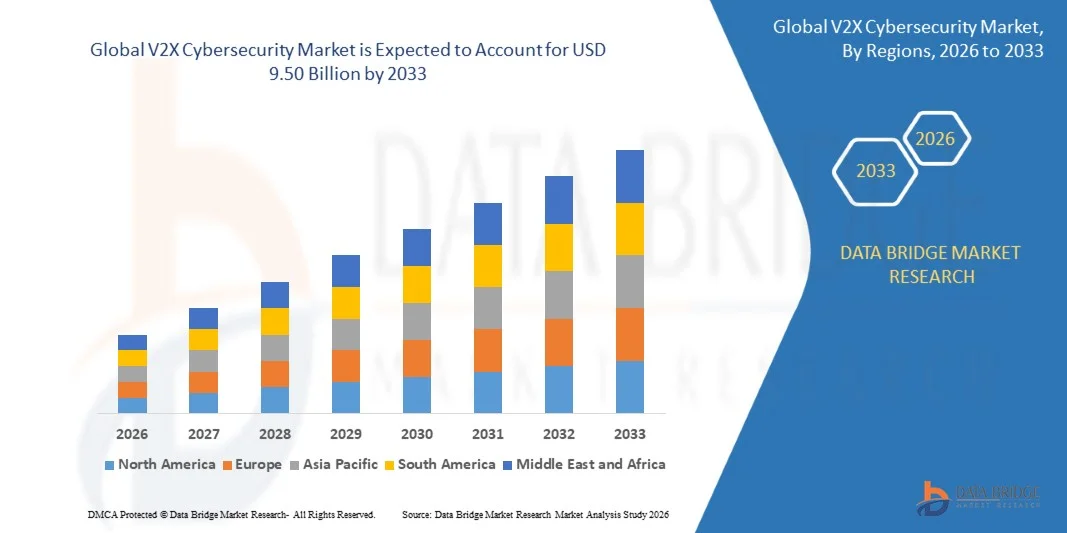
As per Data Bridge Market Research analysis The V2X cybersecurity market was valued at USD 2.30 billion in 2025 and is projected to reach USD 9.50 billion by 2033, growing at a CAGR of 19.40% from 2026 to 2033. The market is experiencing consistent growth driven by rising deployment of connected and autonomous vehicle ecosystems, increasing adoption of cellular V2X (C-V2X) communication, and expanding integration of advanced cybersecurity frameworks across intelligent transportation networks.
The increasing incidence of cyberattacks on connected vehicles, combined with stringent government regulations on automotive cybersecurity and data protection, is compelling automotive OEMs, technology providers, and transportation authorities to adopt robust V2X security solutions. Fixed secure communication protocols and advanced encryption, authentication, and intrusion detection systems are replacing traditional vehicle networking approaches in many markets, offering safer, more reliable, and tamper-resistant environments for vehicle-to-vehicle (V2V), vehicle-to-infrastructure (V2I), and cloud-based communications.
Market Size & Forecast
- Global Market Value (2025): USD 2.30 Billion
- Expected Market Value (2033): USD 9.50 Billion
- Forecast CAGR (2026–2033): 19.40%
- Leading Region in 2025: North America
- Fastest Growing Region: Asia Pacific
Key Market Trends & Insights
- North America dominated the V2X cybersecurity market with the largest revenue share of 36.42% in 2025, supported by early adoption of connected vehicle technologies, strong presence of automotive OEMs, and advanced 5G infrastructure development.
- The vehicle-to-vehicle (V2V) segment led the market with a 29.63% share in 2025, driven by its critical role in real-time collision avoidance, traffic safety enhancement, and direct low-latency communication between connected vehicles.
- Asia-Pacific is expected to be the fastest-growing region from 2026 to 2033, registering a CAGR of 21.36%, fueled by large-scale smart mobility projects, rising EV adoption, and significant investments in intelligent transportation systems across China, India, and Japan.
- Vehicle-to-cloud (V2C) are the fastest-growing communication type, projected to register a CAGR of 22.41%, reflecting the surge in integration of cloud-based mobility services and centralized vehicle data management platforms.
- The software security segment dominated the component category with a 52.18% revenue share in 2025, led by the increasing reliance on encryption algorithms, intrusion detection systems, secure communication protocols, and real-time threat monitoring platforms.
- Encryption & authentication accounted for 29.74% of the market, preferred by the critical need to secure communication channels across vehicles, infrastructure, and cloud systems.
- The cloud security segment is the fastest-growing security type category, with a CAGR of 23.15%, driven by the rapid shift toward cloud-connected mobility platforms and centralized vehicle data ecosystems.
Report Scope and V2X Cybersecurity Market Segmentation
|
Attributes |
V2X Cybersecurity Key Market Insights |
|
Segments Covered |
|
|
Countries Covered |
North America
Europe
Asia-Pacific
Middle East and Africa
South America
|
|
Key Market Players |
|
|
Market Opportunities |
|
|
Value Added Data Infosets |
|
What is the Key Trend in the V2X Cybersecurity Market?
Trend: Expansion of Secure C-V2X Ecosystem & 5G Integration
Automotive OEMs, telecom operators, and infrastructure providers are increasingly converging toward cellular V2X (C-V2X) as the dominant communication backbone for connected mobility. This shift is accelerating the deployment of end-to-end cybersecurity frameworks that protect data exchanged between vehicles, roadside infrastructure, pedestrians, and cloud platforms. With the rollout of 5G networks, V2X systems are now capable of ultra-low latency communication, but this also increases exposure to real-time cyber threats such as spoofing, signal injection, and man-in-the-middle attacks. To counter these risks, companies are embedding multi-layer security architectures, including secure boot processes, hardware-based trust anchors, and continuous authentication protocols within onboard units and roadside units. Cloud-based security orchestration is also becoming central to monitoring millions of vehicle interactions simultaneously.
For instance, the deployment of secure 5G-enabled V2X corridors in China’s intelligent highway projects and Europe’s C-Roads initiative demonstrates how governments are actively enabling encrypted, real-time vehicle communication ecosystems at scale.
V2X Cybersecurity Market Dynamics
Key Market Driver: Rising Adoption of Connected and Autonomous Vehicle Security Systems
The rapid expansion of connected vehicles and autonomous driving technologies is a primary force driving demand for V2X cybersecurity solutions. Modern vehicles now function as software-defined systems, continuously exchanging data with external networks, which significantly increases vulnerability to cyberattacks. As a result, automotive manufacturers are integrating advanced security mechanisms directly into vehicle architecture, including encryption engines, secure communication protocols, and intrusion detection systems. The development of ADAS and Level 3–Level 5 autonomous vehicles further intensifies the need for secure validation environments, where V2X communication integrity must be guaranteed across millions of simulated and real-world scenarios. Regulatory frameworks such as UNECE WP.29 and ISO/SAE 21434 are also compelling OEMs to adopt standardized cybersecurity processes throughout the vehicle lifecycle, from design to deployment and updates.
For instance, the implementation of ISO/SAE 21434-compliant cybersecurity frameworks in Tesla, Mercedes-Benz, and Volkswagen connected vehicle platforms highlights how global OEMs are embedding security-first architecture into next-generation mobility systems.
Key Restraint/Challenge: Complexity and Cost of Large-Scale Cybersecurity Deployment
Despite strong demand, the V2X cybersecurity market faces significant challenges due to the high complexity of securing multi-node communication ecosystems that include vehicles, roadside infrastructure, telecom networks, and cloud platforms. Each communication layer requires specialized protection mechanisms such as encryption, authentication, secure firmware updates, and real-time intrusion monitoring, making system integration highly resource-intensive. In addition, maintaining cybersecurity across millions of connected endpoints requires continuous software updates, threat intelligence systems, and dedicated security operations centers, which increases operational costs significantly. Smaller automotive suppliers and infrastructure operators often struggle with limited budgets, lack of skilled cybersecurity talent, and interoperability challenges between legacy and modern systems.
For instance, the deployment of large-scale secure V2X pilot projects in Europe and the United States involving multi-vendor ecosystems and government-led smart mobility corridors demonstrates the substantial financial and technical barriers associated with real-world implementation of end-to-end V2X security infrastructure.
Key Market Opportunity: Expansion of AI-Driven Predictive Cybersecurity & Secure Autonomous Mobility Ecosystems
The integration of artificial intelligence and machine learning into V2X cybersecurity systems is creating a major market opportunity by enabling predictive threat detection, real-time anomaly identification, and adaptive security response mechanisms across connected vehicle networks. AI-enabled security platforms can continuously analyze massive volumes of V2X communication data to identify unusual patterns, detect intrusion attempts, and automatically trigger mitigation protocols before attacks impact vehicle safety or traffic systems. At the same time, the rapid evolution of autonomous vehicles and software-defined mobility platforms is driving demand for highly scalable cybersecurity architectures capable of securing over-the-air (OTA) updates, sensor-to-cloud communication, and multi-domain vehicle interactions. The shift toward cloud-based V2X security ecosystems is also enabling centralized monitoring and faster deployment of security patches across global vehicle fleets, reducing response time to emerging threats.
For instance, the deployment of AI-based intrusion detection systems in autonomous vehicle testing fleets and connected mobility pilots in the U.S. and South Korea highlights how advanced analytics and cloud-native security platforms are being used to validate and protect next-generation V2X communication environments.
V2X Cybersecurity Market Scope
The V2X cybersecurity market is segmented on the basis of communication type, component, security type, and end user.
- By Communication Type
On the basis of communication type, the V2X cybersecurity market is segmented into vehicle-to-vehicle (V2V), vehicle-to-infrastructure (V2I), vehicle-to-pedestrian (V2P), vehicle-to-cloud (V2C), and vehicle-to-grid (V2G). The vehicle-to-vehicle (V2V) segment dominated the market with a share of 29.63% in 2025, owing to its critical role in real-time collision avoidance, traffic safety enhancement, and direct low-latency communication between connected vehicles. V2V systems require highly secure authentication and encryption layers to prevent spoofing and malicious data injection. The segment is widely adopted in ADAS-enabled vehicles and autonomous driving ecosystems. Increasing deployment of connected cars and 5G-enabled mobility infrastructure is further strengthening its dominance. Governments are also prioritizing V2V safety protocols under smart transportation initiatives. Continuous advancements in edge-based security solutions are enhancing its reliability and scalability.
The vehicle-to-cloud (V2C) segment is expected to register the fastest growth at a CAGR of 22.41% from 2026 to 2033, driven by the rising integration of cloud-based mobility services and centralized vehicle data management platforms. V2C enables real-time software updates, predictive maintenance, fleet analytics, and AI-driven decision-making, all of which require strong cybersecurity frameworks. Increasing adoption of software-defined vehicles is significantly boosting demand for secure cloud connectivity. Automotive OEMs are deploying encrypted communication channels to protect sensitive vehicle and user data. Expansion of connected mobility ecosystems and smart city infrastructure is further accelerating growth. Rising concerns over cloud-based cyberattacks are also driving investment in advanced cloud security architectures.
- By Component
On the basis of component, the V2X cybersecurity market is segmented into hardware security, software security, and services. The software security segment dominated the market with a share of 52.18% in 2025, driven by increasing reliance on encryption algorithms, intrusion detection systems, secure communication protocols, and real-time threat monitoring platforms. Software-based security solutions are essential for managing dynamic cyber threats across connected vehicle networks. OEMs and Tier-1 suppliers are integrating cybersecurity software directly into vehicle ECUs and telematics systems. Continuous updates and over-the-air (OTA) security patching further enhance its importance. Growing complexity of V2X communication ecosystems is increasing demand for scalable software solutions. AI-based threat intelligence integration is also strengthening this segment’s dominance.
The services segment is expected to register the fastest growth at a CAGR of 21.87% from 2026 to 2033, driven by rising demand for managed security services, consulting, system integration, and compliance support. Automotive companies increasingly rely on external cybersecurity experts to manage complex V2X security frameworks. Regulatory requirements such as UNECE WP.29 and ISO/SAE 21434 are boosting demand for compliance-driven services. Service providers offer continuous monitoring, vulnerability assessment, and incident response capabilities. Expansion of connected vehicle fleets globally is further increasing service dependency. Growth of outsourced cybersecurity operations in automotive ecosystems is accelerating this segment’s expansion.
- By Security Type
On the basis of security type, the V2X cybersecurity market is segmented into network security, application security, endpoint security, cloud security, identity & access management, and encryption & authentication. The encryption & authentication segment dominated the market with a share of 29.74% in 2025, driven by the critical need to secure communication channels across vehicles, infrastructure, and cloud systems. These technologies ensure data integrity, prevent unauthorized access, and protect against spoofing and replay attacks in real-time mobility environments. Increasing adoption of PKI (Public Key Infrastructure) frameworks in automotive networks is strengthening this segment. OEMs are embedding cryptographic modules within onboard units for secure communication. Rising cyber threats targeting vehicle networks are further reinforcing its importance. Regulatory mandates are also pushing widespread implementation of authentication standards.
The cloud security segment is expected to register the fastest growth at a CAGR of 23.15% from 2026 to 2033, driven by the rapid shift toward cloud-connected mobility platforms and centralized vehicle data ecosystems. Cloud environments are increasingly used for fleet management, OTA updates, and AI-based driving analytics, making them high-value cyberattack targets. Strong demand for secure data storage, encrypted APIs, and cloud access control is fueling adoption. Automotive OEMs are investing in multi-layer cloud security frameworks. Expansion of smart city infrastructure and connected transport systems is further accelerating growth. Increasing reliance on cloud-native vehicle architectures is also boosting this segment’s expansion.
- By End User
On the basis of end user, the V2X cybersecurity market is segmented into automotive OEMS, fleet operators, telecom operators, government & transport authorities, and infrastructure providers. The automotive OEMs segment dominated the market with a share of 46.32% in 2025, owing to their direct involvement in integrating cybersecurity systems into connected and autonomous vehicles. OEMs are responsible for embedding secure communication protocols, encryption systems, and compliance frameworks during vehicle development. Increasing production of connected cars and EVs is strengthening demand for cybersecurity integration. OEMs are also investing heavily in R&D for autonomous driving safety systems. Partnerships with cybersecurity vendors and telecom companies are expanding rapidly. Regulatory compliance requirements are further reinforcing OEM leadership in this segment.
The fleet operators segment is expected to register the fastest growth at a CAGR of 22.78% from 2026 to 2033, driven by rising adoption of connected fleet management systems and real-time vehicle tracking solutions. Fleet operators require secure communication to protect logistics data, driver behavior analytics, and route optimization systems. Increasing digitization of logistics and e-commerce transportation is boosting demand. Cybersecurity solutions help reduce risks of data breaches and operational disruptions. Growing adoption of electric and autonomous fleets is further accelerating integration of V2X security systems. Expansion of smart mobility and shared transportation services is also supporting strong growth in this segment.
V2X Cybersecurity Market Regional Analysis
North America dominated the V2X cybersecurity market with the largest revenue share of 36.42% in 2025, supported by early adoption of connected vehicle technologies, strong presence of automotive OEMs, and advanced 5G infrastructure development. The region also benefits from advanced cybersecurity frameworks, high investments in intelligent transportation systems, and strong government initiatives promoting vehicle safety and secure mobility ecosystems. Increasing integration of Cellular V2X (C-V2X) solutions, rising concerns over automotive cyber threats, and growing deployment of cloud-based vehicle communication platforms continue to strengthen North America’s leadership position in the global market.
U.S. V2X Cybersecurity Market Insight
The U.S. V2X cybersecurity market is witnessing strong growth due to rapid deployment of connected and autonomous vehicle technologies, large-scale adoption of cellular V2X (C-V2X) frameworks, and increasing investments in smart transportation infrastructure. The country’s advanced automotive ecosystem, strong presence of leading OEMs and technology companies, and early rollout of 5G-enabled mobility systems are driving demand for secure vehicle-to-everything communication. In addition, growing concerns over automotive cyberattacks, rising integration of cloud-connected vehicle platforms, and strict regulatory focus on vehicle cybersecurity compliance are accelerating adoption across commercial, passenger, and fleet mobility applications.
Europe V2X Cybersecurity Market Insight
The Europe V2X cybersecurity market remains a major contributor to global revenue, driven by strong regulatory frameworks such as UNECE WP.29, high investments in intelligent transport systems, and advanced automotive manufacturing capabilities. The widespread adoption of connected mobility solutions across Germany, France, and the U.K., along with strong focus on road safety and data protection standards, is supporting market expansion. Increasing deployment of secure V2X communication infrastructure, rising use of encryption and authentication systems, and growing integration of cybersecurity in autonomous driving programs continue to strengthen Europe’s position in the global market.
U.K. V2X Cybersecurity Market Insight
The U.K. V2X cybersecurity market is experiencing steady growth, supported by increasing adoption of connected vehicle technologies, strong government focus on smart mobility initiatives, and rising investments in automotive cybersecurity frameworks. The country’s advanced telecom infrastructure and growing 5G penetration are enabling secure real-time V2X communication across urban transport systems. Furthermore, integration of AI-driven threat detection, expansion of autonomous vehicle testing programs, and rising demand for secure fleet connectivity solutions are contributing to market growth. The U.K. is also emerging as an innovation hub for automotive cybersecurity and intelligent transportation security systems.
Germany V2X Cybersecurity Market Insight
The Germany V2X cybersecurity market is expanding steadily due to the country’s strong automotive manufacturing base, leadership in automotive engineering, and increasing focus on connected and autonomous mobility solutions. Major OEMs and Tier-1 suppliers are actively integrating advanced cybersecurity frameworks into vehicle communication systems to ensure secure V2X connectivity. Rising adoption of software-defined vehicles, strong R&D investments in mobility security, and compliance with stringent EU cybersecurity regulations are further driving market expansion. In addition, Germany’s focus on industrial innovation and smart transportation infrastructure continues to strengthen its market position.
Asia-Pacific V2X Cybersecurity Market Insight
The Asia-Pacific V2X cybersecurity market is expected to witness rapid growth, driven by large-scale smart city projects, expanding automotive production, and increasing adoption of connected vehicle technologies across China, India, Japan, and South Korea. Growing investments in 5G infrastructure, rising penetration of electric vehicles, and government initiatives for intelligent transportation systems are supporting regional expansion. Increasing cybersecurity risks in connected mobility networks, coupled with rising demand for secure vehicle-to-vehicle and vehicle-to-cloud communication, are accelerating adoption of advanced V2X security solutions.
Japan V2X Cybersecurity Market Insight
The Japan V2X cybersecurity market is witnessing consistent growth due to strong automotive innovation, high adoption of advanced driver assistance systems, and increasing focus on secure mobility ecosystems. Automotive manufacturers are heavily investing in secure V2X communication frameworks to support autonomous driving and connected vehicle deployment. Integration of AI-driven cybersecurity systems, expansion of smart transportation infrastructure, and strong regulatory emphasis on vehicle safety and data protection are further contributing to market growth. Japan’s leadership in robotics and mobility technology continues to support advanced cybersecurity adoption in automotive networks.
China V2X Cybersecurity Market Insight
The China V2X cybersecurity market is growing rapidly, driven by large-scale deployment of connected vehicle ecosystems, aggressive expansion of 5G infrastructure, and strong government support for intelligent transportation systems. Increasing adoption of cellular V2X (C-V2X) technology across highways and urban mobility networks is significantly boosting demand for cybersecurity solutions. Rising investments in autonomous vehicle testing, smart city development, and automotive digital transformation are further accelerating market expansion. In addition, growing concerns over data security, network vulnerabilities, and vehicle hacking risks are positioning China as one of the fastest-growing markets for V2X cybersecurity globally.
Which are the Top Companies in V2X Cybersecurity Market?
The V2X cybersecurity industry is primarily led by well-established companies, including:
- Qualcomm Incorporated (U.S.)
- Robert Bosch GmbH (Germany)
- Continental AG (Germany)
- NXP Semiconductors N.V. (Netherlands)
- Harman International Industries, Inc. (U.S.)
- DENSO Corporation (Japan)
- Aptiv PLC (Ireland)
- STMicroelectronics N.V. (Switzerland)
- Infineon Technologies AG (Germany)
- Cisco Systems, Inc. (U.S.)
- BlackBerry Limited (Canada)
- Thales Group (France)
- Siemens AG (Germany)
- Cisco Systems, Inc. (U.S.)
- Verizon Communications Inc. (U.S.)
- Huawei Technologies Co., Ltd. (China)
- Intel Corporation (U.S.)
- Synopsys, Inc. (U.S.)
- Argus Cyber Security Ltd. (Israel)
- Karamba Security Ltd. (Israel)
Latest Developments in V2X Cybersecurity Market
- In March 2024, the European C-ITS Security Credential Management System (CCMS) continued its large-scale deployment across European road networks to enable trusted and secure V2X communication. The system issues digital certificates for vehicles and infrastructure, ensuring secure authentication and preventing unauthorized access, spoofing, and data manipulation
- In August 2023, the U.S. Department of Transportation (USDOT) expanded its Cellular V2X (C-V2X) deployment initiatives to strengthen secure and scalable connected transportation infrastructure. The initiative focused on enhancing cybersecurity safeguards such as encryption, authentication, and secure communication protocols across V2X networks
- In May 2022, the European Telecommunications Standards Institute (ETSI) advanced its Intelligent Transport Systems (ITS) cybersecurity standards to strengthen protection for V2X communication networks across Europe. These updates enhanced secure messaging protocols, certificate-based authentication, and trust frameworks for cooperative intelligent transport systems
- In July 2021, ISO formally released ISO/SAE 21434 – Road Vehicles Cybersecurity Engineering Standard, establishing a global framework for managing cybersecurity risks across the entire automotive lifecycle, including connected and V2X communication systems. The standard defines structured processes for threat analysis, risk assessment, and security validation, ensuring cybersecurity is embedded into vehicle design from the development stage itself
- In January 2021, the UNECE WP.29 R155 cybersecurity regulation was officially adopted, introducing one of the first legally binding global frameworks for automotive cybersecurity. It mandates that manufacturers implement cybersecurity management systems to protect all external communication interfaces, including V2X systems such as vehicle-to-vehicle and vehicle-to-infrastructure links

- Interactive Data Analysis Dashboard
- Company Analysis Dashboard for high growth potential opportunities
- Research Analyst Access for customization & queries
- Competitor Analysis with Interactive dashboard
- Latest News, Updates & Trend analysis
- Harness the Power of Benchmark Analysis for Comprehensive Competitor Tracking
Data collection and base year analysis are done using data collection modules with large sample sizes. The stage includes obtaining market information or related data through various sources and strategies. It includes examining and planning all the data acquired from the past in advance. It likewise envelops the examination of information inconsistencies seen across different information sources. The market data is analysed and estimated using market statistical and coherent models. Also, market share analysis and key trend analysis are the major success factors in the market report. To know more, please request an analyst call or drop down your inquiry.
The key research methodology used by DBMR research team is data triangulation which involves data mining, analysis of the impact of data variables on the market and primary (industry expert) validation. Data models include Vendor Positioning Grid, Market Time Line Analysis, Market Overview and Guide, Company Positioning Grid, Patent Analysis, Pricing Analysis, Company Market Share Analysis, Standards of Measurement, Global versus Regional and Vendor Share Analysis. To know more about the research methodology, drop in an inquiry to speak to our industry experts.
Data Bridge Market Research is a leader in advanced formative research. We take pride in servicing our existing and new customers with data and analysis that match and suits their goal. The report can be customized to include price trend analysis of target brands understanding the market for additional countries (ask for the list of countries), clinical trial results data, literature review, refurbished market and product base analysis. Market analysis of target competitors can be analyzed from technology-based analysis to market portfolio strategies. We can add as many competitors that you require data about in the format and data style you are looking for. Our team of analysts can also provide you data in crude raw excel files pivot tables (Fact book) or can assist you in creating presentations from the data sets available in the report.













