


Vacuum Dust Filters Market Overview
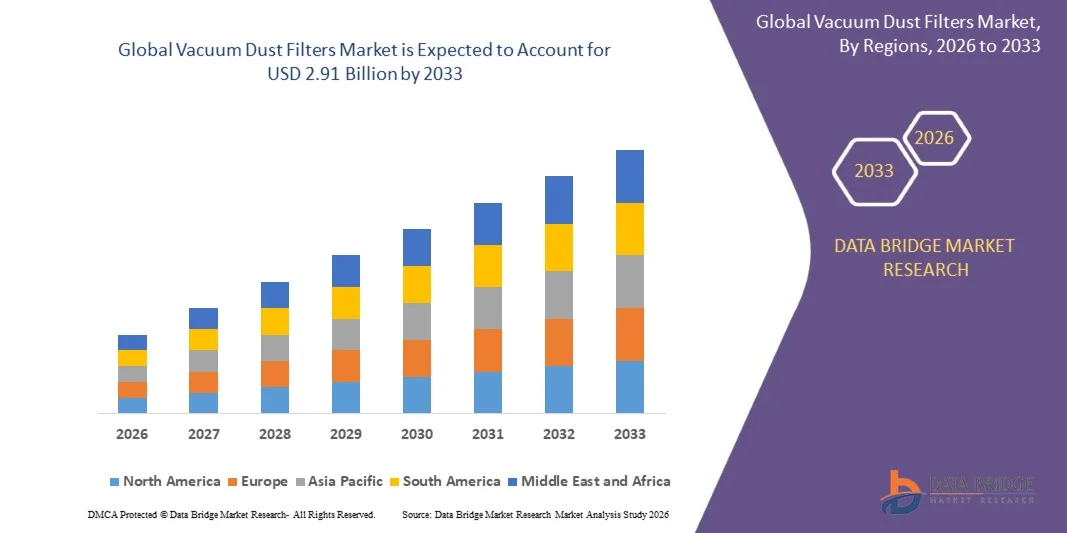
As per Data Bridge Market Research analysis The vacuum dust filters market was valued at USD 1.96 billion in 2025 and is projected to reach USD 2.91 billion by 2033, growing at a CAGR of 5.10% from 2026 to 2033. The market is experiencing steady growth driven by increasing demand for efficient dust collection systems, rising awareness regarding indoor air quality, and growing adoption of advanced filtration technologies across residential, commercial, and industrial applications.
The growing focus on maintaining clean and healthy indoor environments, coupled with stringent regulations related to workplace air quality and dust emission control, is encouraging consumers and businesses to invest in high-performance vacuum filtration solutions. HEPA, activated carbon, and multi-layer filtration systems are increasingly being integrated into modern vacuum equipment, offering enhanced particle capture efficiency and improved protection against airborne contaminants. In addition, expanding applications across households, healthcare facilities, commercial buildings, and manufacturing industries are supporting the widespread adoption of vacuum dust filters, providing reliable and cost-effective solutions for dust management and air purification.
Market Size & Forecast
- Global Market Value (2025): USD 1.96 Billion
- Expected Market Value (2033): USD 2.91 Billion
- Forecast CAGR (2026–2033): 5.10%
- Leading Region in 2025: North America
- Fastest Growing Region: Asia Pacific
Key Market Trends & Insights
- North America dominated the vacuum dust filters market with the largest revenue share of 36.24% in 2025, supported by high penetration of vacuum cleaning appliances, strong consumer awareness regarding indoor air quality, and widespread adoption of advanced filtration technologies across residential and commercial sectors.
- The HEPA filters segment led the market with a 43.18% share in 2025, driven by its superior ability to capture fine dust particles, allergens, pollen, and airborne contaminants.
- Asia-Pacific is expected to be the fastest-growing region at a CAGR of 6.9% from 2026 to 2033, fueled by rapid urbanization, rising disposable incomes, expanding middle-class populations, and increasing demand for household cleaning appliances in China, India, and Southeast Asia.
- Washable filters are the fastest-growing product type, projected to register a CAGR of 6.7%, reflecting the surge in consumer demand for sustainable and cost-effective filtration solutions.
- The upright vacuum cleaners segment dominated the vacuum cleaner type category with a 28.94% revenue share in 2025, led by strong adoption in residential cleaning applications and widespread availability across developed markets.
- Residential cleaning accounted for 47.35% of the market, preferred by the increasing use of vacuum cleaners in households worldwide. Rising awareness regarding indoor hygiene, allergen control, and air quality is driving strong demand for replacement filter.
- The healthcare facilities segment is the fastest-growing application category, with a CAGR of 7.1%, driven by the stringent cleanliness standards and infection control requirements.
Report Scope and Vacuum Dust Filters Market Segmentation
|
Attributes |
Vacuum Dust Filters Key Market Insights |
|
Segments Covered |
|
|
Countries Covered |
North America · U.S. · Canada · Mexico Europe · Germany · France · U.K. · Netherlands · Switzerland · Belgium · Russia · Italy · Spain · Turkey · Rest of Europe Asia-Pacific · China · Japan · India · South Korea · Singapore · Malaysia · Australia · Thailand · Indonesia · Philippines · Rest of Asia-Pacific Middle East and Africa · Saudi Arabia · U.A.E. · South Africa · Egypt · Israel · Rest of Middle East and Africa South America · Brazil · Argentina · Rest of South America |
|
Key Market Players |
· Dyson (U.K.) · BISSELL Inc. (U.S.) · SharkNinja Operating LLC (U.S.) · Miele & Cie. KG (Germany) · Techtronic Floor Care Technology Limited (Hong Kong) · Kärcher North America Inc. (Germany) · Nilfisk A/S (Denmark) · Numatic International Ltd (U.K.) · iRobot Corporation (U.S.) · Tineco Intelligent Technology Co., Ltd. (China) · Dreame Trading Co., Ltd. (China) · Samsung Electronics Co., Ltd. (South Korea) · LG Electronics Inc. (South Korea) · Panasonic Holdings Corporation (Japan) · Koninklijke Philips N.V. (Netherlands) · SEBO Stein & Co. GmbH (Germany) · Tacony Corporation (U.S.) · ProTeam, Inc. (U.S.) · Electrolux AB (Sweden) · Tennant Company (U.S.) |
|
Market Opportunities |
· Growing adoption of robotic and smart vacuum cleaners · Rising consumer focus on allergy prevention and indoor air quality · Increasing preference for sustainable household products |
|
Value Added Data Infosets |
In addition to the insights on market scenarios such as market value, growth rate, segmentation, geographical coverage, and major players, the market reports curated by the Data Bridge Market Research also include in-depth expert analysis, pricing analysis, brand share analysis, consumer survey, demography analysis, supply chain analysis, value chain analysis, raw material/consumables overview, vendor selection criteria, PESTLE Analysis, Porter Analysis, and regulatory framework. |
Vacuum Dust Filters Market Trends
Trend: Rising Demand for High-Efficiency Filtration and Indoor Air Quality Solutions
Consumers are increasingly prioritizing indoor air quality, driving demand for advanced vacuum dust filters capable of capturing fine dust, allergens, pet dander, and airborne particles with greater efficiency. The growing prevalence of allergies and respiratory concerns is encouraging the adoption of HEPA and multi-layer filtration systems across residential and commercial vacuum cleaners. Manufacturers are similarly focusing on filter innovations that improve dust retention, extend product lifespan, and support sustainable cleaning practices, while smart vacuum technologies are creating demand for intelligent filter monitoring and maintenance features.
For instance, in March 2025, several leading vacuum cleaner manufacturers expanded their product portfolios with enhanced HEPA filtration systems and smart filter replacement indicators, reflecting the industry's focus on cleaner indoor environments and improved user convenience.
Vacuum Dust Filters Market Dynamics
Key Market Driver: Growing Consumer Awareness of Health, Hygiene, and Air Quality
The increasing awareness of health, hygiene, and indoor air quality has created substantial demand for high-performance vacuum dust filters that effectively remove microscopic particles, allergens, and pollutants from indoor environments. Residential consumers, commercial facilities, and institutional users are adopting advanced filtration solutions as a core component of cleaning systems, improving cleanliness standards and supporting healthier living and working spaces. The growing emphasis on allergen control, combined with rising ownership of vacuum cleaning equipment, continues to accelerate filter replacement and upgrade demand across global markets.
For instance, in January 2025, multiple household appliance brands introduced vacuum cleaners featuring upgraded HEPA filtration technologies specifically designed to address rising consumer concerns regarding indoor air pollution and allergen exposure..
Key Restraint/Challenge: Frequent Replacement Requirements and Filter Maintenance Costs
A significant restraint in the vacuum dust filters market is the recurring cost associated with filter replacement and maintenance. Advanced filtration products require periodic cleaning or replacement to maintain optimal airflow and filtration efficiency, creating ongoing expenses for consumers and commercial users. The total cost of ownership extends to replacement purchases, maintenance requirements, and compatibility considerations, making long-term adoption less attractive for price-sensitive consumers and cost-conscious organizations. This challenge is particularly evident in premium filtration systems where replacement components often carry higher costs than conventional filter alternatives.
For instance, in 2024, several consumer appliance surveys highlighted replacement filter expenses as a key purchasing consideration among vacuum cleaner owners, reflecting the broader challenge of balancing filtration performance with long-term affordability.
Key Market Opportunity: Expansion of Smart, Sustainable, and Reusable Filtration Solutions
The development of smart and sustainable filtration technologies presents a significant market opportunity. Advanced filter systems can incorporate monitoring capabilities, predictive maintenance alerts, and performance tracking features while supporting improved cleaning efficiency. The growing adoption of washable and reusable filters is further enhancing sustainability objectives, reducing waste generation and lowering lifetime ownership costs. Increasing integration with smart vacuum cleaners and connected home ecosystems is creating additional growth opportunities across developed and emerging consumer markets worldwide.
For instance, in February 2025, manufacturers expanded the availability of reusable HEPA-compatible filter solutions and smart maintenance monitoring features, demonstrating the market's shift toward sustainability, convenience, and connected cleaning technologies.
Vacuum Dust Filters Market Scope
The vacuum dust filters market is segmented on the basis of product type, vacuum cleaner type, application, and end-user.
- By Product Type
On the basis of product type, the vacuum dust filters market is segmented into HEPA Filters, Micro Fresh Filters, Allergen Filters, Washable Filters, Pet Filters, Wet/Dry Filters, Scented Filters, ULPA Filters, and Other Products. The HEPA filters segment dominated the market with a 43.18% share in 2025, owing to its superior ability to capture fine dust particles, allergens, pollen, and airborne contaminants. These filters are widely adopted across residential, commercial, and healthcare environments where air quality is a key concern. Increasing awareness regarding respiratory health and allergy prevention is driving strong demand for HEPA-based filtration systems. Manufacturers are continuously improving filter efficiency while maintaining airflow performance. The segment also benefits from widespread compatibility with premium vacuum cleaner models. Growing regulatory focus on indoor air quality standards continues to strengthen its market leadership.
The washable filters segment is projected to register the fastest growth at a CAGR of 6.7% from 2026 to 2033, driven by rising consumer demand for sustainable and cost-effective filtration solutions. These filters reduce replacement frequency and lower long-term ownership costs compared to disposable alternatives. Increasing environmental awareness is encouraging adoption of reusable products across households and commercial facilities. Manufacturers are developing advanced washable materials that maintain filtration efficiency after repeated cleaning cycles. The growing popularity of eco-friendly appliances is further supporting demand. Enhanced durability and convenience are expected to accelerate segment growth throughout the forecast period.
- By Vacuum Cleaner Type
On the basis of vacuum cleaner type, the vacuum dust filters market is segmented into upright vacuum cleaners, canister vacuum cleaners, stick vacuum cleaners, handheld vacuum cleaners, robotic vacuum cleaners, wet & dry vacuum cleaners, central vacuum systems, and industrial vacuum cleaners. The upright vacuum cleaners segment led the market with a 28.94% share in 2025, driven by strong adoption in residential cleaning applications and widespread availability across developed markets. These vacuum cleaners require regular filter replacement due to frequent household use, supporting sustained demand for dust filters. Their large dust collection capacity and strong suction performance make them highly popular among consumers. Manufacturers continue integrating advanced filtration systems to improve air quality and cleaning efficiency. The segment also benefits from established distribution networks and consumer familiarity. Consistent replacement cycles contribute significantly to market revenues.
The robotic vacuum cleaners segment is expected to witness the fastest growth at a CAGR of 7.3% from 2026 to 2033, driven by the rapid adoption of smart home technologies and automated cleaning solutions. Robotic systems rely on compact, high-efficiency filters to maintain performance in autonomous cleaning operations. Increasing consumer preference for convenience and connected devices is accelerating product adoption. Continuous innovations in navigation systems, AI integration, and smart home compatibility are creating new opportunities for advanced filter manufacturers. Growing urbanization and busy lifestyles are further supporting demand. The segment is also benefiting from rising penetration of premium household appliances worldwide.
- By Application
On the basis of application, the vacuum dust filters market is segmented into residential cleaning, commercial cleaning, industrial dust collection, healthcare facilities, hospitality facilities, retail & commercial spaces, manufacturing facilities, and cleanrooms. The residential cleaning segment dominated the market with a 47.35% share in 2025, supported by the increasing use of vacuum cleaners in households worldwide. Rising awareness regarding indoor hygiene, allergen control, and air quality is driving strong demand for replacement filters. Consumers are increasingly investing in advanced filtration technologies to maintain cleaner living environments. The growth of pet ownership is also contributing to higher filter replacement frequency. Manufacturers continue introducing specialized residential filters designed for dust, pollen, and pet hair removal. Strong demand from both developed and emerging economies reinforces the segment’s leadership.
The healthcare facilities segment is projected to register the fastest growth at a CAGR of 7.1% from 2026 to 2033, driven by stringent cleanliness standards and infection control requirements. Hospitals, clinics, and healthcare centers increasingly rely on advanced filtration systems to minimize airborne contaminants. Growing concerns regarding patient safety and indoor air quality are supporting adoption of high-performance filters. Regulatory compliance requirements are encouraging regular filter replacement and upgrades. The expansion of healthcare infrastructure across emerging economies is creating additional growth opportunities. Rising investments in hygienic facility management are expected to sustain long-term demand.
- By End-User
On the basis of end-user, the vacuum dust filters market is segmented into mining, construction, power and utilities, chemical and processing, oil and gas, pharmaceuticals, and others. The construction segment accounted for the largest market share of 24.86% in 2025, driven by extensive dust-generating activities across residential, commercial, and infrastructure projects. Vacuum dust filters play a critical role in controlling airborne particles and maintaining workplace safety. Increasing implementation of occupational health regulations is supporting adoption of industrial filtration systems. The segment benefits from continuous global infrastructure development and urbanization activities. Contractors are increasingly investing in dust management equipment to comply with environmental and worker safety standards. Rising construction spending across emerging markets continues to strengthen demand.
The pharmaceuticals segment is anticipated to grow at the fastest CAGR of 7.4% from 2026 to 2033, driven by strict contamination control requirements and expanding pharmaceutical manufacturing capacity. Production facilities require high-efficiency filtration systems to maintain clean environments and comply with regulatory standards. Increasing investments in drug manufacturing and biotechnology facilities are creating strong demand for advanced vacuum dust filters. The growing focus on product quality and process integrity is accelerating filter adoption. Manufacturers are introducing specialized filtration solutions designed for highly sensitive production environments. Expansion of pharmaceutical infrastructure globally is expected to support sustained segment growth.
Vacuum Dust Filters Market Regional Analysis
North America dominated the vacuum dust filters market with the largest revenue share of 36.24% in 2025, supported by high penetration of vacuum cleaning appliances, strong consumer awareness regarding indoor air quality, and widespread adoption of advanced filtration technologies across residential and commercial sectors. The region also benefits from growing demand for HEPA-based filtration systems, established replacement filter markets, and the presence of leading household appliance manufacturers. Increasing concerns related to allergies, respiratory health, and indoor pollutant control are driving continuous demand across residential and commercial applications. Rising adoption of smart vacuum cleaners and premium cleaning solutions further supports market expansion. Continuous product innovation and strong consumer spending on home care technologies continue to strengthen North America's leadership position in the global market.
U.S. Vacuum Dust Filters Market Insight
The U.S. vacuum dust filters market is witnessing strong growth due to rising awareness regarding indoor air quality, increasing adoption of advanced vacuum cleaning appliances, and growing demand for high-efficiency filtration technologies. The country’s mature household appliance sector, along with increasing preference for HEPA-based, allergen-control, and smart filtration systems, is driving demand across residential, commercial, and industrial applications. In addition, growing emphasis on maintaining hygienic indoor environments and reducing airborne contaminants is accelerating filter replacement and upgrade demand across consumers and businesses.
Europe Vacuum Dust Filters Market Insight
The Europe vacuum dust filters market remains a major contributor to global revenue, driven by strong environmental awareness, technological innovation, and high demand for advanced filtration solutions. The widespread use of premium vacuum cleaners in households, healthcare facilities, and commercial establishments is supporting market expansion across the region. Increasing investments in sustainable filtration technologies, coupled with strict air quality regulations and growing consumer preference for eco-friendly products, continue to enhance the adoption of vacuum dust filters throughout Europe.
U.K. Vacuum Dust Filters Market Insight
The U.K. vacuum dust filters market is experiencing steady growth, supported by rising adoption of advanced cleaning technologies in residential, commercial, and institutional environments. Increasing investments in high-performance filtration products and growing demand for cost-effective, sustainable cleaning solutions are contributing to market growth. Furthermore, integration of smart monitoring features, reusable filter technologies, and enhanced allergen-control capabilities is improving product performance and maintenance efficiency, positioning the U.K. as a key innovation hub in the vacuum dust filters industry.
Germany Vacuum Dust Filters Market Insight
The Germany vacuum dust filters market is expanding steadily due to the country’s strong manufacturing base, advanced engineering capabilities, and increasing adoption of next-generation filtration technologies. Appliance manufacturers, industrial facilities, and commercial operators are increasingly utilizing advanced dust filters for air quality management, workplace safety, and equipment performance optimization. Continuous advancements in filtration materials, smart maintenance systems, and sustainable product designs, along with strong government focus on environmental protection and indoor air quality, are further driving market growth in Germany.
Asia-Pacific Vacuum Dust Filters Market Insight
The Asia-Pacific vacuum dust filters market is expected to witness rapid growth, driven by increasing urbanization, expanding household appliance ownership, and rising investments in cleaning infrastructure across countries such as China, India, and Japan. Growing awareness regarding indoor hygiene, rising adoption of advanced filtration technologies, and increasing demand for affordable and efficient cleaning solutions are supporting regional market expansion. In addition, the growing presence of appliance manufacturing facilities and rising disposable incomes are accelerating vacuum dust filter adoption across residential and commercial sectors.
Japan Vacuum Dust Filters Market Insight
The Japan vacuum dust filters market is witnessing consistent growth due to rising investments in advanced home cleaning technologies, product innovation, and indoor air quality improvement initiatives. Appliance manufacturers, commercial facilities, and consumers are increasingly adopting high-efficiency filtration systems for dust removal, allergen control, and enhanced cleaning performance. Moreover, increasing integration of smart technologies and the country’s focus on efficient, hygienic, and sustainable living solutions are further contributing to market growth.
China Vacuum Dust Filters Market Insight
The China vacuum dust filters market is growing rapidly, driven by increasing urbanization, expanding residential construction activities, and rising government focus on environmental quality and public health standards. Growing adoption of advanced filtration solutions across residential, commercial, and industrial sectors is significantly boosting market demand. In addition, rising investments in appliance manufacturing, increasing awareness regarding indoor air pollution, and rapid technological advancements are positioning China as one of the fastest-growing markets for vacuum dust filters globally.
Vacuum Dust Filters Market Share
The vacuum dust filters industry is primarily led by well-established companies, including:
- Dyson (U.K.)
- BISSELL Inc. (U.S.)
- SharkNinja Operating LLC (U.S.)
- Miele & Cie. KG (Germany)
- Techtronic Floor Care Technology Limited (Hong Kong)
- Kärcher North America Inc. (Germany)
- Nilfisk A/S (Denmark)
- Numatic International Ltd (U.K.)
- iRobot Corporation (U.S.)
- Tineco Intelligent Technology Co., Ltd. (China)
- Dreame Trading Co., Ltd. (China)
- Samsung Electronics Co., Ltd. (South Korea)
- LG Electronics Inc. (South Korea)
- Panasonic Holdings Corporation (Japan)
- Koninklijke Philips N.V. (Netherlands)
- SEBO Stein & Co. GmbH (Germany)
- Tacony Corporation (U.S.)
- ProTeam, Inc. (U.S.)
- Electrolux AB (Sweden)
- Tennant Company (U.S.)
Latest Developments in Vacuum Dust Filters Market
- In May 2025, Dyson announced the launch of the Dyson PencilVac™, featuring a new linear dust separation system that captures 99.99% of particles as small as 0.3 microns along with the Fluffycones™ cleaner head to prevent hair tangling. The launch highlights Dyson’s continued innovation in advanced vacuum filtration and compact cleaning technologies
- In January 2025, Roborock unveiled the Saros 10R robotic vacuum at CES 2025, introducing the AI-powered StarSight™ Autonomous System 2.0 with advanced filtration and intelligent navigation capabilities for enhanced dust collection and indoor cleaning performance. The product strengthens Roborock’s position in the premium smart vacuum segment
- In September 2024, Miele introduced its new Guard Series vacuum cleaners at IFA 2024, incorporating the ComfortFit bag concept for improved hygiene, enhanced sealed filtration, and connected smart features. The launch reflects Miele’s focus on delivering cleaner indoor environments through next-generation filtration technologies
- In September 2024, Roborock launched the H60 Series cordless stick vacuums, equipped with up to 210AW suction, advanced multi-stage filtration, and a bendable wand for easier cleaning in confined spaces. The new series expands the company's portfolio of high-performance vacuum cleaners designed for improved dust filtration and user convenience
- In September 2024, Miele showcased its latest premium home appliance innovations at IFA 2024, including the next-generation Guard vacuum cleaner platform featuring improved hygienic filtration, enhanced user convenience, and sustainability-focused design. The development reinforces the company's commitment to advancing premium floor-care technologies

- Interactive Data Analysis Dashboard
- Company Analysis Dashboard for high growth potential opportunities
- Research Analyst Access for customization & queries
- Competitor Analysis with Interactive dashboard
- Latest News, Updates & Trend analysis
- Harness the Power of Benchmark Analysis for Comprehensive Competitor Tracking
Data collection and base year analysis are done using data collection modules with large sample sizes. The stage includes obtaining market information or related data through various sources and strategies. It includes examining and planning all the data acquired from the past in advance. It likewise envelops the examination of information inconsistencies seen across different information sources. The market data is analysed and estimated using market statistical and coherent models. Also, market share analysis and key trend analysis are the major success factors in the market report. To know more, please request an analyst call or drop down your inquiry.
The key research methodology used by DBMR research team is data triangulation which involves data mining, analysis of the impact of data variables on the market and primary (industry expert) validation. Data models include Vendor Positioning Grid, Market Time Line Analysis, Market Overview and Guide, Company Positioning Grid, Patent Analysis, Pricing Analysis, Company Market Share Analysis, Standards of Measurement, Global versus Regional and Vendor Share Analysis. To know more about the research methodology, drop in an inquiry to speak to our industry experts.
Data Bridge Market Research is a leader in advanced formative research. We take pride in servicing our existing and new customers with data and analysis that match and suits their goal. The report can be customized to include price trend analysis of target brands understanding the market for additional countries (ask for the list of countries), clinical trial results data, literature review, refurbished market and product base analysis. Market analysis of target competitors can be analyzed from technology-based analysis to market portfolio strategies. We can add as many competitors that you require data about in the format and data style you are looking for. Our team of analysts can also provide you data in crude raw excel files pivot tables (Fact book) or can assist you in creating presentations from the data sets available in the report.













