


What is the Variable Data Printing Market Size and Growth Rate?
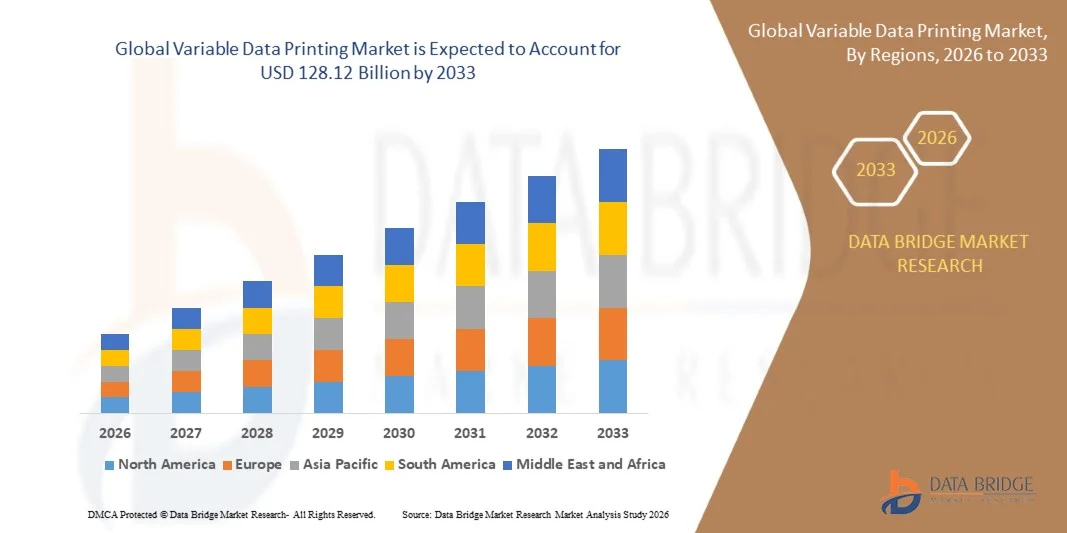
- As per Data Bridge Market Research analysis, the variable data printing market was valued at USD 39.90 billion in 2025 and is projected to reach USD 128.12 billion by 2033, growing at a CAGR of 15.70% from 2026 to 2033.
- The market growth is being supported by demand for personalized communication, serialized labels, QR codes, traceability, short-run digital production, e-commerce packaging, and faster data-driven printing workflows.
- Variable data printing allows text, images, barcodes, serial numbers, dates, QR codes, graphics, and other information to change from one printed item to the next without stopping the digital print process. The technology is increasingly used in direct mail, labels, packaging, retail, healthcare, finance, logistics, and promotional communication. Integration with customer databases, analytics, workflow software, and digital presses is making high-volume personalization and one-to-one communication more practical for print service providers and brand owners.
Market Size & Forecast
- Global Market Value (2025): USD 39.90 Billion
- Expected Market Value (2033): USD 128.12 Billion
- Forecast CAGR (2026-2033): 15.70%
- Leading Region: North America
- Fastest-Growing Region: Asia-Pacific
What are the Major Takeaways of Variable Data Printing Market?
- North America dominated the variable data printing market with largest revenue share in 2025, attributed to the widespread adoption of advanced printing technologies, well-established packaging industries, and increasing demand for personalized and trackable labeling solutions.
- Asia-Pacific is expected to witness the fastest growth from 2026 to 2033, driven by rapid industrial expansion, growing focus on product safety and traceability, rising packaging demand, and increasing adoption of variable data printing technologies across emerging markets such as China and India.
- The variable data printing machines segment dominated the market with the largest revenue share in 2025, driven by the increasing adoption of high-speed digital printing systems for personalized packaging, labels, and marketing materials across industries.
- The release liner labels segment accounted for the largest market share in 2025, owing to its widespread use across food and beverages, pharmaceuticals, retail, and logistics due to its ease of application, durability, and compatibility with automated labeling systems.
- The inkjet segment held the largest share of the market in 2025, supported by its superior print quality, high-speed variable data capabilities, cost efficiency for short print runs, and growing demand for customized and on-demand printing applications.
Report Scope and Variable Data Printing Market Segmentation
|
Attributes |
Variable Data Printing Market Key Market Insights |
|
Segments Covered |
|
|
Countries Covered |
North America
Europe
Asia-Pacific
Middle East and Africa
South America
|
|
Key Market Players |
|
|
Market Opportunities |
|
|
Value Added Data Infosets |
In addition to the insights on market scenarios such as market value, growth rate, segmentation, geographical coverage, and major players, the market reports curated by the Data Bridge Market Research also include import export analysis, production capacity overview, production consumption analysis, price trend analysis, climate change scenario, supply chain analysis, value chain analysis, raw material/consumables overview, vendor selection criteria, PESTLE Analysis, Porter Analysis, and regulatory framework. |
What is the Key Trend in the Variable Data Printing Market ?
Key Market Driver: Rising Demand for Faster, Personalized, and Traceable Printing
The growth of the variable data printing market is primarily driven by the increasing demand for faster, accurate, and customized printing across high-volume applications. Food and beverage companies require variable information such as batch numbers, allergen details, expiration dates, and promotional content, while pharmaceutical companies rely on serialization, authentication, and patient-specific information to meet regulatory requirements. Retail and e-commerce sectors are increasingly using variable data printing for shipping labels, dynamic pricing, packing slips, and personalized customer communication.
Variable data printing enables these applications without the requirement for conventional plate changes, offering greater flexibility for short-run production, improved supply chain visibility, enhanced regulatory compliance, and stronger customer engagement. For instance, in March 2024, HP expanded its Indigo portfolio with the Indigo 120K, Indigo 18K, Indigo 7K Secure, and enhanced automation capabilities. These developments demonstrate the industry's focus on high-speed digital production, security printing, intelligent automation, and personalized applications. As connected packaging, direct-to-consumer commerce, product identification, and regulatory traceability continue to expand, demand for advanced variable data printing hardware, software, services, and inspection systems is expected to increase.
Key Restraint/Challenge: Data Complexity and High Upfront Investment
A major challenge for the variable data printing market is the complexity of managing data-intensive production environments and the high initial investment required for implementation. Variable data printing requires more than just digital printing equipment; it involves accurate databases, efficient data mapping, template management, integration with enterprise and production software, barcode validation, color consistency, and data security measures.
Advanced digital presses, workflow software, inspection systems, maintenance requirements, employee training, and cybersecurity infrastructure can significantly increase implementation and operational costs. Errors in high-volume variable printing operations can impact thousands of individually coded products, leading to compliance issues, production delays, and costly reprints. For instance, in January 2026, Canon introduced the Inspection Unit-C1 to address these challenges by automating the inspection of variable data content, including barcode verification, and reducing dependence on manual quality checks. The increasing adoption of inspection technologies highlights the importance of accuracy and quality control in large-scale variable printing operations. Vendors offering simplified workflows, seamless software integration, automated verification, and comprehensive support services are better positioned to overcome adoption barriers, particularly among small and medium-sized print providers.
Key Market Opportunity: Connected Packaging, Linerless Labels, and E-Commerce Workflows
The integration of variable printing with connected packaging, digital identification, and e-commerce workflows presents significant growth opportunities for market participants. Dynamic QR codes, unique identifiers, serialization, and personalized promotions enable brands to improve product authentication, consumer engagement, loyalty programs, recycling communication, and supply chain tracking.
The rapid expansion of e-commerce and logistics operations is further increasing demand for customized shipping labels, routing information, and real-time tracking solutions. In addition, the adoption of linerless labels provides opportunities to reduce material waste, increase labels per roll, optimize storage, and support sustainable packaging initiatives. For instance, in May 2024, Avery Dennison introduced advancements in its variable-information portfolio, including AD XeroLinr DT linerless solutions and recycled-content label offerings, supporting logistics, e-commerce, food, and retail applications by combining reliable barcode performance with reduced material usage.
The continued growth of connected packaging, item-level identification, e-commerce fulfillment, and sustainable labeling solutions is expected to create new opportunities for companies that can provide integrated offerings combining printing technologies, materials, software platforms, inspection systems, and application support.
How is the Variable Data Printing Market Segmented?
The variable data printing market is segmented on the basis of component, label type, printing technology, end-use sector, and material.
- By Component
On the basis of component, the global variable data printing market is segmented into variable data printing machines, variable data printing software, and services. The variable data printing machines segment dominated the market with the largest revenue share in 2025, driven by the increasing adoption of high-speed digital printing systems across packaging, labeling, and commercial printing applications. The growing demand for customized labels, product identification, serialization, and traceability solutions is encouraging businesses to invest in advanced variable data printing equipment. Additionally, the integration of digital presses with automation, workflow management systems, and inspection technologies is further supporting the growth of this segment across industries.
The variable data printing machines segment is expected to witness significant growth during the forecast period, supported by rising demand for personalized packaging, smart labeling solutions, and automated printing processes. Increasing adoption of digital transformation initiatives, cloud-based workflows, and advanced printing technologies is encouraging manufacturers to enhance production efficiency and meet the growing need for flexible, short-run, and data-driven printing solutions.
- By Label Type
On the basis of label type, the global variable data printing market is segmented into release liner labels and linerless labels. The release liner labels segment dominated the market in 2025, owing to its widespread adoption across food and beverages, pharmaceuticals, retail, and logistics industries. The compatibility of release liner labels with automated labeling systems, ease of application, and reliable performance in barcode and variable information printing applications are driving the demand for this segment.
The linerless labels segment is expected to register strong growth during the forecast period, driven by increasing sustainability initiatives, reduced material waste requirements, and the growing need for efficient packaging solutions. The ability of linerless labels to improve roll utilization, reduce storage requirements, and support environmentally responsible labeling practices is expected to accelerate their adoption across logistics, e-commerce, food, and retail applications.
- By Printing Technology
On the basis of printing technology, the global variable data printing market is segmented into thermal transfer, direct thermal, electrophotography, inkjet, digital, flexography, offset, and rotogravure. The inkjet segment dominated the market in 2025, supported by its ability to deliver high-quality variable data printing, faster production speeds, and cost-effective solutions for customized and short-run applications. The increasing adoption of inkjet technology across packaging, labels, and commercial printing is further driving segment growth.
The inkjet segment is expected to witness significant growth during the forecast period, fueled by continuous advancements in digital printing technology, improved print quality, and increasing demand for personalized and on-demand printing solutions. Additionally, the integration of automation, artificial intelligence, and real-time monitoring capabilities is enhancing the efficiency and reliability of inkjet-based variable data printing systems.
- By End-Use Sector
On the basis of end-use sector, the global variable data printing market is segmented into food and beverages, consumer durables, pharmaceuticals, home and personal care, retail, and others. The food and beverages segment dominated the market in 2025, driven by increasing demand for product traceability, regulatory labeling compliance, expiration date printing, and customized packaging solutions. The rising focus on food safety, supply chain transparency, and consumer engagement is encouraging manufacturers to adopt variable data printing technologies.
The food and beverages segment is expected to maintain significant growth during the forecast period, supported by increasing packaging innovations, growing demand for smart labels, and the expansion of personalized marketing strategies. Additionally, the need for accurate product information, batch tracking, and anti-counterfeit solutions is expected to further strengthen the adoption of variable data printing solutions in this sector.
- By Material
On the basis of material, the global variable data printing market is segmented into flexible and rigid plastic, paper and paperboard, and glass and metal. The flexible and rigid plastic segment dominated the market in 2025, owing to its extensive application in packaging, labeling, and consumer goods industries. The durability, versatility, lightweight properties, and compatibility with advanced printing technologies make plastic materials widely preferred for variable data printing applications.
The flexible and rigid plastic segment is expected to witness steady growth during the forecast period, driven by increasing demand for durable packaging solutions, customized labels, and product identification systems. Furthermore, advancements in recyclable plastics and sustainable packaging materials are expected to create new opportunities for variable data printing applications across multiple industries.
Which Region Holds the Largest Share of the Variable Data Printing Market?
North America Variable Data Printing Market Insight
North America holds a prominent position in the global variable data printing market, supported by advanced digital printing infrastructure, the presence of leading equipment and software providers, a well-established direct marketing industry, strong e-commerce and logistics networks, and stringent labeling and traceability requirements. The region witnesses significant demand for variable data printing solutions across food and beverages, healthcare, pharmaceuticals, retail, finance, consumer goods, transactional communication, and personalized packaging applications.
U.S. Variable Data Printing Market Insight
The U.S. variable data printing market is driven by increasing demand for personalized customer experiences, direct marketing solutions, e-commerce fulfillment, healthcare and financial communications, product serialization, loyalty programs, and customized packaging. The presence of major digital press manufacturers, workflow software providers, inspection technology companies, and print service providers continues to support innovation and technology adoption across various industries.
Asia-Pacific Variable Data Printing Market Insight
Asia-Pacific is the fastest-growing regional market for variable data printing, driven by rapid e-commerce expansion, increasing manufacturing activities, growing adoption of barcode and QR-code technologies, pharmaceutical traceability requirements, digital retail growth, and investments in automated printing and packaging solutions. Countries such as China, India, Japan, South Korea, and Southeast Asian economies are witnessing rising demand for localized labels, short-run printing, serialized products, shipping labels, and smart packaging solutions.
Japan Variable Data Printing Market Insight
Japan is a key contributor to the Asia-Pacific variable data printing market, supported by advanced printing technologies, high levels of industrial automation, stringent quality standards, and strong adoption across electronics, automotive manufacturing, logistics labeling, pharmaceutical traceability, and smart packaging applications. Japanese suppliers and converters are focusing on high-resolution printing, production reliability, sustainable materials, and intelligent workflow management to enhance operational efficiency.
Europe Variable Data Printing Market Insight
Europe represents a significant market for variable data printing, supported by strong demand from pharmaceutical and healthcare labeling, food traceability, premium packaging, product authentication, sustainable labeling solutions, and regulatory communication applications. European brands and converters are increasingly adopting variable data printing technologies to manage multilingual content, serial numbers, patient information, and promotional elements while reducing dependency on large inventories of preprinted labels.
U.K. Variable Data Printing Market Insight
The U.K. variable data printing market is supported by growing demand from e-commerce fulfillment, food and retail packaging, pharmaceutical compliance, direct marketing, QR-enabled labels, and sustainability-focused initiatives. Businesses across the country are increasingly adopting short-run personalized printing and connected packaging solutions to enhance customer engagement, improve product traceability, and reduce obsolete label inventory and production waste.
Which are the Top Companies in Variable Data Printing Market?
The variable data printing market is primarily led by established companies:
- HP Inc. (U.S.)
- Canon Inc. (Japan)
- Xerox Corporation (U.S.)
- Ricoh Company, Ltd. (Japan)
- Konica Minolta, Inc. (Japan)
- Seiko Epson Corporation (Japan)
- Avery Dennison Corporation (U.S.)
- Mondi plc (U.K.)
- 3M Company (U.S.)
- Quad/Graphics, Inc. (U.S.)
- Cenveo Worldwide Limited (U.S.)
- Xeikon N.V. (Belgium)
- Durst Group AG (Italy)
- Mark Andy Inc. (U.S.)
- Memjet (U.S.)
- Colordyne Technologies (U.S.)
- Eastman Kodak Company (U.S.)
What are Latest Developments in Variable Data Printing Market ?
- In February 2026, Canon launched the Inspection Unit-C1 module for its imagePRESS V series. The system is designed to improve quality assurance for variable data content, including barcodes, by automating inspection and reducing the need for manual page-by-page review. This development reflects the growing importance of accuracy and verification in high-volume personalized and serialized printing.
- In February 2026, Xerox held The Future of Xerox Production Print event in the U.K., showcasing next-generation presses, workflow innovation, and production-print ecosystem capabilities for commercial print providers. The event highlighted the industry shift toward integrated hardware, software, automation, and higher-value digital applications.
- In September 2025, Xerox introduced the IJP900 cut-sheet inkjet press. The platform integrates Xerox FreeFlow workflow automation, XMPie personalized communications, AI-assisted workflow tools, and production analytics, strengthening the company’s offering for automated, data-driven print production.
- In April 2025, Konica Minolta announced the rollout of the AccurioJet 30000, a B2 HS-UV inkjet press. The new platform is designed to improve productivity and quality and supports the broader shift toward high-speed digital production for short runs, customized jobs, and premium commercial printing.
- In May 2024, Ricoh highlighted its flagship RICOH Pro VC80000 continuous-feed inkjet platform at drupa and reported leading market positions in continuous-feed inkjet. The platform includes advances in speed, quality control, color management, automation, AI-driven analytics, and predictive maintenance.
- In May 2024, Canon announced the varioPRESS iV7 B2 sheetfed inkjet press, designed for short-run, on-demand, and personalized production. The press was positioned to help commercial printers move more short jobs from offset to digital while maintaining high productivity and broad media support.
- In March 2024, HP introduced the Indigo 120K, Indigo 18K, and Indigo 7K Secure digital presses and expanded automation capabilities across its production ecosystem. HP also moved the Indigo V12 narrow-web press into general commercial availability, reinforcing industry investment in high-speed digital production, intelligent automation, security printing, and personalized applications.

- Interactive Data Analysis Dashboard
- Company Analysis Dashboard for high growth potential opportunities
- Research Analyst Access for customization & queries
- Competitor Analysis with Interactive dashboard
- Latest News, Updates & Trend analysis
- Harness the Power of Benchmark Analysis for Comprehensive Competitor Tracking
Global Variable Data Printing Market, Supply Chain Analysis and Ecosystem Framework
To support market growth and help clients navigate the impact of geopolitical shifts, DBMR has integrated in-depth supply chain analysis into its Global Variable Data Printing Market research reports. This addition empowers clients to respond effectively to global changes affecting their industries. The supply chain analysis section includes detailed insights such as Global Variable Data Printing Market consumption and production by country, price trend analysis, the impact of tariffs and geopolitical developments, and import and export trends by country and HSN code. It also highlights major suppliers with data on production capacity and company profiles, as well as key importers and exporters. In addition to research, DBMR offers specialized supply chain consulting services backed by over a decade of experience, providing solutions like supplier discovery, supplier risk assessment, price trend analysis, impact evaluation of inflation and trade route changes, and comprehensive market trend analysis.
Data collection and base year analysis are done using data collection modules with large sample sizes. The stage includes obtaining market information or related data through various sources and strategies. It includes examining and planning all the data acquired from the past in advance. It likewise envelops the examination of information inconsistencies seen across different information sources. The market data is analysed and estimated using market statistical and coherent models. Also, market share analysis and key trend analysis are the major success factors in the market report. To know more, please request an analyst call or drop down your inquiry.
The key research methodology used by DBMR research team is data triangulation which involves data mining, analysis of the impact of data variables on the market and primary (industry expert) validation. Data models include Vendor Positioning Grid, Market Time Line Analysis, Market Overview and Guide, Company Positioning Grid, Patent Analysis, Pricing Analysis, Company Market Share Analysis, Standards of Measurement, Global versus Regional and Vendor Share Analysis. To know more about the research methodology, drop in an inquiry to speak to our industry experts.
Data Bridge Market Research is a leader in advanced formative research. We take pride in servicing our existing and new customers with data and analysis that match and suits their goal. The report can be customized to include price trend analysis of target brands understanding the market for additional countries (ask for the list of countries), clinical trial results data, literature review, refurbished market and product base analysis. Market analysis of target competitors can be analyzed from technology-based analysis to market portfolio strategies. We can add as many competitors that you require data about in the format and data style you are looking for. Our team of analysts can also provide you data in crude raw excel files pivot tables (Fact book) or can assist you in creating presentations from the data sets available in the report.













